

Aligning lab radiology specialty clinic protocols means adopting standardized imaging procedures, structured reporting templates, and governance frameworks that unify clinical practice across multiple sites. Protocol standardization, the recognized industry term for this process, directly reduces repeat scans, cuts diagnostic variation, and improves patient outcomes. Without it, specialty clinics operating under different departmental rules produce inconsistent results that slow reporting, complicate audits, and increase liability. The tools and frameworks to fix this exist now. EN 18167:2026, imaging protocol libraries, and integrated RIS/PACS systems give healthcare administrators and radiology specialists a clear path forward.
How to align lab radiology specialty clinic protocols: prerequisites and tools
Protocol alignment starts with the right infrastructure. Before any shared library or governance model can work, clinics need compatible systems, defined standards, and clear ownership of each protocol.
Quality standards that set the foundation
EN 18167:2026 sets a comprehensive quality framework for radiology covering X-rays, ultrasound, and MRI. It requires documented procedures, risk management, and external peer audits with detailed patient pathway management. This standard applies to all medical imaging procedures and demands involvement from all clinical staff. Clinics that adopt it gain a defensible baseline for every protocol decision.
IT systems required for alignment
Radiology workflows depend on a connected stack of systems. HL7, FHIR, DICOM, and IHE Scheduled Workflow profiles govern data flow between EHR, RIS, PACS, and modalities to maintain scheduling, image acquisition, and reporting consistency. Without these integrations, order data fragments across systems and creates the exact variation that protocol alignment is designed to eliminate.
The minimum viable IT stack for a specialty clinic includes:
-
RIS (Radiology Information System): Manages scheduling, order entry, and reporting
-
PACS (Picture Archiving and Communication System): Stores and distributes imaging studies
-
EHR integration: Connects clinical orders to imaging workflows via HL7 or FHIR
-
DICOM-compliant modalities: Ensures image data transfers in a standard format
-
Protocol library software: Hosts approved imaging parameters and report templates
Governance structure before you start
Governance defines who owns each protocol and who approves changes. Assign a named protocol owner for each imaging modality, typically a senior radiologist. Set up version control so every protocol update is dated, logged, and traceable. Define staff roles clearly: radiologists approve clinical parameters, technologists flag practical issues, and administrators manage scheduling and compliance documentation. Without this structure, even the best protocol library drifts into inconsistency within months.
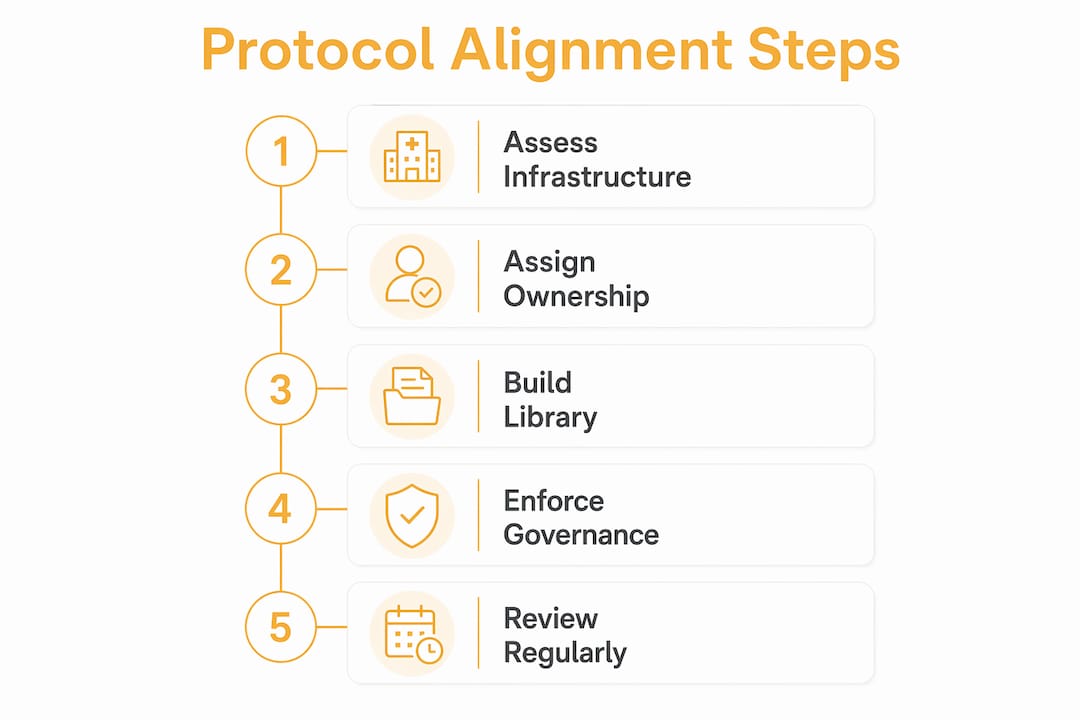
| Governance Element | Purpose |
|---|---|
| Protocol ownership | Assigns accountability to a named radiologist per modality |
| Version control | Tracks changes with dates and approver signatures |
| Staff role definitions | Separates clinical, technical, and administrative responsibilities |
| Review cycle schedule | Sets fixed intervals for protocol audits and updates |
| Deviation log | Records patient-specific adjustments for audit readiness |
How to build a shared imaging protocol library across specialty clinics
A shared imaging protocol library is the operational core of any standardization effort. It gives every technologist and radiologist a single source of truth for exam parameters, image acquisition settings, and report structure.
Steps to build and deploy the library
-
Audit existing departmental protocols. Collect every current protocol from each site. Identify duplicates, conflicts, and gaps. This audit reveals how much variation already exists and where alignment will have the most impact.
-
Synthesize into a master set. Convene a working group of radiologists, senior technologists, and at least one administrator. Use a structured template for each exam type that captures patient preparation, acquisition parameters, contrast protocols, and reporting requirements. A shared library of 131 imaging protocols with structured reporting has been shown to reduce imaging variation and repeat scans while improving clinician efficiency.
-
Assign clinical review and approval. Each protocol in the library needs sign-off from the relevant subspecialty radiologist. Cardiothoracic protocols go to a chest radiologist. Musculoskeletal protocols go to an MSK specialist. This prevents generic parameters from being applied to subspecialty cases.
-
Load protocols into RIS and modality worklist systems. Once approved, protocols must be embedded directly into the RIS so technologists see the correct parameters at order entry. Modality operators should not rely on memory or paper printouts.
-
Train all staff before go-live. Run modality-specific training sessions for technologists. Hold separate sessions for radiologists focused on structured report templates. Document attendance and competency checks.
-
Set a 90-day post-launch review. Collect deviation reports and technologist feedback during the first 90 days. Use this data to refine protocols before they calcify into permanent practice.
Pro Tip: Involve technologists in protocol drafting from day one. They identify practical acquisition issues that radiologists miss from the reading room, and their early buy-in reduces resistance during rollout.
Standardizing imaging protocols reduces variation and repeat scans and eases technologist training through a shared playbook approach. The training benefit alone justifies the investment for clinics with high staff turnover.

What governance and workflow strategies ensure consistent protocol adherence?
Building the library is the first step. Keeping it current and enforced is where most clinics fail. Governance and workflow integration are what separate a one-time project from a lasting operational standard.
Service-level agreements and review cycles
Protocol alignment requires structured service-level agreements and regular syncs to integrate external partners and in-house teams. For specialty clinics that use remote reading services, SLAs must specify turnaround times, report format requirements, and escalation paths for protocol deviations. Internal SLAs between radiology and referring departments define order completeness requirements and acceptable scheduling windows.
Review cycles should be short and frequent rather than annual. Radiology experts emphasize continuous small-scale improvements and peer reviews over major overhauls to achieve lasting workflow gains and staff engagement. A quarterly review involving technologists, radiologists, and at least one administrator catches protocol drift before it becomes a compliance problem.
Workflow integration across RIS, PACS, and EHR
Order completeness at the EHR entry stage is the single biggest lever for improving radiology workflow efficiency and reducing repeat imaging. Incomplete orders trigger protocol ambiguity at the modality, which leads to technologist guesswork and avoidable repeat scans. Standardizing order entry fields in the EHR, with required fields for clinical indication, relevant history, and contrast allergies, removes this ambiguity at the source.
“Workflow integrity depends on synchronization across every system in the chain. A gap at order entry creates a cascade of inefficiencies that no amount of downstream protocol enforcement can fix.”
HIPAA compliance adds another layer of governance. Imaging centers must maintain verified data maps of protected health information across RIS, PACS, and remote reading workflows, with mandatory annual risk assessments and documented technical safeguards like encryption. Assign a designated privacy official who owns this compliance function and reports deviations to administration.
Monitoring protocol compliance requires a defined deviation management process:
-
Log every deviation from approved protocols at the time it occurs
-
Classify deviations by type: patient-specific adjustment, equipment limitation, or protocol gap
-
Review deviation logs monthly to identify patterns that indicate a protocol needs updating
-
Escalate repeated deviations to the protocol owner for formal review
How to troubleshoot common challenges in radiology protocol alignment
Even well-designed alignment programs run into technical and operational problems. Knowing the most common failure points lets you address them before they affect patient care.
Silent integration failures between RIS and PACS
Silent integration failures in RIS-PACS communication can cause images to fail loading without any error message. These failures are often only noticed when radiologists cannot open studies, causing workflow interruptions and delays. Real-time dashboards that monitor HL7 message acknowledgments and PACS transfer queues catch these failures early. Every large radiology operation needs at least one staff member responsible for reviewing these dashboards daily.
Over-reliance on generic hanging protocols
Generic vendor-supplied hanging protocols do not match subspecialty clinical questions. Radiologists who design their own hanging protocols reduce reading times and improve efficiency compared to generic defaults, especially in subspecialty imaging. Customization ensures that critical image series and prior study comparisons display in the sequence that matches the clinical question. Radiology administrators should schedule a hanging protocol review as part of every subspecialty onboarding process.
Incomplete documentation of protocol deviations
Documenting every protocol deviation, including minor patient-specific adjustments, is critical for audit readiness and legal defensibility. Failing to record these adjustments creates blind spots in quality audits and can expose the clinic to compliance risk during regulatory reviews. A simple deviation log embedded in the RIS workflow, requiring a one-line entry at the time of the exam, is sufficient. The barrier to documentation must be low enough that technologists complete it without disrupting exam flow.
Pro Tip: Build deviation logging directly into the RIS order completion screen. If technologists must open a separate system to log a deviation, most will skip it under time pressure.
Key takeaways
Effective radiology protocol alignment requires standardized libraries, integrated systems, and active governance to sustain consistency across specialty clinic sites.
| Point | Details |
|---|---|
| Start with EN 18167:2026 | Use this quality standard as the documented baseline for all imaging procedures and audits. |
| Build a shared protocol library | Synthesize departmental protocols into one approved library loaded directly into RIS and modality systems. |
| Fix order entry first | Standardize EHR order fields to eliminate protocol ambiguity before it reaches the modality. |
| Monitor integration in real time | Use dashboards to detect silent RIS-PACS failures before they interrupt radiologist workflows. |
| Document every deviation | Log patient-specific adjustments at the time of the exam to maintain audit trails and compliance. |
What I’ve learned managing multi-site radiology protocol alignment
The biggest mistake I see healthcare administrators make is treating protocol alignment as a one-time IT project. They build the library, run the training, and then move on. Six months later, the protocols have drifted, the deviation logs are empty, and the original variation problems are back.
The clinics that sustain alignment treat it as a clinical quality program, not a technology deployment. They assign named protocol owners who feel accountable for their modality’s standards. They hold short monthly reviews instead of annual overhauls. They celebrate technologists who flag protocol gaps rather than treating deviation reports as problems.
The other lesson I keep coming back to is that hanging protocol design belongs to radiologists, not IT vendors. Generic defaults are built for average cases. Subspecialty radiology is not average. When a musculoskeletal radiologist designs the display sequence for a knee MRI, reading time drops and report quality improves. That is not a marginal gain. It compounds across thousands of studies per year.
For administrators starting this process, my advice is simple: pick one modality, build the governance model around it, and prove the value before scaling. A successful CT protocol library in one department gives you the political capital and the operational template to expand to MRI, ultrasound, and beyond. Trying to align everything at once is the fastest way to align nothing.
— Amy
How Kohealthlabs supports integrated diagnostic protocol alignment
Specialty clinics managing radiology and lab diagnostics across multiple sites face a coordination problem that single-vendor solutions rarely solve. Kohealthlabs addresses this directly by consolidating central laboratory services and radiology under one contract, eliminating the fragmentation that causes protocol inconsistency.
Kohealthlabs uses AI to identify protocol deviations, enhance data quality, and accelerate regulatory compliance across clinical research operations. With support for over 100 biomarkers and advanced analytics, the platform delivers structured, analysis-ready data bundles to CROs, government agencies, and wellness programs. For healthcare administrators who need integrated clinical diagnostics that align with specialty clinic workflows, Kohealthlabs provides a single operational framework that replaces multi-vendor complexity with consistent, auditable results.
FAQ
What does it mean to align lab radiology specialty clinic protocols?
Protocol alignment means standardizing imaging procedures, report templates, and governance rules across all sites so every exam follows the same approved parameters. It reduces diagnostic variation, repeat scans, and compliance risk.
What is EN 18167:2026 and why does it matter for radiology clinics?
EN 18167:2026 is a quality standard covering X-rays, ultrasound, and MRI that requires documented procedures, risk management, and external peer audits. It gives radiology clinics a defensible framework for protocol standardization and regulatory review.
How does a shared imaging protocol library reduce repeat scans?
A shared library gives every technologist the same acquisition parameters and preparation requirements for each exam type. Consistent inputs at the modality level reduce the ambiguity that leads to technically inadequate images and repeat acquisitions.
What causes silent failures in RIS-PACS integration?
Silent failures occur when HL7 messages between RIS and PACS fail without generating an error alert, causing images to become unavailable to radiologists without warning. Real-time monitoring dashboards that track message acknowledgments and transfer queues detect these failures before they delay reporting.
How often should radiology protocols be reviewed?
Short, frequent review cycles involving technologists and radiologists keep protocols current and reduce ambiguity. Quarterly reviews catch protocol drift and equipment-related gaps far earlier than annual audits.