

Finding a clinical research diagnostic service that delivers rapid results and integrated testing across lab and imaging is difficult for many research organizations. Existing providers separate lab and radiology contracts or limit automation, slowing data collection and increasing coordination work. This comparison presents data integration, turnaround time, and regulatory credentials so research teams can match a provider to their trial requirements.
Table of Contents
KoHealthLabs
At a Glance
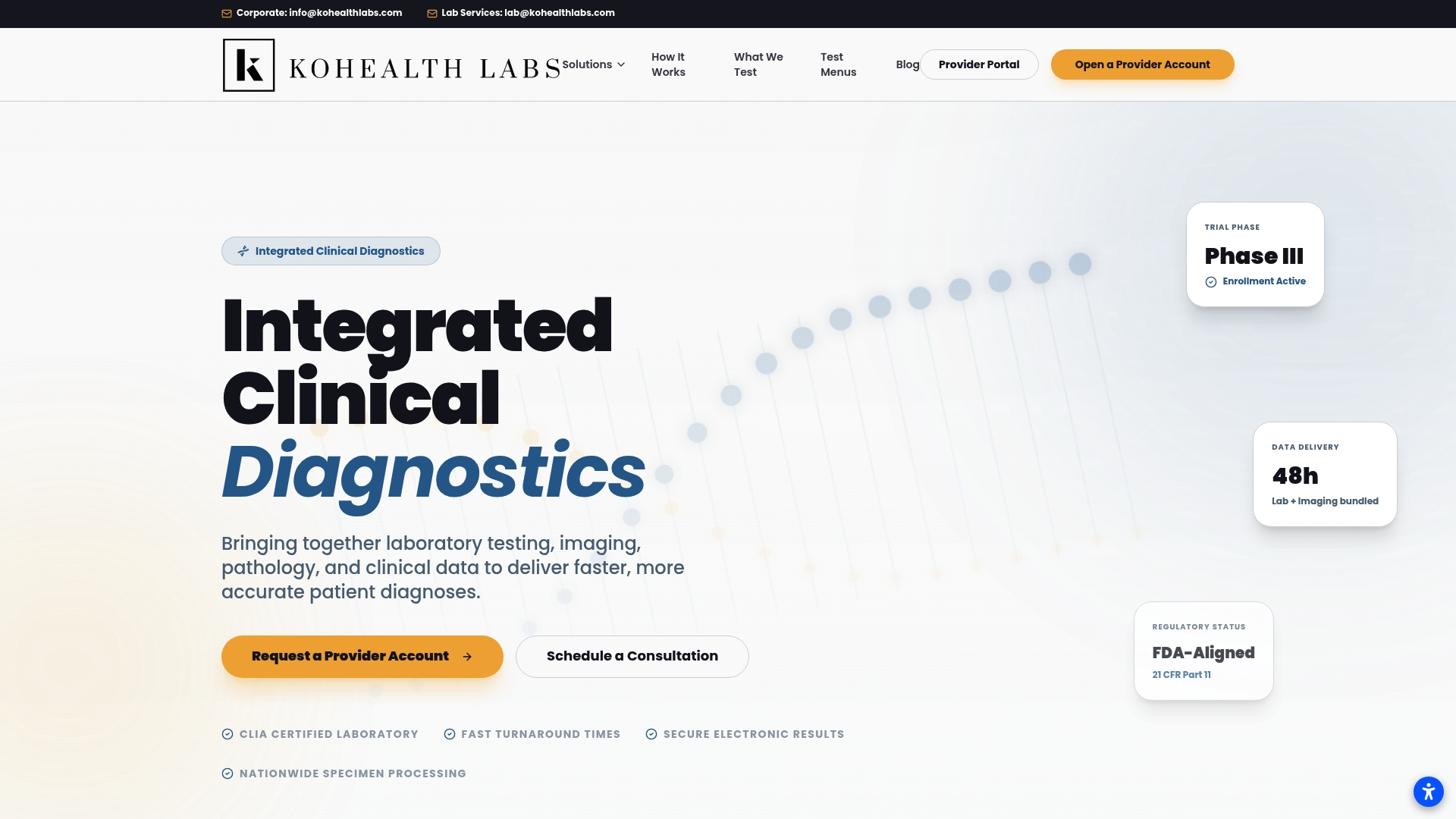
A single-contract model unifies laboratory and radiology services, cutting the number of vendors a trial team must manage. KoHealthLabs reports most results arrive within 24–48 hours. The service targets CROs, government programs, and wellness clinics that need integrated diagnostic data for regulatory workflows.
Core Features
Integrated central lab and radiology services combine specimen testing, imaging, and nationwide specimen pickup and shipment with secure electronic delivery through a HIPAA-compliant portal. The company reports structured, analysis-ready data bundles delivered in HL7 FHIR, SDTM, and ADaM formats. According to the company, analytics cover over 100 biomarkers, and the vendor advertises AI-driven safety and data quality insights. The company states it holds CLIA certification, CAP accreditation, and follows FDA-aligned regulatory standards.
Key Differentiator
Unified lab and radiology services with AI-enhanced, regulation-ready data delivery reduce handoffs between imaging and central lab teams. That model shortens administrative work when trials require both diagnostic testing and imaging. The single-contract approach also centralizes reporting and compliance artifacts for sponsors and regulators.
Pros
Consolidating lab and imaging under one vendor reduces contracting and coordination overhead for multi-site trials. That vendor consolidation pairs with standardized deliverables to speed regulatory submission readiness and reduces file reformatting for data managers. Nationwide logistics, a HIPAA portal, and AI-driven anomaly detection support faster safety reviews while the analysis-ready formats lower the time needed for database lock.
Cons
- Primarily targeted at institutional clients; not appropriate for direct-to-consumer testing without an established provider relationship.
Who It's For
Research organizations, pharmaceutical sponsors, government health agencies, and health systems running Phase I–IV studies will find this model useful. Clinical operations teams that manage multi-site specimen logistics and imaging data will benefit from a single contracting point. Data managers and safety monitors who need regulatory-aligned deliverables will see the most operational gains.
Unique Value Proposition
A single-contract procurement model reduces separate lab and imaging procurement tasks and consolidates billing and compliance records for trials. That change lowers administrative headcount devoted to vendor management and shortens the vendor onboarding timeline. Combined with analysis-ready output, the model shifts effort from data wrangling to data review and safety oversight.
Real World Use Case
A CRO running a Phase II oncology study uses KoHealthLabs to collect blood biomarkers, process genomics panels, and coordinate baseline and follow-up imaging. Specimens move through a single logistics workflow, results arrive in standardized formats, and AI flags values that need safety review. The CRO then compiles regulatory submission packages with fewer manual conversions.
Pricing
Pricing is not publicly listed and appears targeted at institutional engagements. Cost details require direct inquiry and typically depend on test volume, panel complexity, and imaging needs. The vendor notes enterprise contracting rather than consumer pricing.
Website: https://kohealthlabs.com
IndiGlobal Labs
At a Glance
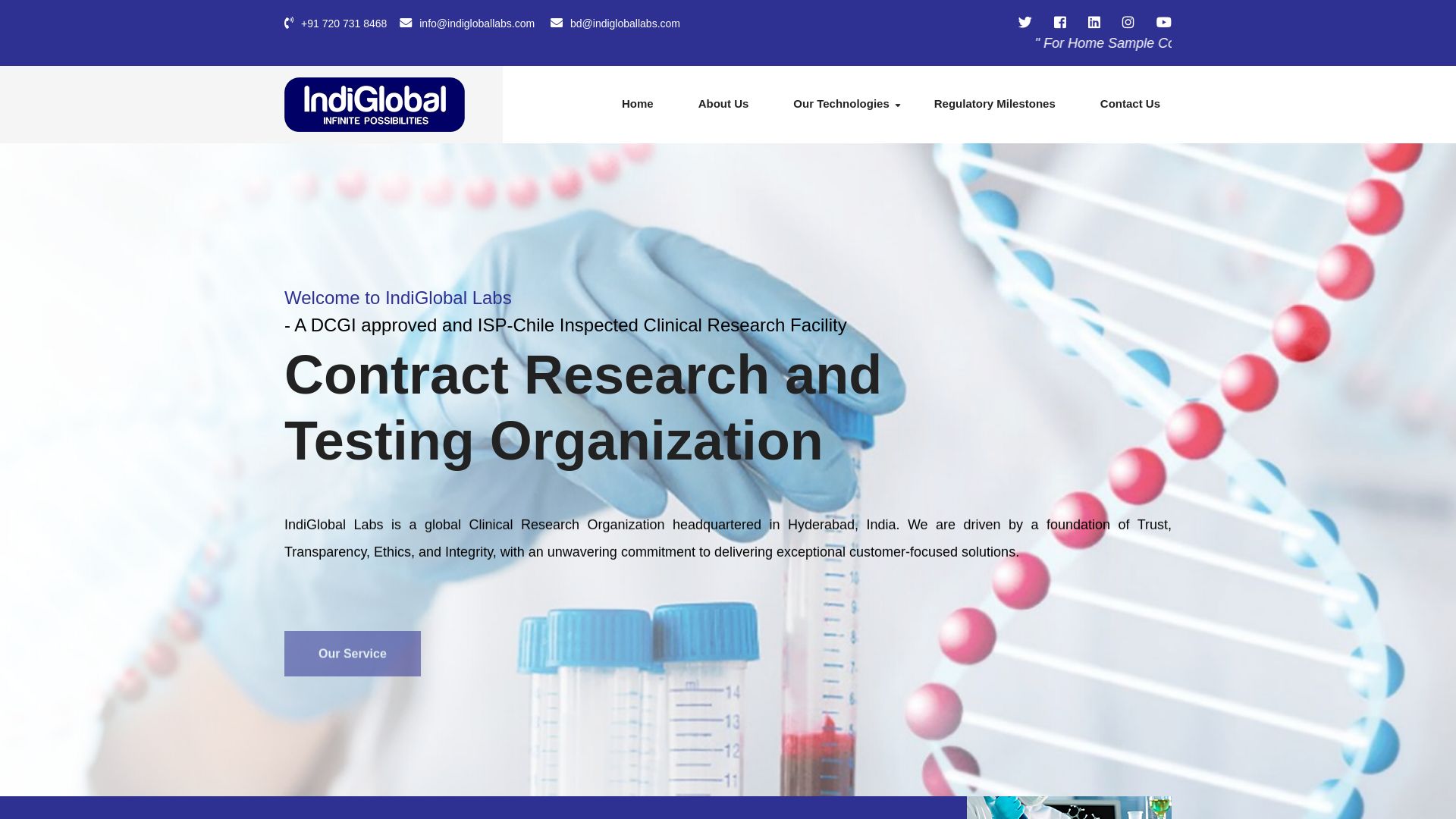
According to the company, IndiGlobal Labs holds DCGI approval, was inspected by ISP-Chile, and is ISO 9001:2015 certified. The organization is headquartered in Hyderabad, India, and began serving pharmaceutical clients and patients in 2021. Facilities include clinical beds and advanced instruments that support clinical trials and bioanalytical work.
Core Features
IndiGlobal Labs provides end to end clinical trial support from protocol development to final reporting, plus bioanalytical method validation and diagnostic testing. The lab runs LC-MS/MS systems and automated analyzers for quantitative assays and routine pathology. Accredited facilities and 24/7 operational capability support time sensitive study workflows and sample handling.
Key Differentiator
Those recorded accreditations align regulatory inspection history with a formal quality management system. That mix of approvals and an international inspection suggests the lab targets sponsors who need documented oversight and traceability. The focus on regulatory credentials separates it from providers that list equipment but not external inspections.
Pros
The vendor reports experienced leadership with regulatory expertise and a history of working with pharmaceutical sponsors, which benefits protocol development and regulatory submissions. The lab offers both clinical services and bioanalysis under one roof, reducing handoffs between vendors and simplifying logistics for study teams. High quality instrumentation such as LC-MS/MS, international accreditations including NABL, and round the clock operations strengthen capacity for complex bioavailability and PK studies.
Cons
-
Primarily serves pharmaceutical and clinical research clients. This focus means individual researchers and small academic labs may not find a suitable offering.
-
Several specific service details and routine turnaround times are not publicly listed. That requires direct contact to confirm timelines for study milestones.
-
Pricing is not published online. Sponsors must request a quote to get budgetary figures.
When It May Not Fit
If your project is a single investigator academic study with small sample volumes, this provider may not match your budget or intake process. If rapid fixed pricing is a priority, the lack of online rates will add procurement steps. Small diagnostic clinics seeking only ad hoc tests may find the ordering model oriented to larger sponsor workflows.
Who It's For
Pharmaceutical companies, biotech sponsors, and CROs needing regulated clinical trial capacity will find the lab relevant. Clinical teams that require integrated bioanalytical assays and clinical conduct in the same facility will see operational advantages. Regulatory affairs staff who want documented inspection history and formal quality systems are the best fit.
Real World Use Case
A pharmaceutical firm engages IndiGlobal Labs to run bioavailability and pharmacokinetic studies for a new oral candidate. The sponsor uses the lab's LC-MS/MS assays and onsite clinical beds to collect timed plasma samples and centralize analysis. That setup reduces sample transfer steps and keeps study documentation under one contract.
Pricing
Pricing is not publicly disclosed and the product entry lists pricing as informational only. Prospective sponsors must contact IndiGlobal Labs for custom quotes and time estimates based on study design and sample volume.
Website: https://indigloballabs.com
Aria Diagnostics
At a Glance
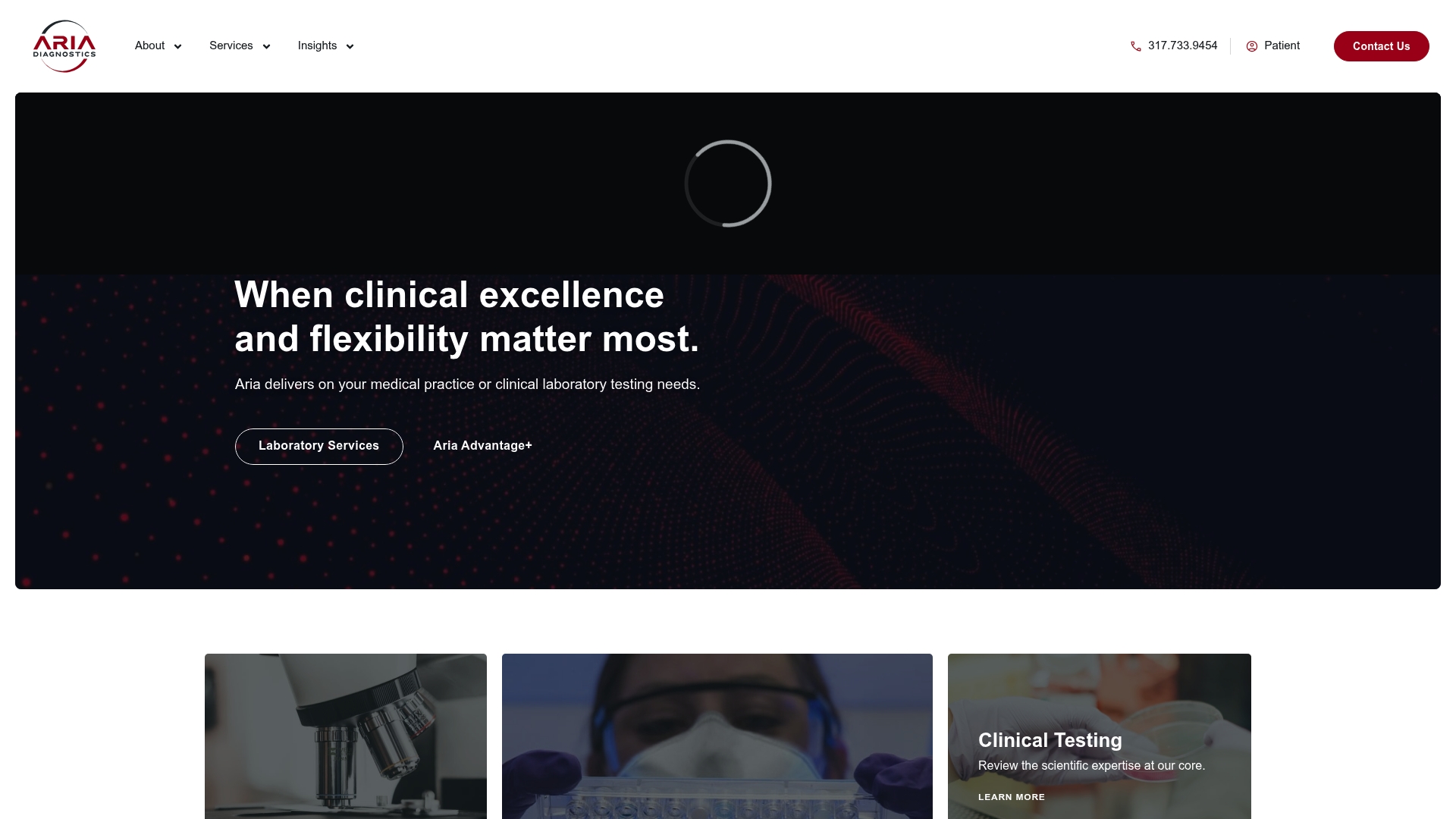
Aria Diagnostics reports 99.5% of toxicology samples returned within 48 hours. That turnaround claim targets clinics and research teams that require quick confirmation for medication management or compliance. The vendor advertises extensive automation from vendors such as Beckman Coulter and ThermoFisher, which supports volume handling and consistent output.
Core Features
The vendor lists customizable testing protocols, toxicology, molecular diagnostics, clinical chemistry, and hematology under one profile, plus a patient portal and lab management tools. The company reports CLIA and CAP accreditation. The vendor reports processing over 500,000 clinical samples, which signals operational scale for trial work and repeat clinical runs.
Key Differentiator
Aria Diagnostics centers on configurable, rapid, and regulation-compliant testing supported by industry-grade instrumentation and experienced staff. That focus makes the vendor a better fit for projects needing bespoke assay parameters or high-complexity validation than for buyers seeking a single-contract integrator that bundles diagnostics, radiology, and analytics.
Pros
Aria Diagnostics offers flexible, client-tailored testing that adapts protocols to trial-specific endpoints, which helps investigators preserve assay validity. Fast processing supports faster clinical decisions and site workflows. The vendor spans multiple disciplines so research teams can keep related testing under one vendor profile while relying on reported accreditations for audit trails and regulatory documentation.
Cons
-
Limited public pricing details. This likely means quotes are customized and may favor larger budgets.
-
No clear mention of an integrated data management platform for results delivery or EDC exports, which can complicate trial data flows.
-
Emphasis on high-complexity testing may leave routine or low-cost diagnostics underserved for smaller clinics.
When It May Not Fit
If your project needs low-cost, high-volume routine panels with simple reporting, this vendor may not match budget constraints. If you require built-in electronic data exports to a clinical trial management system, there is no clear evidence of that capability. Organizations seeking a single vendor for diagnostics plus imaging and analytics under one contract should look elsewhere.
Who It's For
Healthcare providers, hospitals, biotech companies, and research organizations that need tailored laboratory methods, validated assays, and accreditation-ready documentation will find value here. Clinical research groups running assay development or validation projects will appreciate the configurable test protocols. Pain management clinics needing targeted toxicology support are also a good fit.
Real World Use Case
A pain management clinic uses Aria Diagnostics to run a dual-marker alcohol testing protocol for monitored patients, supporting compliance reviews and treatment adjustments. A biotech startup collaborates with the lab to validate a new molecular assay before a clinical study, using the vendor's instrumentation and method customization. Those setups illustrate the vendor's role in both operational testing and trial-level assay development.
Website: https://ariadxs.com
Advanta Genetics
At a Glance
Advanta Genetics reports a 24 hour turnaround for respiratory panels. The lab holds CLIA and CAP accreditation and emphasizes molecular genetics, toxicology, and microbiology services. That combination supports rapid diagnostic workflows for hospitals and public health programs.
Core Features
The platform pairs high complexity laboratory accreditation with advanced molecular testing. It offers genomic sequencing and metagenomic methods for pathogen detection, plus toxicology and clinical microbiology assays. Results are delivered through a digital portal and supported by 24/7 technical assistance.
Key Differentiator
Advanta Genetics positions its strength in active research collaborations and formal accreditation. Those ties feed method development and peer reviewed publications. The result is a lab focused on extending clinical testing into research grade sequencing and pathogen surveillance.
Pros
Accredited operations produce consistently documented workflows and established quality controls. The lab’s research activity and industry collaborations suggest ongoing method validation and new assay development. A broad mix of testing services means clinical teams can consolidate genetic, toxicology, and microbiology tests under one vendor, and the digital results portal plus round the clock support reduces delays in receiving actionable data.
Cons
-
Limited publicly available pricing data. This requires direct contact for cost estimates and budgeting.
-
Onboarding may require several administrative steps. New provider accounts could need extra paperwork and verification.
-
Some specialized tests require provider consultation. Clinicians must confirm clinical appropriateness before ordering.
When It May Not Fit
Advanta Genetics may not fit organizations that need direct to consumer test ordering. It also may not suit teams seeking out of the box consumer reporting tools. Institutions that require instant online pricing and self service onboarding will find the vendor model less convenient.
Notable Integrations
-
Digital results portal: Centralized delivery of reports and raw sequencing files to provider accounts.
-
LIMS systems: Integration points for laboratory information management systems to push results into clinical workflows.
Who It's For
Hospitals, clinics, and public health agencies that need molecular diagnostics and genomic testing will find this lab relevant. Research groups within medical centers that require method collaboration also fit well. Clinical teams seeking accredited, research forward testing will benefit most.
Real World Use Case
A regional hospital expands its infectious disease testing to include next generation sequencing for complex respiratory infections. The lab provides sequencing runs, interpretation, and report delivery through the portal. Clinicians use the data to refine antimicrobial therapy and support infection control reporting.
Pricing
Not applicable. The offering is informational only and requires direct vendor contact for test level pricing and contract terms.
Website: https://aalabs.com
Comparison of alternatives
KoHealthLabs stands out for its unified approach, combining laboratory and radiology services within a single streamlined workflow. This model benefits sponsors seeking integrated diagnostic solutions with regulatory-compliant data delivery. However, depending on specific study needs, other vendors may better address certain requirements.
Laboratory and Imaging Integration
KoHealthLabs simplifies contracting by offering a combined lab and imaging workflow, which reduces administrative overhead and streamlines compliance reporting. While competitors such as IndiGlobal Labs and Aria Diagnostics provide specialized capabilities—IndiGlobal Labs excels in bioanalytical validation, while Aria Diagnostics is highly adaptable for high-complexity testing—their offerings may require multi-vendor coordination for similar integrated setups.
Genomic Diagnostics and Research Collaboration
Advanta Genetics excels in genomic and molecular diagnostics, actively collaborating on assay development and pathogen sequencing. This specialization surpasses KoHealthLabs when a study demands cutting-edge genomic research or advanced sequencing. Clinical teams focused on developing novel diagnostic protocols may prefer Advanta Genetics.
Best fit
- Institutional clients needing integrated lab and radiology services with streamlined operations would benefit from KoHealthLabs.
- Pharmaceutical sponsors requiring validated pharmacokinetics services should consider IndiGlobal Labs for their strong bioanalytical capabilities.
- Research teams conducting bespoke assay validation will find Aria Diagnostics' flexible testing protocols advantageous.
- Healthcare providers focusing on advanced genomic diagnostics should review Advanta Genetics' molecular sequencing options.
Our pick
KoHealthLabs emerges as the recommended option for institutional clients seeking unified diagnostic workflows and simplified vendor management. Its unique capability to integrate laboratory and radiology services under one contract offers a streamlined approach to compliance and operational efficiency. However, sponsors prioritizing advanced genomic research or bioanalytical validation may find specific competitors better suited to those needs, underscoring the importance of aligning vendor selection with study objectives.
Which service fits your needs for clinical diagnostic integration and efficiency?
| Provider | Core Strength | Best Suited For | Key Differentiator | Pricing | Notable Limitation |
|---|---|---|---|---|---|
| Kohealth Labs | Integrated laboratory and radiology services | Multi-site clinical trials and Phase I–IV studies | Unified lab and radiology under one contract | Price not published | Not suited for direct-to-consumer testing |
| IndiGlobal Labs | End-to-end clinical trial support | Pharmaceutical sponsors and clinical research organizations | Regulatory inspection-aligned approvals | Price not published | Small labs may find offerings less suitable |
| Aria Diagnostics | Customizable and rapid assay development | Tailored toxicology and molecular diagnostics needs | Flexible testing protocols | Price not published | Limited EDC-integrated results delivery option |
| Advanta Genetics | Genomic sequencing and pathogen detection | Hospitals and research groups specializing in molecular diagnostics | Research-focused sequencing development | Price not published | Less inapplicable for direct-to-consumer models |
How Can You Reduce Vendor Complexity in Clinical Trial Diagnostics
Managing multiple vendors for lab testing and imaging can slow clinical trials and increase overhead. Kohealth Labs offers a single-contract solution that unifies diagnostic services and radiology. This reduces the number of contracts you manage and delivers results ready for regulatory submission in formats like HL7 FHIR and SDTM. The model also includes AI-driven data quality checks and fast turnaround times, which helps CROs, government agencies, and wellness programs improve safety monitoring and compliance.
Key benefits include:
- Simplified vendor management for multi-site studies
- Nationwide specimen pickup and shipping
- Analysis-ready data bundles
See how Kohealth Labs can cut administrative delays and improve your clinical research diagnostics at Kohealth Labs. Take the next step by visiting their website to learn how this integrated approach can help your team achieve faster trial completions.
FAQ
How quickly can I expect results from Kohealth Labs?
Kohealth Labs typically reports most results arriving within 24–48 hours. This quick turnaround is part of their integrated central lab and radiology services. Users seeking prompt diagnostic data can rely on this efficiency to support their clinical research workflows.
What is the difference between Kohealth Labs and IndiGlobal Labs?
IndiGlobal Labs is known for its extensive regulatory approvals, including DCGI approval and ISO 9001:2015 certification, making it ideal for sponsors needing documented oversight. Kohealth Labs, in contrast, offers a singular contract model that unifies lab and imaging services, simplifying project management for trials requiring both services. Prospective clients should consider the specific regulatory needs of their study when choosing between these service providers.
Does Kohealth Labs provide analysis-ready data formats?
Yes, Kohealth Labs delivers structured, analysis-ready data bundles in HL7 FHIR, SDTM, and ADaM formats. This feature significantly supports data managers by reducing the time needed for database lock and ensuring compliance with regulatory workflows. Clients looking for streamlined data processes will benefit from these capabilities.
Who is the ideal user for Kohealth Labs?
Research organizations, pharmaceutical sponsors, and clinical operations teams managing multi-site studies are the primary users who will benefit from Kohealth Labs. Their single-contract approach simplifies logistics and reporting, making it an excellent choice for those requiring integrated laboratory and imaging support.
How does Kohealth Labs support safety reviews?
Kohealth Labs employs AI-driven anomaly detection to support faster safety reviews. This approach helps identify values needing attention quickly, which facilitates safer and more efficient clinical operations. Organizations that prioritize patient safety can leverage this feature to enhance their study protocols.