

Unified diagnostics across specialties is defined as the integration of laboratory, radiology, pathology, and cardiology data into a single coordinated workflow that supports clinical decisions across multiple medical disciplines. Fragmented diagnostic systems force clinicians to piece together results from disconnected vendors, which slows decisions and increases the risk of error. The benefits of unified diagnostics across specialties extend well beyond convenience. They include measurable reductions in readmission rates, medication errors, and total cost of ownership, while improving the speed and accuracy of diagnosis. Kohealth Labs delivers this model through integrated clinical diagnostics that consolidate laboratory and radiology services under one contract.
1. How unified diagnostics reduce care fragmentation
Care fragmentation is the single largest operational failure in multi-specialty healthcare. When a cardiologist, radiologist, and oncologist each access separate systems, they build separate clinical pictures. The result is duplicated testing, delayed decisions, and a higher rate of diagnostic error.
Integrated multidisciplinary teams at Mayo Clinic close the "diagnostic gap" by reducing reliance on incomplete information and eliminating anchoring bias, the tendency to stick with an initial diagnosis even when new data contradicts it. Anchoring bias is one of the most common causes of missed diagnoses in complex cases. Removing it through structured collaboration directly improves diagnostic accuracy.
- Unified workflows give every specialist access to the same real-time data set
- Cross-specialty health assessments reduce duplicate lab orders and imaging requests
- Shared diagnostic records support faster handoffs between departments
- Multidisciplinary review meetings become more productive when data is already consolidated
Structured diagnostic collaboration reduces 30-day readmission rates to 12.4%, cuts medication errors by 56%, and raises patient satisfaction scores to 4.3 out of 5. Those numbers reflect what happens when specialists stop working in silos and start working from a shared clinical record.
Pro Tip: When building a multi-specialty diagnostic workflow, assign one data steward per department to maintain record consistency before full integration goes live. This prevents conflicting entries during the transition period.

2. Cost advantages of consolidating diagnostic contracts
Consolidating diagnostic platforms is one of the highest-return financial decisions a health system can make. The cost difference between fragmented and unified contracts is not marginal.
| Contract model | Annual cost estimate | Key advantage |
|---|---|---|
| Multiple vendor contracts | $24,000–$30,000/year | Specialty-specific flexibility |
| Single consolidated contract | ~$8,000/year | Unified billing, lower overhead |
| Direct diagnostic contracting | Varies by system | Up to 20% price reduction |
Consolidating fragmented platforms reduces total cost of ownership by 40–60% over five years through single service contracts and optimized inventory. That level of savings frees budget for clinical staffing and technology upgrades rather than vendor management overhead.
Direct diagnostic contracting delivers a 20% contract price reduction and generated $46 million in annual savings for one health system. Removing intermediaries from the diagnostic supply chain gives health systems direct negotiating power over pricing and service terms.
Multi-TIN contract consolidation is an ongoing process critical to capturing platform-scale negotiating leverage for multi-specialty organizations. Health systems that treat consolidation as a one-time event miss the compounding benefits of continuous contract refinement.
Pro Tip: Map all active diagnostic vendor contracts before consolidation. Identify overlapping service scopes first. Eliminating redundant contracts before renegotiating gives you a cleaner baseline for cost comparison.
3. Faster diagnosis and better clinical accuracy
Speed and accuracy are the two metrics that matter most in clinical diagnostics. Unified platforms improve both at the same time.
Philips HealthSuite Integrated Diagnostics connects cardiology, radiology, and pathology data, reducing clinician data fragmentation and accelerating time to diagnosis. The platform embeds AI intelligence directly into clinical workflows rather than treating it as a separate reporting layer. That distinction matters because AI applied at the workflow level catches deviations in real time, not after the fact.
The clinical improvements from integrated diagnostics include:
- Reduced time between test order and clinical decision
- AI-assisted flagging of abnormal results across multiple biomarker panels
- Fewer repeat tests caused by lost or inaccessible prior results
- Higher diagnostic confidence when specialists review a complete, unified patient record
Platforms that enable AI at scale across the entire diagnostic workflow outperform point solutions applied to isolated tasks. A single AI tool embedded in one department does not produce the same outcome as AI applied consistently across radiology, laboratory, and pathology data together. The difference is systemic versus incremental improvement.
4. Operational efficiency gains for healthcare administrators
Administrators carry the operational burden of managing vendor relationships, staff training, contract compliance, and reporting. Unified diagnostics reduce that burden across all four areas.
Transitioning to unified diagnostic platforms cuts staff training time from 40–60 hours per technician down to 20–25 hours because standardized interfaces replace the need to learn multiple systems. That reduction translates directly into lower onboarding costs and faster staff proficiency. For large health systems with high technician turnover, the cumulative savings are significant.
The operational gains extend beyond training. A single contract covers service, maintenance, and compliance reporting across all diagnostic modalities. Administrators spend less time coordinating between vendors and more time on clinical operations. Reporting becomes consistent because all data flows through one system rather than being reconciled from multiple exports.
5. Contract compliance and version history management
Contract compliance is not a back-office concern. It directly affects reimbursement accuracy and audit readiness across every diagnostic specialty.
Preserving version history of fee schedules and contract amendments is critical for payment appeals and contract compliance in unified diagnostics. When a payer disputes a claim, the ability to reference the exact contract terms in effect at the time of service determines whether the appeal succeeds. Health systems without documented version histories lose appeals they should win.
Unified diagnostic contracts simplify this process. A single contract covering multiple specialties means one amendment history, one compliance audit trail, and one point of contact for dispute resolution. Compare that to managing separate amendment histories for laboratory, radiology, and pathology contracts simultaneously.
- Maintain a centralized contract repository with timestamped amendments
- Assign a contract administrator responsible for version control across all diagnostic modalities
- Set automated alerts for contract renewal dates and rate change effective dates
- Run quarterly reconciliation between billed rates and contracted rates
- Document every payer communication related to contract terms in the same repository
6. Security, interoperability, and implementation challenges
Unified diagnostics require careful planning around data security and system interoperability. These are real challenges, not theoretical ones.
Interoperability between legacy laboratory information systems and modern integrated platforms is the most common implementation barrier. Many health systems run laboratory software that predates current HL7 FHIR standards. Connecting those systems to a unified platform requires middleware or phased migration, not a simple plug-in. Administrators who underestimate this step face longer timelines and higher integration costs.
Data security becomes more complex when diagnostic data from multiple specialties flows through one platform. A single breach point can expose cardiology, oncology, and radiology records simultaneously. Health systems must apply role-based access controls at the specialty level, not just at the system level. Each clinician should access only the diagnostic data relevant to their patient care role.
Privacy compliance under HIPAA requires that unified platforms maintain audit logs for every data access event across all connected specialties. This is non-negotiable. Vendors that cannot demonstrate comprehensive audit logging should not be considered for multi-specialty integration.
7. Single contract diagnostics and clinical trial advantages
Clinical research organizations face the same fragmentation problem as health systems, but the consequences are more acute. A delayed or inconsistent diagnostic result in a clinical trial can compromise data integrity and regulatory timelines.
The single contract diagnostics model gives CROs one point of accountability for laboratory and radiology results across all trial sites. Protocol deviations are identified faster when all diagnostic data flows through one system with consistent quality controls. Regulatory submissions are cleaner because the data is already structured and analysis-ready rather than requiring manual reconciliation from multiple vendor exports.
Kohealth Labs applies this model directly. By consolidating central laboratory services with radiology under one contract, Kohealth Labs provides CROs and government agencies with structured data bundles that are ready for analysis. AI-assisted quality checks identify protocol deviations before they affect trial outcomes. That capability shortens trial timelines and reduces the compliance burden on research teams.
Key Takeaways
Unified diagnostics across specialties deliver the strongest outcomes when integrated at the platform level, not applied as isolated point solutions across separate departments.
| Point | Details |
|---|---|
| Reduced readmissions and errors | Structured diagnostic collaboration cuts 30-day readmission rates to 12.4% and reduces medication errors by 56%. |
| Major cost savings | Consolidating diagnostic platforms reduces total cost of ownership by 40–60% over five years. |
| Faster staff proficiency | Unified interfaces cut technician training time from 40–60 hours down to 20–25 hours. |
| Contract compliance protection | Maintaining version histories of fee schedules and amendments is critical for winning payment appeals. |
| AI works best at scale | AI embedded across a full diagnostic platform outperforms AI applied to isolated departmental tasks. |
Kohealth Labs' view on where unified diagnostics are heading
The conversation in healthcare administration has shifted. Five years ago, the debate was whether to consolidate diagnostic vendors at all. Now the question is how fast to do it and which platform to trust.
What we have observed working with CROs, government agencies, and wellness programs is that the organizations moving fastest are not the ones with the largest budgets. They are the ones that made a clear internal decision to treat diagnostics as a platform problem rather than a procurement problem. That shift in framing changes everything. It moves the conversation from "which vendor is cheapest" to "which system gives our clinicians the most complete picture."
The organizations that still manage laboratory and radiology as separate vendor relationships are carrying a hidden cost that never shows up cleanly on a balance sheet. It shows up in delayed decisions, repeated tests, and staff hours spent reconciling data that should already be connected. Those costs are real, and they compound over time.
The next phase of integration will be driven by AI applied consistently across the full diagnostic workflow, not as an add-on to one department. Health systems that build that foundation now will have a measurable advantage in both clinical outcomes and operational efficiency within three to five years. The window to build that foundation without major disruption is still open, but it will not stay open indefinitely.
— Kohealth Labs
Integrated diagnostics from Kohealth Labs
Healthcare administrators and CROs looking to act on the multi-specialty diagnostic benefits covered here have a direct path forward with Kohealth Labs.
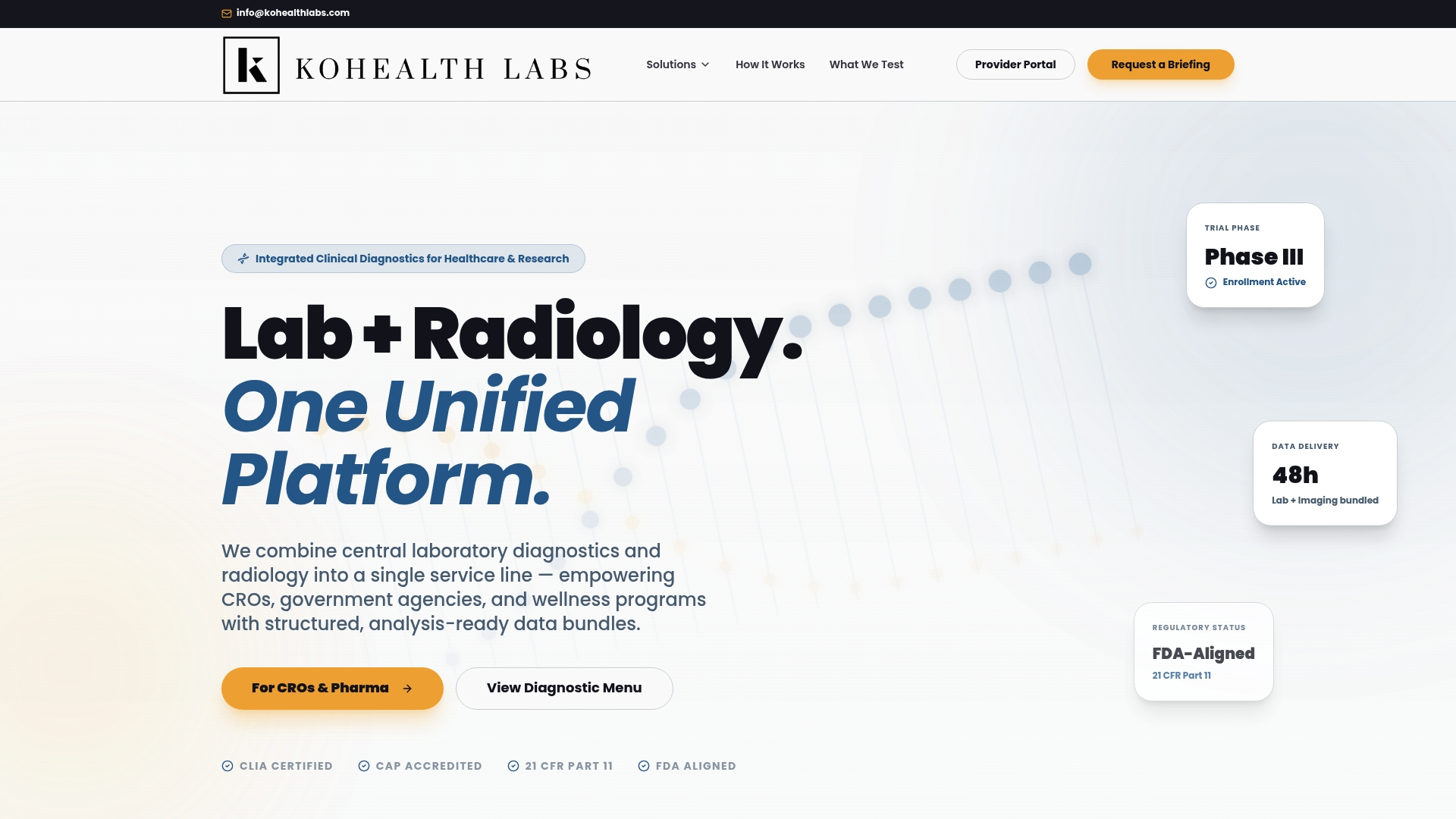
Kohealth Labs consolidates central laboratory services and radiology under a single diagnostic contract, giving clinical research organizations and health systems structured, analysis-ready data bundles. With over 100 biomarkers, AI-assisted quality monitoring, and support across multiple therapeutic areas, Kohealth Labs removes the vendor coordination burden that slows trials and fragments patient data. The result is faster regulatory compliance, cleaner data, and a single point of accountability for your entire diagnostic program. Contact Kohealth Labs to learn how consolidated diagnostics can fit your organization's needs.
FAQ
What are the main benefits of unified diagnostics across specialties?
Unified diagnostics reduce care fragmentation, cut costs by 40–60% over five years, and improve diagnostic accuracy by giving all specialists access to the same real-time patient data.
How do unified diagnostics reduce medication errors?
Structured diagnostic collaboration reduces medication errors by 56% by ensuring clinicians across specialties review complete, consistent patient records before prescribing.
What is the cost difference between single and multiple diagnostic contracts?
A single consolidated diagnostic contract costs approximately $8,000 per year compared to $24,000–$30,000 per year for multiple vendor contracts, representing savings of up to 60% over five years.
How does a unified diagnostic platform benefit clinical trials?
A single contract model gives CROs one accountability point for all diagnostic data, reduces protocol deviations through AI-assisted monitoring, and produces structured data that accelerates regulatory submissions.
What implementation challenges should administrators expect?
The most common barriers are legacy system interoperability, staff retraining, and establishing role-based access controls. Unified platforms reduce training time to 20–25 hours per technician, but middleware integration for older systems requires dedicated planning.