
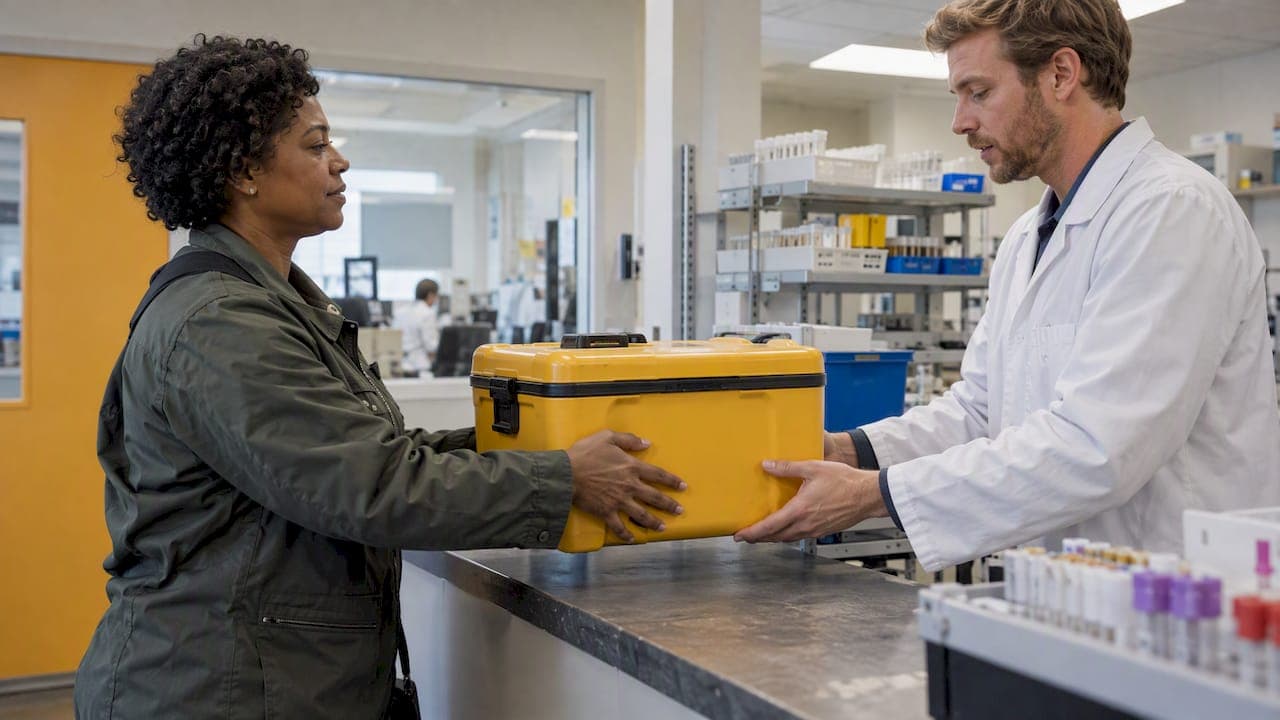
Choose a medical courier the way you would choose a lab: on evidence, not promises. The right partner can show you timestamped pickups, temperature records, signed handoffs and a plan for the night a driver calls out. The wrong one gives you a fast van and a gap in the record when a specimen is questioned. This guide walks through what a courier should carry, how to test reliability, what the rules require, how to compare quotes and what to ask before you sign.
It is written for practice managers, urgent care and primary care teams, long-term care and home health organizations, and clinical research sites who move specimens every day and cannot afford a bad run.
TL;DR
- A medical courier is a logistics partner for specimens, pharmaceuticals, records and supplies. Judge it on documentation: chain of custody, timestamps, temperature logs and tracking.
- Match the packaging and temperature capability (ambient, refrigerated, frozen) to the specimens you actually send, and confirm who is responsible for packaging.
- Ask about HIPAA handling, driver training, insurance and a written backup plan before you compare prices.
- Request an itemized rate card that separates routine routes, STAT runs, cold-chain add-ons, fuel and after-hours service.
- If your lab already runs its own pickup network, the simplest option may be one partner for testing and transport.
What a medical courier actually does
A medical courier moves biological specimens, pharmaceuticals, medical records, lab supplies or equipment between clinical and research sites, according to one industry guide. That sounds like ordinary delivery, but the cargo changes the job. A blood tube that sits in a hot car, a frozen aliquot that thaws, or a requisition that goes to the wrong bench can mean a recollection, a delayed diagnosis or a compromised study sample.
For most practices, the work falls into three patterns:
- Scheduled routes. A driver visits your clinic at set times, once or several times a day, and carries specimens to the lab.
- STAT or on-demand runs. A dedicated pickup for a time-sensitive specimen, usually priced at a premium.
- Specialty transport. Refrigerated or frozen shipments, research specimens with strict custody requirements, or supplies delivered back to your site.
Before you talk to any courier, list what you send, how often, at what temperature and by what time results are needed. Every later decision depends on that list.
How to test a courier's reliability
Any courier will tell you it is reliable. A useful test is to ask what it can produce when something goes wrong. A lab-director article in HealthManagement.org makes this point: a capable courier should be able to show route-level GPS data, pickup and delivery timestamps, temperature logs, geofenced confirmations and custody records when a shipment is questioned.
Turn that into a short test you can run during vendor selection:
- Ask for a sample trace. Request an anonymized record from a past run. It should show who picked up, when, where and who received.
- Ask how a missing specimen is handled. You want a named escalation path and a time target, not a general assurance.
- Ask who the drivers are. Employees or independent contractors? What training have they completed, and who supervises them?
- Ask about the worst day. Heat waves, ice storms, road closures, a driver out sick. What happens to your 5 p.m. pickup?
- Run a pilot. One or two weeks on a single route will tell you more than any proposal.
Chain of custody is the core deliverable
Chain of custody is the unbroken, documented record of a specimen at every point from pickup to delivery. According to the same industry guide, a compliant courier provides time-stamped pickup and delivery records, signature or scan capture at handoffs, and real-time tracking, which become the audit trail. For research sites and CROs, this record is often as important as the result itself. Our own guide on the five chain of custody fields that make CROs audit ready shows what to capture at each handoff, and the same fields are a good checklist for any courier.
Packaging and temperature: what the courier must get right
Temperature is where many courier failures happen, so confirm capability for each condition you use. CDC guidance on specimen shipping defines ambient, room temperature (15 to 25°C), refrigerated (2 to 8°C) and frozen (at or below −20°C) conditions, and notes that packaging depends on transport mode and specimen classification.

For frozen specimens, the same CDC guidance calls for sufficient dry ice around sealed secondary packaging inside a secondary container, further insulation and rigid outer packaging. Dry ice should not touch the primary receptacle or stand in for padding. If you ship on dry ice, read our guide to UN1845 rules for U.S. dry ice shipping and ask the courier whether its drivers are trained to handle it. For the full picture on holding temperature through a route, see our specimen cold chain management guide.
A review of biospecimen shipping hosted by the National Institutes of Health adds practical points for research shipments: coordinate timing with the receiving laboratory, provide tracking information, use enough dry ice to cover possible delays, and confirm receipt at the intended laboratory rather than relying only on delivery to the institution. Ask your courier to deliver to the testing bench or receiving dock, not simply to a building.
Who packs, and who labels?
Clarify this in writing. Some couriers only carry what you hand them. Others supply coolers, ice packs and bags. Neither is wrong, but the person who packs is the person responsible if the contents leak or warm up. Labels matter just as much: a perfectly transported tube with a mismatched label is still a rejected specimen. Our sample labeling standards guide covers what a compliant label should carry.
Compliance questions to settle before you sign
This section is general information, not legal advice. Have your compliance officer or healthcare counsel confirm how each rule applies to your organization.
HIPAA and business associate agreements
A specimen requisition and the tube it rides with are protected health information. HHS guidance says that certain private couriers acting only as conduits are not business associates and do not require a business associate contract. The conduit exception is narrow: it covers transport of PHI without access other than on a random or infrequent basis, as needed for the transportation service or as required by law.
That has a practical consequence. If a courier also scans documents, handles records, stores items overnight or otherwise touches PHI more than occasionally, you should ask your compliance team whether a business associate agreement is appropriate. Many practices simply require one from every courier as a matter of policy. For a plain-language overview of how privacy obligations, vendor agreements and staff training fit together, see this HIPAA compliance for practices guide.
Packaging and ground transport rules
CDC states that transport mode determines which federal rules apply: air and ground shipments follow different classification guidance, and packing, marking, labeling and documentation depend on both mode and classification. A courier working by road should understand which rules cover its work.
Two details are worth knowing:
- Under 49 CFR 173.199, Category B packaging must be capable of passing a 1.2-meter drop test, though it is not required to be tested using that method. A PHMSA interpretation adds that the person authorizing compliance remains responsible for demonstrating the packaging can meet that standard.
- Diagnostic specimens moved by private or contract motor carriers used exclusively for those specimens may be excepted from certain hazardous materials requirements, and PHMSA says such dedicated vehicles must not carry patients at the same time as specimens.
You are not expected to recite regulations. You are expected to ask the courier, "Which packaging standard do your drivers follow for Category B specimens, and who trains them?" and to hear a specific answer.
Insurance, training and credentials
Review insurance and liability coverage for lost or damaged specimens, documented BAAs and staff training, and facility credentialing, as the industry guide suggests. Ask for the certificate of insurance, not a verbal statement, and check whether coverage addresses the value of a specimen that cannot be recollected, such as a tissue sample or a research aliquot. Some hospitals and research sites require vendor credentialing before a driver may enter, so ask which sites the courier is already cleared for.
Service levels, coverage and contingency plans
This is the area where proposals are thinnest, so ask direct questions and write the answers into the agreement.
| Question | What a good answer sounds like |
|---|---|
| What are your pickup windows? | Specific times by route, with a cutoff for same-day lab processing |
| How fast is a STAT response? | A stated response target, plus where drivers are positioned in off hours |
| What hours and days are covered? | Weekends, holidays and after-hours listed, with what each costs |
| Where do you operate? | A defined service area, including your rural or outlying sites |
| What if a driver is unavailable? | A named backup driver or partner and a notification process |
| How will I know about a delay? | Proactive alerts, not a call from you asking where the van is |
| Who do I call at 2 a.m.? | A staffed dispatch line, not a voicemail |
Coverage matters more than it first appears. A courier that serves your main clinic well but reaches your satellite office only twice a week will push specimens past stability limits. If you manage skilled nursing or assisted living sites, home health patients or rural clinics, ask for the actual pickup schedule at each address, not a regional claim.
Pickup timing should also work backward from the lab. Specimens that arrive after the lab's cutoff may wait until the next shift. Ask the lab and the courier to agree on the same cutoff.
What affects courier cost, and how to compare quotes
There is no useful universal price for medical courier work, because routes, volume and urgency differ so much. What you can do is understand the drivers. According to the industry guide, costs are shaped by the mix of STAT and routine runs, fuel surcharges and add-ons such as cold-chain packaging and after-hours or weekend service, and it advises asking for an itemized rate card rather than a blended quote.
When you collect quotes, put them side by side on the same assumptions:
- Volume. Quote everyone on the same number of stops and the same schedule.
- Pricing model. Per stop, per mile, per route, or a flat monthly fee? Know which you are comparing.
- Surcharges. Fuel, wait time, redelivery, weekend and holiday rates.
- Cold-chain items. Are coolers, gel packs, dry ice and temperature loggers included or billed separately?
- Minimums and contract terms. Monthly minimums, term length, and the notice required to cancel.
- Liability limits. What the courier pays if a specimen is lost.
The cheapest per-stop rate can become the most expensive option if it leads to recollections. Count a single redraw, including patient time, staff time and a delayed result, against the savings.
Perspective: why we think transport belongs with testing
We run a laboratory, so we see what happens on both sides of the courier handoff. Most complaints we hear from practices about "slow results" start before the specimen reaches the bench: a missed pickup window, a cooler that was not sealed, a requisition that did not travel with the tube. Turnaround time is a shared outcome between the practice, the courier and the lab.
That is why we offer specimen pickup and medical courier service alongside testing, electronic results reporting and LIS and EHR integration. When one team handles the pickup and the testing, there is one place to call, one record from collection to result and no finger-pointing between vendors. For clinical research, the same logic applies to custody records and cold-chain handling.
If you already have a courier you trust, keep it, and ask it the questions in this article anyway. If you are choosing for the first time, we would encourage you to start with the documentation you can get, not the price.
— Kohealth Labs
Specimen pickup with KoHealth Labs
KoHealth Labs provides specimen pickup and transportation, mobile phlebotomy, electronic results reporting and LIS integration for physician practices, urgent care, long-term care, home health and research sites, and supports clinical trials with specimen collection and management. If you want one partner for the collection, transport and testing steps, see how our process works, or read about our laboratory services for physicians. Research teams can review our clinical trial laboratory services. Our team can walk through your volumes and sites and tell you what a pickup arrangement would look like.
A short checklist for your decision
- List your specimen types, temperatures, volumes and lab cutoffs.
- Ask each courier for a sample trace showing timestamps, signatures and temperature data.
- Confirm packaging responsibility and driver training for the rules that apply to your specimens.
- Decide with compliance whether a BAA is required, and get insurance certificates.
- Review coverage at every site, including after hours and holidays.
- Get an itemized rate card and compare on the same assumptions.
- Pilot on one route before committing, and write the escalation path into the agreement.
FAQ
What is a medical courier?
A medical courier is a delivery service trained to move specimens, pharmaceuticals, records, lab supplies and equipment between healthcare and research sites. Unlike a general parcel carrier, it is expected to maintain documented custody and, when needed, temperature control. Many also offer STAT and scheduled routes.
Does a medical courier need a business associate agreement?
Not always. HHS guidance says that a private courier acting only as a conduit for PHI, without access other than on a random or infrequent basis, is not a business associate. If the courier handles records, stores items or has more regular access, ask your compliance officer or counsel whether an agreement is needed. Many practices require one regardless.
How do I know if a courier can handle temperature-sensitive specimens?
Ask which of the ambient, refrigerated and frozen conditions it supports, how it monitors them, and whether it can provide temperature logs for each run. For frozen shipments, ask about dry ice training and packaging. A courier that cannot show logs should not carry cold-chain specimens.
What should I ask for in a courier quote?
Ask for an itemized rate card that separates routine routes, STAT runs, fuel surcharges, cold-chain supplies and after-hours or weekend service. Give every provider the same volume and schedule so the quotes are comparable. Also ask for minimums, contract length and liability limits.
Should I use the lab's courier or hire my own?
Both work. A lab-provided courier gives you one point of contact and one record from pickup to result. An independent courier gives you flexibility across several labs. Whichever you pick, require the same documentation standards.
Sources
- Medical Courier Services: STAT, Chain of Custody, Cold Chain
- Five questions every lab director should ask before hiring a medical courier, HealthManagement.org
- CDC specimen packing and shipping guidance
- Domestic and International Shipping of Biospecimens
- HHS: Are the following entities considered business associates?
- CDC updated storage and shipping guidance
- CDC Step 4 job aid: labeling, marking and documenting
- PHMSA interpretation 14-0060
- PHMSA interpretation 03-0070
- HIPAA Compliance for Practices Explained
For more information about our diagnostic testing, clinical research laboratory services, or partnership opportunities, visit https://kohealthlabs.com or contact KoHealth Labs at (469) 792-8439 and ask for Amy Patterson.