
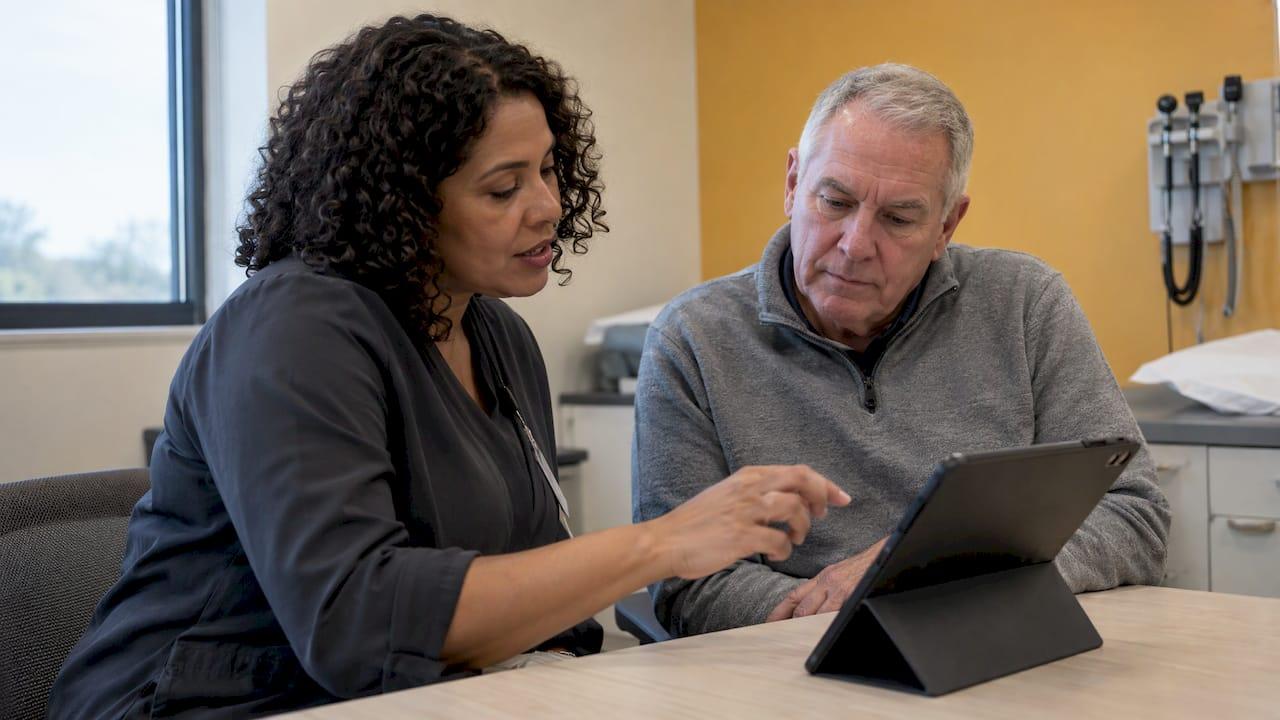
An eConsent lab workflow is the chain that starts when a participant signs a consent form on a screen and ends when a result reaches the investigator, with the specimen, the order and the consent record all agreeing along the way. The workflow fails when those three records drift apart: a specimen collected under an old consent version, a draw with no signed form on file, or a withdrawal that never reaches the lab. A central laboratory that handles collection, transport, testing and electronic reporting under one partnership gives sponsors, CROs and sites fewer handoffs where that drift can start. KoHealth Labs supports clinical trials with specimen collection and management, biomarker analysis, courier pickup, electronic results reporting and LIS integration.
TL;DR
- eConsent changes the medium, not the responsibility: the investigator and delegated, qualified staff still obtain consent, and the electronic system cannot do it for them (HHS OHRP).
- In FDA-regulated research, an electronic signature on a consent form requires a system that meets 21 CFR Part 11 (Yale HRPP guidance).
- The lab needs to know, before it accepts a specimen, which consent version applies and which uses the participant allowed.
- Measure the workflow by consent completeness, participant ease, collection errors and turnaround time.
- Fewer vendors between consent, collection and results means fewer places for records to diverge.
What an eConsent lab workflow connects
eConsent is a digital consent process that can use images, diagrams, audio or video, with the signature captured electronically. NCI's 2026 best practices for biospecimen resources recommend considering it because it streamlines consent, improves participant understanding and makes consent form versions, signatures and dates easier to track (NCI, 4th Edition). The same document says it is not a substitute for personal interaction, and that a secure, privacy-compliant setup can take significant resources.
The lab side matters because consent decides what may be done with a sample. Consent defines whether blood can be drawn for the protocol, whether leftover material can be stored, and whether it can be used for future research. A lab workflow that cannot see those permissions is working blind.
The workflow, step by step
The U.S. government's report to Congress on electronic ordering and reporting describes a standard laboratory data flow: intake and demographics in the EHR, an electronic order with specimen details, collection and transport, receipt by the laboratory information system (LIS), analysis, results transferred to the LIS, approval, and sharing with the ordering provider and, sometimes, public health agencies (Report to Congress, 2024). In a trial, consent sits in front of that flow. Here is how the pieces fit.

1. Consent and eligibility
The investigator or a delegated team member explains the study, answers questions and documents consent. FDA's guidance on decentralized trials allows consent to be obtained electronically or on paper from participants at remote locations when all regulatory requirements are met, and the process must tell participants whom to contact about questions, rights and research-related injury (FDA DCT guidance, 2024).
Where it goes wrong: the signed form exists in the eConsent platform but the site's order system has no flag showing consent is complete. Build the order so it cannot be released until consent status is confirmed.
2. Test ordering
The order should carry the participant ID, visit, consent version and any specimen-use restrictions. Keep it electronic. Free-text requisitions are where version and restriction information gets lost.
3. Collection and transport
FDA's guidance allows trial specimens such as blood or sputum to be collected by remote trial personnel, local health care providers, local clinical laboratories or participants using home kits, then sent to designated laboratories, with IRB oversight to confirm the process is adequate (FDA DCT guidance, 2024). Each model needs labeling and chain-of-custody discipline. Our guides cover remote specimen collection in clinical trials, mobile phlebotomy models and specimen cold chain management.
Where it goes wrong: a draw happens at a visit where the participant was never re-consented after a protocol amendment. The phlebotomist needs the current consent status at the point of collection.
4. Receipt, testing and review
The lab receives the order in its LIS, matches the specimen, tests it and approves results. NCI's best practices say that when procurement and transport are not directly under the CLIA laboratory's auspices, the testing laboratory medical director oversees them to protect sample integrity and identification (NCI, 2026). That is the reason to have the specimen handling and testing under one accountable laboratory.
5. Results reporting
Results go back to the investigator, the sponsor's data system and, where the protocol says so, the participant. FDA expects sponsor data management plans to describe how data flows from every source to the sponsor, including the service providers that collect, handle and manage it (FDA DCT guidance, 2024). Write the lab's reporting format and timing into that plan.
For a working example at national scale, the NCI Moonshot biobank workflow has the provider begin eConsent (paper if unavailable), the coordinator enroll the participant and ship specimens with tracked labels, record data within two weeks, and the lab log specimens in a LIMS before testing and reporting (NCI Moonshot Biobank).

What must be exchanged between site, sponsor, CRO and lab
Keep the shared data set small and exact:
| Data element | Why the lab needs it | Who owns it |
|---|---|---|
| Participant ID and visit | Matches specimen to the right record | Site |
| Consent version and date signed | Confirms the draw is authorized | Site, eConsent system |
| Specimen-use permissions | Controls storage and secondary testing | Site, sponsor |
| Withdrawal status and date | Stops further use | Site, sponsor |
| Collection date and time | Stability and turnaround | Collector |
| Result and approval time | Data lock and safety review | Lab |
FDA notes that electronic systems can maintain approved consent versions, document IRB approval and archive signed forms, and can capture reports from remote personnel, local providers and local laboratories (FDA DCT guidance, 2024). Systems that produce records required by FDA regulations are subject to 21 CFR Part 11.
Compliance basics for the workflow
Part 11. Under 21 CFR 50.27, if an electronic signature and date document consent in FDA-regulated research, the system must meet Part 11. Yale's guidance adds that a Part 11-compliant system should always be used for eConsent in FDA-regulated research, and that sponsors supplying technology to all sites should provide a written attestation of compliance, security and ongoing access to records (Yale HRPP, 2025). See our explainers on 21 CFR Part 11 compliance and Part 11 lab data.
IRB review. IRBs review and can approve, modify or disapprove research activities, including whether the consent process is adequate (HHS OHRP). Submit the eConsent screens and the specimen-handling description together.
Clinical responsibility. Consent is a human process. The investigator must make sure consent is legally effective before participation and cannot hand that authority to the software.
Versions, re-consent and withdrawal
These are the three events that most often break a lab workflow.
- New versions. Keep every approved version in the system with its IRB approval date, and show the version on every order.
- Re-consent. University of Michigan guidance, citing 45 CFR 46.116(b)(5) and 21 CFR 50.25(b)(5), says re-consent applies when changes could affect willingness to continue, such as new risks or new alternatives. Hold new draws until the new version is signed.
- Withdrawal. HHS OHRP's biospecimen FAQ says participants may withdraw specimens from future research, must be told the procedure up front, and that specimens already distributed and analyses already completed generally cannot be retrieved or destroyed. Say so in the form (HHS OHRP FAQ).
For storage and secondary use, the 2017 final Common Rule allows broad consent for storing and reusing identifiable private information and biospecimens (Federal Register, 2017). Tiered electronic consent is workable too: in an academic medical center pilot, 126 of 394 patients offered access changed their sharing preferences by data category and recipient, and the authors concluded it respects preferences without significantly affecting participation (Kim et al.). A lab that can read tiered permissions can honor them.
Measuring whether the workflow works
Track a short list monthly:
- Consent completeness. At a large academic cancer center, eConsent produced no completeness errors across 235 consents, compared with 6.4% for paper (Buckley et al.).
- Participant experience. In the same study, 83% of 777 participants rated eConsent easy or very easy to use, with comprehension similar to paper.
- Specimen errors. Rejected or mislabeled specimens, and draws without confirmed consent (the target is zero).
- Turnaround. Collection to result approval, by visit type.
- Query rate. Data queries tied to missing or inconsistent lab data. FDA recommends risk-based and centralized monitoring to find missing data, inconsistent data and outliers (FDA DCT guidance, 2024).
Where KoHealth Labs fits
We serve as a centralized laboratory and supplier partner for clinical trials, with specimen collection and management, biomarker analysis, courier specimen pickup, mobile phlebotomy, electronic results reporting and LIS and EMR integration. For a sponsor or CRO, that puts collection, transport, testing and reporting under one team, which keeps the consent-to-result chain short. Our clinical trials laboratory services page describes the offer, and our integrated diagnostics for CROs and pharma page covers analysis-ready data delivery.
If you are mapping an eConsent workflow for a study, bring the protocol's specimen schedule and your reporting needs to us and we will build the lab side around them.
Our perspective
Most eConsent projects are scoped around the consent platform. The lab is treated as something that happens afterward. We think that order is backwards.
A consent is only useful to a study if the people handling the specimen can act on it. That means the version, the permissions and any withdrawal have to reach the courier, the phlebotomist and the lab bench as plainly as the test code does.
That is why we build around speed, reliability, flexibility and direct communication. A sponsor or CRO with one laboratory partner for collection, transport, testing and electronic reporting has one team to call when a specimen and a record disagree.
The best workflows we can design are simple: one order, one set of identifiers, one reporting path.
Kohealth Labs
FAQ
Does eConsent replace the conversation with the participant?
No. Under HHS OHRP guidance, consent may take place on-site or remotely, but the investigator and delegated, qualified staff remain responsible for obtaining it. NCI's best practices likewise say eConsent is not a substitute for personal interaction.
Does every eConsent system need to meet 21 CFR Part 11?
In FDA-regulated research, yes, when an electronic signature and date document consent under 21 CFR 50.27. Part 11 applies only to FDA-regulated trials, so check with your IRB and sponsor for studies outside that scope.
How does the lab know which consent version applies to a specimen?
The order should carry the consent version and date, drawn from the eConsent system or the site's records. Integrating the order and result flow with the lab's LIS keeps that information attached to the specimen from collection through reporting.
What happens to specimens if a participant withdraws?
The participant may withdraw specimens from future research, and the consent form should explain how. Specimens already distributed and analyses already completed generally cannot be retrieved or destroyed, so the form should state that limit.
Sources
- NCI 4th Edition Best Practices for Biospecimen Resources, 2026
- HHS OHRP: Use of Electronic Informed Consent Questions and Answers
- FDA: Conducting Clinical Trials With Decentralized Elements, 2024
- Yale HRPP: 21 CFR Part 11 Guidance, 2025
- NCI Moonshot Biobank: How the Biobank Works
- Report to Congress: Standards for Electronic Ordering and Reporting of Laboratory Test Results, 2024
- HHS OHRP biospecimen FAQ, 2011
- Federal Register: Final Common Rule, 2017
- Kim et al., iCONCUR tiered e-consent pilot
- Buckley et al., Digitalizing the Clinical Research Informed Consent Process
For more information about our diagnostic testing, clinical research laboratory services, or partnership opportunities, visit https://kohealthlabs.com or contact KoHealth Labs at (469) 792-8439 and ask for Amy Patterson.