

Electronic laboratory reporting is the automated, secure transmission of reportable test results from a laboratory to state and local public health agencies, replacing fax and manual entry with standardized digital messages. The primary payoff is speed: standardized ELR reports let health departments spot outbreaks and act days sooner than paper-based workflows allow. Implementation runs through HL7 messaging standards, jurisdictional onboarding, and a testing partner that already handles the mapping and validation work.
TL;DR:
- Automated ELR delivers reportable test results faster, averaging 2.7 days earlier than faxed reports, which is crucial during outbreaks.
- Implementation requires careful vocabulary mapping, validation, and matching of local reportability rules, often taking months to finalize.
- Acceptance testing must go beyond syntax to include identity matching, duplicate detection, and routing accuracy, before ending manual reporting.
- Most programs slow down by turning off manual channels too soon, before jurisdictional approval confirms full readiness.
- Partnering with an experienced lab can expedite onboarding by providing existing LIS integration, validated messaging, and ongoing monitoring support.
What Is ELR Lab Reporting and How Does It Differ From eCR?
ELR moves in one direction only: a laboratory identifies a reportable result, such as a positive measles or HIV test, and transmits it electronically to the relevant health department. That is distinct from routine electronic results delivery to an ordering physician's EHR, which is a private clinical transaction with no public health destination. It is also distinct from electronic case reporting, or eCR, which triggers from a reportable condition observed during a clinical encounter rather than from a lab result itself. Many organizations end up running both, since the obligations do not overlap completely.
The technical path looks like this: a laboratory information system captures the result, generates a standardized message using HL7 v2.5.1 structures, and transmits it through a secure transport channel to the receiving health department. That agency then validates the message, checks it against reportability rules, and ingests it into its surveillance systems, sometimes linking it to an existing case record.
Reportable conditions and required fields vary by jurisdiction. A field that is optional in one state's implementation guide might be mandatory in another, which is why the Interoperability Standards Platform points implementers toward their specific state or local health department before finalizing message specifications.
What Operational Gains Come From ELR Automation?
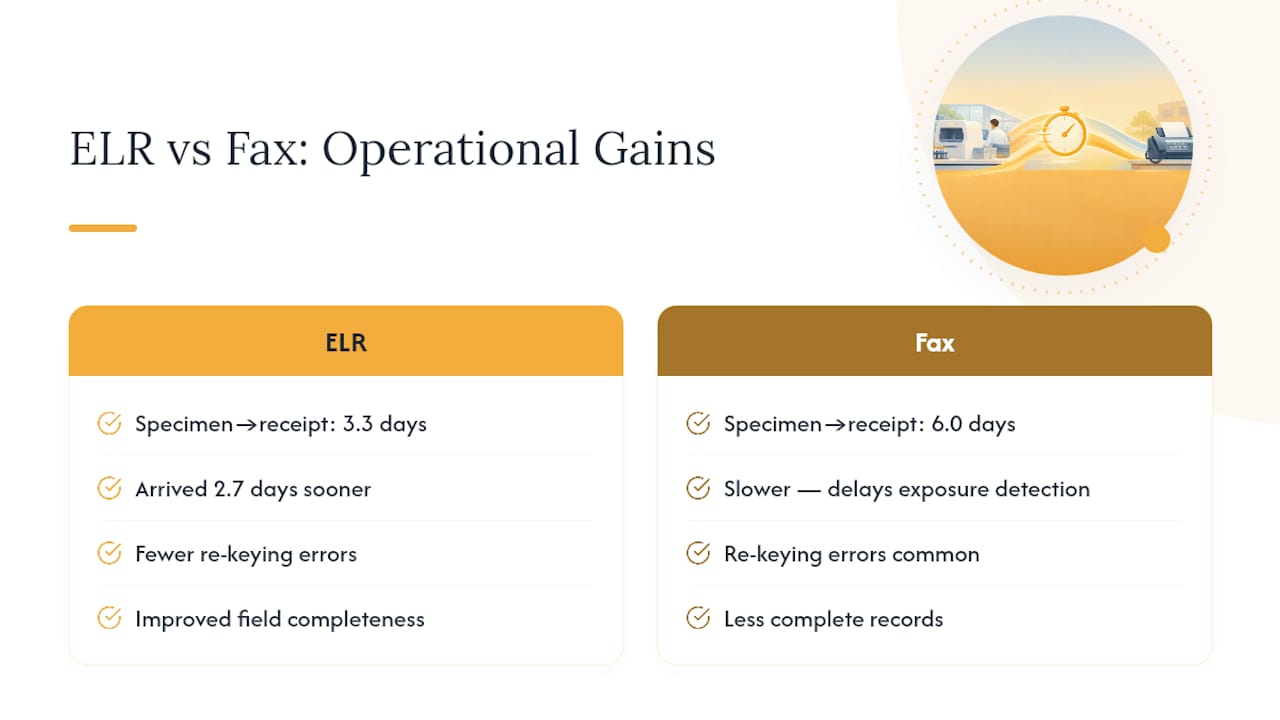
The clearest evidence comes from a CDC MMWR analysis of jurisdictions studied in 2014, which found electronically reported results arrived an average of 2.7 days sooner than faxed reports, 3.3 days versus 6.0 days from specimen collection to report receipt. That gap matters enormously during an outbreak, when every day of delay means more unnoticed exposure.
Beyond speed, ELR cuts down the errors that come from re-keying paper reports and improves how completely a record captures required fields.
CDC frames these gains as more than a faster delivery channel. Standardized, machine-processable messages let receiving agencies process and analyze reports at scale, which is a different capability than simply speeding up a fax.
Which Standards Govern ELR Implementation?
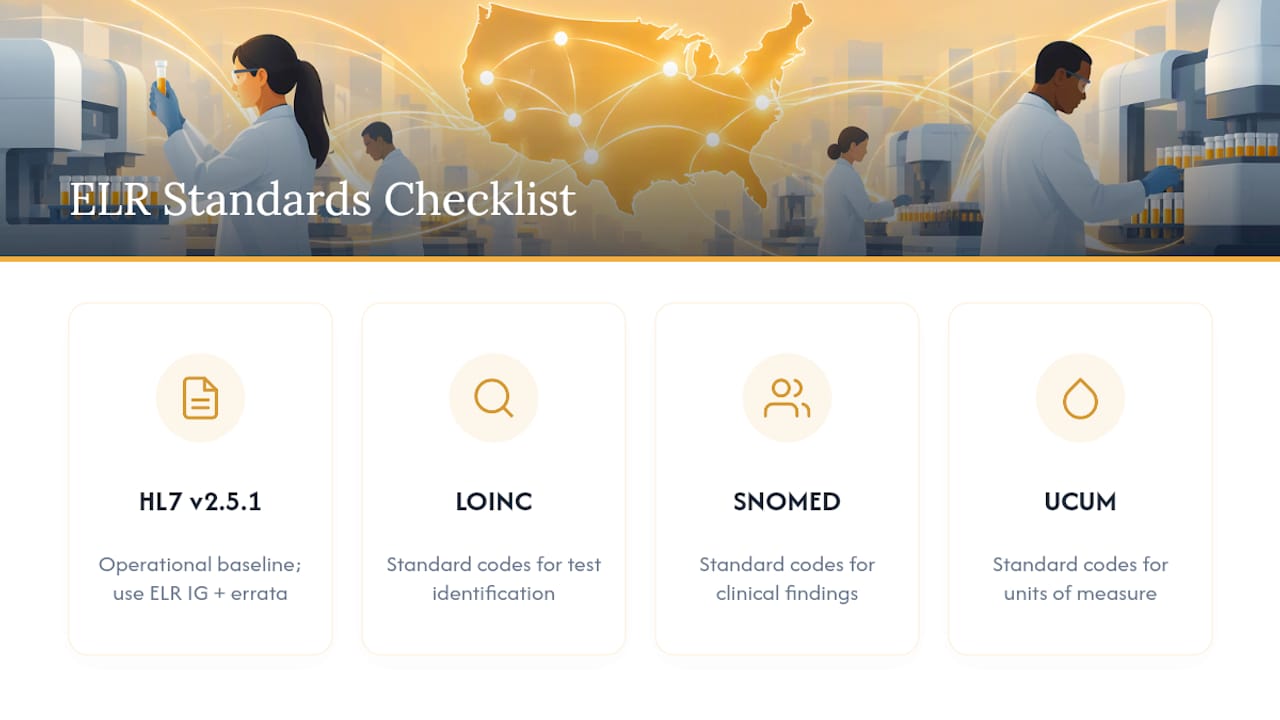
HL7 Version 2.5.1, paired with the ELR implementation guide and its published errata, remains the operational baseline for U.S. laboratories submitting reportable results. Alongside message structure, labs need standardized code sets: LOINC for test identification, SNOMED for clinical findings, and UCUM for units of measure. A syntactically correct HL7 message with the wrong LOINC code is still unusable, since APHL's own implementation guidance notes that semantic mapping and local routing are often the hardest parts of the job, harder than getting the message format right.
For testing and certification, NIST maintains an ELR Validation Suite used in ONC certification and conformance testing, letting vendors and labs confirm their messages meet the required structure before they hit production. ONC's own guidance adds a caution worth repeating: a technically capable lab can still fail onboarding if it uses the wrong transport method or omits content a specific jurisdiction requires locally.
FHIR US Lab Report is emerging as a complementary standard, but it supplements rather than replaces HL7 v2.5.1 for most current implementations. Teams evaluating their own EMR lab integration stages should treat FHIR readiness as a forward-looking addition, not a substitute for the certification baseline in place today.
What Does the ELR Onboarding Process Look Like?
Every jurisdiction runs its own onboarding sequence, but the shape is consistent across states. Following it in order avoids the rework that comes from testing before mapping is finished.
- Register with the jurisdiction. Contact the state or local health department to begin the formal ELR onboarding process and confirm which conditions and fields apply to your facility type.
- Prepare vocabulary mapping. Map local test codes to LOINC and SNOMED, since this step surfaces more gaps than any other part of onboarding.
- Develop and test messages. Build HL7 v2.5.1 messages against the jurisdiction's implementation guide, including negative results and corrected or amended reports, not just clean positive cases.
- Run validation and acceptance testing. Confirm reportability logic, required-field completeness, transport, acknowledgments, and duplicate handling before requesting go-live approval.
- Go live in production. Begin sending live messages once the health department authorizes the transition.
- Monitor and reconcile ongoing. Compare submitted volume against expected test volume regularly to catch silent failures.
Pro Tip: Keep your legacy fax or manual reporting channel active until the jurisdiction explicitly authorizes you to stop. An "accepted" test message is not the same as a jurisdiction's sign off to retire your fallback.
Coordinate this sequence across your LIMS or EHR vendor, the public health onboarding staff, and your internal informatics and compliance teams from the first registration step, not after testing begins.
What Mistakes Slow Down ELR Programs?
The most common failure is shutting off manual reporting the moment a test message gets accepted, before the jurisdiction has confirmed production readiness. Washington State's own onboarding guidance treats an accepted message as the start of lifecycle monitoring, not the finish line.
Acceptance testing needs to go beyond syntax checks. It should cover identity matching, duplicate detection, corrected and amended results, and routing errors, since a message can be perfectly formed and still land in the wrong queue.
- Test identity matching and duplicate handling explicitly, not just once during a demo
- Treat vocabulary mapping as a required acceptance-test item, not a one-time setup task
- Reconcile submitted message volume against actual test volume on a recurring schedule
- Confirm routing rules whenever a jurisdiction updates its reportable conditions list
Pro Tip: If your facility runs low test volumes, a direct interface may not be worth the engineering cost. Many states accept results through web-based submission portals or regional data hubs instead, so ask your health department which option fits your volume before building a custom feed.
Who Owns Each Piece of an ELR Implementation?
The laboratory or LIS handles message generation, vocabulary mapping, and reconciling what was sent against what the jurisdiction confirms received. The EHR or ordering system needs to guarantee complete order and result data, plus accurate patient demographic fields, since incomplete demographics are a leading cause of identity-matching failures downstream. The public health agency sets jurisdictional rules, runs onboarding and acceptance testing, and manages routing on its end. Internally, informatics, compliance, lab operations, and clinical leadership all need a seat at the table, since a mapping decision made in isolation by one team routinely breaks something another team depends on.
How Kohealth Labs Supports ELR Onboarding in Practice
A laboratory partner works through LIS integration, specimen logistics, and message validation as a connected process, not separate handoffs. Mapping errors, routing failures, and identity-matching problems tend to surface at the seams between systems, and that is exactly where ongoing monitoring support catches them before they become compliance issues.
— Kohealth Labs
Get ELR-Ready Faster With a Lab Partner Built for It
Choosing a laboratory partner instead of building ELR connectivity from scratch allows your team to avoid months of mapping, testing, and vendor coordination, benefiting from existing LIS integration, electronic results delivery, and specimen pickup groundwork. That means fewer surprises during onboarding and a faster path to a stable go-live.
Before you commit to any laboratory partner for your ELR onboarding, ask directly how they handle vocabulary mapping, corrected-result testing, and reconciliation monitoring after go-live, since those are the areas where most programs stall. Kohealth Labs supports practices, urgent care centers, skilled nursing facilities, and research organizations across what we test, and works with telehealth platforms through dedicated remote care solutions that keep results flowing without manual re-entry. If you are evaluating a laboratory partner for the Dallas-Fort Worth area or beyond, book a conversation with our team to walk through your current reporting setup and where an integration gap might be slowing you down.
Sources
- Electronic Laboratory Reporting (ELR) | CDC
- Electronic Transmission of Reportable Laboratory Results to Public Health Agencies | Interoperability Standards Platform (ISP)
- Electronic Laboratory Reporting onboarding guidance | Washington State Department of Health
FAQ
What Is an ELR Test Report?
An ELR test report is a standardized digital message, typically built on HL7 v2.5.1, that a laboratory sends automatically to a public health agency when a test result meets a reportable-condition threshold. It replaces the fax or manual entry a lab would otherwise use to notify health officials of results like a positive infectious disease test.
What Diseases Are Reportable in Pennsylvania?
Reportable disease lists are set at the state level and change periodically, so Pennsylvania providers should confirm the current list directly with the Pennsylvania Department of Health rather than relying on a general national list. Common categories across most states include infectious diseases such as measles, HIV, and certain foodborne illnesses, but exact requirements and reporting timeframes vary by jurisdiction.
What Diseases Are Reportable in Michigan?
Michigan, like every state, maintains its own reportable conditions list through its state health department, and that list is updated periodically rather than fixed. Providers and labs operating in Michigan should check current requirements directly with the Michigan Department of Health and Human Services before finalizing ELR mapping work.
How Do I Choose a Laboratory Partner for ELR Support?
Look for a partner with existing LIS integration experience, a track record of message validation and reconciliation monitoring, and staff who understand jurisdictional variation firsthand. Some laboratory partners offer electronic results delivery and integration support designed to meet these requirements.
Is ELR the Same as Electronic Case Reporting?
No. ELR starts with a laboratory result and reports it to public health, while electronic case reporting starts from a reportable condition identified during a clinical encounter. Many healthcare organizations need both systems running, since their triggers and obligations do not fully overlap.