

Functional medicine lab panels are bundled sets of targeted assays, covering thyroid, hormones, nutrients, metabolic function, and inflammation, that examine multiple body systems at once instead of testing for a single suspected condition. Their clinical value lies in pattern recognition: connecting biomarkers across systems often reveals early imbalances that a standard, symptom-triggered test would miss entirely. That broader view is why physicians and informed patients increasingly ask for them by name rather than settling for one isolated blood draw.
TL;DR:
- Functional medicine panels provide a broader view of biomarkers across body systems, aiding early imbalance detection compared to standard tests.
- Optimal ranges are narrower than standard reference ranges but require clinical context for accurate interpretation, especially with trend analysis over time.
- Testing should be symptom-driven, with retests ideally scheduled three to six months apart to accurately track progress and treatment effects.
- Lab accreditation, proper sample collection, and integrated result delivery are critical for ensuring test reliability and operational efficiency.
- Using a high-quality lab that offers easy specimen collection and direct EHR integration simplifies implementation and improves turnaround times for practice workflows.
What Functional Medicine Lab Panels Include
Most panels fall into a handful of recognizable categories, each built around a specific physiological question. A comprehensive metabolic panel looks at kidney function, electrolytes, glucose, and liver enzymes. A full thyroid panel goes beyond TSH to include free T3, free T4, and thyroid antibodies. Hormone panels track sex hormones like estradiol, progesterone, and testosterone, along with stress markers such as cortisol.
Micronutrient panels flag deficiencies in vitamin D, B12, folate, magnesium, and ferritin. Inflammation and cardiovascular panels typically include hs-CRP, homocysteine, and an advanced lipid profile. Gut and microbiome testing uses stool samples to assess bacterial diversity and markers of intestinal permeability, while toxicant panels screen blood or urine for heavy metals.
Sample type varies by panel:
- Blood draws cover metabolic, thyroid, hormone, nutrient, and inflammation markers.
- Saliva testing is common for cortisol rhythm assessment across the day.
- Stool samples support microbiome and digestive-function panels.
- Urine collection applies to certain toxicant and hormone-metabolite tests.
Clinicians building a panel roster can review sample-collection specifics in the hormone panels PDF or browse the fuller wellness panels menu for less common assay combinations.
Functional Ranges vs. Standard Reference Ranges
Standard reference ranges are built from a broad population sample and flag values only when they fall outside what is statistically common, healthy or not. Functional or optimal ranges are narrower bands that some clinicians use to catch early dysfunction before a value crosses into the standard "abnormal" zone. A peer-reviewed overview of integrative laboratory testing notes that this approach only works when panels are read alongside clinical context, not treated as a stand-alone diagnosis.
A few examples show why the distinction matters:
- Free T3 can sit inside the standard range while still running low enough to correlate with fatigue and cold intolerance in a given patient.
- Ferritin below 50 ng/mL is often still "normal" on a standard report but frequently correlates with hair loss and low energy, especially in women.
- Vitamin D levels above 30 ng/mL clear the standard cutoff, but many functional practitioners target 40 to 60 ng/mL for immune and mood support.
- hs-CRP under 3.0 mg/L is standard-normal, yet values above 1.0 mg/L can signal low-grade inflammation worth tracking over time.
The same research notes that single time-point values carry real interpretive risk. A biomarker drawn once tells you where a patient stands that day, not whether the trend is improving or worsening.
Pro Tip: Always pair a lab result with the patient's symptom timeline. A ferritin of 45 ng/mL means something very different in a patient reporting new fatigue than in one who feels fine and has always tested in that range.
Matching Panels to Clinical Presentations
Ordering the right panel for the right complaint keeps testing high-yield instead of scattershot. Here is how common presentations typically map to panel choice:
- Persistent fatigue points first to a full thyroid panel plus ferritin, vitamin D, and B12. If those return unremarkable, add a cortisol rhythm test.
- Brain fog warrants thyroid antibodies, B12, homocysteine, and a fasting glucose or HbA1c to rule out insulin resistance.
- Unexplained weight change calls for a comprehensive metabolic panel alongside full thyroid and insulin markers.
- Irregular menses benefits from a hormone panel covering estradiol, progesterone, and testosterone, timed to cycle day.
- Digestive symptoms are best served by stool-based microbiome and intestinal permeability testing before adding food-sensitivity panels.
- Cardiometabolic risk screening should include an advanced lipid panel, hs-CRP, and HbA1c together, not lipids alone.
- Baseline longevity screening in an otherwise healthy patient combines a metabolic panel, full thyroid, key micronutrients, and inflammation markers as a single starting reference.
Retesting cadence matters as much as the initial order. Most interventions, whether a supplement protocol or a hormone adjustment, need three to six months before a repeat panel shows a meaningful trend. Testing sooner than that usually just adds noise.
How Testing Works: Collection, Turnaround, and Cost
Getting from order to result involves a few operational choices that shape both patient experience and practice workflow. Blood-based panels can be collected via in-office phlebotomy, an at-home collection kit, or mobile phlebotomy scheduled at the patient's location. Stool and saliva panels almost always ship as at-home kits with mailed return packaging.
A few logistics points worth knowing before you order:
- Lab accreditation matters. Confirm any partner lab holds CLIA certification and, where relevant, CAP accreditation before relying on its results clinically.
- Turnaround time varies by assay type. Routine chemistry and thyroid panels often return within one to two business days, while specialty hormone assays and microbiome sequencing can take one to three weeks.
- Pricing shapes differ. Some labs charge per panel, others run membership-style subscription pricing, and clinician-ordered testing is usually billed separately from direct-to-consumer packages.
- HSA and FSA funds frequently cover clinician-ordered functional panels; confirm with the specific plan administrator since coverage rules vary.
- Specimen pickup and routing should be scheduled in advance so samples reach the lab within their stability window, particularly for stool and saliva collections.
Where Functional Panels Fall Short
Functional lab testing has real limits worth naming plainly. Assay methods and "optimal" cutoffs are not standardized across labs, so the same sample can generate different functional-range flags depending on which lab ran it. The same integrative testing research cautions against treating a flagged value as an automatic mandate to treat, since over-interpretation of borderline numbers can trigger unnecessary supplementation or treatment cascades that never solve the underlying complaint.
Best practice keeps three habits in place: prioritize the highest-yield tests for the presenting complaint rather than ordering every panel available, track values as trends across repeat draws rather than one-off snapshots, and document the baseline reading and the specific action taken before each retest. That documentation is what turns a lab report into an actual treatment record.
How Kohealth Labs Supports Functional Testing in Practice
Running functional panels well depends less on which assays exist and more on whether the lab behind them makes ordering, collecting, and reporting simple for a busy practice. Kohealth Labs operates as a full-service diagnostic laboratory built around exactly that operational layer.
- Comprehensive testing menu: chemistry, molecular and PCR testing, microbiology, and pathology support alongside the panel categories covered above, detailed on the what we test page.
- Specimen pickup and mobile phlebotomy: reduces the burden on practices that lack in-house draw staff or want to offer at-home collection to patients.
- LIS and EHR integration: routes electronic results directly into existing practice workflows instead of requiring manual entry.
- Panel-building guidance: the biomarker panel selection resource walks through how assay choices get built into a coherent panel.
For practices weighing whether to add functional testing, that combination, faster turnaround plus fewer manual handoffs, is often the deciding factor over which specific biomarkers a lab can run.
Preparing Patients for Accurate Results
Result accuracy depends heavily on what happens in the 24 to 48 hours before the draw, and skipping preparation guidance is one of the most common reasons a functional panel comes back misleading. Fasting matters for several core markers: glucose, insulin, and a full lipid panel typically require 8 to 12 hours without food, though water is fine and usually encouraged.
Timing relative to the menstrual cycle changes hormone panel accuracy substantially. Estradiol and progesterone should generally be drawn on a specific cycle day, most often day 3 for baseline ovarian reserve markers or day 19 to 22 for a mid-luteal progesterone check, since values shift dramatically across a single cycle. Cortisol testing depends on time of day rather than cycle day, since the hormone follows a daily rhythm that peaks in the early morning and drops by evening. A single random draw without a specified collection window tells you far less than a properly timed one.
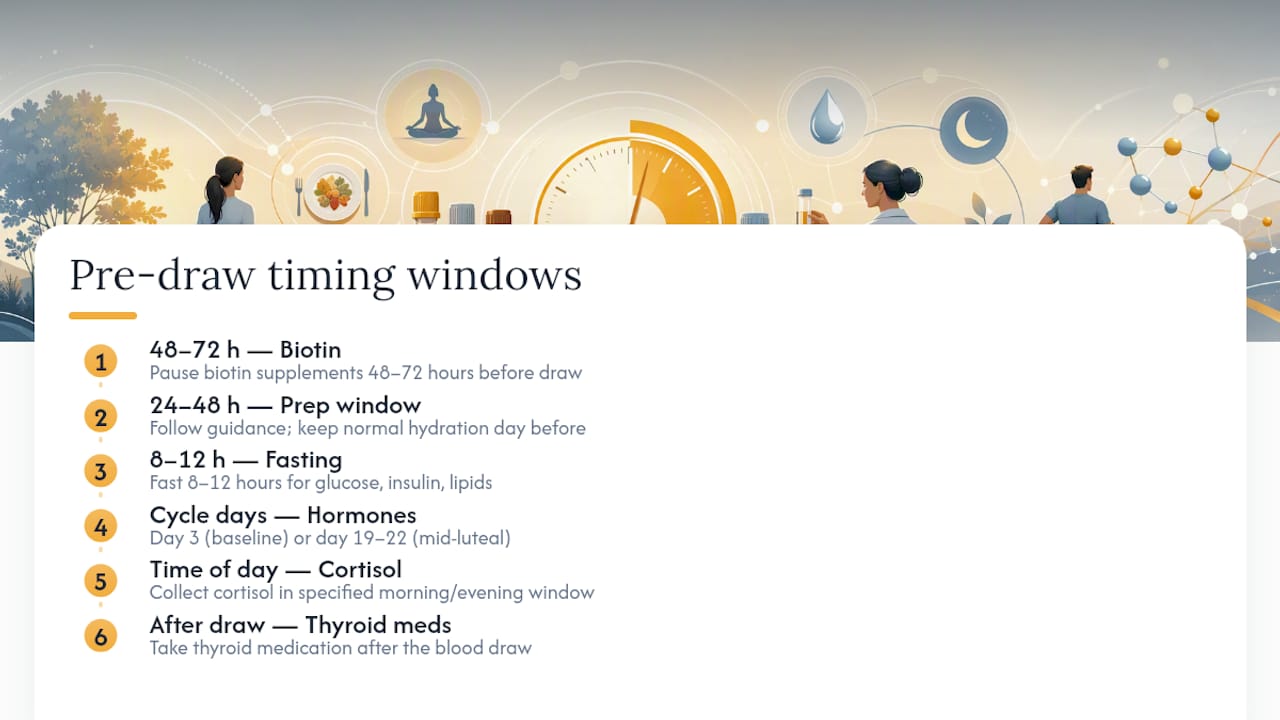
Medication and supplement timing deserves its own conversation with the patient. Biotin supplements, common in hair and nail formulas, can skew certain immunoassay-based thyroid and hormone results and should typically be paused 48 to 72 hours before the draw. Thyroid medication should usually be taken after the blood draw, not before, so the test reflects trough levels rather than a recent dose spike. Patients on hormonal birth control need a clear conversation about whether sex hormone panels are even meaningful while on the medication, since exogenous hormones suppress natural production and can make results uninterpretable.
Hydration status also affects several markers, particularly kidney function values on a metabolic panel, so encouraging normal water intake (not excessive) in the day before testing helps keep results representative of the patient's baseline state.
Getting Access to These Panels
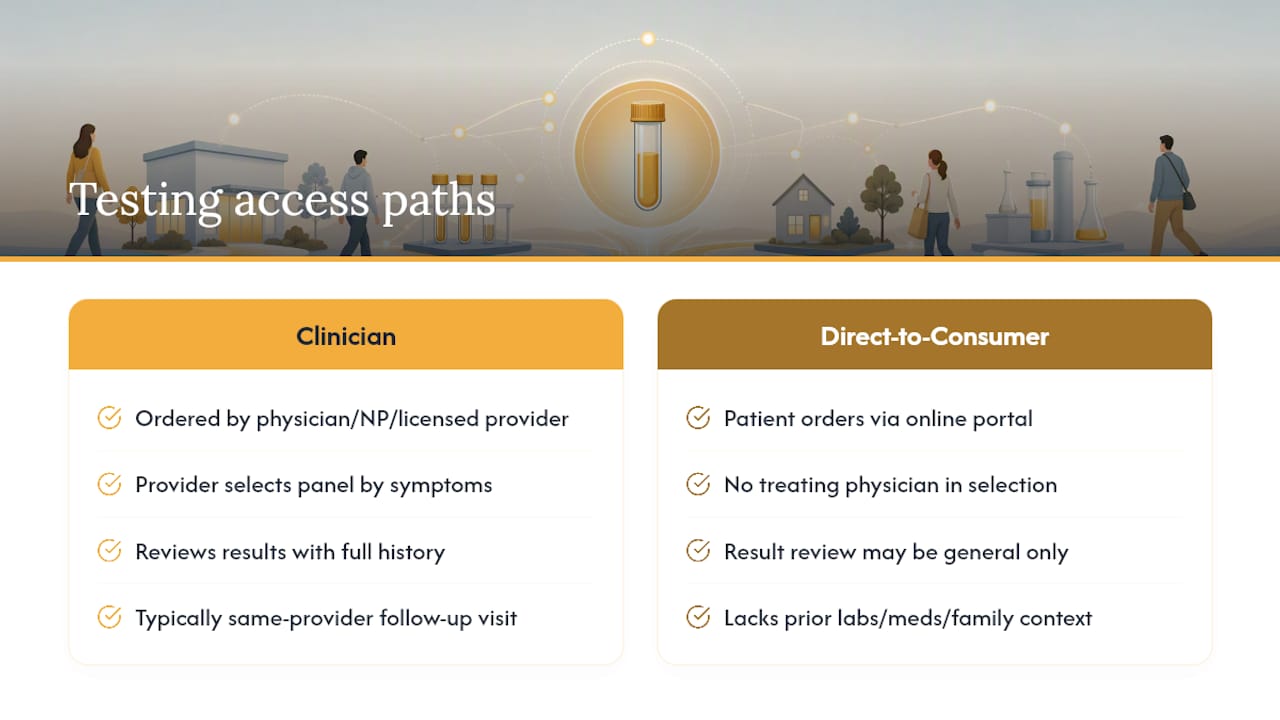
Two distinct paths lead to a functional panel result, and they carry meaningfully different levels of clinical oversight. Clinician-ordered testing runs through a physician, nurse practitioner, or other licensed provider who selects the panel based on presenting symptoms, reviews results against the patient's full history, and builds a treatment plan around the findings. This path typically includes a same-provider follow-up visit to discuss results and next steps.
Direct-to-consumer panels let patients order testing themselves, often through an online portal, without a treating physician involved in the initial panel selection. Some direct-to-consumer services include a general clinician review of results as part of the package, but that review usually happens without the fuller clinical context a treating provider already has: prior labs, medication list, family history, and an ongoing relationship with the patient.
For practices, the ordering workflow matters as much as the panel itself. A provider portal that lets clinicians select panels, review pending orders, and receive results electronically removes a significant amount of administrative back-and-forth compared to faxing requisitions or calling a lab for status updates. Practices that see enough patient demand for functional testing to justify an ongoing relationship generally get better turnaround and support working directly with a lab partner rather than routing individual patients to a direct-to-consumer service and hoping the results land in the chart in a usable format.
Turning Results Into a Treatment Plan
A panel full of flagged values is not a treatment plan. It is a starting inventory that only becomes useful once a clinician connects the findings to the patient's actual symptoms, history, and goals. The multi-system view is the real advantage here: a patient with fatigue, low mood, and irregular cycles might show a combination of borderline-low free T3, elevated cortisol, and low ferritin that, read together, points toward a specific intervention sequence rather than three unrelated problems treated in isolation.
Sequencing matters more than most patients expect. Correcting a significant ferritin deficiency before addressing thyroid function often changes how the thyroid numbers read on a follow-up panel, since iron status affects thyroid hormone conversion. Jumping straight to thyroid medication without checking iron first can mean chasing a moving target.
The retest becomes the actual test of whether the plan worked. Comparing a three to six month follow-up panel against the documented baseline shows whether the intervention, dietary change, supplement, hormone adjustment, moved the needle or whether the plan needs revision. Clinicians who skip this step, treating once and never rechecking, lose the single clearest signal the panel data can offer: whether the chosen action actually worked for that specific patient.
Comparing Laboratory Quality and Reliability
Not every lab running a "functional panel" performs to the same standard, and the difference usually comes down to accreditation, assay consistency, and how results get delivered rather than which biomarkers appear on the requisition. CLIA certification is the baseline requirement for any lab performing patient testing in the United States, and CAP accreditation adds a further layer of proficiency testing and quality review that many higher-volume clinical labs pursue voluntarily.
Consistency across repeat testing is where quality differences show up most clearly in practice. A lab that runs the same assay method across visits gives a clinician a trend that reflects the patient, not a shift in laboratory methodology. Switching labs between a baseline panel and a retest, even for the same biomarker, can introduce enough assay variability to make a "change" look meaningful when it is actually just noise from different testing platforms.
Turnaround reliability and results delivery separate an adequate lab from a genuinely useful practice partner. A lab that returns routine chemistry in one to two business days and integrates results directly into a practice's electronic health record, as Kohealth Labs does through LIS integration, removes the manual re-entry step that introduces both delay and transcription error. For a clinic building an ongoing functional testing program, that operational reliability tends to matter more over time than any single specialty assay a lab happens to offer.
Operational Steps for Clinics Adopting Functional Panels
Start with one baseline panel, thyroid or metabolic, before expanding your menu. Define a retest cadence up front, usually three to six months, and train front-desk staff on collection logistics so patients understand fasting and timing rules. Set up specimen pickup and LIS integration early so results land in the chart without manual entry, and prepare a short, plain-language explanation sheet for common flagged values. Track which panels actually changed a treatment decision, then refine your roster around what serves your patient population.
— Kohealth Labs
Start Offering Functional Panels Without the Logistics Headache
Certain laboratory services provide practices a direct path to functional testing without the delays and manual handoffs that come from routing patients to a separate consumer lab service. Where a direct-to-consumer panel leaves you waiting on a portal and reconciling PDFs by hand, Some laboratories integrate results directly into existing workflows through LIS and EHR integration, sometimes offering comprehensive testing menus and mobile phlebotomy that brings collection to the patient instead of the other way around.

If your practice is ready to add thyroid, hormone, metabolic, or inflammation panels to your service line, start by reviewing the pathology laboratory services page or request a mobile phlebotomist to see how specimen pickup fits your current schedule. Onboarding is built to get your team collecting and receiving results without a long setup process.
FAQ
What Are Functional Medicine Lab Tests?
Functional medicine lab tests are bundled assays that examine thyroid, hormone, nutrient, metabolic, and inflammation markers together rather than testing one system in isolation. The goal is spotting early imbalances that correlate with symptoms, often using narrower "functional" target ranges alongside standard reference ranges, as described in research on integrative laboratory testing.
What Are the Top Biomarkers for Longevity Screening?
A baseline longevity panel commonly includes HbA1c, an advanced lipid profile, hs-CRP, vitamin D, and full thyroid function, since these markers together capture metabolic, cardiovascular, inflammatory, and endocrine status. No single marker on its own predicts longevity risk; the value comes from reading them as a set and tracking trends over repeat testing.
What Is Included in a Full Lab Panel?
A full functional panel typically covers metabolic function, full thyroid markers, key micronutrients like vitamin D, B12, and ferritin, and an inflammation marker such as hs-CRP. Some panels add hormone testing or gut microbiome analysis depending on the patient's presenting symptoms, with sample types spanning blood, saliva, stool, and urine.
What Labs Get Tested in a Comprehensive Panel Like Function Health's?
Broad consumer panels marketed under names like Function Health generally test similar categories: metabolic, thyroid, hormone, nutrient, and inflammation markers, covering many biomarkers in total. The specific assay list varies by provider, so confirming exact test names and sample requirements directly with whichever lab is running the panel is the most reliable way to know what is actually included.
How Often Should Functional Panels Be Retested?
Most clinicians retest three to six months after starting an intervention, giving enough time for a supplement, medication, or lifestyle change to produce a measurable shift. Retesting sooner usually just adds noise rather than a meaningful trend, since many biomarkers fluctuate day to day for reasons unrelated to treatment.