

A protocol deviation in clinical trials is defined as any departure from the approved study protocol that affects participant safety, data integrity, or regulatory compliance. The FDA's December 2024 draft guidance classifies "important" deviations as those that may significantly impact study data or subject safety, establishing a risk-based management framework. For clinical trial professionals and sponsors, the ability to reduce protocol deviations in clinical trials is not a quality checkbox. It is a direct driver of trial success, regulatory approval, and participant protection. The strategies that work best combine clear protocol design, structured training, and AI-driven monitoring from day one.
What causes protocol deviations in clinical trials and how can you detect them early?
Protocol deviations fall into two broad categories: systemic design failures and execution errors at the site level. Systemic causes include overly complex eligibility criteria, unrealistic visit windows, and high protocol burden on coordinators. Execution errors include missed assessments, incorrect consent versions, and documentation gaps.
Near-miss tracking is the most effective leading indicator of deviation risk. A near-miss is a process failure that did not result in a formal deviation but signals that one is likely. Examples include a pharmacokinetic draw completed slightly outside the required window or a coordinator using an outdated consent form that was caught before signature. Experienced sites monitor near-misses aggressively and redesign workflows before formal deviations occur.
Technology accelerates early detection. An integrated statistical and AI approach identified outlier sites with 88.7% accuracy in classifying deviation types across nearly 40,000 sites. That level of precision means sponsors can target corrective resources at the sites most likely to generate problems, rather than applying blanket oversight to every location.
Key early warning signs to monitor include:
- Consent version mismatches between site files and the sponsor-approved document
- Visit windows consistently at the outer edge of the allowed range
- Repeated documentation corrections in the same data fields
- Staff turnover at high-enrollment sites without documented retraining
- Clusters of minor deviations in the same protocol section across multiple sites
Pro Tip: Set up a near-miss log as a standard site document from study startup. Reviewing it monthly during monitoring visits reveals workflow failures before they become reportable deviations.
How to design protocols that minimize deviations from the start
The most effective time to reduce protocol deviations is before the trial begins. Quality by Design (QbD) is the industry-recognized framework for building feasibility and clarity into protocols at the design stage. QbD requires input from statisticians, clinicians, site coordinators, and patient representatives to set realistic study parameters.
Four steps define a deviation-resistant protocol design process:
- Define critical-to-quality factors. Identify which protocol elements directly affect participant safety or primary endpoint data. These become the non-negotiable requirements that drive Quality Tolerance Limits.
- Set Quality Tolerance Limits (QTLs). Sponsors should predefine QTLs during protocol development as early warning triggers. Crossing a QTL threshold signals a systemic problem requiring investigation before it compounds.
- Write site-friendly language. Protocol sections covering eligibility criteria, visit schedules, and assessment procedures must be unambiguous. Ambiguous language is a direct cause of coordinator interpretation errors.
- Build realistic visit windows. Overly tight visit windows generate deviations mechanically. A window designed around real-world scheduling constraints reduces deviation risk without compromising data quality.
The table below shows how QbD principles map to specific deviation risk areas:
| Protocol element | Common deviation risk | QbD mitigation |
|---|---|---|
| Eligibility criteria | Enrollment of ineligible participants | Involve clinicians to set achievable inclusion rules |
| Visit schedules | Missed or out-of-window visits | Build windows around site capacity and patient travel |
| Assessment procedures | Incorrect technique or timing | Provide step-by-step procedural guides at the site level |
| Consent process | Outdated or unsigned consent forms | Embed consent version tracking into site startup tools |
Multidisciplinary collaboration during protocol development reduces the statistical likelihood of deviations linked to redundant or overly restrictive protocol elements. Protocols designed in isolation by sponsors without site input consistently generate higher deviation rates during execution.
What operational strategies reduce protocol deviations during trial execution?
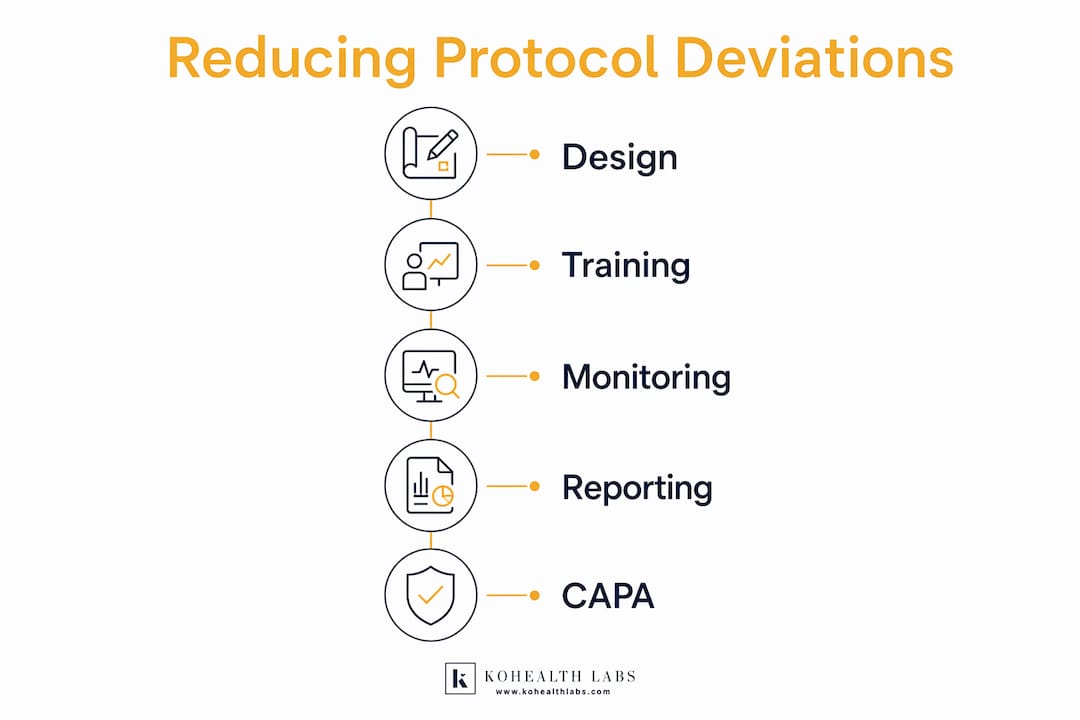
Operational compliance depends on converting the protocol from a static document into a set of working tools. Effective deviation management includes translating protocols into visit checklists, consent version controls, and window trackers that integrate into daily site workflows.
Site training is the foundation. Structured training combined with peer mentorship improves protocol adherence and promotes compliance with Good Clinical Practice guidelines. In one published study, educating 31 clinical research nurses on monitor integration (MI) technology led to high adoption rates and measurable reductions in documentation errors. Training that includes real case examples of past deviations from similar protocols is consistently more effective than generic Good Clinical Practice refreshers.

Centralized monitoring with AI support adds a second layer of protection. Clinical teams are transitioning from reactive deviation correction to proactive quality management using centralized monitoring, AI, and machine learning to detect emerging problems. AI tools can flag sites where deviation rates are trending upward before those sites reach a reportable threshold.
Practical tools that improve compliance during execution include:
- Visit checklists tied to each protocol visit type, updated when amendments are issued
- Window tracker dashboards visible to both site coordinators and monitors
- Automated alerts when consent form versions are updated
- Centralized deviation logs accessible to the sponsor in real time
- Structured deviation review meetings at monthly monitoring intervals
Pro Tip: Assign a single point of contact at each site for deviation reporting. Diffuse accountability is one of the most common reasons deviations go undocumented until a monitoring visit.
The combination of monitor integration technology and focused education reduced vital sign protocol deviations from 2.7% to 0.3% across 682 post-intervention visits in a published clinical research unit study. That result demonstrates what structured technology adoption, paired with training, can achieve in practice.
How to investigate and prevent recurring protocol deviations
Corrective and preventive action (CAPA) planning is the formal mechanism for addressing deviations after they occur. The most common mistake in CAPA development is targeting the individual coordinator rather than the system that allowed the error. Effective CAPA must address systemic root causes such as protocol burden, staffing gaps, and workflow design to produce lasting change.
A structured investigation process follows four steps:
- Conduct root cause analysis. Ask why the deviation occurred at least three levels deep. A missed assessment is a symptom. The cause may be an unrealistic visit window, an undertrained coordinator, or a scheduling system that does not flag protocol visits separately from routine clinic appointments.
- Document the impact assessment. Align the impact assessment with FDA guidance on what constitutes an "important" deviation. Assess whether the deviation affected participant safety, primary endpoint data, or the validity of informed consent.
- Develop the CAPA plan with clear ownership. Assign a named responsible person and a verification deadline for each corrective action. CAPA plans without ownership do not get completed.
- Trend deviations by category, phase, and staff role. Trending reveals workflow failures that single-deviation reviews miss. A pattern of consent deviations across multiple sites in the same therapeutic area points to a protocol language problem, not a site-specific training gap.
Teams should also focus on impact rather than classification labels. Instead of debating minor versus major deviations, the focus should be on the actual effect on safety, data integrity, and consent, with clear escalation pathways defined in advance.
Key Takeaways
Reducing protocol deviations requires proactive design, structured training, AI-driven monitoring, and CAPA plans that target systemic causes rather than individual errors.
| Point | Details |
|---|---|
| Design for feasibility first | Use Quality by Design principles and multidisciplinary input to build realistic eligibility criteria and visit windows. |
| Track near-misses actively | Near-miss logs reveal workflow failures before they become reportable deviations. |
| Convert protocols to working tools | Visit checklists, window trackers, and consent controls reduce execution errors at the site level. |
| Use AI for early site detection | AI-driven monitoring can classify deviation outlier sites with high accuracy, enabling targeted intervention. |
| Target systems in CAPA, not people | Root cause analysis must address protocol burden and workflow design, not just coordinator behavior. |
The case for anticipatory quality management
At Kohealth Labs, we have seen firsthand that the teams with the lowest deviation rates are not the ones with the most aggressive monitoring programs. They are the ones that treat protocol design as a quality event, not a drafting exercise. The difference shows up months later in clean data and faster regulatory review.
The shift from reactive correction to anticipatory quality management is real, and it is accelerating. AI tools that flag outlier sites before deviations become reportable are no longer experimental. They are available now, and the teams not using them are operating with a significant blind spot. The simaerep bootstrap algorithm and generative AI validation work published in 2026 across 578 clinical studies makes that point clearly.
What we find most underused is the concept of protocol translation. A protocol is a scientific document. It is not an operational one. Converting it into checklists, trackers, and workflow guides is not administrative overhead. It is the single most practical step a site can take to protect data integrity. The teams that skip this step consistently generate more deviations, not because their staff are less capable, but because the protocol was never made usable.
Near-miss culture is the other undervalued lever. Sites that log and review near-misses monthly catch process failures early. Sites that only report formal deviations are always one step behind. Building near-miss tracking into site startup documentation costs almost nothing and pays back in cleaner data and fewer regulatory queries.
— Kohealth Labs
How Kohealth Labs supports clinical trial compliance
Kohealth Labs integrates laboratory diagnostics, radiology, and AI-powered data analysis into a single contract model for CROs, sponsors, and government agencies. That integration directly supports protocol adherence in research by delivering analysis-ready data bundles that reduce the documentation complexity associated with managing multiple vendors.
The Kohealth Labs data AI platform applies machine learning across more than 100 biomarkers to identify data quality issues and flag deviations early. Sponsors get faster turnaround, cleaner data, and a compliance-ready audit trail without coordinating across separate lab and imaging vendors. If you want to see how integrated diagnostics can reduce protocol risk in your next trial, visit Kohealth Labs to learn more.
FAQ
What is a protocol deviation in clinical trials?
A protocol deviation is any departure from the approved study protocol. The FDA classifies "important" deviations as those that may significantly affect participant safety or study data integrity.
What are the most common causes of protocol deviations?
The most common causes are systemic design flaws such as high protocol burden, unrealistic visit windows, and insufficient site staffing, rather than individual coordinator errors.
How does AI help reduce protocol deviations?
AI-driven monitoring tools can classify deviation outlier sites with high accuracy across large trial networks, enabling sponsors to direct corrective resources before deviations become reportable.
What is a Quality Tolerance Limit in clinical trials?
A Quality Tolerance Limit (QTL) is a predefined threshold set during protocol development. Crossing a QTL signals a systemic problem requiring investigation and corrective action.
What should a CAPA plan include for protocol deviations?
A CAPA plan must include a root cause analysis targeting systemic failures, an impact assessment aligned with FDA guidance, named responsible owners, and a verification deadline for each corrective action.