
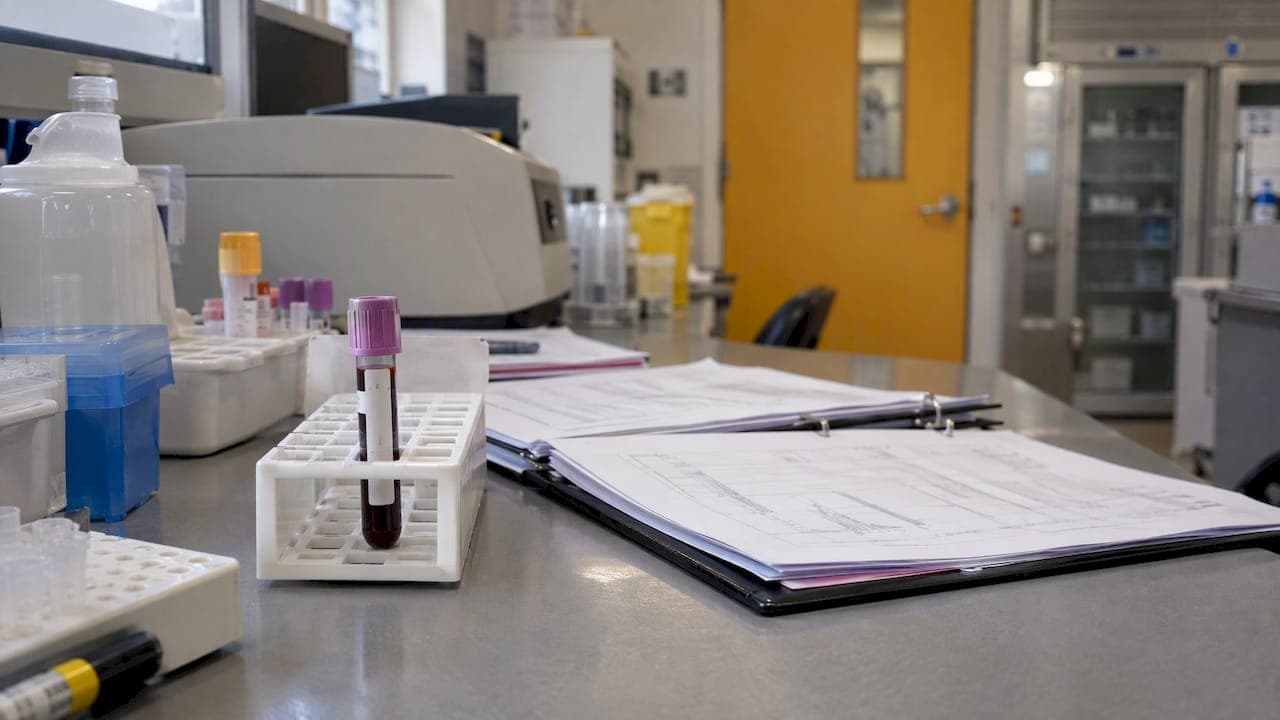
Lab data lineage is the documented path of a result: where the specimen and data came from, every system and step that touched them, and where the finished report went. If you can open a result and answer who collected it, which instrument ran it, what was changed and why, and which report version you are holding, you have lineage. If you cannot, an audit, a sponsor query or a corrected report can turn into days of detective work.
This guide is for practice managers, lab directors, clinic physicians and clinical operations teams. It explains what lineage records, how it differs from chain of custody and provenance, which U.S. rules touch it, and how to build it without a large data-engineering project.
TL;DR
- Data lineage is the history of a data element: its origin, its processing and where it now sits, as NIST's glossary describes it.
- In a lab, lineage links specimen collection, instrument results, LIS and EHR transfers, edits and final reports in one traceable record.
- Chain of custody follows the physical specimen. Lineage follows the data. You need both to pass an audit.
- Start small: pick your highest-volume tests, capture a handful of fields at every handoff, and verify the trail on a pilot batch.
- Lineage is what makes error tracing, sponsor questions and inspections quick instead of painful.
What lab data lineage actually traces
In general data management, lineage is a map of a data asset's life cycle, showing where it originated, how it moved and transformed, and where it resides now. ISACA's description is a visual representation of an organization's data from its original source to its final destination.
In a diagnostic lab, that general idea becomes concrete. A single potassium result passes through several hands and systems:
- The order is placed in an EHR or telehealth platform.
- A phlebotomist collects the specimen and labels it.
- A courier moves it to the lab.
- The specimen is accessioned, processed and run on an analyzer.
- The instrument result is verified, sometimes flagged or amended.
- The LIS sends the report to the provider portal or EHR, often with coded values.
- The result may be exported into a trial database or a government report.
Lineage is the record that ties those seven steps together. ISACA notes that lineage metadata can capture users, systems, processes and dependencies, business rules and scripts, and timestamps for when data are changed, created, deleted, added and processed. It can also record data location, owner, steward, format and retention policy.
Clinical laboratory literature adds detail that is specific to testing. The total testing process generates sample handling conditions, calibration curves and technical validation rules, not just the number on the report. Those are the context a reviewer needs to believe the number.
A report has its own lineage
The report itself is a data object with a history. A peer-reviewed clinical-reporting study describes report lineage that can include sample metadata, report versions, timestamps, signatures and links to prior reports, so a user can verify authenticity and tell whether a report is current. That matters the first time a corrected report goes out and a provider wants to know which version their treatment decision used.
Lineage, provenance and chain of custody: what is different
The three terms overlap, and teams often use them loosely. A working distinction helps when you write procedures.
| Concept | What it follows | Typical question it answers | Typical record |
|---|---|---|---|
| Chain of custody | The physical specimen | Who held this tube, when, and at what condition? | Collection time, handoff signatures, temperature, receipt time |
| Data provenance | The origin and influences on a dataset | Where did this dataset come from and what shaped it? | Source system, collection method, transformations |
| Data lineage | The path of data through systems | Which steps turned the raw instrument output into this reported value? | Transformation steps, system IDs, versions, timestamps |
Researchers note that lineage, pedigree and provenance are sometimes used interchangeably, with provenance metadata describing the events that influenced a dataset and its transformations. The U.S. Office of the National Coordinator for Health IT frames clinical-data provenance as the original source of clinical information plus the processing and transitions it underwent.
The practical point: the physical and digital halves have to connect. A draft ISO technical specification proposes a common provenance chain linking physical and digital objects, which is exactly the gap that appears when custody forms live on paper and results live in an LIS. If you want the specimen side in detail, our guide to five chain of custody fields that make CROs audit ready covers it.
Lineage is not limited to human medicine. Any lab that issues results people rely on faces the same question of which lot, which run and which report. A certificate of analysis for a research compound, for example, is only as useful as its link to a specific lot, and independent peptide sample testing information shows how buyers now look at test data tied to the sample it describes.
Why lineage matters to your practice or study
Faster troubleshooting
Lineage records data sources and transformations, which helps validate accuracy and consistency and trace errors to their root cause. In lab terms, that is the difference between "this result looks wrong" and "this result was mapped from a local test code to the wrong LOINC code on a specific interface date." If your team is cleaning up test codes, see how to map high-volume tests to LOINC first.
Trust from the people reading the report
ONC's view is that identifying the source of clinical information is critical to provider trust when data is aggregated from patients, EHRs, personal health records or health information exchanges. A physician who sees a result from an outside lab, a home draw and an in-house point-of-care device in one chart needs to know which is which.
Audit and inspection readiness
Lineage supports reproducibility, audits and debugging, as AWS puts it in its Life Sciences Lens guidance on lineage metadata. In regulated work, an auditor's first question is rarely about the result. It is about how you know the result is the one that was produced.
Reliable data for AI and analytics
Laboratories are starting to feed their data into AI and machine-learning tools. A 2026 article in the American Journal of Clinical Pathology describes the CARE Data Checklist and Data Lineage, which documents dataset composition, demographics, collection methods, labeling, usage constraints, maintenance and data readiness. Its authors say that working on this early in the AI lifecycle can help laboratories address data-related challenges and improve reliability. If a model is trained on data you cannot trace, you cannot defend its output.
U.S. rules and guidance that touch lineage
No single U.S. regulation is titled "data lineage." Instead, several rules and guidance documents require the records that lineage is made of. Check which ones apply to your setting.
- CLIA record retention. Under 42 CFR 493.1105, laboratories must retain quality control and patient test records, including instrument printouts where applicable, for at least 2 years. The same section requires the ability to retrieve a copy of the original report, including preliminary and corrected reports. Some states and accrediting bodies require longer, so confirm yours.
- FDA audit trails. FDA's 2018 data integrity guidance defines an audit trail as a secure, computer-generated, time-stamped electronic record that allows reconstruction of the course of events around the creation, modification or deletion of an electronic record. It also says audit trails include changes to data and processing parameters, and that reprocessing should be justified.
- ALCOA. For CGMP drug data, the same guidance expects records to be attributable, legible, contemporaneous, original or a true copy, and accurate. We break down the extended version in nine ALCOA+ attributes for lab and imaging data.
- Research integrity. When data from laboratory or clinical studies are questioned, the HHS Office of Research Integrity says sequestered records should include an audit trail from the beginning of the study to its conclusion.
- FDA record basics. FDA's Office of Regulatory Affairs procedure expects records to be identifiable, dated and to show who established them.
The FDA guidance applies directly to CGMP manufacturing, so a clinic is not bound by it in the same way. But it is a clear, widely used description of what a defensible audit trail looks like, and sponsors running trials often hold their vendors to it. For the practical side, see our posts on proving the reason for change in audit trails and audit trail compliance for U.S. labs.
What to capture at each step
You do not need to record everything. You need to record enough to reconstruct the path. A useful minimum for most clinics, trial sites and CROs:
At order and collection
- Order ID, ordering provider, ordering system
- Patient or subject identifier and the protocol or visit, if a study
- Collection date and time, collector, collection method
In transit and at receipt
- Courier handoff times and temperature conditions
- Accession time, receiving technician, specimen condition
On the analyzer
- Instrument ID, method, reagent lot, calibration and QC status
- Raw result, units, flags and reference range at time of testing
On verification and release
- Who verified or released, and when
- Any edit: old value, new value, who, when, and the reason for change
- Report version and link to the prior version
On delivery and reuse
- Destination system (portal, EHR, trial database, public-health feed)
- Code set and mapping version, such as the LOINC code used
- Any transformation applied, with software version and parameters
AWS recommends lifecycle metadata that identifies whether data is raw, filtered, processed or analyzed, along with transformation steps, software versions and parameter settings. That raw-versus-processed label is simple and catches many problems on its own. A peer-reviewed guide to managing laboratory information adds that linking protocol versions, analytical protocols and the datasets they produce creates the provenance needed for reproducibility.
Where lineage breaks down
Most lineage failures are not technical. They are handoff failures.
- Paper and digital do not meet. Custody lives on a form, results live in the LIS, and nothing links the two IDs.
- Edits without reasons. A value is corrected, the audit trail shows that it changed, but not why.
- Silent remapping. A test code or unit conversion changes in an interface and no one records the date.
- Many systems, no map. In multiplatform environments, point-to-point flows must be mapped from sources through staging, warehouses and analytics tools to destinations, as SAS notes. Few clinics have drawn that map.
- No shared standard. Provenance information is often sparse, incomplete or incoherent, and there is no uniform framework for cross-organization documentation.
The last point is why your choice of laboratory partner matters. If your lab and your EHR record the same event in different ways, lineage has to be stitched together by hand.
How to start without a big project
- Draw the current path. Pick one high-volume test and sketch every system it passes through, from order to final report. Mark where a person, not a system, hands it off.
- Assign IDs that survive every handoff. One accession or order ID that appears in the EHR, LIS, courier log and report is worth more than any dashboard.
- Turn on and review audit trails. Confirm edits log old value, new value, user, time and reason.
- Standardize codes. Map the tests you run most before you map the long tail.
- Pilot on a small batch. Trace ten orders from order to report and note every place you had to ask a person. Our walkthrough of CLIA-ready lab data pipeline design uses exactly this ten-order pilot.
- Use standards for exchange. For trials, HL7's FHIR implementation guide gives sites and sponsors a standard for exchanging clinical research laboratory data.
- Document it. Write down who owns lineage records, where they live and how long you keep them.
If you run systems on a cloud platform, tooling can help. Google Cloud's Data Lineage API, for example, records processes, runs and data-movement events. Tools only record what you feed them, though, so the IDs and handoff rules come first.
Our perspective: lineage is a service feature, not paperwork
We run a diagnostic laboratory that supports physicians, practices, skilled nursing and home health organizations, and clinical research sponsors and CROs. What we hear from them is consistent: nobody asks about lineage until a result is questioned, and then they want the answer in minutes.

So we treat the trail as part of the deliverable. Specimen pickup, phlebotomy, testing, electronic reporting and LIS or EHR integration are parts of one workflow for us, which means the IDs and timestamps that connect them are designed in rather than reconstructed later. For research partners, we focus on regulatory-aligned data delivery and analysis-ready data, so a sponsor can follow a value back to its specimen.
Our view is that a lab partner should be able to show you its trail on request, in plain language, without a week of emails. When you evaluate any lab, ask to see a corrected report and the record behind the correction. The answer tells you more than a brochure.
— Kohealth Labs
Lineage-ready lab support from KoHealth Labs
If you are choosing or reconsidering a laboratory partner, we can walk you through how orders, courier pickup, results and integrations connect for your setting. Practices can see how onboarding works, and sponsors and CROs can review our clinical trial laboratory services.
We can serve as your primary lab or as an additional resource for specialized testing. Tell us which systems you use and we will map where lineage is strongest and where it needs work.
FAQ
What is the difference between data lineage and an audit trail?
An audit trail records changes to a single record: who created, modified or deleted it, and when. Lineage is wider. It shows how data moved between systems and what transformations it went through. An audit trail is one of the inputs to lineage.
Do small clinics need data lineage?
Yes, in a simple form. You do not need specialized software. You need consistent IDs, logged edits with reasons, and a documented path from order to report. That is enough to answer most questions from providers, payers or inspectors.
How long should we keep lineage records?
CLIA requires patient test records and quality control records to be kept for at least 2 years, and original reports must be retrievable for the same period. State law, accreditation programs and study sponsors may require more, so use the longest requirement that applies to you.
How does lineage help clinical trials?
Sponsors and CROs need to show that each value in an analysis dataset came from a specific specimen, was tested under known conditions and was changed only for documented reasons. Lineage makes that traceable, and standards such as FHIR make exchange between sites and sponsors consistent.
Sources
- Lineage, NIST CSRC Glossary
- What is data lineage? Google Cloud
- Data Lineage and Compliance, ISACA Journal
- Data flow in clinical laboratories, De Gruyter
- ARBoR: an identity and security solution for clinical reports
- Data Provenance in Health Care, JMIR
- Patient-Generated Health Data and Health IT, ONC
- Towards a common standard for data and specimen provenance
- What Is Data Lineage? IBM
- LSREL07-BP04 Track data lineage with lifecycle metadata, AWS
- CARE framework for AI dataset documentation, AJCP
- 42 CFR 493.1105 Retention requirements
- FDA Guidance for Industry, Data Integrity and Compliance With CGMP
- ORI Research Records Guidance
- FDA ORA procedure on records
- Data lineage: Making artificial intelligence smarter, SAS
- Ten simple rules for managing laboratory information
- Clinical Research Sponsor Laboratory Semantics in FHIR
- About data lineage, Google Cloud
- Peptide sample testing information
For more information about our diagnostic testing, clinical research laboratory services, or partnership opportunities, visit https://kohealthlabs.com or contact KoHealth Labs at (469) 792-8439 and ask for Amy Patterson.