
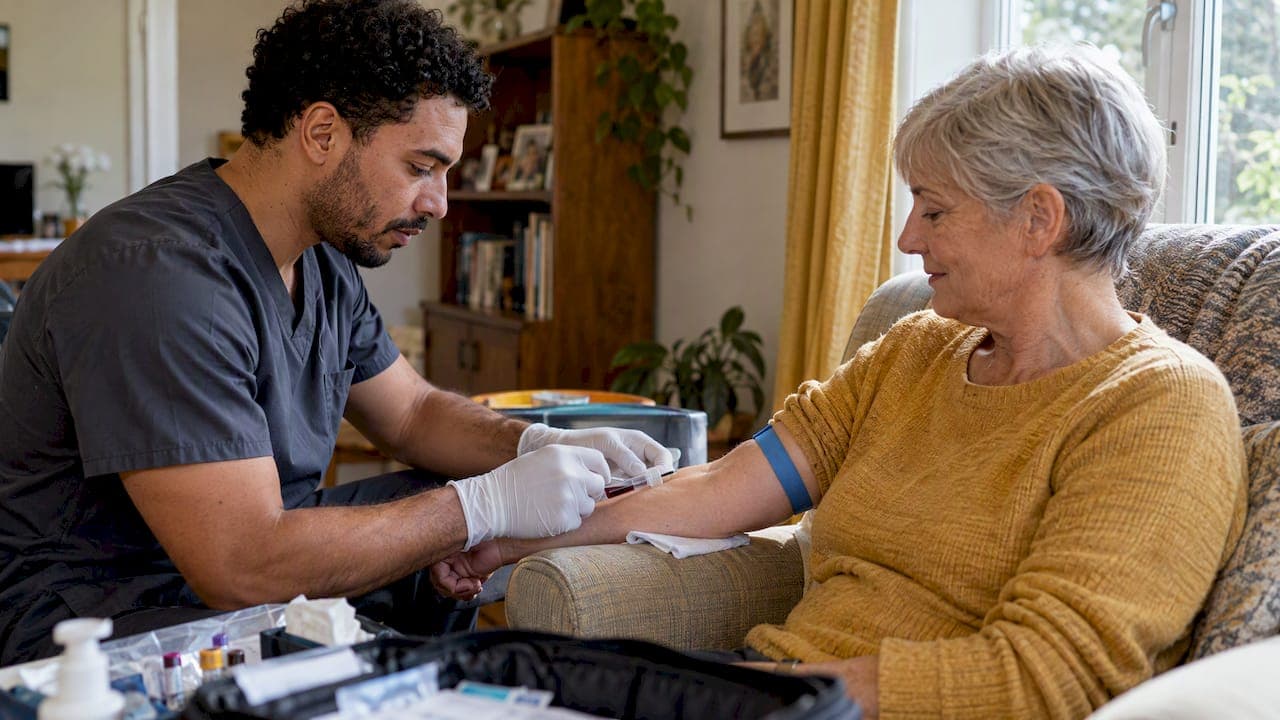
Mobile phlebotomy in a clinical trial means a trained phlebotomist travels to the participant, draws blood at home, work or another agreed location, and sends the specimen to the study laboratory under the same controls as a site visit. It works when the protocol allows it, the person drawing is qualified and supervised under state law, and the specimen path from the draw to the lab is documented from end to end. This guide covers when to use it, what to define before the first visit, how to protect samples, and which U.S. requirements shape the plan.
TL;DR
- Decentralized trial protocols can delegate blood draws to mobile healthcare providers or local phlebotomists, as long as the work stays consistent with the investigational plan and state law (CTTI).
- Define the draw schedule, tubes, processing, packaging, data flow and supervision in the protocol and vendor plan before the first visit.
- Informed consent stays with the investigator or a trained designee. FDA does not consider consent an appropriate task for a local healthcare provider (FDA guidance).
- Sample quality depends on documentation: timing, location, conditions, deviations and chain of custody for every tube.
- Choose a partner that can handle collection, courier pickup, testing and results delivery as one connected workflow.
What mobile phlebotomy means in a trial
In a traditional study, participants travel to a site for every blood draw. Mobile phlebotomy reverses that. The draw comes to the participant, which can matter a great deal for studies with frequent pharmacokinetic timepoints, participants who are frail or live far from a site, or protocols with long follow-up periods.
The Clinical Trials Transformation Initiative (CTTI) notes that decentralized trial protocols may delegate blood draws and biological sampling to mobile healthcare providers or local phlebotomists who travel to the participant. The condition is that study procedures remain consistent with the investigational plan and local state law (CTTI recommendations).
A mobile draw is not a different kind of sample. Safety panels, biomarker analysis and efficacy endpoints all use standard venipuncture. What changes is the setting, and with it the number of places where a tube can go wrong: a warm car, a delayed courier, a missing label.

When it fits and when it does not
Mobile collection tends to fit best when:
- The visit is a blood draw or other simple specimen collection with no need for site-only equipment.
- Participants are older, immunocompromised, in long-term care, or far from the investigative site.
- The protocol has many short visits, such as repeat safety labs between dosing visits.
- Retention is a concern and travel burden is a likely reason for dropout.
It fits less well when a visit combines the draw with an investigational product administration, an imaging session or an assessment that must be performed by the investigator. Those steps stay at the site, and the protocol should say so plainly.
How a mobile collection works, step by step
A published example shows the sequence. At Memorial Sloan Kettering, once providers placed orders, the team partnered with a mobile phlebotomy company to schedule and coordinate home collection. The vendor delivered specimens to an MSK laboratory for processing, and results appeared in the electronic medical record (MSK home phlebotomy study). Adapted to a trial, the workflow looks like this:
- Order and schedule. The study team releases a draw order tied to the visit window. The participant picks a time inside that window.
- Prepare the kit. The phlebotomist receives the protocol-specific kit: correct tubes and anticoagulant, labels with the subject ID, requisition, and packaging.
- Draw and record. The phlebotomist verifies identity, draws, and records the subject or study ID, collection date and time, specimen type and any deviations.
- Process on site if required. Some protocols need centrifugation, light protection or stabilizers before transport. These steps must be written into the lab manual, not left to judgment.
- Pack and ship. The specimen is packed per the protocol and applicable shipping rules, then handed to a courier or shipped to the central lab.
- Receive and test. The lab logs arrival condition and time, tests, and reports results to the study team and sponsor systems.
What to define before the first visit
Most mobile-draw problems are planning problems. CTTI advises that sponsors and sites define which protocol activities suit mobile healthcare providers, the safeguards and training required, how source documents are managed and stored, and how data flows. Only qualified personnel should be delegated, as permitted by the protocol and state law (CTTI).
In practice, a vendor plan should cover:
- Eligible visits. Which timepoints can be mobile and which must be at the site.
- Training and delegation. Who is qualified, who trained them on the protocol, and how delegation is documented.
- Routine care versus trial activity. CTTI suggests the protocol clearly separate "routine care" from "clinical trial-related activities" to avoid ambiguity about participant roles and data origin.
- Tube and processing specifications. The Global Bioanalysis Consortium recommends the protocol or laboratory manual specify blood volume, collection container and anticoagulant, centrifugation parameters, light protection, stabilizers, analyte stability and clear, unique labeling (best-practice recommendations).
- Discrepancy reporting. The same recommendations call for site quality checks and immediate reporting of discrepancies.
- Supervision. Investigators remain responsible for trial conduct and must adequately supervise activities delegated to local healthcare providers (FDA guidance).
The Association of Clinical Research Professionals makes a point worth keeping on the wall: building quality into a decentralized process through proactive compliance is more effective than trying to fix data integrity problems after they occur (ACRP).
For a deeper look at structuring these arrangements, our article for coordinators on three mobile phlebotomy models and FDA-ready SOPs walks through the options.
Protecting specimens collected off-site
A tube drawn in a living room has to be as defensible as one drawn in a clinic. Three habits do most of the work.
Document everything
The FDA's E18 guidance on genomic sampling recommends standardized, documented procedures for collection, processing, transport and storage. It calls for recording timing, method, location and conditions, documenting deviations, and tracking chain of custody at every stage (FDA E18). Although written for genomic samples, the logic applies to any specimen whose integrity a sponsor may need to defend.
A U.S. academic SOP gives a practical minimum: document the subject or study ID, collection date and time, specimen type and protocol information; follow sponsor-defined processing and storage conditions; use PPE; and ship according to the protocol or laboratory manual plus applicable IATA and DOT requirements (LSUHSC SOP 2.11).
Pack for transport
CDC training material describes Category B specimen shipment as triple packaging: a primary tube, leak-absorbent secondary packaging and an outer package, with the required documentation, markings, labels and sealing. It also states that employer-specific SOPs and certification requirements still apply (CDC Pack and Ship). Whoever packs the box at the participant's door needs that training, not just a phlebotomy certificate.

Control temperature and time
Many analytes are sensitive to delay and temperature. Your lab manual should state the stability window, the required temperature range and what happens when either is missed. Our specimen cold chain guide covers the controls in detail, and the assay side is covered in assay validation for clinical trials.
What good performance looks like
The MSK study offers a useful benchmark. Across 1,464 home collection visits for 345 oncology patients in New York, New Jersey, Connecticut and Pennsylvania, among 5,104 samples one clotted, none were hemolyzed, one was unlabeled, and no collection was cancelled because of stability, contamination or other collection problems (MSK study). This was a health-system program, not a trial, but it shows that with disciplined logistics, home collection can produce clean specimens.
Data flow and results delivery
Specimens are half the job. The other half is the record that travels with them. FDA guidance says trial records must capture the visit type, location, date and data originator so that monitoring plans can be followed and source documents reviewed (FDA guidance).
Academic guidance adds that sponsors, CROs and other parties handling decentralized trial data should map and manage data flow, user access controls, reconciliation and storage to support reliability, integrity, control and security (Legal, Regulatory, and Practical Issues paper).
In plain terms, before launch ask:
- Where does the phlebotomist record the draw, and does that record reach the study team the same day?
- How do collection times reconcile with lab receipt times?
- Who can see results, and through which system?
- Can the lab's reporting connect to your EDC, EMR or reporting workflow without manual re-entry?
U.S. consent, privacy and laboratory requirements
The regulatory frame for mobile draws is the same frame as for any trial, with a few points that deserve extra attention.
Consent stays with the investigator. Informed consent must be obtained by the investigator or an appropriately trained designee. FDA does not consider collecting informed consent an appropriate activity for a local healthcare provider (FDA guidance). A mobile phlebotomist should confirm that consent is on file before drawing, and should not be asked to run the consent conversation.
Privacy and federal rules. U.S. decentralized trial considerations include HIPAA and applicable federal and state laws, and CTTI cites FDA regulations including 21 CFR Parts 11, 50, 54, 56, 312 and 812. Operators must also keep up with evolving state-level privacy and security rules (Legal, Regulatory, and Practical Issues paper). Your regulatory lead and IRB decide which of these apply to your protocol.
State law. Phlebotomy scope and licensing differ by state, which is why the protocol language is "as permitted by state law." A multi-state trial needs a state-by-state check of who may draw and under what supervision.
Laboratory certification and materials. The lab that tests the specimen matters as much as the person who draws it. Whether a study needs a CLIA-certified lab depends on how results will be used, and we explain the trade-offs in CLIA for research testing and what lab managers must know about CLIA. If your assays involve reagents sold for laboratory use only, it helps to understand research-use-only materials and FDA approval before your quality team reviews the vendor plan.
How to choose a mobile phlebotomy partner
Use these criteria when you compare vendors, whether a national network, a regional provider or a laboratory with its own collection team.
| Criterion | What to ask |
|---|---|
| Training | Is each phlebotomist trained on the protocol and on Category B packing and shipping? |
| Coverage | Which states and zip codes, and how are state-specific rules handled? |
| Specimen handling | Who processes, packs and transports, and how are temperature and time recorded? |
| Documentation | What is captured at each visit and how fast does it reach the study team? |
| Laboratory link | Does the same partner test the sample, or is there a handoff to a second vendor? |
| Data delivery | Can results flow to your systems, and in what format? |
| Communication | Who answers when a draw is late or a tube is compromised? |
The fewer handoffs between the door and the result, the fewer places for a specimen or a record to be lost. That is the strongest argument for a single partner that handles collection, courier and testing.
Our perspective
Most trial delays we hear about from coordinators are not about the science. They are about logistics: a draw that missed its window, a courier that arrived late, a result that sat in an inbox.
We believe the answer is a laboratory that treats mobile phlebotomy, specimen pickup, testing and reporting as one service. At KoHealth Labs, we offer mobile phlebotomy, courier specimen pickup, molecular and PCR diagnostics, chemistry, electronic results reporting and LIS and EMR integration, so a CRO or sponsor can work with one team rather than coordinating several.
Unlike large national laboratories, where providers may experience lengthy turnaround times and impersonal service, we prioritize direct communication, fast results and solutions customized to each protocol. We think that is what a study team under timeline pressure actually needs.
Kohealth Labs
Work with KoHealth Labs on your next study
KoHealth Labs supports clinical research with laboratory testing, specimen collection and management, biomarker analysis and flexible diagnostic solutions built around study-specific requirements. Our services include mobile phlebotomy, courier specimen pickup, electronic results reporting and regulatory-aligned data delivery.
If you are planning decentralized visits, you can request mobile phlebotomy or see how integrated diagnostics for CROs and pharma fit together with your protocol.
FAQ
Can mobile phlebotomists collect informed consent?
No. Informed consent must be obtained by the investigator or an appropriately trained designee, and FDA does not consider consent collection appropriate for a local healthcare provider. The phlebotomist can confirm consent is documented before the draw, but the consent process itself stays with the study team.
Which trial visits are good candidates for mobile blood draws?
Simple venipuncture visits are the strongest candidates: safety labs, biomarker timepoints and follow-up draws. Visits that combine the draw with investigator-only assessments or product administration generally stay at the site. Your protocol should list which visits may be mobile.
What happens to the specimen after a home draw?
The phlebotomist records the draw details, processes the sample if the lab manual requires it, packs it to the applicable shipping rules and hands it to a courier or ships it to the laboratory. The lab logs its arrival condition, tests it and reports results to the study team. Each step should be documented to maintain chain of custody.
Who is responsible for quality when a vendor does the draw?
The investigator remains responsible for trial conduct and must adequately supervise delegated activities. The vendor owns its training and execution, but oversight cannot be handed off. Define supervision, reporting of deviations and escalation paths in the vendor plan.
Do state laws affect mobile phlebotomy in trials?
Yes. Who may draw blood and under what supervision varies by state, and decentralized trial guidance ties delegation to state law. Multi-state studies need a state-by-state review before launch.
Sources
- CTTI Recommendations: Decentralized Clinical Trials
- The feasibility and acceptability of home phlebotomy (MSK)
- FDA E18 Genomic Sampling and Management of Genomic Data
- CDC: Packing and Shipping Category B
- Sample Management: Recommendation for Best Practices
- LSUHSC SOP 2.11 Research Specimen Management
- FDA guidance: Conducting Clinical Trials With Decentralized Elements
- Legal, Regulatory, and Practical Issues to Consider When Adopting Decentralized Clinical Trials
- ACRP: Decentralized Clinical Trials Perspectives
For more information about our diagnostic testing, clinical research laboratory services, or partnership opportunities, visit https://kohealthlabs.com or contact KoHealth Labs at (469) 792-8439 and ask for Amy Patterson.