

Pharmaceutical communications, in the context of clinical trials, means the secure, regulatory-aligned delivery of laboratory and imaging data from diagnostics partners to sponsors and CROs, packaged so it moves straight into analysis without rework. The recommended model is straightforward: contract one integrated diagnostics partner for labs, radiology, and data, and require standardized, audit-ready formats from day one rather than reconciling vendors after the fact.
Kohealth Labs built its service around this exact model. Two points matter most for procurement teams evaluating it:
- A single-contract structure covering phlebotomy, imaging, and data delivery under one chain of custody and one billing relationship
- AI-driven quality checks that flag deviations across more than 100 biomarkers before they become query backlogs
Key Takeaways
Integrated diagnostics under a single contract, backed by AI-driven quality checks, cuts reconciliation delays and speeds database lock more reliably than sourcing labs and imaging separately.
| Point | Details |
|---|---|
| Choose one contract | Consolidate lab, imaging, and data delivery under a single diagnostics partner to eliminate vendor handoff delays. |
| Demand CDISC and DICOM proof | Require standardized, analysis-ready formats before signing, not promises of future compliance. |
| Verify system validation | Ask for validation plans, test reports, and audit-trail access, not vendor assurances alone. |
| Build in a real start-up window | Plan 6 to 10 weeks for pilot transfers, mapping tests, and site training before first-patient-in. |
| Kohealth Labs delivers the model | Its single-contract structure and AI-driven QC across 100+ biomarkers exemplify the integrated approach this guide recommends. |
What Is Pharmaceutical Communications in Clinical Trials?
Fragmented diagnostics vendors create the single biggest hidden cost in trial operations: reconciliation work. When a lab runs on one data schema and a radiology reader submits DICOM files with inconsistent metadata, someone on the sponsor's data management team has to manually align timestamps, units, and specimen IDs before biostatisticians can touch anything. That work multiplies data queries, delays database lock, and pushes safety signal review further from real time than most sponsors realize.
Integrated pharmaceutical communications, delivered through a single diagnostics partner, cuts that friction at the source. Sponsors evaluating a partner should track a few concrete outcomes:
- Fewer data queries per case report form, since lab and imaging data arrive pre-mapped to a shared schema
- Faster time to database lock, because CDISC-compatible exports need no secondary transformation
- Tighter safety reporting cadence, since deviation detection happens closer to specimen collection or image acquisition
Industry analysis backs the underlying logic here: synthesizing fragmented lab, genomics, and imaging data into unified reports determines whether a trial extracts clinical value from its diagnostics spend, not the raw volume of data collected. Raw throughput without integration just produces more silos to reconcile later.
What Regulatory Standards Govern Trial Diagnostics Data?
Before signing with any diagnostics partner, sponsors need to verify four regulatory baselines are already built into the vendor's workflow, not promised as a future roadmap item.
- Imaging charter documentation. The FDA's Clinical Trial Imaging Endpoint Process Standards guidance recommends sponsors develop a charter describing acquisition protocols, transfer procedures, archiving rules, and image interpretation methods before the first patient is imaged. A partner who can't produce a charter template on request isn't ready for a regulated trial.
- 21 CFR Part 11 controls. Electronic records and signatures need audit trails, access controls, and validated timestamping. This isn't optional documentation. It's the difference between data an inspector accepts and data that triggers a finding.
- CDISC and DICOM conformance. Analysis-ready datasets require CDISC-standard structuring for lab data and DICOM-compliant packaging for imaging. Datasets that arrive outside these formats create the mapping delays that push back statistical analysis.
- ClinicalTrials.gov registration obligations. 42 CFR Part 11 registration and results reporting rules require truthful, electronically submitted trial information in specified formats, which places real constraints on how diagnostics data gets packaged upstream.
Sponsors frequently underestimate how often transfer procedures go undocumented. Insisting on a documented transfer receipt and chain of custody for every imaging transfer substantially lowers the risk that regulators re-evaluate images during inspection.
Regulatory guidance also emphasizes maintaining a verifiable chain of custody for imaging transfers specifically to support audits. That requirement doesn't disappear because a vendor is small or a trial is early-phase.
What Should an Analysis-Ready Data Bundle Include?
Vendor selection breaks down fastest at the technical deliverables stage, when procurement teams accept vague assurances instead of specific artifacts. Here's what to actually demand.
Lab bundle requirements:
- Standardized test codes and units mapped to CDISC structures from the point of collection
- Specimen tracking with full timestamp chains from draw to result
- Reconciliation workflows that catch discrepancies before they reach the sponsor's data management queue
Imaging bundle requirements:
- Complete DICOM sets with series-level metadata intact
- Deidentification logs documenting exactly what was stripped and when
- Reader annotations linked to source images
- Transfer receipts confirming successful, verified delivery
A validated clinical trial imaging management system built to good-practice standards supports deidentification, transfer logging, audit trails, and CDISC-compatible exports as core architecture, not bolt-on features. That same study documents the server and client layers needed to handle large DICOM volumes with API-driven exports, which is the practical bar sponsors should hold vendors to.
| Deliverable | What to verify |
|---|---|
| Lab data mapping | CDISC-standard structure, unit consistency, specimen timestamps |
| Imaging package | DICOM completeness, series metadata, deidentification logs |
| System validation | Documented validation plans, test reports, audit history |
| Data transfer | Encrypted channels (SFTP/TLS), API delivery, transfer receipts |
| EMR/EDC integration | Confirmed field mapping, no manual re-entry required |
Ask for validation evidence directly: a validation plan, test execution reports, and a documented audit trail showing the system has been checked, not just built. Vendors who can't produce these on request usually haven't done computerized system validation at all.
How Does a Single-Contract Diagnostics Model Reduce Delays?

Kohealth Labs runs its clinical trial diagnostics on a single-contract structure that unifies lab and radiology services under one chain of custody, one courier network, and one reporting portal. The operational logic is simple: every vendor handoff is a point where data can get lost, mislabeled, or delayed, and a single contract removes most of those handoffs entirely.
Coordination friction drops in measurable ways when a sponsor works with one partner instead of separately managing a lab, an imaging core lab, and a data integration vendor:
- One onboarding process instead of three, which shortens site activation timelines
- Consolidated courier flows, reducing the specimen transit windows that create chain-of-custody gaps
- A unified portal for both lab and imaging results, so site staff and CRAs check one system instead of toggling between vendor logins
- Simplified billing and governance, with a single point of contract accountability
AI-driven deviation detection adds a second layer of speed. Rather than waiting for a manual data review cycle to catch an out-of-range biomarker or an inconsistent imaging timestamp, AI-driven data quality analytics flag anomalies across more than 100 biomarkers as data arrives. That shortens query resolution windows and gives safety monitoring teams a faster signal path, which matters most in trials with frequent interim safety reviews.
Pro Tip: Ask any diagnostics partner to walk you through their deviation flagging logic before you sign. If they can't explain what triggers a flag and how fast a resolved query gets pushed back into the dataset, the "AI-driven" claim is marketing, not architecture.
What Belongs in the Diagnostics RFP and Contract?
Sponsors and CROs should build these items into every RFP and contract before study start-up, not negotiate them after a partner is already onboarded.
- Scope and SLA terms. Define single-contract scope explicitly, with turnaround time SLAs, breach remedies, and incident response timelines spelled out in writing.
- Data ownership clauses. Confirm who owns the raw and processed data, and what transfer rights the sponsor retains if the relationship ends mid-trial.
- Technical evidence requirements. Demand CDISC mapping documentation, DICOM packaging specifications, deidentification validation records, and direct audit-trail access, not summaries of them.
- Onboarding milestones. Require site training schedules, pilot data transfers before go-live, courier schedule validation, and clearly assigned escalation roles.
A multicenter trial combining lab and imaging services typically needs 6 to 10 weeks for full start-up validation, covering pilot transfers, mapping tests, and site training before first-patient-in. Build that window into your timeline expectations rather than compressing it under launch pressure.
Why Integrated Diagnostics Beats Vendor-by-Vendor Sourcing
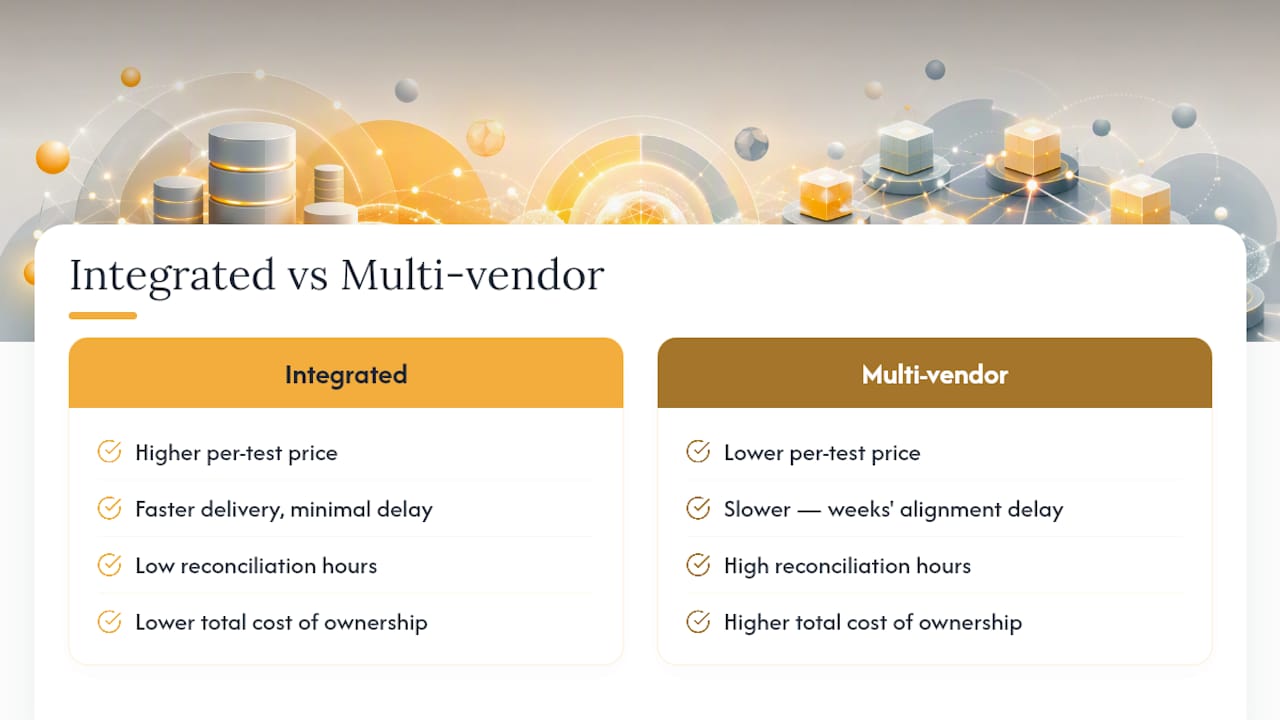
Most procurement guidance on trial diagnostics still treats labs and imaging as separate sourcing decisions, evaluated on price and turnaround in isolation. That approach misses the real cost driver: reconciliation. A cheap lab vendor and a cheap imaging core lab that don't share a data schema will cost more in data manager hours than a single integrated partner charging a premium for unified delivery.
The overlooked variable is timing, not cost. Sponsors chase per-test pricing during RFP negotiations, then absorb weeks of delay at database lock when lab and imaging datasets need manual alignment before biostatisticians can start work. That delay rarely shows up in a procurement scorecard, but it shows up in the trial timeline.
What should sponsors prioritize first? Validation evidence, not vendor promises. Any partner claiming CDISC compliance or AI-driven quality control should produce the documentation: validation plans, test reports, and a working demonstration of deviation flagging. Integrated diagnostics only delivers its speed advantage when the underlying systems are genuinely validated, not marketed as validated.
— Kohealth Labs
Get Analysis-Ready Diagnostics Data Without the Vendor Juggling
Kohealth Labs is built around one idea: sponsors and CROs shouldn't have to manage three vendor relationships to get one clean dataset. The single-contract model covers phlebotomy, courier specimen pickup, radiology, and data delivery under one chain of custody, so the reconciliation work that eats data management hours never has to happen in the first place.
What you get is concrete: analysis-ready lab and imaging bundles mapped to CDISC standards, DICOM-compliant imaging packages with deidentification logs intact, and AI-driven quality checks running across more than 100 biomarkers to catch deviations before they become open queries. Validation documentation, audit-trail access, and EMR/EDC integration come standard, not as an add-on negotiation.
If your trial's next start-up phase involves coordinating labs and radiology across multiple sites, start by reviewing Kohealth Labs' integrated diagnostics solutions and requesting a scope walkthrough for your protocol.
Sources
- Clinical Trial Imaging Endpoint Process Standards guidance — FDA
- A Good Practice–Compliant Clinical Trial Imaging Management System (AiCRO) — JMIR Medical Informatics
- 42 CFR Part 11 — Clinical Trials Registration and Results Information Submission (CFR)
- Chapter on integrating diagnostic data — Springer