
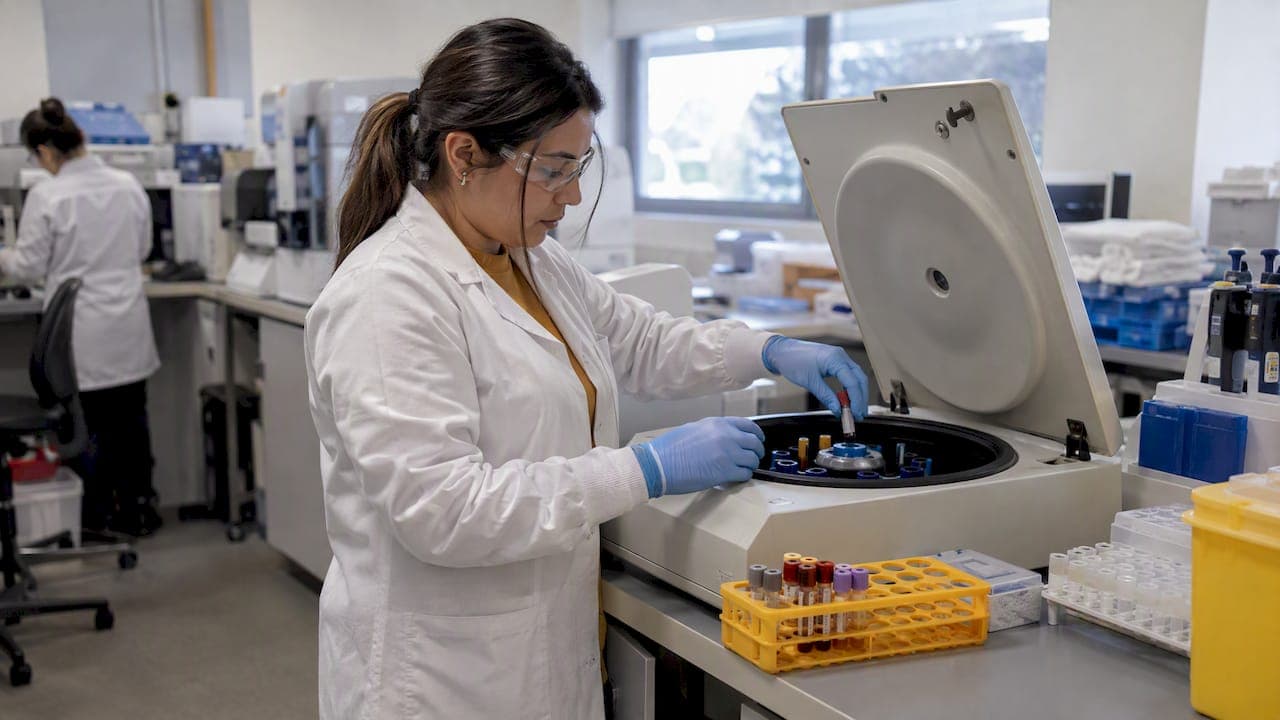
A risk-based monitoring lab is a laboratory that treats its results as a live data stream for oversight, not as a stack of reports filed after the fact. For a CRO or sponsor, that means protocol-specific testing, reliable specimen logistics, fast electronic results, and data that line up across sites so unusual patterns surface early. This guide explains what that looks like in practice, how to build laboratory criteria into your monitoring plan, and which questions to put to a lab before you sign.
TL;DR
- Risk-based monitoring (RBM) focuses oversight on the study activities and data most important to participant protection and reliable results. FDA guidance describes it as a quality strategy, and the sponsor stays responsible for oversight.
- Laboratory data are often among the most critical and most analyzable data in a trial, so the lab belongs in the risk assessment from protocol design onward.
- Inconsistent reference ranges, delayed transfers, missing results and poor specimen quality can create false signals or hide real safety trends.
- Ask any prospective lab how it handles thresholds, escalation, data transfer and specimen logistics, not only what tests it offers.
What risk-based monitoring means for a laboratory
RBM replaces uniform, check-everything oversight with oversight proportionate to risk. FDA's question-and-answer guidance, updated in November 2024, lists three core elements: planning the monitoring approach, defining the monitoring plan, and addressing and communicating findings. It applies to investigations of drugs, biologics, devices and combination products.
RBM is not simply fewer site visits. The same FDA guidance expects sponsors to combine methods and to increase oversight when emerging evidence calls for it. A peer-reviewed update on RBM describes the full framework: an initial cross-functional risk assessment, ongoing reassessment, quality-tolerance limits, key risk indicators, centralized monitoring, targeted remote or on-site review, and reduced source-data verification where it is justified.
Where does the laboratory fit? Centralized monitoring can pull together electronic data capture, laboratory results, patient-reported outcomes, diaries, wearable data and site-performance metrics to find anomalies and trigger targeted review. Lab results are objective, timestamped and numeric, which makes them some of the best raw material for that analysis. They are also the data most easily distorted by logistics. A lab that understands this is a monitoring partner, not just a testing vendor.
Why lab data matter so much to monitoring
Three reasons stand out.
- Safety signals live in lab values. Liver enzymes, renal function, blood counts and infection markers often define eligibility, dose adjustment and stopping rules. Delays in lab data are delays in seeing safety trends.
- Lab data can reveal site problems. A site whose samples repeatedly arrive hemolyzed, mislabeled or out of the stability window is telling you something about its processes.
- They support the shift to forward-looking oversight. The authors of the 2021 RBM review describe the strongest programs as those that use current and accumulating data to detect patterns, rather than relying only on retrospective checks after an error has already affected the study.
The flip side is risk. Inconsistent reference ranges, late transmission, missing results, specimen-quality problems and unlinked laboratory records can produce false signals or bury real ones. The RBM update in PMC is explicit that laboratory specifications and data-transfer checks belong in the monitoring plan.
Build the lab into your risk assessment early
A laboratory partner should be at the table during protocol and risk-assessment design, not added after the protocol is final. The risk assessment is where you decide which laboratory data are critical to safety and efficacy, whether testing will be central or local, how reference ranges will be handled, and which signals trigger escalation.
Decide which lab data are critical
Not every analyte deserves the same attention. Start with the protocol's primary and key secondary endpoints, then the safety parameters tied to dose decisions or stopping criteria. Mark those as critical. Everything else can be monitored with lighter, periodic review. Public-sector guidance on risk-based trial management, such as a health district guidance document from New South Wales, makes the same point: intensity should be proportionate to risks to participant rights, safety and well-being and to critical data integrity.
Define thresholds and escalation rules
A laboratory monitoring plan should state the critical laboratory processes, acceptable data-quality limits, escalation rules, responsibilities and documentation. In practice, write them as numbers and names:
- Percentage of results transmitted within a set window after analysis.
- Share of samples rejected or flagged for quality problems, by site.
- Missing scheduled draws or results per participant visit.
- Who is notified, how fast, and who decides whether to escalate to targeted review or an on-site visit.
The point is to define the trigger before you see the data. When a site crosses a limit, the plan should already say what happens next.
Settle reference ranges and assay validation
If several local labs contribute to one study, each brings its own reference ranges and methods, and your central analytics have to reconcile them. A single central or specialty lab simplifies that. Whichever route you take, confirm that the assays behind safety decisions are validated for clinical use. Labeling matters here: reagents sold for research use only sit in a different regulatory category, as this explainer on why FDA approval does not apply to RUO materials outlines. Keep that distinction written into your lab specifications.
Central monitoring, targeted review and on-site visits: how they fit together
Public-sector guidance stresses that these methods are complementary. Central review reveals patterns across sites. On-site review assesses context and activities that aggregated lab data cannot verify alone, such as source-document checks and protocol or regulatory compliance.
| Method | What it does well | Lab-related example |
|---|---|---|
| Central monitoring | Spots cross-site patterns and outliers early | A rising rate of out-of-range values at one site relative to others |
| Targeted remote review | Investigates a flagged signal without travel | Reviewing collection times and shipment records for one site |
| On-site monitoring | Assesses processes and source documents directly | Checking how samples are processed, stored and labeled at the site |
| Reduced SDV/SDR | Saves effort on low-risk data | Sampling non-critical lab entries instead of verifying every one |
A caution from SAHPRA's monitoring guidance, a South African regulator: RBM should stay dynamic. Findings may call for more training, protocol clarification or more monitoring, and a fixed low-monitoring model is not RBM. This is South African guidance, but the principle matches what FDA expects of US sponsors.
What the regulatory picture looks like in the US
FDA frames monitoring as a quality-control activity. The sponsor must be able to explain why the chosen methods are adequate for the specific risks of the investigation, and FDA permits a variety of monitoring approaches. The agency also publishes a companion document, Oversight of Clinical Investigations: A Risk-Based Approach to Monitoring, which helps sponsors develop monitoring strategies and plans.
The international GCP standard is moving the same way. One summary of ICH E6(R3) says it emphasizes quality by design, critical-to-quality factors and proportionate risk management, and that FDA published its final guidance on E6(R3) in October 2025. Check the current FDA text before you finalize your plan, since requirements can change.
The practical conclusion for lab selection: your lab must be able to produce documentation that supports your rationale. If you cannot show how lab data were collected, transmitted and reviewed, the monitoring plan is hard to defend.
Does RBM actually save effort?
It can, but not automatically. TransCelerate identifies reduced effort, potential cost reductions, a stronger focus on critical processes, earlier issue detection, better protocol compliance and cross-functional collaboration as expected benefit areas. It does not claim a universal cost or time saving for every study, and neither should you. Treat RBM as a way to put attention where it counts. If your lab data arrive late or messy, RBM will cost you more, because analysts spend time cleaning rather than interpreting.
A checklist for choosing a risk-based monitoring lab
For a CRO or sponsor in the United States, the practical requirements are protocol-specific testing capability, dependable specimen logistics, timely electronic results, data that aggregate across sites, documented quality controls, and the ability to support triggered review when trends cross predefined thresholds. Turn those into questions:
- Protocol fit. Can the lab run every analyte in your schedule of assessments, including specialty or molecular tests, or will you need a second vendor?
- Specimen logistics. How are samples collected, picked up and transported? Is there courier pickup, mobile phlebotomy or support for home visits?
- Turnaround and transmission. What are typical turnaround times, and how fast do results reach your data system?
- Data format. Can results arrive in a structured, analysis-ready format with consistent units and reference ranges?
- Integration. Does the lab connect to your EMR, LIS or EDC workflow, and who handles mapping and testing?
- Quality documentation. What controls, audit trails and records can the lab show your quality team?
- Responsiveness. When a site problem appears, who do you call, and how quickly does someone answer?
- Onboarding. What training do sites get on collection, labeling and shipping?
For a closer look at how to write these criteria into a request for proposals, see our guide to RFP must-haves for CROs. If protocol deviations tied to lab handling are your concern, our article on reducing protocol deviations in clinical trials covers the practical side. Our piece on safety lab monitoring windows looks at timing of safety draws.
A worked example: a rising signal at one site
Imagine a multi-site study where a safety analyte is a critical data point. Your plan sets a key risk indicator: if a site's share of out-of-range values is well above the pooled rate for two consecutive review cycles, the study team reviews it.
In month three, one site crosses that line. A central review looks at the lab data first. Are the values truly elevated, or were they run under a different reference range? Were samples delayed in transit, which can affect some analytes? Are results missing for scheduled visits? That targeted look may show a courier gap on Fridays. The fix is logistical: adjust pickup, retrain the site on collection timing. If the review instead shows genuine participant-level changes, the plan escalates to medical review and possibly an on-site visit.
This is a hypothetical illustration, not a client case. It shows why the lab has to supply clean, timestamped, linked data. Without collection time, receipt time and result time on the same record, the first question cannot be answered quickly.

Our perspective
We see the lab as part of the monitoring system, not a box that sits outside it. In our experience working with clinical research organizations and sponsors, the trouble rarely starts with the assay. It starts with the handoffs: a specimen that waits for pickup, a result that reaches the sponsor in a format the data team has to rebuild, a question that sits in a queue.
That is why we focus on the pieces a monitoring plan depends on: specimen pickup and transportation, mobile phlebotomy, electronic results reporting, LIS and EMR integration, and analysis-ready data delivered in a regulatory-aligned form. We also believe in direct communication. When a threshold is crossed, you should be able to reach a person who knows your protocol.
Our advice is simple. Bring your lab in before the protocol is locked, write your thresholds down, and test the data flow with a dry run before the first participant is enrolled.
— Kohealth Labs
How KoHealth Labs supports risk-based monitoring
Our clinical trials laboratory services combine laboratory testing, specimen collection and management, biomarker analysis and data delivery for CROs, pharmaceutical sponsors and research sites. You can see how onboarding and workflow come together on our how it works page, or read about PCR testing for clinical trials if molecular endpoints are part of your protocol. To discuss your monitoring plan and lab requirements, start at KoHealth Labs.
FAQ
What is the difference between RBM and RBQM?
RBM refers to the monitoring of trial conduct and data, such as which sites to visit and which data to verify. RBQM, risk-based quality management, is the wider framework that also includes risk assessment, quality-tolerance limits, key risk indicators and ongoing reassessment, as described in the peer-reviewed RBM update. Many teams use the terms loosely, so define them in your own plan.
Does risk-based monitoring mean no source data verification?
No. It means source data verification and source document review are reduced where justified and focused on critical data. The sponsor still has to explain why the approach fits the study's risks, and it should be ready to increase checking if signals appear.
Can a single central lab simplify RBM?
Often, yes. One lab means one set of methods, reference ranges and data formats, so cross-site comparisons are cleaner. Whether it is the right choice depends on protocol needs, geography and specimen stability, which your risk assessment should weigh.
What does FDA say about risk-based monitoring?
FDA's guidance describes it as a quality-control approach, allows a variety of monitoring methods, and holds the sponsor responsible for oversight. Read the current FDA question-and-answer document for the exact wording, because guidance can be updated.
Sources
- FDA: A Risk-Based Approach to Monitoring of Clinical Investigations, Questions and Answers
- FDA: Oversight of Clinical Investigations, A Risk-Based Approach to Monitoring
- Risk-Based Monitoring in Clinical Trials: 2021 Update (PMC)
- Risk-Based Monitoring in Clinical Trials: Past, Present, and Future (PMC)
- Risk-based Management and Monitoring of Clinical Trials (NSW health district)
- TransCelerate: Benefits of RBM
- SAHPRA: Oversight and Monitoring in Clinical Trials
- ICH E6(R3) Explained
For more information about our diagnostic testing, clinical research laboratory services, or partnership opportunities, visit https://kohealthlabs.com or contact KoHealth Labs at (469) 792-8439 and ask for Amy Patterson.