

For most interventional trials, a single integrated diagnostics provider beats a multivendor approach because it consolidates accountability, shortens reconciliation cycles, and gets you to database lock faster. The exception is when a trial needs a highly specialized assay or geographic coverage a single partner cannot reach, and even then, multivendor only works if your team has strong governance capacity. Providers like KoHealth Labs, built around standards such as CDISC and HL7/FHIR, make the default case clear.
TL;DR:
- Single provider models simplify audit trails, reduce manual reconciliation, and expedite database lock, but require validation of their assay scope and coverage.
- Multivendor setups offer niche testing and regional access but often incur hidden costs like repeated onboarding, duplicated quality controls, and complex coordination efforts.
- Automated reconciliation tools and standardized data formats can cut manual matching time in half, significantly decreasing delays during database lock.
- For high-risk or data-critical diagnostics, centralized control minimizes delays and regulatory issues, while distributed testing is suitable for low-risk or highly specialized needs.
- Contracts should include clear turnaround guarantees, responsibility mapping, audit rights, and penalty clauses to protect against vendor failures and ensure compliance.
Single vs Multivendor Labs: Pros and Cons for Clinical Trials
The trade-offs here are not theoretical. They show up in every audit, every query resolution cycle, and every line item on your budget.
A single integrated diagnostics provider gives you one contract, one set of standard operating procedures, and one courier and logistics chain across sites. That consolidation pays off most visibly in audit response: when an inspector asks for specimen custody records or performance validation data, you're pulling from one system instead of stitching together five. Data arrives as analysis-ready bundles rather than as five separate files needing manual alignment. The downside is real too: you become dependent on one vendor's breadth, and you need to validate upfront that they can actually cover your assay list, not just claim to.
Multivendor arrangements have their own upside. You get best-of-breed technical fit for niche testing, room to negotiate competitive pricing across specialists, and access to local capabilities a single provider might not offer in every region. But multi-vendor models can create hidden operational costs that rarely show up in the initial proposal: repeated onboarding for every new site, duplicated quality control processes, and subcontractor visibility gaps that only surface during an inspection.
Here's how the trade-offs stack up in practice:
- Contracting complexity: one master agreement versus several, each with its own terms and renewal dates.
- Data format: unified, analysis-ready bundles versus multiple raw exports needing manual mapping.
- Audit trail: centralized custody and performance records versus fragmented documentation across vendors.
- Specialized coverage: may require validating a single provider's breadth versus native access to niche specialists.
- Cost structure: predictable bundled pricing versus potentially lower per-service rates offset by coordination overhead.
Neither model is universally cheaper. The question is whether the coordination savings of one model offset the flexibility you give up.
Decision Checklist: How to Choose the Right Model for Your Program
Before you sign anything, run your program through a short risk assessment. This isn't about picking a side. It's about matching the model to what your trial actually needs.
- Map your internal governance capacity. Do you have staff who can own vendor escalation pathways and responsibility mapping across five or six specialist relationships, or does your oversight bandwidth realistically support one primary point of contact?
- Flag safety-critical and primary-endpoint diagnostics. Any test that feeds directly into a primary endpoint or triggers a safety stopping rule belongs under centralized control, not split across vendors with different turnaround times.
- Score each diagnostic need on three axes: complexity of the assay, regulatory risk if results are delayed or inconsistent, and interoperability requirements, including whether the vendor supports API connections to your LIMS and EDC systems.
- Total the real cost drivers, not just the quoted price per sample. That means onboarding FTEs, repeated staff training across vendor portals, and the audit remediation risk if reconciliation fails during an inspection.
- Apply the matrix: centralize anything high-risk or data-critical with a single integrated partner; reserve multivendor sourcing for low-risk, highly specialized, or geographically isolated needs where no single provider can reach.
The insight worth sitting with here: the real question isn't "one vendor or many." It's whether your team has the governance and technical integration to make a multivendor network function as one coordinated system. If the answer is no, the model choice has already been made for you.
Pro Tip: Before your next protocol amendment, run a quick audit of how many separate requisition forms your sites currently juggle. If sites juggle multiple requisition forms per patient visit, this may indicate a reconciliation problem hiding in plain sight.
How Sourcing Choices Affect Timelines, QA, and Cost
Reconciliation is where multivendor models quietly lose the most time. When lab values and imaging results arrive from separate systems with separate formats, someone on your data management team has to manually match them against the EDC before database lock can even begin.
AI matching engines and automated reconciliation pipelines have been shown to significantly reduce reconciliation time, cutting it by about half or more compared to manual matching. That number matters because reconciliation delays are one of the most common reasons database lock slips past its target date.
A few levers make the difference between a fragmented process and a coordinated one:
- AI-powered matching engines that flag discrepancies before they become queries.
- Central discrepancy dashboards giving your team one view across all diagnostic streams.
- CDASH and SDTM mapping that standardizes how data enters your systems regardless of source.
- HL7/FHIR APIs that let lab and imaging data flow directly into EDC and LIMS platforms without manual re-entry.
Sites feel this too. Research staff managing multiple vendor-specific kits and requisition processes face higher error risk and time burden than sites working with a single integrated workflow. Fewer kits, fewer portals, fewer chances for a mislabeled sample.
The cost picture is often misread. A lower per-sample fee from a specialist vendor looks attractive until you add the hidden oversight FTEs needed to manage five separate relationships, plus the onboarding time repeated at every new site activation.
Regulatory and Quality Factors in the Sourcing Decision
Diagnostics used in a clinical trial can carry regulatory weight beyond the trial protocol itself. In multinational studies, the EU IVDR framework can reclassify an assay used for eligibility or endpoint assessment, triggering performance study requirements that need planning months before first patient enrollment.
Sponsors should expect and require:
- ALCOA+ traceability across every data point, from specimen collection to final report.
- Direct audit access, not access mediated through a prime contractor who may limit visibility into subcontractors.
- Specimen custody records that hold up under inspection, showing chain of custody from courier pickup to lab receipt.
- Performance validation documentation for every assay, especially ones used for enrollment or safety decisions.
A single integrated partner tends to simplify this because sponsor responsibility doesn't disappear through delegation; you still own oversight, but consolidated evidence makes inspection response faster. Contract language should explicitly guarantee audit rights, subcontractor disclosure, performance SLAs, and clear data provenance clauses regardless of which model you choose.
Risk Management and Contingency Planning for Diagnostic Sourcing
Every sourcing model carries a failure mode you need a plan for before it happens, not after.
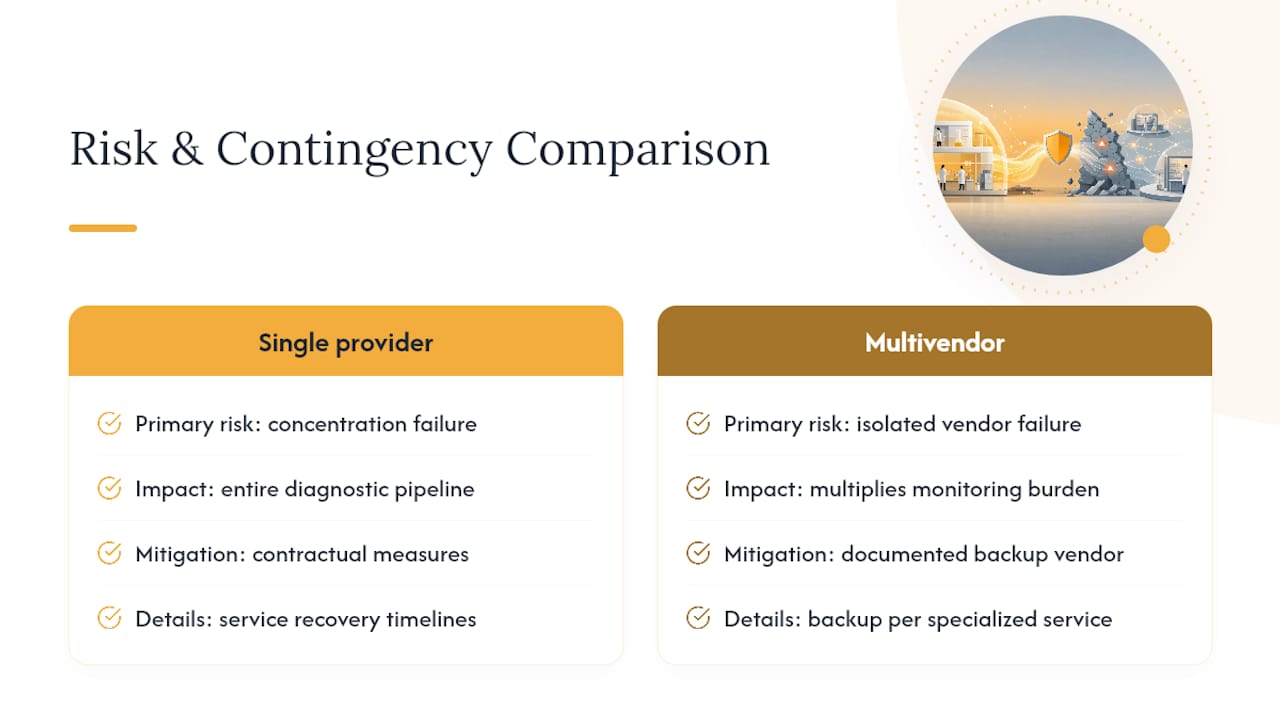
With a single integrated provider, the primary risk is concentration: if that partner has a system outage or a quality issue, it touches your entire diagnostic pipeline at once. The mitigation is contractual, not operational. Build in defined service recovery timelines, data backup protocols, and a clear escalation path with named contacts on both sides. Ask what happens to sample chain of custody and turnaround guarantees if a regional lab within the network goes offline.
With a multivendor model, the risk is different: a single vendor's failure might only touch one data stream, but you're managing that risk across every relationship simultaneously, which multiplies your monitoring burden. Contingency planning here means having a documented backup vendor for each specialized service, not discovering the gap when the primary vendor misses a deadline.
Both models benefit from a pre-trial risk registry that scores each diagnostic dependency by likelihood of disruption and impact on your primary endpoint. Update it at each interim analysis, not just at study startup. And build your data query escalation thresholds into the protocol itself: if unresolved discrepancies cross a set percentage, that should trigger an automatic review, not wait for someone to notice at the next monitoring visit.
Coordination Protocols Between Sponsors, Sites, and Diagnostic Partners
Communication breakdowns cause more trial delays than most sponsors want to admit, and the sourcing model you choose determines how many communication channels you're managing.
A single integrated provider gives you one primary point of contact for status updates, one escalation ladder, and one set of standard reports flowing to your data management team. That doesn't mean communication becomes an afterthought. You still need a documented protocol specifying who gets notified when a specimen fails quality control, and how fast.
Multivendor models need something more deliberate: a coordination matrix mapping which vendor communicates with which site coordinator, and a shared status dashboard everyone can see, so no single vendor's delay becomes invisible to the rest of the team. Weekly cross-vendor calls sound excessive until you've lived through a database lock delayed by a specimen tracking mismatch nobody flagged for three weeks.
Whichever model you run, put escalation triggers in writing before the trial starts, not after the first missed deadline. Specify response time expectations for critical queries versus routine ones, and name backup contacts for every primary point of contact. Sites need to know exactly who to call when a courier misses a pickup window, and that answer shouldn't depend on which vendor happens to be reachable that day.
Scalability: Planning for Trial Needs That Change Mid-Study
Trials rarely stay the same shape they started in. Enrollment expands into new regions, protocol amendments add biomarker panels, and phase transitions bring new diagnostic requirements you didn't budget for at study startup.
A single integrated provider tends to absorb these changes more smoothly because the infrastructure, standards mapping, and reporting formats are already in place. Adding a new site or a new panel means extending an existing relationship, not negotiating a new contract with a new vendor and mapping their data format from scratch.
Multivendor models can scale too, but each expansion often means repeating the onboarding process: new SOPs, new training, new interoperability testing between that vendor's systems and your EDC. That's manageable for a small addition. It becomes expensive when a phase 2 to phase 3 transition triples your site count across multiple countries at once.
The practical question to ask during vendor selection: how does this model behave when your trial's scope changes by 50 percent? If the answer involves renegotiating multiple contracts simultaneously, factor that friction into your total cost projection now, not after the amendment lands on your desk.
Contractual and SLA Terms Worth Negotiating Upfront
The contract you sign at trial startup determines how much leverage you have when something goes wrong eighteen months in. A few terms deserve specific attention regardless of which sourcing model you choose.
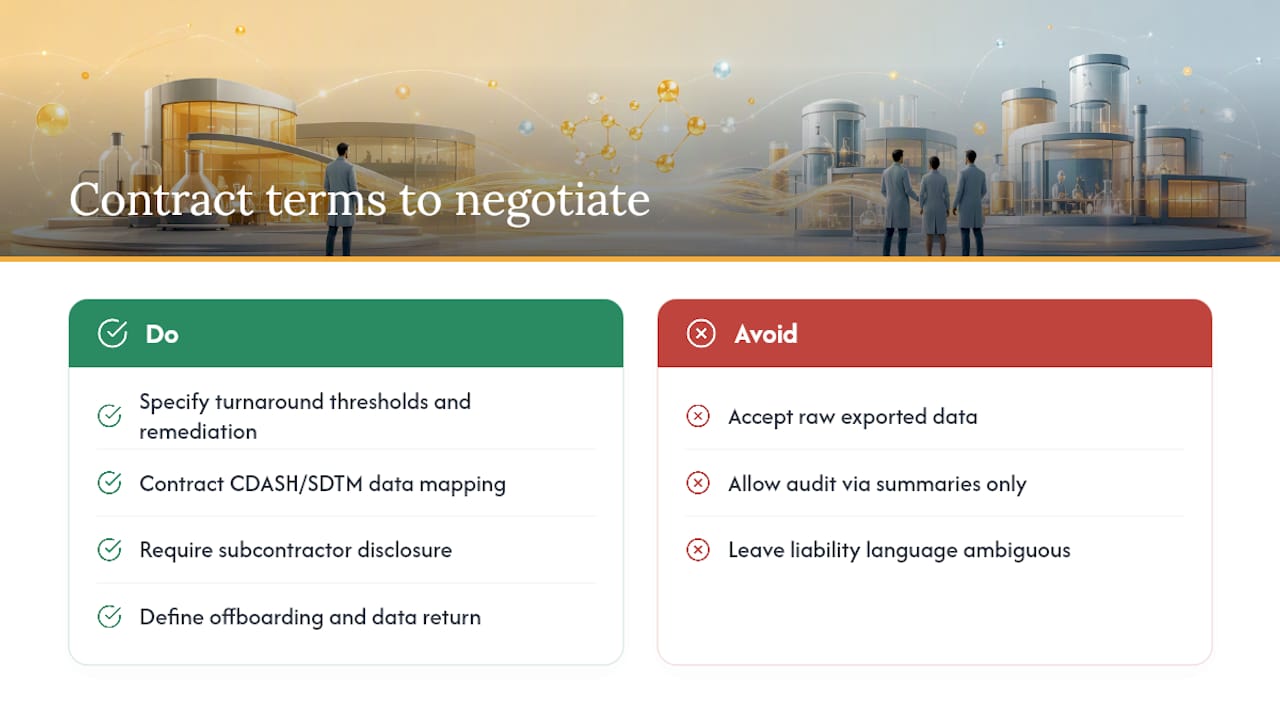
Turnaround time guarantees should specify not just an average but a defined threshold for delayed results and what remediation looks like when that threshold is missed. Data delivery format commitments matter more than they seem: get it in writing that data will arrive mapped to CDASH or SDTM standards, not as a raw export you'll need to reformat internally. Audit access clauses should guarantee direct access to underlying records, not summary reports filtered through a account manager.
For multivendor arrangements specifically, insist on subcontractor disclosure clauses that name every entity handling your specimens or data, plus responsibility mapping that assigns clear ownership when a discrepancy crosses two vendors' systems. Ambiguous liability language is where multivendor contracts most often fail sponsors during an actual inspection.
Negotiate performance penalty structures tied to measurable outcomes: query resolution time, specimen rejection rate, and data delivery timeliness. And always request a defined offboarding process, so a change in vendor relationship doesn't strand your historical data in an inaccessible format.
Case Examples: How Each Model Plays Out in Practice
A multi-site oncology trial running across a dozen countries illustrates the multivendor risk clearly. Each regional lab used its own data format, and the sponsor's data management team spent a disproportionate share of study-startup time building reconciliation logic just to make the numbers align across vendors before database lock could proceed.
Contrast that with a mid-size cardiovascular trial that consolidated laboratory and imaging services under one integrated provider from the outset. Sites reported fewer requisition errors because they were working with one kit system instead of three, and the sponsor's data team spent less time on manual matching, since results arrived pre-mapped to CDISC standards.
The pattern holds across both cases: multivendor complexity scales with geographic and specialty breadth, while single-provider efficiency scales with how well that provider's standards and API integrations actually work. Neither outcome is guaranteed by the model alone. A single provider with weak data standards can underperform a well-governed multivendor network, and a multivendor network with strong responsibility mapping can outperform a poorly integrated single contract. The model sets the starting conditions. Execution determines the outcome.
KoHealth Labs's Perspective: How Integrated Diagnostics Change This Trade-Off
We built our single-contract model specifically because we watched sponsors lose months to reconciliation problems that had nothing to do with the science and everything to do with fragmented vendor coordination. Combining laboratory services with radiology under one agreement means you get analysis-ready data bundles instead of raw files waiting on someone's desk.
Our AI-driven quality checks flag deviations early, which shortens the compliance review cycle before data ever reaches your statisticians. Across our analytics covering more than 100 biomarkers, that early flagging matters more as panels grow more complex.
What we'd push back on is the assumption that multivendor flexibility is free. It's not. It's a governance cost most sponsors underestimate until it shows up in a delayed database lock.
— Kohealth Labs
How Kohealth Labs Can Help You Choose the Right Model
Kohealth Labs is the integrated alternative to piecing together separate lab and imaging vendors for your next trial: one contract, one data pipeline, and AI-cleaned results instead of five mismatched files to reconcile by hand. Our model shows exactly how integrated diagnostics including labs, radiology and data accelerates clinical trials, from specimen pickup through analysis-ready delivery to your EDC.

Our services span pathology and specialty lab testing, imaging, and analytics across more than 100 biomarkers, all delivered under one set of standards your data team already recognizes. If you're weighing your next sourcing decision, request an onboarding plan, ask for our reconciliation metrics, and request audit access before you sign anything. Start by reviewing our integrated diagnostic solutions and get a data delivery SLA in writing before your next protocol amendment lands.