
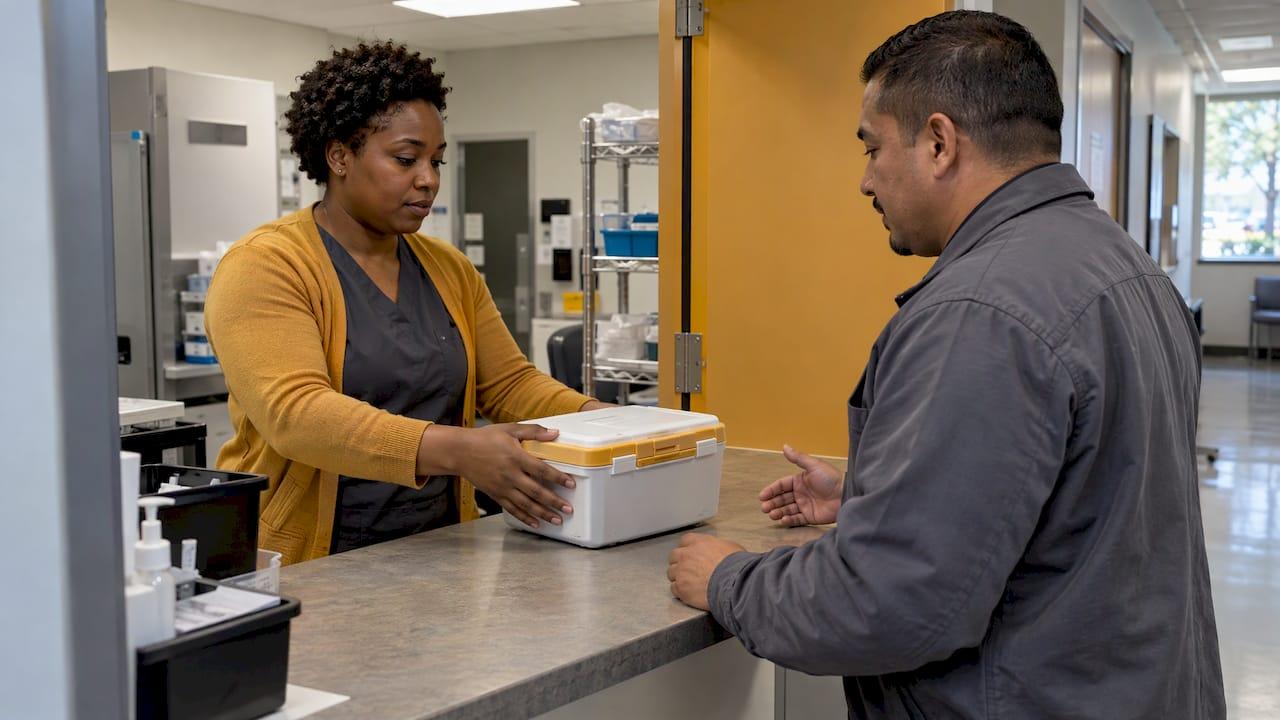
A reliable specimen pickup schedule comes down to five decisions: which days the courier comes, what time window you commit to, what has to be packed and labeled before the driver arrives, who hands the package over, and what you do when a pickup is late or changes. Get those five right and results move on time. Leave one vague and specimens sit at the front desk or miss the lab's receiving window. At KoHealth Labs, courier specimen pickup is part of the laboratory service we provide to practices, facilities and research sites, and the routine below is the one we would hand a new practice manager or study coordinator.
TL;DR
- Settle five things before the first pickup: pickup days, time window, packaging standard, a named person for handoff, and a process for changes and missed pickups.
- Cutoffs matter more than windows. Public courier programs publish a same-day order deadline, and anything submitted after it rolls to the next scheduled day.
- Category B diagnostic specimens follow the federal triple-packaging rule and carry UN3373 marking, and many labs add their own labeling and requisition rules on top.
- Tell the lab how many specimens to expect, and keep a tracking record for every pickup.
- Ask the laboratory to set up pickup, results delivery and ordering integration together so the schedule and the data stay in step.
What a pickup schedule has to settle
Scheduling a specimen pickup looks like a phone call. In practice it is a small operating agreement between your site, a courier and a laboratory. The courier controls the vehicle and the route. The laboratory controls when it receives, accessions and tests the sample. You control the collection time, the packaging and the handoff. A schedule that works fits all three.
The terms below come up in every conversation, so here they are in plain words:
- Scheduled (standing) pickup: the courier visits on fixed days, whether or not you have specimens, or by agreement when you do.
- Will-call pickup: you request a pickup when you have specimens, and the driver adds you to an existing route.
- On-demand (STAT) pickup: a dedicated driver goes to you outside the route, usually for urgent or time-critical samples.
- Category B diagnostic specimen: a patient sample that is known or reasonably believed to contain pathogens, but not in a form that would cause permanent disability or life-threatening disease on exposure. Most routine clinic and trial specimens are shipped under this category.
- Handoff: the moment a trained staff member gives the sealed package to the driver and the pickup is logged.
Colorado's public health laboratory draws the same line in its vendor requirements. It separates on-demand non-scheduled pickups, served by a dedicated driver around the clock, from will-call pickups served on existing routes, and it expects the tracking system to record which service type each pickup was (Colorado Department of Public Health and Environment). Your own laboratory will use its own names, but the same three modes are almost always there.
Step 1: Match pickup frequency to your volume
Start with how many specimens you collect and on which days. A busy primary care practice that draws every morning needs a different cadence from a rural clinic that sends a handful of samples a week or a skilled nursing facility with standing orders on set days.
Public programs show the range. Indiana's state courier program, described in its official FAQ (May 1, 2024), sets pickup frequency from daily to weekly depending on how much a facility submits (Indiana Courier System FAQ). That is a public health program with its own rules, not a universal standard, but the logic transfers: volume drives frequency.
Where it goes wrong: sites pick a frequency for the average week and forget the peaks. Flu season, a screening event, a wound care clinic day or a study visit window can double a day's volume. Schedule for the busy day, then add will-call or on-demand coverage for spikes.
What we do here: our courier pickup service is built around the practice or study, so the pickup pattern is set with you rather than handed down as a fixed route. Bring your collection days and approximate volumes to the first conversation.
Step 2: Learn the cutoffs, not just the windows
A pickup window tells you when the driver arrives. A cutoff tells you whether your request makes today's route at all. Treat the cutoff as the real deadline.
In the Indiana program, same-day orders must be submitted by 10:30 a.m. Eastern, and future pickups can be booked only on the facility's own scheduled pickup days. The courier gives a projected arrival with a one-hour window. Specimens reach the state laboratory the same day before 10 p.m. Eastern, central receiving processes them the next business day before noon, and there are no weekend pickups unless the health department approves a specialty emergency pickup (Indiana Courier System FAQ).
That one program shows what to ask any laboratory or courier:
| Question to settle | Why it matters |
|---|---|
| What is the same-day order cutoff? | Defines the last collection time that still ships today |
| How wide is the arrival window? | Tells you when staff must be ready at the door |
| Which days can you book ahead? | Prevents booking a day the route does not run |
| When does the lab receive and process? | Sets the real clock on stability and turnaround |
| What happens on weekends and holidays? | Decides whether Friday afternoon draws are safe |
Where it goes wrong: a Friday collection that misses the cutoff can sit through a weekend. For unstable specimens, that changes the result or forces a recollection. Build the cutoff into your collection schedule so draws that need same-day transport are done early.
For urgent clinical needs, a pickup schedule is only half the answer. Our guide to clinic workflow for STAT lab orders covers how to handle time-critical orders when routine routes are too slow.
Step 3: Pack and label to the transport rules
The driver can only take what is packed correctly. Federal Department of Transportation rules (49 CFR 173.199) require a triple packaging system for Category B diagnostic samples: a leakproof primary container, a leakproof secondary container, and a rigid outer package. The outer package must show UN3373 and the proper shipping name "Biological Substances, Category B," and it must give the name and phone number of a person responsible for emergency response information, either on the package or in a document such as a bill of lading. A state public health laboratory's packaging guidance dated June 9, 2026 summarizes these requirements (Utah Public Health Laboratory guidance).
The marking details are specific. A university shipping manual (January 2026 edition) specifies for Category B packages the shipper and consignee name, address and phone number, the responsible person's contact, the proper shipping name in lettering at least 6 mm high, and a UN3373 diamond at least 50 mm point to point. When dry ice is used, the package also needs a Class 9 label with UN1845, the words "Dry Ice" and the dry ice weight in kilograms (University of Pennsylvania shipping manual).
Laboratories add their own labeling rules for the specimen itself. Examples from public laboratories:
- Oregon's state laboratory courier handbook requires two unique patient-specific identifiers on each specimen, with a window left clear so the expiration date and contents can be seen (Oregon State Public Health Laboratory).
- Wisconsin's state laboratory asks for at least two identifiers, the specimen source and the collection date and time on each tube, and wants the requisition kept separate from the specimens so it is not contaminated (Wisconsin State Laboratory of Hygiene).
- Utah's guidance puts the test request form in the outer pouch of the biohazard bag, not inside it (Utah Public Health Laboratory guidance).
These are the requirements of those particular laboratories, so use the instructions from the lab you actually send to. The pattern is consistent: identifiers on the tube, requisition protected and separate, a sealed leakproof package, and the right marking outside.
Where it goes wrong: a leaking package. In Indiana's program, drivers will deny pickup of any leaking package, and they monitor specimen temperature with digital thermometers (Indiana Courier System FAQ). A refused pickup at 4 p.m. is a lost day.
Temperature is the other half of packing. Frozen and refrigerated specimens need a plan before the pickup is booked. Our guides on specimen cold chain management and U.S. dry ice shipping rules under UN1845 walk through the details. For a broader look at coolant choices, this comparison of gel packs versus dry ice for lab shipments covers the weight and handling differences.
Step 4: Name who hands off, and what they log
Every pickup needs a person. The Indiana FAQ requires facility staff to be present for the handoff, and it asks sites to use a client portal for order entry with one login per pickup location, with no protected health information in the order and room for special instructions (Indiana Courier System FAQ). Two habits follow from that.
First, keep patient identifiers out of free-text pickup instructions. Put pickup logistics in the courier order and clinical detail on the requisition.
Second, log each handoff. Colorado's vendor requirements list what a good tracking record contains: service type, handler ID, actual and estimated delivery times, pickup and delivery locations, unique sample or batch numbers, a sample description, the requested pickup date and time, and the temperature requirement for each pickup. The estimated-arrival field there must refresh at least every 30 minutes, and the system must record error codes for missing or lost deliveries (Colorado Department of Public Health and Environment).
You do not need a state-grade system, but you do need the same fields in some form: who gave it, who took it, when, how many, and at what temperature.
What we do here: when a practice joins us, we provide dedicated onboarding and training, and our provider portal and EMR integration are there so orders and results sit in the same workflow as the pickup. That means fewer handwritten slips between the exam room and the courier bag.
Facilities that automate other intake tasks can use the same thinking for pickups. This overview of healthcare workflow automation examples shows how scheduled, rule-based steps cut missed handoffs.

Step 5: Tell the lab what is coming
A pickup that arrives unannounced can still be processed, but a pickup the lab expected is processed faster. Utah's public health laboratory network asks facilities to email the number of specimens in each shipment ahead of delivery, because the lab receives samples from many facilities and needs to plan staffing (Utah Public Health Laboratory guidance).
Make advance notice a line on your own checklist: specimen count, specimen types, any frozen or time-critical items, and any special handling. For multi-day shipping through a national carrier, the same guidance tells sites to call the carrier with the return label's tracking number to schedule pickup and never to leave packages in a drop box. Keep the tracking number on file.
Step 6: Plan for changes, cancellations and missed pickups
The schedule will fail on some days. What matters is that your team knows the response before it happens.
- Check status first. In Indiana's system, tracking in the portal updates in real time, and the courier contacts facilities directly if routes change.
- Cancel by phone when required. Indiana orders are canceled by calling the courier's customer service line, which is staffed around the clock (Indiana Courier System FAQ).
- Escalate to on-demand. If a window is missed and the specimen is time-sensitive, request a dedicated pickup rather than waiting for the next route.
- Document the delay. Note the original window, the miss, and the new time. For a clinical trial, that note supports the specimen's chain of custody and any deviation report.
- Review patterns. Two misses in a month is a schedule problem, not bad luck. Change the window or the day.
Where it goes wrong: nobody owns the call. Assign a primary and a backup person at each site, and put the courier and lab numbers where they can be found without a search.
Special case: clinical trial specimens
Research sites carry stricter demands: protocol-defined collection windows, processing steps such as spinning and aliquoting, frozen shipping, and sponsors who want a clean record of every shipment. The schedule should be built backward from the protocol. Take the visit window, the time allowed from collection to processing, the shipping temperature, and the days the receiving lab can accept samples. What is left is the set of days and times a pickup can happen.
Two practical rules help. Do not schedule trial visits on days when the courier cannot pick up, and avoid Friday collections for specimens that cannot wait through the weekend. Our clinical trial specimen pickup guide for sites and sponsors goes through the site and sponsor responsibilities in detail, and our clinical trials laboratory page describes how we support study specimen logistics and regulatory-aligned data delivery.
Questions to settle before you rely on a schedule
Before you commit a clinic or study to a pickup arrangement, get plain answers on these points from the laboratory or courier:
- Hours and days: which days and hours does the route run, and what happens on holidays?
- Service area: is your address on a standard route, or does it need an on-demand charge?
- Fees: is pricing per pickup, per specimen or per mile? In Indiana, the state program was free to participating facilities at the time of the FAQ, and it was charged per pickup, so the price did not change with the number of packages. Other arrangements differ.
- Cutoffs and windows: what is the same-day deadline and the arrival window?
- Escalation: who answers when a pickup is late, and how fast?
- Records: what tracking and chain-of-custody records do you get?
- Integration: do orders, pickups and results connect to your EHR or LIS?
If you are comparing courier arrangements more broadly, our guide on how to choose a medical courier for your lab lays out the criteria.
Our perspective: the schedule is part of the lab service
Practices often treat the courier and the laboratory as two separate vendors. Then a missed window falls between them: the courier points at the lab's cutoff, the lab points at the courier's route, and the specimen waits.
We see pickup as part of the diagnostic service, not a add-on to it. Our service covers specimen pickup and transportation, phlebotomy, results reporting and EMR and LIS integration, so the people who set the schedule are the same people who receive the specimen and report the result.
That is why we put direct communication first. Unlike large national laboratories, where providers may experience lengthy turnaround times and impersonal service, we aim to give you a responsive, flexible partner who adapts the pickup routine to your practice or study rather than the other way around.
Whether you use us as your primary laboratory or as an additional resource for specialized testing, the first step is the same: tell us your collection days, volumes and specimen types, and we build the routine around them.
Kohealth Labs
Set up pickup with KoHealth Labs
KoHealth Labs is a full-service diagnostic laboratory serving physicians, medical practices, skilled nursing and long-term care facilities, home health organizations, and clinical research organizations and sponsors. Our services include courier specimen pickup, mobile phlebotomy, molecular and PCR diagnostics, provider portal access, electronic results reporting and LIS and EMR integration, with onboarding and training for your team. Tell us your pickup days and volumes and we will start there. Visit KoHealth Labs to begin, or use our mobile phlebotomy request page if you also need draws at the patient's location.

FAQ
How far ahead should I schedule a specimen pickup?
For standing routes, set the schedule once and review it each quarter. For same-day requests, work to the laboratory's cutoff. In Indiana's public program, for example, same-day orders are due by 10:30 a.m. Eastern (Indiana Courier System FAQ). Ask your own laboratory for its deadline in writing.
What should I have ready when the driver arrives?
A sealed, leakproof package with the correct marking, labeled specimens with at least two patient identifiers, the requisition kept separate from the specimens, and a staff member to hand it over. Frozen or refrigerated items need the temperature packaging in place before the driver arrives.
Can I cancel or change a pickup?
Usually yes, but the method depends on the courier. In Indiana's program, cancellations are made by phone, while status is tracked in the online portal (Indiana Courier System FAQ). Confirm the method and the deadline for changes when you set up service.
Do pickups happen on weekends?
It depends on the laboratory and courier. Some public programs run no weekend routes without special approval, while others, such as Colorado's vendor requirements, call for pickups seven days a week (Colorado Department of Public Health and Environment). Ask what weekend and holiday coverage you will have before booking Friday collections.
What do I do if a pickup is missed?
Check tracking, call the courier or laboratory, and request an on-demand pickup if the specimen is time-sensitive. Document the delay with the original window and new time. If misses repeat, change the pickup day or window.
Sources
- Indiana Courier System: Frequently Asked Questions (May 1, 2024)
- Colorado Department of Public Health and Environment: Courier information for vendors
- Utah Public Health Laboratory: Packaging and Shipping Guidance (June 9, 2026)
- Oregon State Public Health Laboratory: Courier System Handbook
- University of Pennsylvania: Manual for the Shipment of Biological Products (January 2026)
- Wisconsin State Laboratory of Hygiene: Specimen Collection and Shipping Procedures (October 2025)
For more information about our diagnostic testing, clinical research laboratory services, or partnership opportunities, visit https://kohealthlabs.com or contact KoHealth Labs at (469) 792-8439 and ask for Amy Patterson.