
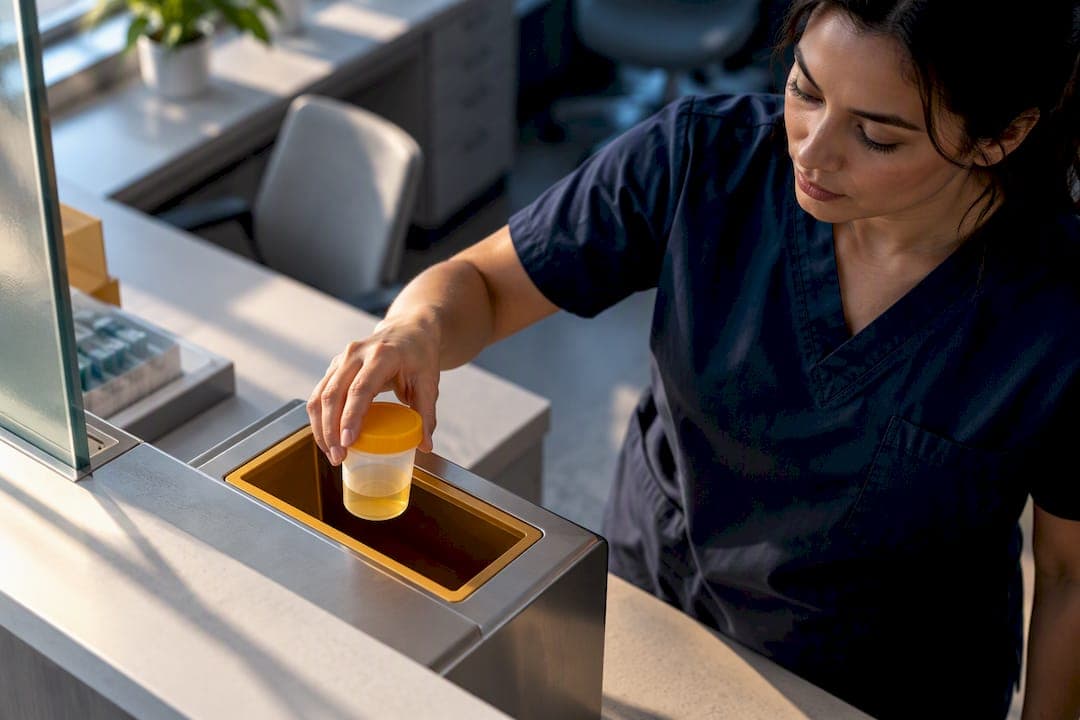
A STAT lab order tells the laboratory that a test result is needed immediately, not on the routine schedule, because a clinical decision depends on it. The single most important action when you place one is to mark the requisition and specimen clearly as "STAT" and arrange expedited transport or activate the priority flag in your EHR. From there, expect common STAT chemistry and hematology results in a window of about 30 to 60 minutes once the specimen reaches the lab, based on College of American Pathologists benchmarking.
TL;DR:
- The median turnaround time for common STAT tests is 30 to 60 minutes from specimen receipt, according to College of American Pathologists benchmarks.
- Proper labeling, including "STAT" and collection details, along with immediate transport, are critical to prevent delays caused by preanalytical errors.
- Choosing between courier or hand-delivery depends on specimen stability, with unstable or complex samples requiring direct hand-delivery for faster processing.
- Ensuring a standardized, pre-approved STAT order workflow and clear communication with the lab prevents delays and maintains prioritization.
- Hospitals should reserve STAT status for true emergencies and follow strict procedures for notification and escalation of critical results.
Quick clinic checklist for placing a STAT lab order
A STAT request moves faster when your team follows the same sequence every time, so ambiguity does not creep in during a busy shift. The steps below reflect how most hospital and reference laboratories expect STAT orders to be structured, drawing on laboratory policy standards for requisition labeling and clinician notification.
- Confirm there is a genuine clinical reason for urgency and note it briefly in the order when your system requires a reason code.
- Enter the order through your CPOE or EHR using the dedicated STAT or Code Labs button rather than a routine order marked urgent after the fact.
- Label both the requisition and the specimen container with the word "STAT," the collection time, and the collector's initials.
- Choose the transport method, hand-delivery or courier pickup, and call ahead so the lab knows a critical specimen is inbound.
- Record who placed the order and confirm the receiving department or accessioning point in the lab.
Skipping any one of these steps is usually what turns a 30-minute STAT into a two-hour wait, not a problem with the lab itself.
Pro Tip: Keep a laminated STAT checklist at every nursing station or intake desk. Staff under pressure follow habits, not memory.

Labeling and specimen handling that prevent STAT delays
Preanalytical mistakes, not the testing itself, cause most STAT delays. A tube with only one identifier, a partially filled draw, or a requisition missing the collection time will bounce back for correction, and that round trip erases whatever time you saved by marking the order STAT in the first place.
- Every label needs two patient identifiers, the word "STAT," the exact collection time, and the collector's initials.
- Match the tube type and minimum volume to the test: a CBC needs a properly filled lavender-top tube, a troponin or basic metabolic panel needs correctly filled chemistry tubes, and an arterial blood gas needs a capped, air-free syringe processed within minutes.
- Double-check labels before the specimen leaves the room; an unlabeled or mislabeled sample is one of the most common reasons a STAT gets rejected and restarted.
- Use cold packs and double-bagging as required for temperature-sensitive analytes, and confirm your pneumatic tube system is rated for the specimen type before sending it that way.
Additional technician workload during high-volume STAT periods can lengthen turnaround if the lab lacks process controls to absorb the surge. Research on STAT laboratory operations found that rising urgent test volumes and added technician tasks measurably extend processing time unless workload is actively monitored.
Choosing between hand-delivery and courier pickup
Not every STAT specimen needs a person walking it to the lab, but some do. Reserve hand-delivery for unstable patients, active code situations, or specimens that are not suitable for a pneumatic tube system, such as certain hematology or coagulation samples that can hemolyze or clot in transit.
- For courier or pickup requests, tell the lab the STAT designation, the exact pickup location, and a callback contact in case of questions.
- If your facility uses pneumatic tubes for STAT samples, follow the manufacturer's speed and padding settings for fragile specimens to avoid hemolysis or breakage.
- Log the pickup time and the lab's receipt time in the EHR or LIS so you have an auditable record if turnaround falls outside the expected window.
- Maintain chain-of-custody notes whenever a specimen changes hands, particularly for legal or research-related draws.
That timestamp discipline matters more than it seems. Without a documented pickup and receipt time, there is no way to tell whether a delay happened at the bedside, in transport, or inside the lab.
What turnaround time to expect and how critical results get escalated
Turnaround time for a STAT order is generally measured from the moment the specimen is received and accessioned in the lab to the moment the verified result posts in the patient record, not from when the order was placed. That distinction matters because a specimen sitting in a pickup queue counts against your clinical decision-making time even though the lab has not started the clock yet.
- A CAP q-probes study of 52 institutions found a median STAT testing rate of 37.0% of total test volume, with many participating labs targeting 30 to 60 minutes for common STAT chemistry and hematology results.
- The Joint Commission's National Patient Safety Goals require laboratories to define what counts as a critical result, specify who must be notified, and set an acceptable timeframe for that notification.
- When a critical value posts, the lab calls the ordering clinician or a covering provider directly rather than relying on the chart alone.
- If the lab cannot reach anyone after a defined number of attempts, it escalates to a charge nurse, supervising physician, or another named backup according to your facility's written escalation policy.
Median STAT test volume across participating labs represented a substantial portion of billable tests, drawn from a large, multi-institutional sample. That scale is why CAP's benchmarking data is often the reference point labs use when setting their own internal TAT targets.
Building an ordering workflow that prevents STAT breakdowns
Most STAT failures trace back to an ordering system that makes the wrong thing easy and the right thing optional. A well-configured CPOE or EHR closes that gap before a specimen is ever drawn.
- Build standardized STAT order panels with a dedicated STAT or Code Labs button so staff never have to manually flag urgency after the fact.
- Make diagnosis, ordering provider, and a direct contact phone number required fields so incomplete orders cannot reach the lab.
- Set up auto-routing for critical-value alerts and require documented read-back when a clinician receives a critical result by phone.
- Agree with your laboratory partner on a defined STAT test list that will be processed without additional lab director approval, since some labs require sign-off for specialty or lower-volume STAT requests.
Getting that STAT list agreed upon in advance, rather than during a crisis, removes one of the most common points of friction between ordering clinicians and lab staff.
When not to call it STAT, and the safeguards that protect patients
STAT status only works if it is reserved for genuine emergencies. When every routine test gets marked STAT out of habit or convenience, the lab loses its ability to prioritize the orders that truly need it, and turnaround slows for everyone, including the patient who actually needs an immediate answer.
- Reserve STAT for results that will change an immediate clinical decision, not for convenience or to skip a queue.
- Confirm two patient identifiers at every step, since Joint Commission guidance identifies wrong-patient errors as a persistent and preventable safety risk.
- Document read-backs for every critical-value phone call and keep a running escalation log for audits.
- Train front-line staff regularly on specimen requirements so preanalytical errors do not undo the time saved by ordering STAT in the first place.
Pro Tip: If your STAT rate creeps well above what your lab reports as typical, audit your ordering habits before you audit your lab's turnaround.
KoHealth Labs' view on what makes STAT workflows work
The clinics that handle STAT orders best are not the ones with the fastest lab alone. They are the ones whose lab partner treats specimen pickup, results delivery, and LIS integration as one connected process rather than three separate handoffs. KoHealth Labs builds its workflow around that principle, offering responsive service and flexible support to physicians who need dependable turnaround without sacrificing accuracy.
— Kohealth Labs
How KoHealth Labs supports your STAT lab orders
When a critical patient can't wait on a routine courier schedule, having a laboratory partner that already understands your STAT workflow matters more than any single feature. Some laboratory partners work with physicians, urgent care centers, and multi-specialty practices to simplify specimen collection, expedite results, and integrate directly with existing EHR or LIS systems, whether as a primary lab or a supplemental partner for faster STAT support.

- Specimen pickup and courier service built around urgent turnaround needs.
- Mobile phlebotomy for practices that need on-site collection without sending patients elsewhere.
- LIS and EHR integration so results post directly into your existing workflow.
- Molecular, chemistry, microbiology, and pathology support alongside digital results delivery.
If your practice needs a laboratory partner that treats STAT orders as a priority rather than an exception, you can schedule a specimen pickup or request mobile phlebotomy to get started.
Sources
The turnaround targets and procedural expectations in this article come from a small set of primary references worth keeping on hand. The CAP q-probes study established the 37.0% median STAT utilization rate and the 30 to 60 minute TAT benchmark cited above. Research on STAT laboratory workload explains how rising test volume and technician tasks can erode turnaround without active process control. The Joint Commission's National Patient Safety Goals set the framework for defining and reporting critical results. Hospital laboratory policy documents the labeling and hand-delivery expectations that most STAT protocols follow.
- Utilization of stat test priority in the clinical laboratory: a College of American Pathologists q-probes study of 52 institutions - PubMed
- National Patient Safety Goals® Effective January 2026 for the Laboratory Program
- Additional technician tasks and turnaround time in the clinical Stat laboratory - PMC
- UTMC laboratory policy on STAT and critical reporting
FAQ
Who is authorized to mark a lab order as STAT?
Any licensed provider with ordering privileges, typically a physician, nurse practitioner, or physician assistant, can mark an order STAT, though CLIA regulations govern who may order nonwaived tests at a given facility. Most facilities also require the CPOE system to log which provider entered the STAT designation for accountability.
How long should a STAT lab result take?
Turnaround runs from specimen receipt at the lab to verified result posting, and common STAT chemistry and hematology tests typically fall in a 30 to 60 minute window based on CAP benchmarking data. Specialty or send-out STAT tests can take longer depending on the assay.
Are there extra fees for ordering a STAT lab test?
Fee structures vary by laboratory and by payer contract, and pricing for STAT services is not something we can state as a fixed figure here. Practices should confirm STAT pricing directly with their laboratory partner before ordering.
What should I do if a STAT result is taking longer than expected?
Call the laboratory's designated contact line and reference the order number, collection time, and pickup time you documented in the EHR or LIS. If the lab cannot give a clear status update, escalate through your facility's defined chain according to the Joint Commission's critical-results reporting requirements.
How are critical lab values reported to clinicians?
Laboratories notify the ordering clinician or an authorized backup by direct phone call, followed by a documented read-back to confirm the value was heard correctly. Joint Commission standards require facilities to define acceptable notification timeframes and to escalate when the first contact attempt fails.