

Telehealth-integrated diagnostics is defined as the combination of telemedicine platforms with clinical diagnostic tools, enabling remote examination, specimen collection, and test interpretation outside traditional care settings. The best examples of telehealth-integrated diagnostics span connected exam devices, AI-powered imaging tools, FDA-cleared at-home collection kits, and validated behavioral instruments. Each category solves a distinct access or accuracy problem. Together, they represent a shift from conversation-only telehealth visits toward exam-enabled encounters that generate real clinical data. Healthcare administrators who understand these categories can make faster, better-informed decisions about which tools belong in their remote care workflows.
1. What are examples of telehealth-integrated diagnostics?
Telehealth-integrated diagnostics covers four main categories: real-time physiological data capture, AI-assisted imaging and screening, at-home specimen collection linked to lab analysis, and standardized remote behavioral assessments. Each category has distinct operational requirements and clinical applications. The examples below represent the most clinically validated and operationally deployed tools available in 2026.
2. Connected exam devices for real-time clinical data
Telehealth diagnostics succeed when encounters capture live clinical signals, not just patient-reported symptoms. Digital stethoscopes with telehealth streaming capability are the clearest example of this principle in practice.
The Eko CORE 500 Digital Stethoscope streams high-fidelity lung and heart sounds securely to remote physicians during home visits. Origin Healthcare deployed this device in its hospital-at-home program, allowing bedside clinicians to transmit auscultation data in real time. Remote physicians hear exactly what the field clinician hears, which removes the diagnostic uncertainty that comes from secondhand verbal descriptions.
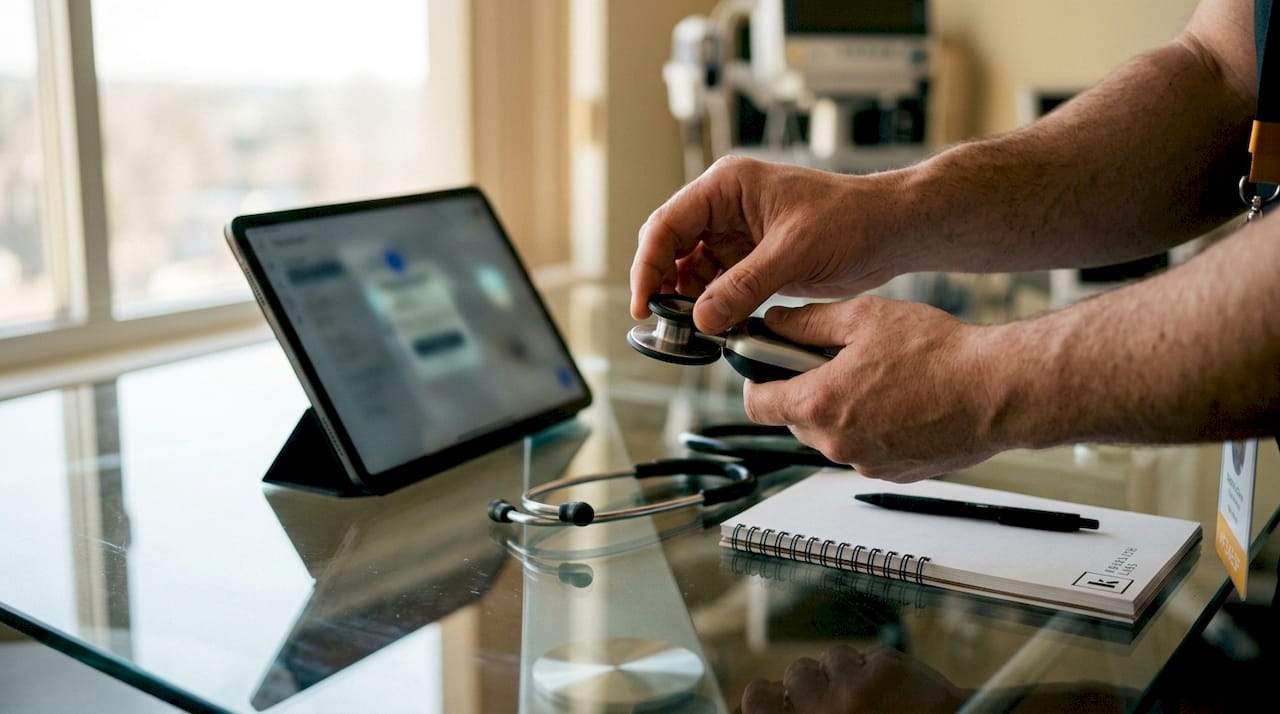
High-fidelity transmission is essential in hospital-at-home care models because diagnostic confidence must match what a bedside evaluation would produce. When it does, teams avoid unnecessary hospital escalations and keep patients in the lower-cost home setting.
Key operational requirements for connected exam devices:
- Secure, low-latency audio or video streaming integrated with the telehealth platform
- Field clinician training on device placement and signal quality
- Clear escalation protocols when remote physicians need confirmatory in-person evaluation
- Technical support coverage during active patient visits
Pro Tip: Map your telehealth platform's audio streaming specifications before purchasing any connected exam device. Incompatible systems create workflow gaps that erode the clinical value of the device.
3. AI-enhanced imaging for infectious disease screening
AI-based imaging tools represent the fastest-growing category of integrated telemedicine tools in 2026. They work as screening and triage aids, not as standalone diagnostic replacements.
The BADI throat camera is a published example of this approach. AI flags high-risk patients for confirmatory antigen testing by integrating throat images, patient demographic data, and deep learning analysis. Clinicians then combine the AI output with symptom history and physical exam findings to reach a final diagnosis. The AI does not replace clinical judgment. It prioritizes which patients need confirmatory testing first, which is operationally valuable in high-volume telehealth settings.
AI-assisted chest X-ray screening for tuberculosis follows a similar model. Apollo TeleHealth uses handheld digital imaging devices in community settings, with AI screening the images and flagging abnormalities. A radiologist then validates the AI output before a final report is issued. Integrated digital workflows linking imaging, AI screening, and radiologist review drive fast turnaround times, with Apollo reporting teleradiology reporting in approximately 2 hours.
Operational considerations for AI imaging tools:
- Define the confirmatory testing pathway before deploying any AI screening tool
- Train clinicians to treat AI outputs as one data point, not a final answer
- Audit AI performance regularly against confirmed diagnoses to catch drift
Pro Tip: AI diagnostic tools in telehealth are deployed as screening aids requiring confirmatory clinical judgment. Build that confirmation step into your protocol from day one, not as an afterthought.
4. At-home sample collection kits linked to lab assays
At-home specimen collection kits connected to certified laboratory processing represent one of the most scalable remote health monitoring solutions available. The end-to-end workflow covers kit delivery, patient self-collection, return shipping, lab processing, and result delivery to the ordering provider.
Waters' Onclarity HPV Self-Collection Kit received FDA clearance for at-home cervical cancer screening. The kit is mailed to the patient's home, covered by insurance, and results guide follow-up care with the ordering provider. This model removes the clinic visit as a prerequisite for cervical cancer screening, which directly addresses access barriers for rural and underserved populations.
FDA 510(k) clearances for at-home infectious disease tests have expanded significantly. Cleared products include the Nano-Check Influenza and COVID-19 Dual Test, the Flowflex Plus RSV, Flu A/B, and COVID home test, and the Fastep COVID-19 Antigen Pen Home Test. Each of these at-home tests represents a telehealth-integrated diagnostic component when results are linked to a clinician review workflow.
| Kit type | Condition tested | Integration model |
|---|---|---|
| Onclarity HPV Self-Collection | Cervical cancer screening | Mail-in, lab-processed, provider follow-up |
| Nano-Check Dual Test | Influenza and COVID-19 | Home use, result linked to telehealth visit |
| Flowflex Plus | RSV, Flu A/B, COVID-19 | Home use, result linked to telehealth visit |
| Fastep Antigen Pen | COVID-19 | Home use, result linked to telehealth visit |
Lab-based at-home diagnostic integrations depend on logistics coordination from kit delivery through lab processing and result return to providers. Without that coordination, results arrive without clinical context and the diagnostic value is lost.
5. Validated behavioral diagnostic tools delivered via video
Standardized behavioral instruments adapted for telehealth delivery are a less-discussed but clinically important category of virtual health assessment examples. The Tele-ASD-PEDS (TAP) instrument is the most validated example in pediatric autism screening.
TAP uses structured caregiver-child interaction scenarios conducted during live video sessions. Clinicians score behaviors using Likert and dichotomous rating scales targeting children 15–36 months with limited verbal skills. The tool produces 92% diagnostic agreement with in-person autism assessments. That level of agreement demonstrates that standardized scoring systems with caregiver-led scenarios preserve diagnostic quality in remote settings.
Newer TAP variants extend coverage to older children with phrased and fluent speech, broadening the tool's clinical reach. Training requirements for both caregivers and clinicians are specific. Caregivers must understand how to position the child and execute the interaction prompts correctly. Clinicians must score consistently across sessions to maintain reliability.
Other behavioral telehealth diagnostic tools in active use include:
- Validated depression and anxiety screening instruments (PHQ-9, GAD-7) delivered via secure patient portal before video visits
- Cognitive screening tools adapted for video administration in older adult populations
- Attention-deficit/hyperactivity disorder rating scales completed by caregivers and teachers, then reviewed during telehealth appointments
6. Integrated workflows combining diagnostics, imaging, and lab testing
The most effective remote care pathways combine multiple diagnostic modalities into a single coordinated workflow. Apollo TeleHealth's tuberculosis screening program is the clearest published case study in telehealth showing this integration in practice.
The Apollo workflow connects handheld digital imaging in community settings, AI-based image screening, radiologist validation, nucleic acid amplification testing (NAAT) for confirmation, and rapid digital reporting. Teleradiology reporting turnaround runs approximately 2 hours. That speed is only possible because each step feeds directly into the next through a shared digital platform.
Remote patient monitoring (RPM) adds another layer to integrated diagnostic workflows. A JMIR assessment of Louisiana Medicare beneficiaries with diabetes or hypertension found that RPM affects healthcare utilization in a predictable pattern: utilization rises initially after RPM initiation, then declines gradually. That pattern means administrators must plan for a short-term increase in diagnostic activity when launching RPM programs.
Pro Tip: Select patients for integrated diagnostic workflows based on clinical risk stratification, not just device availability. High-risk patients generate the clearest return on the investment in connected diagnostics.
Key takeaways
The most effective telehealth-integrated diagnostics combine real-time clinical data capture, AI-assisted screening, lab-linked home collection, and validated behavioral instruments into coordinated workflows that match or approach in-person diagnostic accuracy.
| Point | Details |
|---|---|
| Connected exam devices | Devices like the Eko CORE 500 stream live auscultation data, removing diagnostic uncertainty in home care settings. |
| AI as a screening aid | Tools like BADI and Apollo TeleHealth's TB workflow use AI to flag risk, not to replace clinician judgment. |
| At-home kit logistics | FDA-cleared kits like the Onclarity HPV test require end-to-end logistics coordination to deliver clinical value. |
| Behavioral instrument validation | TAP achieves 92% diagnostic agreement with in-person autism assessments when caregivers and clinicians follow standardized protocols. |
| Utilization planning | RPM programs cause an initial rise in healthcare utilization, so patient selection and workflow planning matter from the start. |
Kohealth Labs' perspective on telehealth diagnostic integration
The field has moved well past the question of whether telehealth can support real diagnostics. The question now is whether your workflow is built to capture the clinical signal those tools produce.
What we observe consistently is that organizations invest in devices or AI tools without mapping the full data pathway first. A digital stethoscope that streams to a platform your remote physicians cannot access in real time is not a diagnostic tool. It is an expensive piece of hardware. The same applies to AI imaging outputs that arrive without a defined confirmatory testing protocol. The technology is ready. The workflow planning often is not.
Behavioral telehealth diagnostics like TAP show what is possible when the protocol is built correctly from the start. The 92% diagnostic agreement figure is not a product of the technology alone. It reflects caregiver training, clinician scoring consistency, and structured session design. That level of rigor is what separates a validated clinical instrument from a video call with a checklist.
For healthcare administrators, the practical priority is this: treat device selection and clinical workflow design as a single project, not two separate decisions. The organizations seeing the strongest outcomes from telehealth-integrated diagnostics are the ones that planned both together.
— Kohealth Labs
Kohealth Labs: integrated diagnostics for telehealth and clinical research
Healthcare administrators building telehealth diagnostic programs need a diagnostics partner who understands both the clinical and operational sides of data delivery.
Kohealth Labs consolidates central laboratory services and radiology under a single contract, providing clinical research organizations, government agencies, and wellness programs with structured, analysis-ready data bundles. With AI-assisted data quality review, over 100 biomarkers, and rapid reporting capabilities, Kohealth Labs supports the kind of integrated diagnostic workflows described throughout this article. If you are building or expanding a telehealth diagnostic program, Kohealth Labs offers the infrastructure to support it without managing multiple vendors. Visit kohealthlabs.com to review the full range of diagnostic services.
FAQ
What is telehealth-integrated diagnostics?
Telehealth-integrated diagnostics is the combination of telemedicine platforms with clinical diagnostic tools, including connected exam devices, AI imaging, at-home specimen kits, and behavioral instruments, to enable remote examination and testing.
How accurate are telehealth behavioral diagnostic tools?
The Tele-ASD-PEDS (TAP) instrument achieves 92% diagnostic agreement with in-person autism assessments when standardized caregiver-led protocols are followed during live video sessions.
Are at-home diagnostic test kits covered by insurance?
The Onclarity HPV Self-Collection Kit, cleared by the FDA for at-home cervical cancer screening, is covered by insurance and results are returned to the ordering provider for follow-up care.
How does AI fit into telehealth diagnostic workflows?
AI tools in telehealth function as screening and triage aids. They flag high-risk patients for confirmatory testing but require clinician review and additional testing before a final diagnosis is made.
What happens to healthcare utilization when remote patient monitoring starts?
Research on Louisiana Medicare beneficiaries shows that RPM programs cause an initial increase in healthcare utilization followed by a gradual decline, which means patient selection and workflow planning are critical from the start.