

Unified diagnostics in clinical research is defined as the integration of multiple diagnostic data streams, including lab tests, imaging, electronic clinical outcome assessments (eCOA), and device data, into one connected trial workflow with a consistent source of truth. This approach eliminates manual data transfers between siloed systems, directly reducing transcription errors and audit gaps. Platforms like OpenClinica and Oracle Clinical One have demonstrated that workflow-level integration changes how trial coordinators and sponsors interact with data daily. For clinical research organizations (CROs) and pharma sponsors, understanding unified diagnostics clinical research explained is the foundation for faster trial completion, stronger data integrity, and defensible regulatory submissions.
What is unified diagnostics in clinical research?
Unified diagnostics is defined as workflow-level integration where consent status, recruitment, enrollment, and diagnostic data flow without manual re-entry, rather than a collection of tools connected by application programming interfaces (APIs). The distinction matters because API connections between separate products create invisible seams. Data can pass between modules but still require manual reconciliation, duplicate entry, or format conversion at each handoff.
True unification means a single shared data model underlies every diagnostic element. Consent status updates automatically trigger eligibility checks. Lab results feed directly into safety monitoring dashboards. Imaging findings attach to the same subject record as eCOA responses. No coordinator manually copies a value from one system to another.

Platforms that bolt APIs together often share a user interface without sharing a data model. That distinction is the difference between a unified platform and a connected suite. OpenClinica describes this as the difference between native workflow design and shared interfaces. The operational impact is significant: sponsors gain real-time dashboard visibility, and coordinators spend less time on data reconciliation.
The benefits of unified diagnostics for clinical research teams include:
- Single source of truth: All diagnostic data lives in one record, reducing version conflicts and query backlogs.
- Reduced manual transfers: Automated data flow cuts transcription errors at every stage.
- Sponsor visibility: Real-time dashboards replace weekly data exports and manual status reports.
- Audit continuity: One event model tracks every data creation, modification, and lock action across the trial lifecycle.
Why is data harmonization critical in unified diagnostics?
Data harmonization is the process of mapping source variables from heterogeneous diagnostic datasets into common standards so that data from multiple sites, instruments, and modalities can be analyzed together. Without harmonization, a unified platform collects data in one place but cannot reliably compare or analyze it. The result is a structurally unified but semantically fragmented dataset.
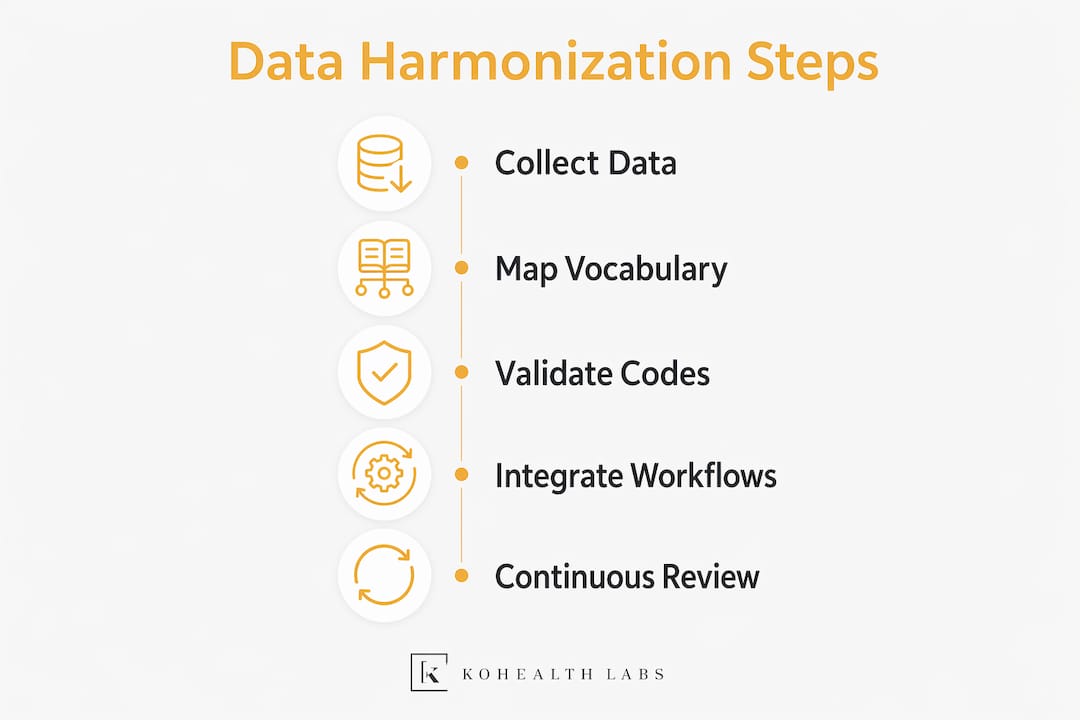
The harmonization process follows a defined sequence. Each step builds on the last, and errors at any stage propagate silently into downstream analyses.
- Variable mapping: Identify source variables across all data streams and map them to a target schema, such as CDISC CDASH or OMOP CDM. This step reveals structural conflicts where the same concept is captured differently across sites.
- Vocabulary mapping: Translate local codes for diagnoses, lab tests, and medications into standard terminologies. SNOMED CT handles clinical concepts. LOINC covers lab and clinical observations. This step is the most labor-intensive in the entire harmonization workflow.
- Semantic conflict resolution: Address cases where two sites use the same code to mean different things, or different codes to mean the same thing. Clinical and terminology expertise is required here, not just IT configuration.
- Structural conflict resolution: Reconcile differences in data types, units of measure, and collection timing across sites and instruments.
- Validation and QA: Run automated checks against the target schema and review exceptions manually. Unresolved exceptions must be documented before data lock.
- Output verification: Confirm that the harmonized dataset produces expected summary statistics and passes pre-specified analysis checks.
Pro Tip: Budget for a dedicated clinical terminologist on every harmonization project. Vocabulary mapping to SNOMED CT and LOINC requires expertise that data engineers alone cannot provide. Errors at this step quietly corrupt downstream analyses without triggering obvious system alerts.
Poor harmonization does not always produce visible errors. A misaligned LOINC code maps the wrong lab test to a biomarker endpoint. The data passes validation because the structure is correct. The analysis runs without errors. The result is wrong. Vocabulary mapping errors represent the highest-risk failure mode in unified diagnostic datasets precisely because they are hard to detect after the fact.
How does diagnostic stewardship elevate unified diagnostics beyond IT?
Clinical diagnostic stewardship is defined by the WHO 2026 practical manual as the practice of ensuring the right diagnostic test is selected, performed at the right time, and interpreted correctly to guide clinical decisions. This is an operational and quality goal, not a software feature. A unified platform can collect data from any test ordered. Stewardship determines whether the right test was ordered in the first place.
"Diagnostic stewardship is a life-saving, capacity-building priority that requires facility-level commitment to quality improvement, not just access to diagnostic technology." — WHO, Strengthening Clinical Diagnostic Stewardship in the Western Pacific Region, 2026
Stewardship integrates into unified diagnostics implementations at the protocol design stage. Test selection criteria, timing windows, and result interpretation thresholds must be specified in the protocol and enforced by the platform's data entry rules. When stewardship is treated as a post-collection quality check, protocol deviations accumulate before anyone notices.
The operational implications for clinical research teams include:
- Protocol-aligned test selection: Diagnostic criteria in the protocol must match the platform's data collection forms exactly.
- Timing enforcement: Collection windows for lab draws and imaging must be system-enforced, not coordinator-dependent.
- Result interpretation rules: Normal range definitions and clinically significant thresholds must be pre-specified and locked before enrollment.
- Antimicrobial resistance (AMR) relevance: The WHO manual specifically identifies stewardship as a tool for fighting AMR, which is directly relevant to infectious disease trials where diagnostic accuracy determines treatment assignment.
Stewardship also has capacity-building implications. Sites that lack trained staff to interpret diagnostic results correctly will produce data that passes technical validation but fails clinical review. Unified diagnostics implementations must include site training plans that address interpretation competency, not just data entry procedures.
What regulatory challenges affect unified diagnostic trials with companion diagnostics?
Combined drug and companion diagnostic (CDx) studies face fragmented regulatory submission pathways because the drug trial and the CDx performance study are filed under separate regulatory frameworks. In the European Union, the drug trial follows the Clinical Trials Regulation (CTR) track. The CDx performance study follows the In Vitro Diagnostic Regulation (IVDR) track. These two tracks have different timelines, different competent authorities, and no integrated approval pathway.
The IVDR track is consistently the slower of the two. IVDR notified body reviews for CDx devices take longer than CTR ethics and competent authority approvals. This means the IVDR approval timeline becomes the critical path for trial enrollment, regardless of how quickly the drug trial receives authorization.
Pro Tip: Treat CDx regulatory readiness as a first-class feasibility dependency. Map the IVDR notified body review timeline before finalizing the trial start date. A drug trial that receives CTR approval on schedule but waits months for CDx authorization loses all the time saved by early preparation.
Operational steps that reduce regulatory delay in combined studies include:
- Parallel protocol development: Write the drug protocol and CDx performance study protocol simultaneously, with aligned endpoints and shared subject populations where permitted.
- Early notified body engagement: Contact the IVDR notified body during protocol development, not after submission. Pre-submission meetings reduce review cycles.
- Unified data management planning: Design the data management plan to accommodate both CTR and IVDR data requirements from the start. Retrofitting a CDx data stream into an existing trial database adds time and risk.
- Regulatory affairs alignment: Assign a single regulatory lead who owns both submission tracks and monitors milestone dependencies between them.
Workflow unification must account for these regulatory realities. A platform that integrates lab and imaging data but cannot accommodate CDx performance data under IVDR requirements creates a gap at the most critical point in the trial.
How do audit trails and multimodal data improve trial data integrity?
Unified audit trail dashboards give sponsors direct visibility into how trial data was created and modified. Oracle Clinical One Analytics provides data operation summaries, evolution trend views, and modification analyses at the form and subject level with dynamic visualization. This replaces the manual process of requesting audit extracts from a data manager and waiting for a static report.
The practical value is speed and specificity. A sponsor can identify which site has the highest rate of data modifications, which forms generate the most queries, and whether modification patterns suggest systematic data quality problems. That level of visibility is only possible when all diagnostic data flows through a single audit model.
Pro Tip: Review audit trail dashboards weekly during active enrollment, not just at data lock. Early detection of modification patterns at a specific site allows you to address training gaps before they affect a significant portion of the dataset.
Multimodal diagnostic data integration adds a second dimension to data integrity: robustness. Multimodal diagnostics combine complementary modalities, such as lab biomarkers, imaging findings, and patient-reported outcomes, to reduce reliance on any single data source. When one modality has missing data or measurement noise, the others compensate.
| Fusion category | Description | Clinical research benefit |
|---|---|---|
| Early fusion | Combine raw data before feature extraction | Maximum information retention across modalities |
| Intermediate fusion | Combine extracted features from each modality | Balances complexity with predictive performance |
| Late fusion | Combine model outputs from each modality | Preserves modality-specific model optimization |
Multimodal frameworks also improve fairness and generalizability. A diagnostic model trained on a single modality may perform well in the trial population but fail in subgroups where that modality is less reliable. Combining modalities reduces this risk and produces findings that hold across broader patient populations.
Key takeaways
Unified diagnostics in clinical research requires workflow-level data integration, rigorous harmonization to standard terminologies, diagnostic stewardship at the protocol level, and synchronized regulatory planning for combined drug and CDx studies.
| Point | Details |
|---|---|
| Workflow integration vs. API connections | True unification requires a shared data model, not just linked interfaces between separate tools. |
| Vocabulary mapping is the highest-risk step | Mapping to SNOMED CT and LOINC requires clinical expertise; errors here corrupt analyses silently. |
| Stewardship is operational, not technical | The right test at the right time must be protocol-enforced, not left to coordinator judgment. |
| IVDR is the critical path in CDx trials | Plan regulatory timelines around the slower IVDR notified body review, not the CTR track. |
| Audit trail dashboards enable proactive oversight | Weekly review of Oracle Clinical One Analytics or equivalent tools catches data quality issues early. |
What we have learned from building unified diagnostic workflows
The most common mistake clinical research teams make is treating unification as an IT project. They connect systems, confirm data passes between them, and declare the platform unified. The audit gaps appear later, during inspection, when auditors ask for a complete event history and find that three separate vendor logs need to be reconciled manually.
A single end-to-end audit and event model is not a feature you add after go-live. It has to be designed into the platform architecture from the start. Every data creation, modification, query, and lock event must write to the same audit record. When you have multiple vendor logs and transformation rules, you have audit gaps. Period.
The second lesson is about harmonization budgets. Teams consistently underestimate the cost of vocabulary mapping. Variable mapping is straightforward. Vocabulary mapping to SNOMED CT and LOINC requires people who understand both clinical concepts and terminology standards. That expertise is rare and expensive. Budget for it explicitly, or the harmonization will be incomplete and the errors will be invisible.
Regulatory alignment for CDx trials surprised us most. The assumption that a unified data platform solves the regulatory coordination problem is wrong. The IVDR and CTR tracks are structurally separate. A unified platform helps you manage the data. It does not synchronize the approval timelines. You need a regulatory strategy that treats CDx readiness as a dependency, not an afterthought.
The teams that get this right start with protocol design, not platform selection. They define the diagnostic endpoints, the stewardship rules, the regulatory tracks, and the harmonization standards before they evaluate any technology. The platform serves the protocol. Not the other way around.
— Kohealth Labs
Kohealth Labs: integrated diagnostics for clinical research teams
Clinical research teams managing multiple diagnostic vendors know the cost of fragmented data. Kohealth Labs integrates central laboratory services, radiology, eCOA, and device data into one connected workflow, delivering structured, analysis-ready data bundles under a single contract.
With over 100 biomarkers and AI-assisted quality checks that identify protocol deviations before they reach the database, Kohealth Labs supports CROs, government agencies, and pharma sponsors across therapeutic areas. The result is faster trial completion, cleaner data, and regulatory submissions that hold up to scrutiny. If your current model splits diagnostics across vendors and reconciles data manually, visit Kohealth Labs to see what a genuinely unified approach looks like.
FAQ
What is unified diagnostics in clinical research?
Unified diagnostics is the integration of lab tests, imaging, eCOA, and device data into one connected trial workflow with a shared data model and no manual re-entry between systems.
How does unified diagnostics differ from standard system integration?
Standard integration connects tools via APIs but keeps separate data models. Unified diagnostics uses native workflow design so all diagnostic data flows through one consistent record from capture to lock.
Why does vocabulary mapping matter in clinical trial data harmonization?
Vocabulary mapping translates local lab and diagnosis codes into standard terminologies like SNOMED CT and LOINC. Errors at this step corrupt downstream analyses without triggering system alerts, making it the highest-risk harmonization step.
What is diagnostic stewardship and why does it apply to clinical trials?
Diagnostic stewardship ensures the right test is selected, timed correctly, and interpreted accurately. The WHO 2026 manual frames it as a facility-level quality priority that directly affects the reliability of trial diagnostic data.
How does the IVDR affect enrollment timelines in companion diagnostic trials?
The IVDR notified body review for CDx devices typically takes longer than CTR authorization for the drug trial. This makes IVDR approval timing the critical path dependency for enrollment start dates in combined studies.