

For weight-loss clinical programs and trials, the right procurement move is an integrated diagnostics partner that supplies bundled lab, imaging, and AI-validated, analysis-ready data under a single contract. That single-contract structure cuts vendor management overhead, shortens data turnaround, and delivers datasets your biostatisticians can use without weeks of manual cleaning. Certain providers build their model around exactly this approach.
TL;DR:
- Bundled diagnostics with standardized data linkage can increase usable research data by up to 573 percent and streamline patient eligibility assessments.
- Contracts should specify scope, technical data standards, service levels, compliance, and billing details to ensure quality and efficiency in integrated diagnostics.
- Proper schema mapping and secure data transfer protocols are crucial for creating analysis-ready datasets that reduce manual reconciliation efforts.
- AI enhances data quality through automated quality control and eligibility screening but requires clear contract thresholds and human oversight.
- Effective onboarding involves phased validation, with pilot testing, validation, and ongoing performance monitoring to prevent delays from schema mismatches.
What Integrated Diagnostics Means for Weight-Loss Clinic Labs
Integrated diagnostics combines laboratory panels, imaging studies, and structured metadata into one coordinated data stream instead of three disconnected vendor outputs. For weight-loss research and clinic operations, that means DICOM imaging files, biomarker results, and analytics arrive linked by study ID rather than sitting in separate systems waiting for someone on your team to reconcile them.
Diagnostic "islands" have been a persistent operational problem in trials. Aggregating imaging, pathology, and lab data lets multidisciplinary teams pull unified insights instead of chasing down results across platforms, according to an international diagnostics working group. The linkage itself has measurable payoff: multilevel queries that connect lab and imaging datasets can increase usable research data by 112% to 573% compared with single-level linkage methods. That is the difference between a dataset your team can analyze on delivery and one that needs another round of manual matching.
For weight-loss endpoints specifically, integration matters because the meaningful signals span modalities:
- Body composition scans (DXA or MRI-based fat quantification) paired with metabolic panels
- Hepatic steatosis imaging cross-referenced against liver enzyme and lipid results
- Metabolic biomarkers (HbA1c, insulin, leptin) mapped against imaging-derived adiposity metrics
When these arrive linked, eligibility assessment moves faster, site query volume drops, and endpoint reliability improves because reviewers aren't reconstructing the patient record from three separate files.
What to Require From a Weight Loss Clinic Labs Partner
Procurement teams evaluating weight loss testing services should treat the contract itself as a quality control mechanism, not just a pricing exercise. A single-contract model only delivers its promised efficiency if the scope, technical deliverables, and service levels are spelled out before you sign.
- Scope of services: phlebotomy, imaging modalities, courier logistics, LIS/PACS connectivity, and analytics reporting should all sit under one agreement, not separate statements of work.
- Technical deliverables: standardized DICOM tags, FHIR or HL7 exports, consistent study IDs, de-identification protocols, and precise timestamps on every result.
- Service levels: defined sample turnaround windows, imaging read times, acceptable QC rejection rates, and a stated reprocessing window when something fails QC.
- Compliance documentation: CAP, COLA, or equivalent lab accreditations, documented AI validation procedures, and audit trails for every data touchpoint.
- Commercial terms: onboarding fees, per-sample versus panel pricing, and billing arrangements that match how your institution actually pays vendors.
Pro Tip: Ask any prospective diagnostics partner to show you a sample analysis-ready dataset before you sign, not after your first shipment. If they can't produce one, they haven't built the pipeline yet.
Skipping the technical deliverables section is the most common procurement mistake. A vendor can hit every turnaround SLA and still hand you a dataset that takes your data team three weeks to reconcile because the DICOM tags weren't standardized at intake.
How Lab and Imaging Data Reach Your EDC or CDW
Getting bundled diagnostics into a usable form for research or clinic-level decision-making comes down to architecture. The most reliable setup treats the electronic data capture (EDC) system as the primary access point, with a research PACS node holding DICOM objects linked by study ID. Image references get stored in the eCRF, and images are served on demand through WADO, which avoids the repeated manual linkage that plagues multicenter trials, according to research on EDC and PACS interconnection.
A complete, analysis-ready delivery typically includes:
- DICOM series with standardized, harmonized tags
- Structured lab exports in CSV or JSON format
- Radiology annotations in DICOM-SR format
- Radiomics feature lists where imaging-derived metrics matter to the endpoint
The hardest part isn't collecting the data. It's mapping metadata correctly into your clinical data warehouse (CDW) schema. Get that mapping wrong and you end up with fragmented datasets that require manual linkage anyway, undoing the efficiency the integration promised in the first place.
Secure transfer protocols like WADO, FHIR, and SFTP, combined with consistent de-identification workflows, keep data moving without compliance risk. Linked lab and imaging datasets can boost usable research data by as much as 573% over single-level linkage, but only when the underlying schema mapping holds up. Acceptance criteria should include an automated QC pass, a full audit trail, and sample traceability back to the original specimen or scan before any dataset counts as delivered.
How AI Improves Data Quality and Eligibility Screening
AI earns its place in weight-loss diagnostics by doing the tedious work humans get inconsistent at: flagging deviations, standardizing measurements, and screening candidates faster than manual chart review allows.
- Automated QC: colorimetric segmentation and deviation detection can achieve high accuracy while reducing subjective human error in diagnostic assessments.
- Eligibility prescreening: AI-enhanced point-of-care testing paired with EHR data accelerates enrollment and cuts screen failure rates by catching disqualifying results earlier.
- Multimodal endpoints: fusing biomarker panels with imaging-derived body composition metrics supports surrogate endpoints that a single modality can't capture on its own, per a narrative review of AI in trial design.
Pro Tip: Set your AI QC thresholds and audit trail requirements as explicit acceptance gates in the contract. That's what actually earns the "analysis-ready" label, not just a vendor's marketing copy.
None of this replaces human oversight. AI-driven methods support trial design and analysis, but most applications still require prospective validation before regulators treat them as routine. Treat AI as a consistency layer over your data pipeline, not a substitute for a qualified reviewer signing off on results.
Onboarding Timeline: From RFP to Analysis-Ready Data
Moving from a signed contract to reliable data flow follows a predictable arc if you set gating criteria at each phase instead of assuming everything will work on the first try.
- Weeks 0 to 4, pre-award: Finalize the requirements document, agree on the data schema, and define acceptance tests and pilot success metrics before any specimens move.
- Weeks 4 to 12, onboarding: Run connectivity tests between systems, train site staff, validate courier pickup routes and cold-chain handling, and process an initial batch of test samples.
- Weeks 12 to 20, pilot validation: Confirm QC pass rates meet your threshold, check radiology harmonization across sites, and finalize the rules for when a sample gets reprocessed versus rejected.
- Ongoing, scale and maintain: Stand up dashboards for turnaround and QC metrics, schedule periodic revalidation, and monitor AI model performance as sample volume grows.
The most common pitfall is skipping the pilot validation phase to save time, then discovering at scale that radiology tags aren't harmonized across sites. Build a remediation clause into the project plan up front. Something as simple as a two-week reprocessing window for QC failures saves far more time than renegotiating mid-trial.
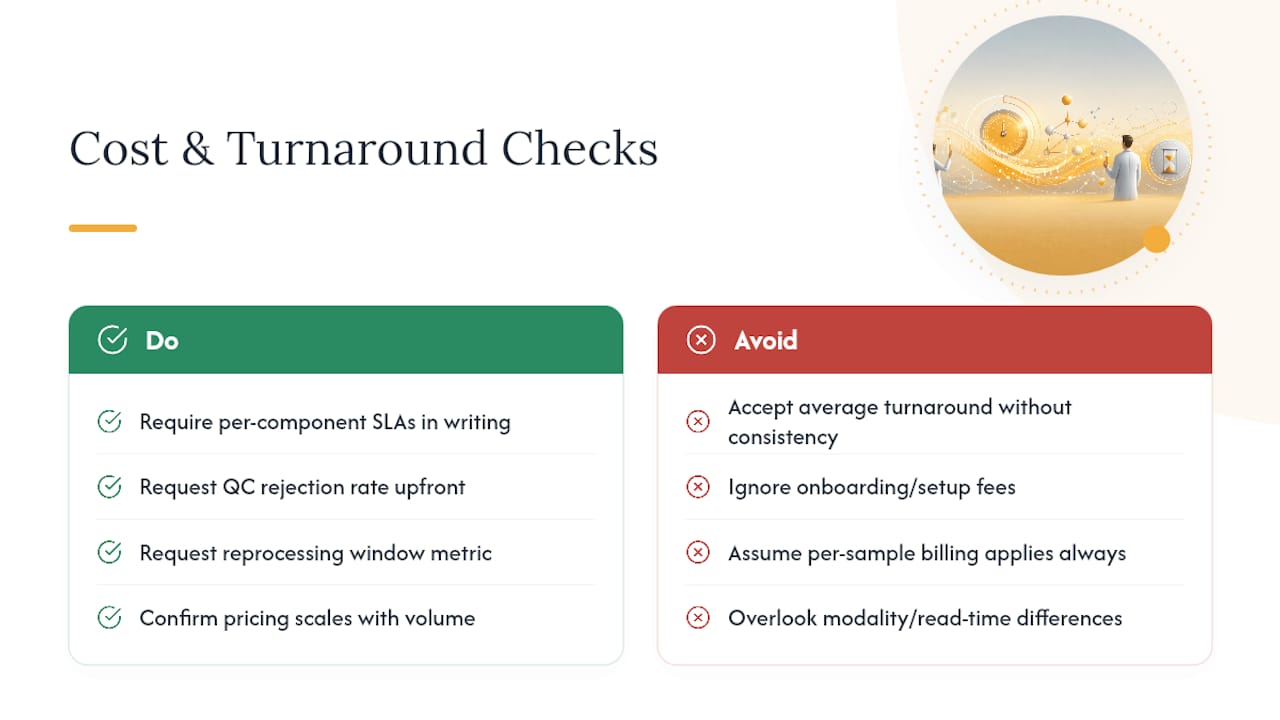
Cost and Turnaround Expectations for Diagnostics Bundles
Pricing for bundled lab and imaging diagnostics generally runs on a per-panel or per-study basis rather than itemized per test, which is one of the practical advantages of a single-contract model. Institutional buyers should expect onboarding or setup fees layered on top of ongoing per-sample or per-panel charges, with billing structured around your organization's payment cycle rather than individual patient encounters.
Turnaround expectations vary by test complexity, but a well-run integrated diagnostics program should give you clearly stated service level agreements for each component: standard chemistry and metabolic panels typically turn around faster than specialized biomarker assays, and imaging read times depend on modality and whether radiologist overread is required.
What matters more than any single number is consistency. A partner that quotes a turnaround window and hits it 95% of the time is more valuable to your trial timeline than one that occasionally beats the estimate but misses it just as often. Ask prospective partners for their QC rejection rate and reprocessing window as part of the SLA discussion, not as an afterthought once samples are already flowing. Those two figures tell you more about real-world turnaround than a marketing brochure's stated average.
Nutrition clinics and multi-site weight-management programs should also confirm whether pricing scales with volume. A program running a handful of patients per month has different economics than a 500-patient trial, and your contract should reflect that difference rather than applying flat per-sample pricing regardless of scale.
Which Lab Tests Matter Most in Weight-Loss Clinic Labs
Weight-management programs and medical weight loss programs rely on a fairly consistent core panel, even though the exact mix shifts based on whether a patient is starting a GLP-1 therapy, a structured diet program, or a surgical pathway.
The tests ordered most often include a comprehensive metabolic panel (kidney and liver function, electrolytes, glucose), a lipid panel, HbA1c or fasting glucose to screen for prediabetes and diabetes, and thyroid-stimulating hormone to rule out thyroid dysfunction as a contributing factor. Many programs add a fasting insulin level alongside glucose to assess insulin resistance more precisely than glucose alone allows.
Beyond the baseline panel, clinics running GLP-1 or other pharmacologic weight-loss protocols typically monitor liver enzymes and kidney function at intervals throughout treatment, since these medications carry gastrointestinal and, less commonly, renal considerations that warrant tracking. Vitamin D and B12 levels come up often too, particularly for patients pursuing bariatric surgery, where nutrient absorption changes permanently.
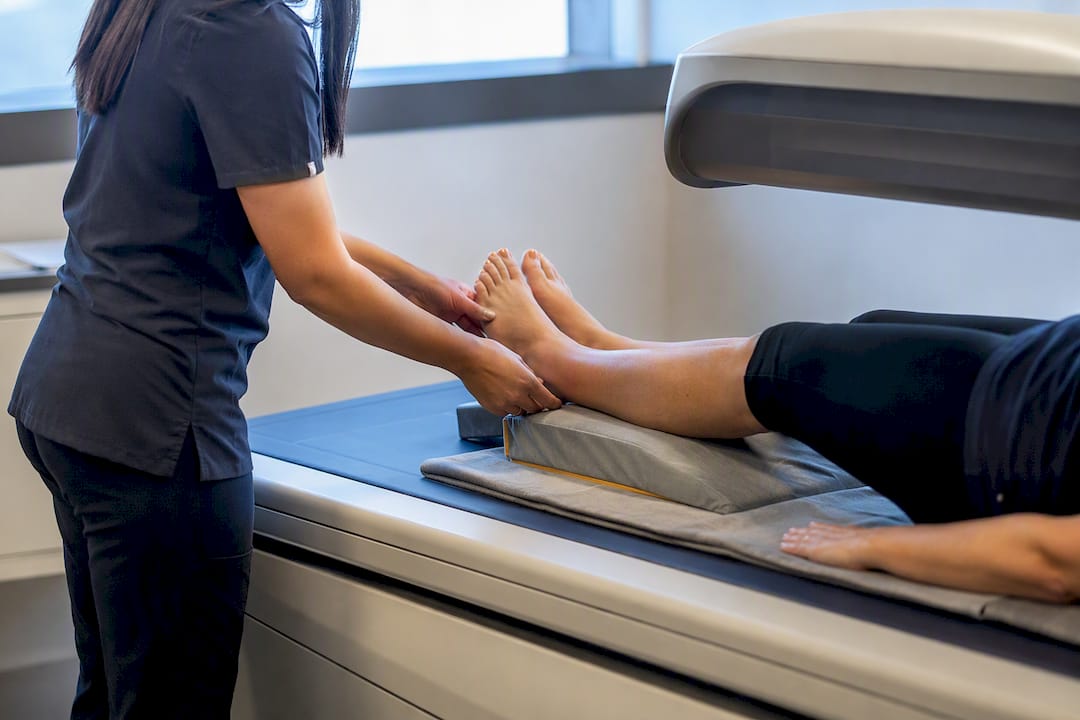
Imaging enters the picture for body composition assessment, most commonly DXA scans or bioelectrical impedance analysis, and occasionally liver imaging when metabolic panels suggest hepatic steatosis. Getting these lab assessments for weight loss linked to the imaging record, rather than filed separately, is exactly the integration problem an integrated diagnostics model solves.
How Lab Results Shape Weight-Loss Treatment Decisions
Lab results aren't a formality before treatment starts. They actively steer which pathway a clinic recommends and how aggressively a program adjusts a patient's plan over time.
An elevated HbA1c can shift a patient from a lifestyle-only track toward a GLP-1 or combination pharmacologic approach, since the metabolic risk profile changes the risk-benefit calculation. Abnormal liver enzymes discovered at baseline might delay starting certain medications until a clinician investigates further, while thyroid dysfunction identified early can redirect a patient toward endocrine treatment before weight-loss interventions even begin, since untreated thyroid disease undermines most weight-management approaches.
Follow-up labs matter just as much as the baseline panel. A patient losing weight rapidly on a GLP-1 protocol needs kidney function and electrolyte monitoring, because dehydration and reduced intake can shift those values in ways that call for dose adjustment. Improving lipid panels or falling HbA1c over successive visits often justify tapering medication or shifting a patient toward a maintenance protocol rather than continued escalation.
For clinical trials specifically, this is where analysis-ready data delivery earns its value. When lab and imaging results reach the study team already linked and QC-validated, safety monitoring committees can flag a concerning trend within days instead of the weeks it takes when someone has to manually cross-reference three separate vendor reports.
Common Indications for Ordering Labs in Weight Management
Certain clinical scenarios reliably trigger a lab order in weight-management settings, and recognizing the pattern helps clinics and trial sites standardize their testing protocols instead of ordering reactively.
New patient intake is the most obvious trigger, establishing a metabolic and organ-function baseline before any intervention starts. Beyond intake, clinics typically order labs when a patient reports symptoms suggesting an underlying endocrine cause of weight gain, such as unexplained fatigue or cold intolerance pointing toward thyroid dysfunction. Starting or changing a pharmacologic weight-loss therapy is another standard trigger, both to confirm the patient is a safe candidate and to establish a pre-treatment reference point for later comparison.
Periodic monitoring during active treatment covers a third category. GLP-1 protocols in particular call for interval liver and kidney function checks, and any patient reporting new gastrointestinal symptoms during treatment usually gets an unscheduled panel to rule out complications. Rapid or unexpected weight change in either direction, plateau after sustained progress, or new symptoms during a maintenance phase all justify an off-schedule lab order rather than waiting for the next routine visit.
Getting Patients Ready for Weight-Loss Lab Testing
Most panels ordered in weight-management settings require some preparation, and getting this wrong is a common source of unreliable results that then trigger unnecessary follow-up testing.
Fasting glucose, lipid panels, and fasting insulin typically require 8 to 12 hours without food, though water is generally fine. Patients should confirm with their clinic whether current medications need to be held before the draw, since some supplements and medications can skew thyroid or metabolic results. Timing matters for certain hormone panels too. Morning draws are standard for cortisol and some thyroid measures because levels fluctuate throughout the day.
For imaging components like DXA scans, patients usually need to avoid calcium supplements for 24 hours beforehand and remove metal objects that could interfere with the scan. Clinics should communicate prep instructions clearly at scheduling, not at check-in, since a patient who ate breakfast an hour before a fasting draw means a wasted visit and a delayed result that pushes back the whole treatment timeline.
Publisher Perspective: Lessons From Running Integrated Diagnostics
Vendor consolidation sounds simple until you watch a site juggle three separate courier schedules and two different result portals. The friction rarely shows up in the RFP. It shows up in week six, when someone realizes the imaging vendor's timestamp format doesn't match the lab vendor's.
Single-contract execution earns its value in reduced query volume, not just faster turnaround. That said, integrated diagnostics isn't the right fit for every program. A single-site pilot with a handful of patients may not need the full analytics stack. Scale is where the model pays for itself.
**
Start a Pilot With Kohealth Labs
An effective approach uses a single-contract model to avoid juggling separate lab and imaging vendors, which often causes delays in weight-loss trials and clinics rather than the testing itself. Such a structure covers phlebotomy, courier pickup, imaging, and analytics under one agreement, with AI-driven QC checking for deviations across multiple biomarkers before data reaches the team.
Starting a pilot engagement typically begins with a requirements conversation, followed by a connectivity test between your systems and ours before any live samples move. From there, onboarding runs through initial sample batches and QC validation before scaling to full volume. If your program is evaluating a diagnostics partner for a weight-loss trial or clinic expansion, review the clinical trials services page to see how a pilot engagement is structured, or visit Kohealth Labs directly to start the conversation.