
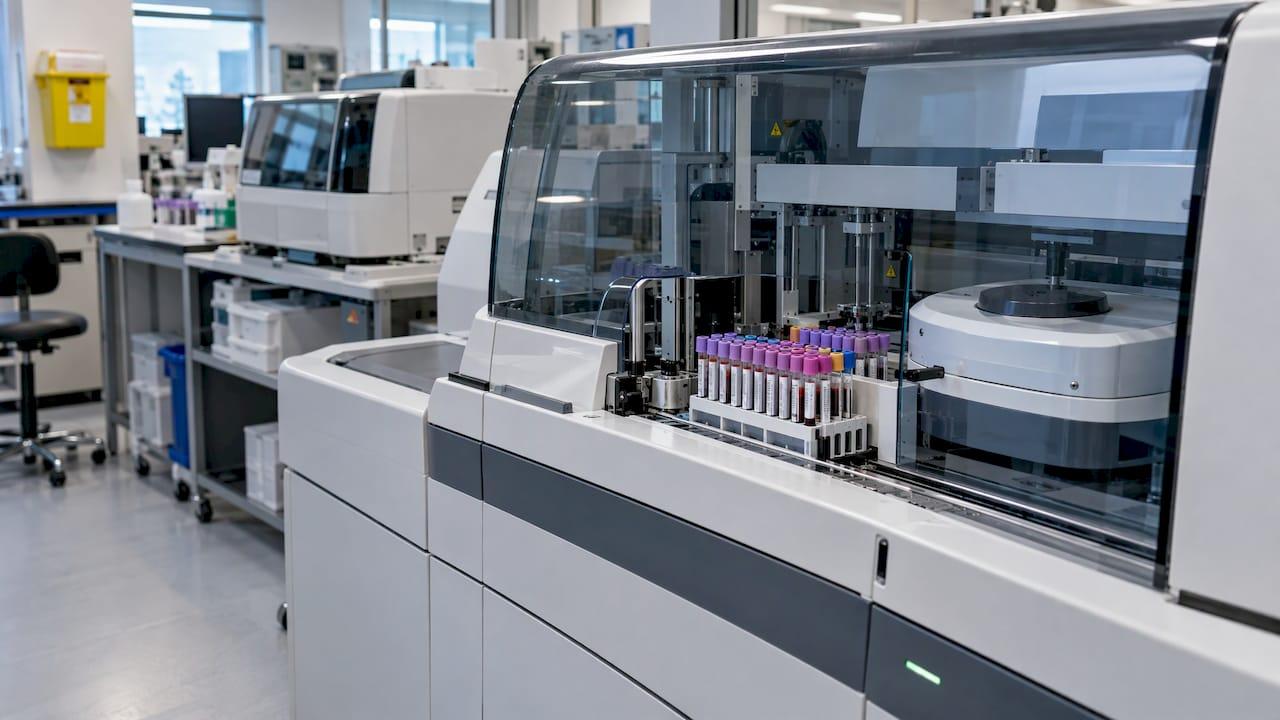
A wellness biomarker panel works when every marker on it answers a question you can act on, the specimen is collected the same way every time, and results come back fast enough to use in the same care cycle or study visit. Getting there takes a laboratory partner that handles collection, testing and reporting as one workflow. KoHealth Labs supports practices, wellness programs and research organizations with test panels across 100+ biomarkers, genomics and imaging, courier specimen pickup, mobile phlebotomy, electronic results reporting and EMR integration.
This guide is for physicians, practice managers, wellness program directors and clinical operations teams who need to decide what goes on a panel and how to run it day to day.
TL;DR
- A wellness panel looks for risk in people without symptoms. A diagnostic test finds the cause of symptoms. The two have different purposes and should be ordered and interpreted differently.
- Build the panel around the population and the action you will take. A marker with no next step adds cost and follow-up questions without adding care.
- Fasting status, posture, time of day and recent activity change results, so collection must follow one written protocol.
- Choose a lab on turnaround time, technical support, assay performance and reporting format, not on test count alone.
- Interpret every result in clinical context and use shared decision-making with the patient or participant.
What a wellness biomarker panel is, and what it is not
A biomarker is a measurable value in blood, urine or another specimen that reflects how a body system is working. A wellness panel bundles several of them to give a baseline across systems such as metabolism, heart health, hormones, inflammation and nutrition.
The key distinction is purpose. The CDC describes screening as testing people without symptoms to look for a specified disease before it becomes clinically apparent, while diagnostic tests are ordered when a person has symptoms or other clinical indications and the cause needs to be found or ruled out. A wellness panel sits closer to the screening and monitoring side. It establishes a baseline, flags risk and tracks change over time.
That framing changes how you design the order. A symptomatic patient with fatigue needs a diagnostic work-up chosen for the differential. A wellness member, an employee in a screening program or a trial participant at baseline needs a standard, repeatable set of markers that can be compared visit to visit.
Which markers belong on a wellness panel
Panels differ by program, but most are assembled from a few core domains. The table shows common groupings and what each group is generally used to look at. Final selection belongs to the ordering clinician.
| Domain | Typical markers | What the results help you look at |
|---|---|---|
| Metabolic | Fasting glucose, hemoglobin A1c, insulin | Blood sugar regulation over time |
| Cardiovascular | Total cholesterol, HDL, LDL, triglycerides, hs-CRP, ApoB | Lipid profile and inflammation tied to heart risk |
| Kidney and liver | Creatinine, eGFR, ALT, AST, bilirubin | Organ function and medication monitoring |
| Blood health | Complete blood count, ferritin | Anemia, iron status, cell counts |
| Thyroid | TSH, free T4, sometimes free T3 | Thyroid function |
| Hormones | Testosterone, estradiol, DHEA, PSA for men where appropriate | Hormone status for men's and women's health programs |
| Nutrition | Vitamin D, B12, magnesium | Common deficiencies |
The ranking pages for this topic range from compact panels of a few dozen markers to bundles of 100 or more. Size is not the quality signal. A 40-marker panel that your clinicians read and act on serves a population better than a 160-marker panel nobody has time to interpret.
For workplace programs, the marker choice is tied to what a group can realistically change. Our guide to workplace wellness biomarkers walks through that selection. For polyclinics and multi-physician groups, biomarker analytics in polyclinic patient care covers how results feed everyday care.
Start with the action, not the assay
The strongest design rule is to include a biomarker only when the finding leads somewhere. A 2026 review of predictive biomarkers in asymptomatic adults concludes that biomarkers should be offered when findings are clinically actionable and effective interventions are available.
In practice, that gives you a simple test for each line item:
- What decision does an abnormal value trigger? A repeat test, a medication review, a lifestyle program, a referral.
- Who owns that decision? The ordering physician, a care coordinator or the program lead.
- What happens to a borderline value? Write the recheck interval in advance so results are handled consistently.
The same logic applies to specialty markers. If your program uses bone turnover markers to guide an intervention, a protocol such as this three-month bone turnover markers plan shows how timing and follow-up measurements are structured around a clinical purpose.
Match the panel to the population
Different organizations need different panels. Here is how the common reader types tend to shape them.
Primary care, internal medicine and family practice
These practices usually anchor on metabolic, lipid, kidney, liver, thyroid and blood count markers, repeated at intervals so trends are visible. Standardizing the panel across all physicians in a group keeps results comparable between providers.
Functional, integrative, hormone and weight management clinics
These programs add hormone, inflammation, insulin and nutrition markers. Because they retest often to track response, fast turnaround and a consistent reporting layout matter more than a long menu.
Skilled nursing, assisted living and home health
Patients are often tested in place. Mobile phlebotomy and scheduled specimen pickup keep the draw with the patient, and electronic reporting delivers results to the clinicians who adjust care plans.

Wellness programs and employers
Program panels favor a short list of widely understood markers and a clear way to return results to participants through their own clinician.
Clinical research and trial sponsors
Here the panel is defined by the protocol. Biomarkers may serve as baseline characteristics, safety measures or exploratory endpoints. The lab must deliver data in a form the study team can use directly, and the assays must be fit for purpose. Our biomarker panel guide for clinical research covers how panels support studies.
Standardize collection before you compare results
Many out-of-range values trace back to how the sample was collected, not to the patient. The 2026 review notes that posture, fasting status, time of day and physical activity significantly influence biomarker levels, which is why standardized specimen collection procedures matter.
A workable protocol fixes the following in writing:
- Fasting window. State the number of hours and whether water and medications are allowed. Our clinic fasting protocols include copy-ready patient instructions for 8 to 12 hour fasts.
- Time of day. Schedule hormone and other time-sensitive markers in a consistent window, such as morning draws.
- Posture and rest. Seat the patient for a set interval before the draw.
- Activity. Ask patients to avoid strenuous exercise before collection.
- Labeling and transport. Use the same tubes, labels and handling steps for every site.
For multi-site groups and trials, consistency is hardest to maintain when each location sends specimens to a different place with different handling. KoHealth Labs offers courier specimen pickup and mobile phlebotomy, so collection and transport can follow one routine across locations. Dedicated onboarding and training is part of what we provide to practices.
How to choose a laboratory for your panel
The CDC's laboratory quality guidance, To Test or Not to Test, tells sites to choose tests that meet their needs and to review intended use, performance characteristics, reliability for the patient population, sample requirements, result time, technical support and cost. Turn that into a vendor checklist:
| Criterion | Question to ask |
|---|---|
| Intended use | Is each assay meant for the population and purpose you have in mind? |
| Performance | What are the accuracy, precision, sensitivity and specificity, and what interferences are known? |
| Sample requirements | What specimen type, volume and handling does each test need? |
| Turnaround time | How quickly do results return, and is that time consistent? |
| Technical support | Can you reach someone who knows your account when a result needs discussion? |
| Reporting | Do results arrive electronically, and do they connect to your EMR or LIS? |
| Cost and billing | Can the lab bill insurance or direct pay, as your program requires? |
Two points deserve extra weight for wellness programs. First, turnaround time and technical support are explicitly named by the CDC as things clinicians should evaluate so the test system fits the clinical or research objective. Second, integration saves staff hours: results that land in your EMR do not need re-keying.
For research, validation carries more weight. FDA guidance on biomarker assays for a drug safety use describes fit-for-purpose validation covering accuracy, precision and measurement range. Our assay validation guide for clinical trials explains what sponsors and CROs should expect. If your team is also evaluating the software side of laboratory data, this overview of LIMS validation in pharma covers data integrity expectations.
Interpreting and following up on results
A result is a data point, not a diagnosis. The 2026 review advises clinicians to contextualize findings, explain uncertainty and use shared decision-making. That is good practice for any panel, and it protects patients from reading too much into one value.
MedlinePlus makes the same point with a specific example: a calcitonin result depends on why the test was done, and providers consider other information, including other test results. The principle carries across markers. An abnormal value can have several causes, and a normal one does not by itself settle a question.
A repeatable follow-up routine looks like this:
- Review against the order's purpose. Was this a baseline, a screening look or a monitoring check?
- Check collection conditions. Was the patient fasting as instructed? Was the draw at the planned time?
- Recheck borderline values at the interval your protocol sets before changing care.
- Escalate to diagnostic testing when a value together with symptoms or history points to a specific condition.
- Document the discussion with the patient, including what was and was not found.
Symptoms always change the pathway. A patient who reports new symptoms should be evaluated by their physician with a diagnostic work-up chosen for those symptoms, not treated as a routine wellness draw.
What good reporting looks like
Results are only useful when the right person sees them in a form they can read. For practices, that usually means electronic reporting, a provider portal and EMR integration, so values appear next to the patient's chart. For research sponsors and government agencies, it means data delivered in a structured, analysis-ready format aligned to the reporting requirements of the study or program.
KoHealth Labs provides provider portal access, electronic results reporting, EMR integration and regulatory-aligned data delivery, along with AI-driven analysis-ready data bundles for clinical research. For a program running hundreds of panels, that removes the manual steps between a result and a decision.
Putting a program together: a practical sequence
- Define the purpose and population. Baseline, ongoing monitoring, trial enrollment or employer program.
- List candidate markers and attach an action to each. Remove any marker without one.
- Write the collection protocol. Fasting, timing, posture, tubes, labels, transport.
- Select the laboratory using the criteria above, including turnaround time and support.
- Set up logistics. Pickup schedule or mobile phlebotomy, portal access and EMR connection.
- Train staff on collection and on the result review routine.
- Pilot with a small group, then review turnaround, specimen quality and clinician feedback before scaling.
Where KoHealth Labs fits
If you want one partner to handle testing, collection logistics and reporting for your wellness panel, KoHealth Labs offers laboratory diagnostics across clinical research, healthcare practices, telehealth and wellness programs. You can see the available panels on our test menu, look at our clinical trial laboratory services if you run studies, or book a conversation about setting up your program.
Our model is built for organizations that want a responsive laboratory with direct communication and customized solutions rather than a one-size-fits-all national workflow.
Our perspective
We see a wellness panel as a clinical tool first and a product second. The best panels start with a question a physician or study team needs answered, and everything else follows: which markers, which specimen, how fast the result returns and in what format.
That is why we build around partnership. A practice should be able to reach a person who knows its account. A research sponsor should receive data that is ready for analysis. A wellness program should be able to rely on the same collection routine at every site.
Speed, reliability, flexibility and personalized service are what we aim to deliver, whether we serve as your primary diagnostic laboratory or as an additional resource for specialized testing and faster results. Our goal is for every result to arrive where it can inform care or advance a study.
Kohealth Labs
FAQ
What is the difference between a wellness biomarker panel and a diagnostic test?
A wellness panel looks at people without symptoms to establish a baseline or flag risk. A diagnostic test is ordered when symptoms or clinical findings call for finding the cause. The same marker can appear in both, but the reason for the order and the way you interpret the result differ.
How many biomarkers should a wellness panel include?
There is no standard number. Published panels run from a few dozen to well over 100 markers. Choose the count by the actions you can take: include a marker when an abnormal value leads to a defined next step and the intervention is available.
Does fasting matter for every biomarker?
No, but it matters for several, including glucose and triglycerides. Fasting status is one of the factors known to influence biomarker levels. Give patients a written protocol with the number of hours and what they may drink or take.
What should a practice look for in a lab partner for wellness testing?
Look at intended use, assay performance, sample requirements, turnaround time, technical support and cost, as the CDC guidance lists. Add electronic reporting and EMR integration so results reach your chart without re-entry.
Can a research team use a wellness panel in a clinical trial?
Yes, as long as the markers and assays fit the protocol. In research the assay must be validated for its intended purpose, and the data must be delivered in the format the study needs. Our clinical trials page describes how we support studies.
Sources
- Screening for Ovarian Cancer, CDC
- Predictive Biomarkers for Asymptomatic Adults, PubMed Central
- To Test or Not to Test, CDC
- Calcitonin Test, MedlinePlus
- FDA biomarker assay guidance
- Three Month Bone Turnover Markers Plan for Clinicians
- FDA CSA LIMS Validation for Pharma
For more information about our diagnostic testing, clinical research laboratory services, or partnership opportunities, visit https://kohealthlabs.com or contact KoHealth Labs at (469) 792-8439 and ask for Amy Patterson.