

An audit trail for lab data is a computer-generated, time-stamped, immutable record that documents who changed what, when, and why. It is the central piece of evidence regulators use to verify data integrity under frameworks like Part 11 and ALCOA+. For lab managers, QA staff, and CROs, a clean audit trail is what separates a routine inspection from a warning letter.
TL;DR:
- Ensuring audit trails are non-disablable and synchronized across all systems is critical to prevent tampering and maintain data integrity.
- Regular, risk-based review of high-impact data, rather than all entries, enhances compliance without overwhelming resources.
- Proper audit trail entries must include specific, comprehensive fields like timestamps, user IDs, reasons for changes, and old versus new values.
- Exported audit trails must be readable, filterable, and validated during system testing to meet inspector expectations.
- Integrated data pipelines and AI-driven checks support continuous compliance by reducing handoff gaps and flagging deviations early.
What Does an Audit Trail Cover in Laboratory Data?
Two distinct trail types exist in most labs, and confusing them is a common source of gaps. A data audit trail tracks changes to a specific record: a result value, a sample status, a calculation. A system audit trail tracks activity at the platform level: logins, permission changes, configuration edits, software updates. Inspectors want to see both, because a clean data trail means little if the underlying system audit trail shows an administrator disabled logging for three days last quarter.
Typical captured events include:
- Sample creation and receipt timestamps
- Result entry, recalculation, and manual overrides
- Method or specification changes tied to a version number
- Electronic approvals, signatures, and rejections
- Instrument events such as calibration, maintenance, and error codes
- User login, logout, and failed access attempts
There's a third layer worth naming separately: data lineage. A single LIMS audit trail requirement shows who touched a record inside one system, but it does not automatically show the full path a sample took across instrument, LIMS, and clinical database. Complex investigations, especially in multi-vendor environments, often stall because teams have strong single-system trails but no clear lineage connecting them.
Regulatory Requirements and Standards Driving Audit-Trail Behavior
Three frameworks set the bar labs are actually inspected against, and each one attacks a slightly different weakness.
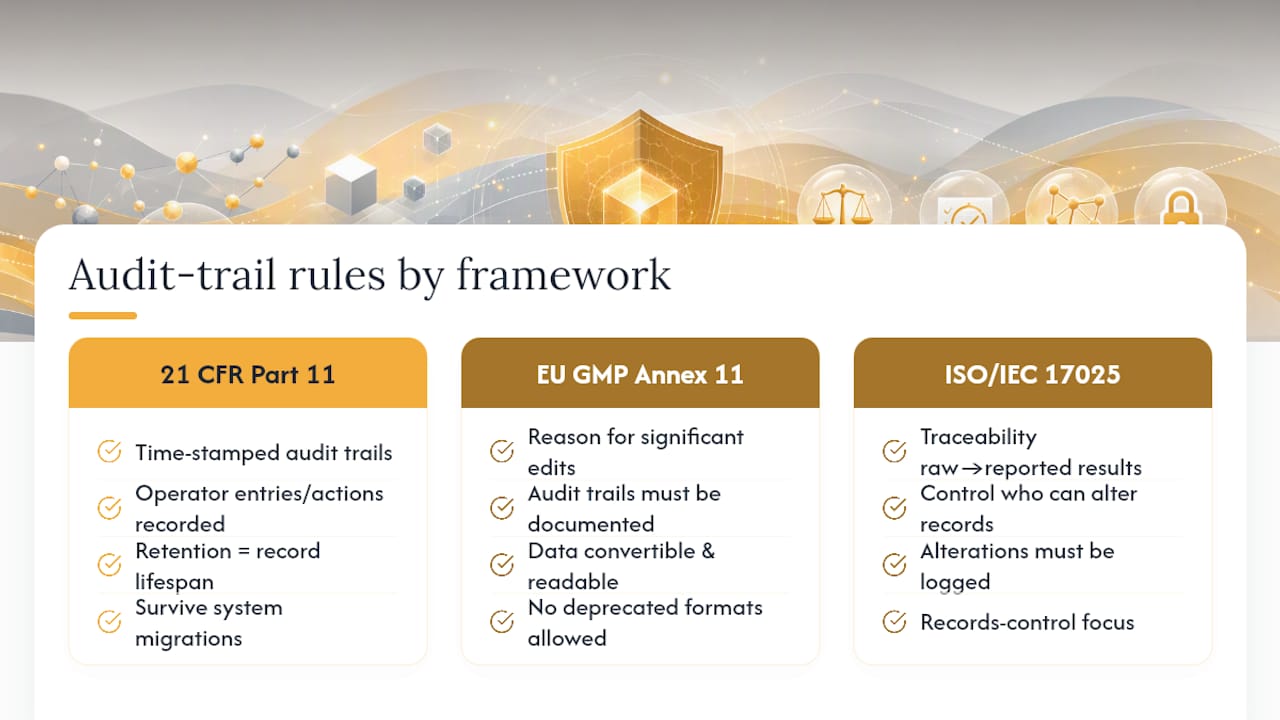
21 CFR Part 11, Section 11.10(e), requires secure, computer-generated, time-stamped audit trails that record operator entries and actions independently, and mandates they be retained for as long as the underlying electronic records themselves. That retention clause trips up more labs than the capture requirement does. Systems get replaced, but the old audit trail data has to survive the migration.
EU GMP Annex 11 goes further on intent: it expects a documented reason for change attached to significant edits, not just a record that an edit occurred. It also requires that electronic data remain convertible and readable throughout the retention period, which rules out formats that degrade or require discontinued software to open.
ISO/IEC 17025 frames the same idea through a records-control lens. Testing and calibration labs need traceability from raw data through to reported results, with control over who can alter records and how those alterations are logged.
Here's the pattern across all three: regulators no longer accept manual printouts as a substitute for the underlying electronic record when a dynamic system exists. A LIMS audit trail analysis from Lab Manager makes this explicit. If your system can generate a live, filterable audit trail, inspectors expect to see that, not a static PDF exported once and filed away.
Note: Part 11's retention rule ties audit-trail life span directly to record life span, implying a lab must maintain audit-trail retention at least as long as the related records, regardless of storage costs.
What Fields Belong in Every Audit-Trail Entry?
A single audit-trail entry needs specific fields to hold up under review, and missing even one of them creates ambiguity an inspector will flag.
- Timestamp in UTC or a clearly recorded time zone, at a resolution fine enough to sequence rapid events
- User ID tied to a unique individual, never a shared or generic login
- Action type (create, edit, delete, approve, void)
- Record identifier linking the entry to the specific sample, batch, or result
- Old value and new value, shown side by side
- Reason for change, entered by the user at the time of the edit
- Session or context metadata, such as which module or workflow triggered the action
These fields map directly onto ALCOA+: Attributable, Legible, Contemporaneous, Original, Accurate, plus Complete, Consistent, Enduring, and Available. A well-formed entry showing "J. Torres changed result from 4.2 to 4.6 mg/L on 03/14/2026 14:22 UTC, reason: recalculation after dilution correction" satisfies attributable, contemporaneous, and complete in one line. An entry that just says "value edited" satisfies none of them.
Pro Tip: Run a mock inspection query on your own system: pick one sample, one result, and ask your LIMS to show its full change history in under two minutes. If that takes longer than a coffee break, your export process needs work before an actual auditor asks.
How Should Labs Design Audit Trails Across LIMS and Instruments?
Design decisions made once, at implementation, tend to determine whether audit trails hold up five years later. A few choices matter more than the rest.
Make the audit trail non-disablable. Any user, including administrators, who can turn off logging has effectively created an unmonitored blind spot. Append-only logging, or cryptographic hash chaining such as SHA-256, provides tamper-evidence that plain database logs cannot match, since hash-based approaches make retroactive edits mathematically detectable rather than merely policy-forbidden.
Synchronize clocks across every connected system. A Technology Networks analysis of audit-trail design points out that separating system audit trails from data audit trails only works if both share a reliable, high-resolution timestamp source. Instrument clocks drift; LIMS servers don't always share a time zone with the instruments feeding them.
A few more practices worth locking in during setup:
- Map every instrument interface event into a central LIMS view rather than leaving it siloed on the instrument's local log
- Build human-readable viewers so any qualified reviewer, not just IT, can browse an audit trail without specialist software
- Test exports as part of formal system validation, not as an afterthought
- Add automated alerts or flags for high-risk actions (deletions, overrides) to cut down on manual review workload
Pro Tip: When validating a new instrument interface, simulate a real edit: change a value, capture the before and after, then try exporting that single event without opening a database console. If your team can't do it, an inspector definitely won't be able to either.
How Often Should Labs Review Audit Trails?
Audit trail review, often shortened to ATR, is where good documentation habits actually get tested. Reviewing every entry in every system is not realistic for most labs, and it is not what regulators expect either.
The IQ Working Group's guidance on risk-based audit trail review recommends scoping ATR to high-impact GxP data rather than treating every log entry equally. A preventative technical control, such as a permission setting that blocks unauthorized deletion outright, reduces how much manual ATR is needed in the first place. Where prevention isn't possible, the audit trail has to be reviewed closely enough to catch the change after the fact.
A workable tiered structure looks like this:
- Batch or release review, tied to every product release decision, covering the full record set for that batch
- Triggered review, activated by a deviation, complaint, or out-of-specification result
- Periodic review, a scheduled sweep of lower-risk data on a set interval, such as quarterly
Document each review with who performed it, when, what scope it covered, and what was found, even when the finding is "no anomalies detected." Inspectors treat the absence of documented review as equivalent to the absence of review itself.
Statistic to know: the risk-based ATR model exists specifically because reviewing 100% of every audit trail entry is not sustainable at scale. Concentrating review effort where the data risk is highest is the documented industry consensus for making ATR both rigorous and achievable.
What Do Inspectors Expect to See During a Site Visit?
Retention rules follow a simple principle: an audit trail must survive exactly as long as the record it documents, no shorter. Archived systems still need to produce readable, retrievable trails years after the original platform is retired.
On the export side, inspectors expect:
- A human-readable, on-screen view that can be filtered by date, user, or record without IT assistance
- The ability to export that view to a shareable, printable format within minutes, not days
- Confirmation, tested during validation, that the export accurately reflects what the live system shows
- A backup and archive strategy that has been test-restored, not just assumed to work
A Lab Manager review of inspection readiness notes that inspectors increasingly ask to see live audit trail queries performed in real time rather than accepting a pre-printed report. If your team's only proof is a PDF generated last month, that gap will show.
What Are the Most Common Audit-Trail Failures?
A handful of findings show up repeatedly across regulatory inspections, and most trace back to setup decisions rather than bad intent.
- Disabled or partially disabled logging. Remediation: restrict who can change logging configuration, and alert QA automatically if logging status changes.
- Shared or generic user accounts. Remediation: enforce unique logins tied to individuals, owned by IT, enforced through onboarding policy.
- Missing reason-for-change fields. Remediation: make the field mandatory at the system level, not just a training expectation, owned by whoever configures the LIMS.
- Exports that require specialist software or manual reformatting. Remediation: validate a simple export path during system qualification, owned by QA and IT jointly.
- No documented review evidence. Remediation: create a standard review log template and require sign-off at each tier of ATR, owned by lab management.
Pro Tip: Separate quick fixes from structural ones. Turning on a missing alert is a same-week fix. Replacing a LIMS that can't produce readable exports is a budget cycle away. Fix what you can this month, and put the rest on a documented remediation timeline inspectors can actually see.
How Integrated Diagnostics and AI Change Audit-Trail Readiness
Most audit-trail gaps in clinical research don't start inside a single system. They start at the handoffs between systems, when a sample moves from lab to radiology to a separate data vendor, each with its own login structure, its own timestamp format, its own export quirks. Every handoff is a place where lineage gets murky even when each individual system's audit trail looks fine in isolation.
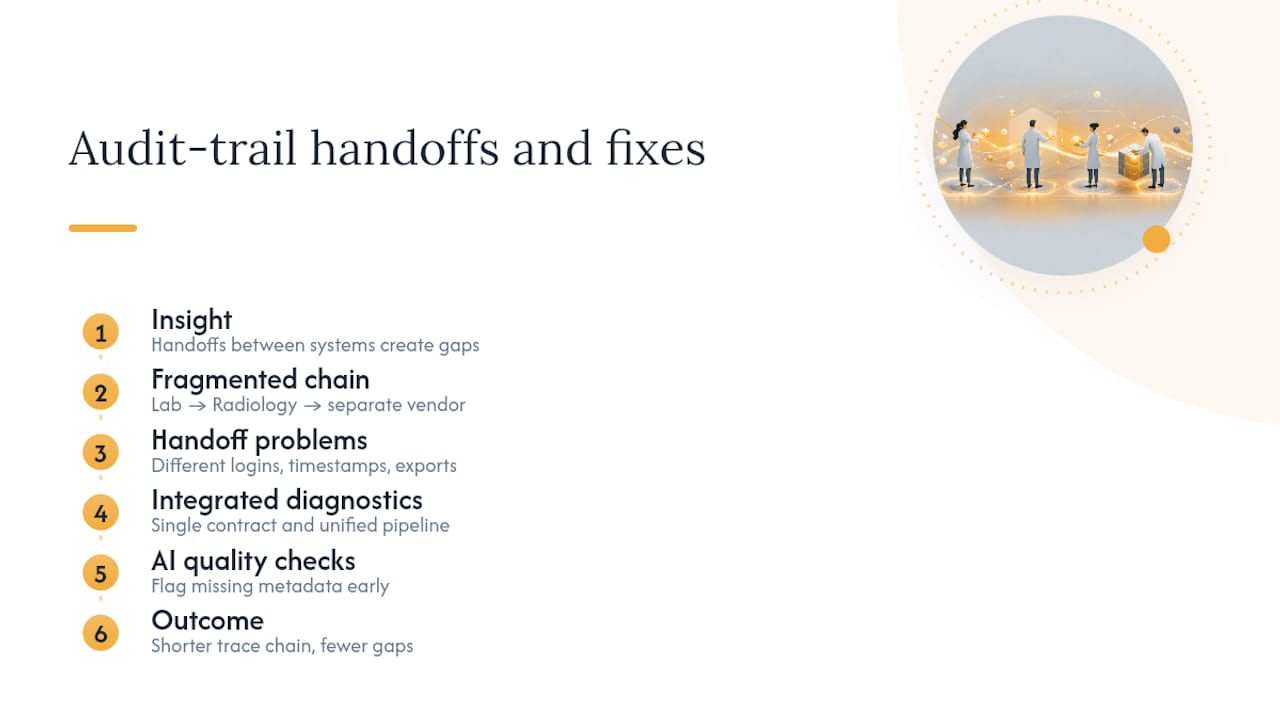
Integrated diagnostics that combine lab and radiology under one contract and one data pipeline remove several of those handoffs before they happen, which shortens the chain an auditor has to trace and reduces the number of places a reason-for-change field can go missing. AI-assisted quality checks add another layer, flagging deviations in result patterns or missing metadata early, before they become the kind of finding that shows up during a full ATR cycle months later. That earlier detection is what actually reduces manual review load, more than any single dashboard feature does.
A single-contract model unifies lab and imaging data delivery with analytics spanning many biomarkers so CROs and sponsors get one coherent audit trail instead of several partial ones stitched together after the fact.
— Kohealth Labs
How Kohealth Labs Supports Inspection-Ready Lab Data
This approach offers an alternative to juggling separate lab, imaging, and data vendors for a clinical trial: one contract, one integrated data pipeline, and audit-trail behavior built in from onboarding rather than patched on afterward.
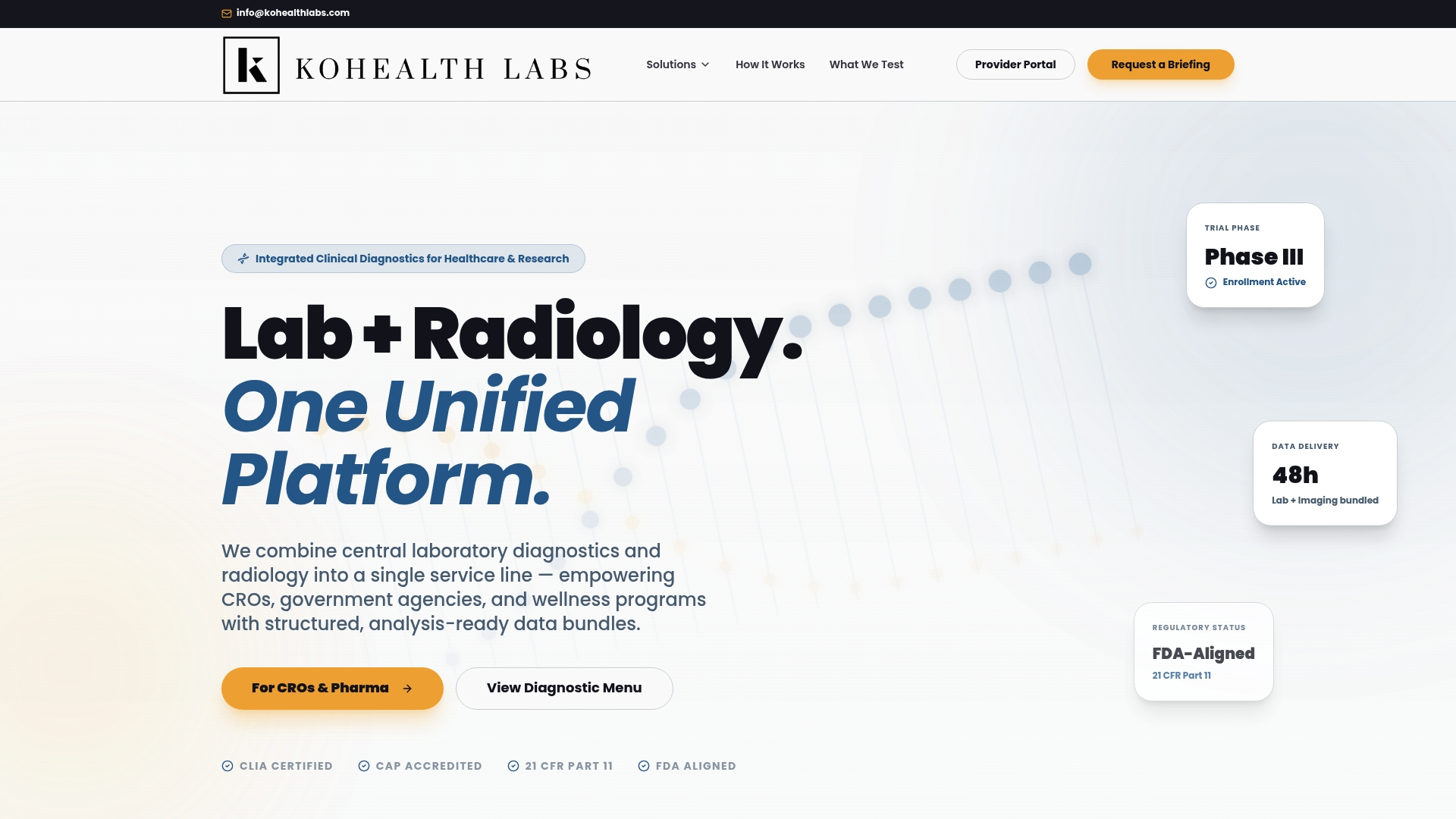
That single-contract structure means fewer system handoffs for your QA team to trace during a review, and fewer places where a reason-for-change field or a timestamp can fall out of sync between vendors. Kohealth Labs pairs phlebotomy, courier specimen pickup, and radiology services with AI-driven analysis across more than 100 biomarkers, built to flag data deviations before they become the kind of finding an inspector circles in red. Onboarding and training are included, so lab managers and CRO data teams aren't left configuring export formats on their own months into a trial. If your team is evaluating how integrated clinical diagnostics could tighten your next study's data trail, reach out to Kohealth Labs to discuss your trial's specific testing and imaging needs.
Where to Read the Underlying Regulatory Guidance
The claims in this article draw directly on a small set of primary and industry sources, listed here for reference rather than as an exhaustive reading list.
- Part 11, Electronic Records; Electronic Signatures — Scope and Application, FDA
- LIMS audit trails: automating compliance documentation for regulatory inspections, Lab Manager
- A harmonized approach to performing a risk-based audit trail review, Pharmaceutical Technology
- Audit trail requirements for a digitalized regulated laboratory, Technology Networks
- How to Verify an AABB Lab for Legal and Immigration Use, for readers comparing chain-of-custody concepts against audit-trail requirements
Sources
- Part 11, Electronic Records; Electronic Signatures — Scope and Application (FDA)
- LIMS audit trails: automating compliance documentation for regulatory inspections | Lab Manager
- A harmonized approach to performing a risk-based audit trail review | Pharmaceutical Technology
- Audit trail requirements for a digitalized regulated laboratory | Technology Networks