

Start with the architecture, not the vendor. For a reliable laboratory API integration, adopt a standards-first REST/JSON approach that maps instrument output to FHIR R4 resources, normalizes test codes to LOINC, and validates every order through a middleware layer before it reaches your LIMS. Providers like Kohealth Labs offer turnkey integrated diagnostics with analysis-ready data bundles already structured around these standards, which makes them a practical starting point if you want to skip months of custom build work.
Your immediate action list:
- Inventory your endpoints. List every system that sends or receives lab data: instruments, LIMS, EHR, ELN, radiology platform, and any analytics pipeline.
- Collect your compendium. Pull your full test catalog and map each internal code to its LOINC equivalent. This single step prevents the majority of downstream mapping failures.
- Request sandbox access. Ask every vendor or integration partner for a sandbox or test environment before signing anything. No sandbox means no safe place to validate.
- Confirm your async strategy. Decide whether you will poll for results or use FHIR Subscriptions for push notifications. Document the choice before development begins.
- Schedule a stakeholder kickoff. Bring informatics, clinical operations, compliance, and IT into one room within 72 hours. Misaligned assumptions at this stage cost weeks later.
Common failure modes when lab APIs are weak or missing
Weak APIs cause mapping failures, asynchronous mismatches, and data noise that surface only after months of production use, usually at the worst possible moment in a trial timeline.
The most common problems informatics teams encounter:
- Poor or outdated documentation — Undocumented endpoints force developers to reverse-engineer behavior, which introduces bugs and delays.
Pro Tip: Prioritize compendium mapping and your async workflow strategy before writing a single line of integration code. These two decisions affect every downstream component. A mapping error caught in planning costs an hour; the same error caught in production costs a database lock delay.
What a robust lab API actually requires
The minimum viable spec for a lab-grade API is standards-based endpoints, a working sandbox, compendium alignment to LOINC, and auditable metadata on every transaction. Anything less creates technical debt that compounds with every new integration point.
Here is the checklist to apply when evaluating any API for lab systems:
Protocol and data model:
- REST/JSON as the primary transport protocol, with consistent resource naming and predictable HTTP status codes
- Explicit support for FHIR R4 resources:
DiagnosticReport,Observation,ServiceRequest,RequestGroup,DocumentReference, andBinary - Structured result retrieval with coded values (LOINC) and units (UCUM)
- Document support for PDF reports and attachments via
DocumentReference/Binary
Async and notification:
- Webhook or FHIR Subscription support for push-based result notifications
- Polling fallback with documented retry windows and pagination
Security and access:
- OAuth2 with fine-grained scopes (read-only result access vs. order submission are separate permissions)
- TLS 1.2 or higher on every endpoint, no exceptions
- Token rotation and expiry policies documented and enforced
Operations:
- Semantic versioning policy with a documented deprecation timeline (minimum 6 months notice before breaking changes)
- Pagination on all list endpoints
- Published rate limits and SLA metrics
- Sandbox and test environment with realistic synthetic data
Error handling:
A well-designed lab API returns structured
OperationOutcomeresources on every error, not plain HTTP 400 or 500 responses with no body. Each outcome should carry aseverity,code, anddiagnosticsstring that tells the calling system exactly what failed and whether to retry. Idempotency keys on order submission prevent duplicate orders when a network timeout causes the client to retry. Retry windows should be documented: typically 3 attempts with exponential backoff over 30 seconds for transient errors, with a dead-letter queue for persistent failures.
REST API design best practices consistently show that consistent error models and versioning policies reduce maintenance cost and developer friction more than any other single design decision.
Which standards and data models to use in U.S. lab integrations
The primary standards for U.S. lab integrations are FHIR R4 for orders, results, and subscriptions; HL7 v2 for legacy interfaces; LOINC for test codes; UCUM for units; and ANIML or .mzML/.mzXML for raw instrument data. Each standard addresses a different layer of the data stack.
Layer-by-layer mapping:
- Raw instrument data layer: — ANIML for chromatography and spectroscopy instruments;
.mzML/.mzXMLfor mass spectrometry; vendor-agnostic formats prevent lock-in and reduce data noise - Experiment metadata layer: ISA-Tab for packaging experiment-level context (study design, sample provenance, protocol versions) alongside results
| Standard | Primary use | Key implementation note |
|---|---|---|
| FHIR R4 | Orders, results, subscriptions, documents | Use DiagnosticReport + Observation for structured results; ServiceRequest for orders |
| HL7 v2 | Legacy LIS/EHR interfaces | Maintain as a translation layer; do not build new systems on v2 |
| LOINC | Test code vocabulary | Map your entire internal compendium before development begins |
| ANIML / .mzML | Raw instrument output | Normalize via middleware agent before LIMS ingestion |
| ISA-Tab | Experiment metadata | Package with datasets for reproducibility and AI-readiness |
When mapping your internal test catalog to LOINC, use persistent identifiers wherever possible. For datasets that will feed publications or regulatory submissions, ORCID identifiers for contributors and DOIs for datasets add provenance that auditors and AI pipelines both rely on.
Security and compliance requirements for PHI in lab API integrations
Every API project that touches protected health information must align with HIPAA's Security Rule from day one, not as a final review step. Security-by-design means encryption, access control, and audit trails are built into the architecture, not bolted on afterward.
Compliance checklist:
- OAuth2 with fine-grained scopes; never issue a single all-access token to an integration partner
- TLS 1.2+ on every endpoint; enforce HTTPS at the load balancer and reject plain HTTP connections
- Token lifecycle management: short expiry windows (15–60 minutes for access tokens), refresh token rotation, and revocation endpoints
- Encryption at rest for all PHI-containing data stores (AES-256 is the current standard)
- Encryption in transit for all API calls, file transfers, and webhook payloads
- Immutable audit logs capturing who accessed what, when, and from which IP; logs must be tamper-evident and retained per your HIPAA retention policy
- Role-based access controls that enforce the minimum necessary standard: a billing system should not have read access to genomic results
- Breach detection and documented incident response procedures, including notification timelines that meet HIPAA's 60-day breach notification requirement
- Business associate agreements (BAAs) executed with every vendor, cloud provider, or integration partner that processes PHI
- Strict sandbox separation: test environments must use synthetic data only, never de-identified copies of real patient records
For AI and analytics pipelines, apply de-identification under HIPAA's Safe Harbor or Expert Determination method before data enters any model training workflow. Consent management and minimal necessary data principles apply even when the downstream consumer is an internal analytics system.
Pro Tip: During end-to-end sandbox testing, run your full PHI handling workflow using realistic but entirely synthetic data. Generate synthetic patient records that mirror your production data structure, including edge cases like missing fields and out-of-range values. This catches compliance gaps before they become breach risks.
The five stages of a laboratory API integration project
A successful integration follows five stages: planning, mapping, development, validation and testing, and deployment with ongoing monitoring. Skipping or compressing any stage is the most common reason integrations go over budget and over schedule.
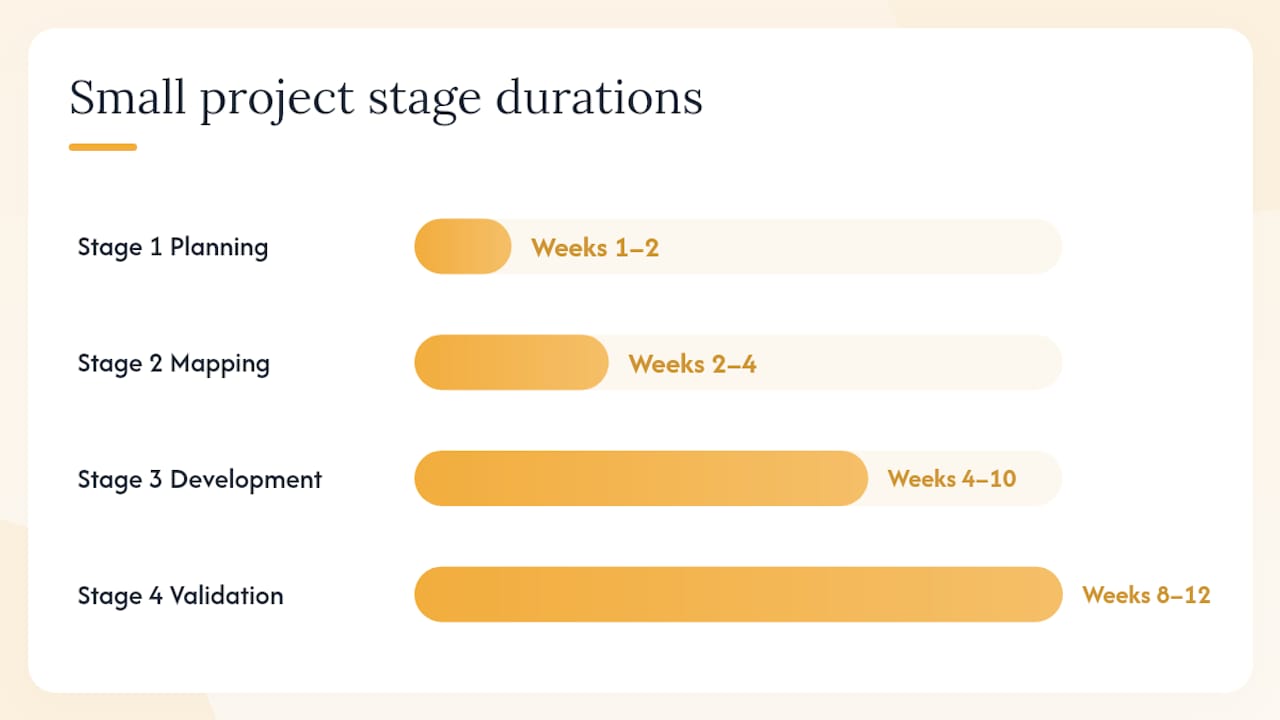
Stage 1: Planning (Weeks 1–2 for small projects; Weeks 1–4 for large) Deliverables: system inventory, stakeholder RACI, data flow diagrams, standards selection, and vendor API evaluation. Stakeholders: informatics lead, IT, clinical operations, compliance, and the integration vendor. The primary risk here is scope creep from undocumented legacy interfaces discovered late.
Stage 2: Mapping (Weeks 2–4 / Weeks 3–8) Deliverables: complete LOINC compendium mapping, FHIR resource mapping document, field-level data dictionary, and async workflow decision (polling vs. subscriptions). Stakeholders: informatics team and lab operations. The risk is an incomplete compendium; unmapped codes cause silent result failures in production.
Stage 3: Development (Weeks 4–10 / Weeks 6–20) Deliverables: working API client or middleware layer, instrument adapters, authentication implementation, and webhook handlers. Stakeholders: developers, informatics, and vendor support. Use the sandbox throughout this stage. Stable sandbox environments and example code materially reduce integration time and the error rate at go-live.
Stage 4: Validation and testing (Weeks 8–12 / Weeks 16–24) Deliverables: order-to-result roundtrip test results, subscription notification reliability report, load test results, security review sign-off, and compendium mapping audit. Required before production cutover:
- Full order submission and result retrieval roundtrip in sandbox
- Subscription or webhook notification delivery confirmed under simulated load
- OperationOutcome error handling verified for all documented failure modes
- Load test at 2x expected peak volume
- Security review covering OAuth2 scopes, TLS configuration, and audit log completeness
- Compliance sign-off from your privacy officer
Stage 5: Deployment and monitoring (Ongoing) Deliverables: production cutover plan, rollback procedure, alerting dashboards, and SLA monitoring. Stakeholders: IT operations, informatics, and vendor support. Monitor result latency, error rates, and subscription delivery failures as your primary health metrics. For asynchronous workflows, a dead-letter queue with alerting on unprocessed messages is not optional.
For small integrations (one instrument, one LIMS), realistic timelines run 8–12 weeks. Medium projects (multi-instrument, EHR connection) typically run 16–24 weeks. Large enterprise integrations covering multiple sites, radiology, and analytics pipelines often require 6–12 months.
Practical questions to ask vendors and developers before you commit
The best time to discover that a vendor's API lacks webhook support or has no documented versioning policy is during procurement, not after go-live. Lead your vendor evaluation with these criteria.
Vendor questions to include in every RFP:
- Does your API provide a fully functional sandbox with synthetic test data, and is it available before contract signing?
- How do you handle compendium mapping? Do you provide a pre-built LOINC mapping, or is that the buyer's responsibility?
- What is your versioning policy? How much notice do you give before deprecating an endpoint or breaking a resource structure?
- What are your support SLAs for integration issues? Is there a dedicated integration support channel separate from general customer support?
- How long do you retain result data, and can we export our full dataset in a standard format (FHIR Bundle, CSV) at any time?
- What is your documented incident response procedure for API outages, and what are your uptime SLA commitments?
- What performance SLAs do you guarantee for result retrieval under peak load?
- What does your onboarding timeline look like from contract signing to first production result?
- What are the primary cost drivers: per-test fees, per-API-call fees, setup fees, or a flat subscription?
Acceptance tests to require before go-live:
- A complete order-to-result roundtrip in the sandbox, timed and documented
- Subscription or webhook notification delivery confirmed for at least 100 consecutive test results
- Deliberate injection of malformed requests to verify that
OperationOutcomeresponses are returned correctly - A load test at your expected peak daily volume
Pro Tip: Negotiate rollback windows and data reconciliation responsibilities into your contract before signing. Specify who owns the reconciliation process if a production cutover causes result gaps, and require a minimum 30-day parallel-run period for high-volume or trial-critical integrations.
For practical workflow guidance on CRO diagnostic data delivery, the specifics of compendium handoff and result format requirements are worth reviewing before you finalize your RFP.
Real-world API integration use cases and data flows
The canonical use cases for connecting laboratory applications are instrument-to-LIMS ingestion, EHR order submission with result posting, ELN synchronization, centralized analytics pipelines, and integrated lab-radiology report bundles. Each has a distinct data path and a different set of failure points.
-
Instrument-to-middleware-to-LIMS. A mass spectrometer outputs raw
.mzMLfiles. A middleware agent picks up the file, normalizes it to a structured JSON payload with LOINC codes and UCUM units, and posts it to the LIMS via REST. The LIMS returns a confirmation with a persistent result ID. This pattern prevents raw vendor formats from reaching the LIMS directly, which is where data noise originates. -
EHR order submission to LIMS result posting. A clinician submits a
ServiceRequestfrom the EHR. The integration layer translates it to the lab's order format, submits it to the LIMS, and subscribes to result notifications. When the result is ready, aDiagnosticReportwith linkedObservationresources is posted back to the EHR. The clinician sees the result in their workflow without leaving the EHR. -
ELN ingestion for research workflows. An electronic lab notebook publishes experiment records as ISA-Tab packages. An API connector picks up new packages, extracts sample metadata and assay results, and loads them into the LIMS with full provenance. Researchers can query results by study, protocol version, or operator without manual data entry.
-
Centralized analytics data lake. All LIMS result events trigger a webhook that pushes a FHIR
DiagnosticReportbundle to a cloud data lake. A normalization pipeline applies consistent LOINC coding and de-identification before the data enters any ML model. This is the architecture that makes real-time AI monitoring of trial safety signals possible. -
Radiology-lab integrated report bundles. Lab results and radiology findings are packaged into a single FHIR Bundle per subject per visit. The bundle includes
DiagnosticReportresources for both modalities, linked by subject and encounter identifiers. A CRO receives one structured delivery per subject rather than two separate vendor feeds, which cuts data reconciliation time significantly. -
Telehealth platform result delivery. A telehealth provider submits orders via API, and results are delivered as structured FHIR resources to the provider portal in real time. Kohealth Labs supports this model directly, with integrated diagnostics for telehealth platforms that include phlebotomy, courier pickup, and provider portal access under one contract.
-
Multi-site clinical trial safety monitoring. Results from multiple collection sites flow through a central middleware layer that normalizes codes, flags out-of-range values, and posts alerts to a safety monitoring dashboard. The API layer provides the audit trail that regulators require.
Sample order-to-result-to-analytics flow:
EHR → [ServiceRequest] → Integration Middleware
Middleware → [Order POST] → Lab LIMS
LIMS → [Order Accepted, result pending] → Middleware
LIMS → [FHIR Subscription notification] → Middleware
Middleware → [DiagnosticReport + Observation] → EHR
Middleware → [FHIR Bundle] → Analytics Data Lake
Data Lake → [Normalized, de-identified dataset] → AI/ML Pipeline
How analysis-ready data accelerates clinical trials
APIs that deliver standardized, provenance-rich, analysis-ready data reduce trial delays and enable real-time safety monitoring. The connection between API architecture and trial speed is direct: every hour a sponsor waits for a clean, queryable dataset is an hour added to database lock.
The difference between a trial that closes on schedule and one that runs months over budget often comes down to a single question: was the data analysis-ready when it arrived, or did it require remediation? Retrospective normalization of lab data, whether fixing inconsistent LOINC codes, reconciling units, or resolving missing metadata, is one of the most common and most avoidable sources of trial delay. The architecture decision to normalize at ingestion, not at analysis, is where that time is either saved or lost.
The technical patterns that produce analysis-ready data are not complicated, but they require deliberate design:
- Middleware normalization at ingestion — Raw instrument output is transformed to vendor-agnostic formats (ANIML,
.mzML) and then to structured FHIR payloads before reaching the LIMS. Problems caught here cost minutes; problems caught at database lock cost weeks. - Persistent identifiers throughout — Every sample, result, and dataset carries a stable identifier that survives system migrations and vendor changes. ORCID for contributors, DOIs for published datasets, and internal UUIDs for specimens give auditors and AI pipelines a reliable chain of custody.
Kohealth Labs applies this architecture to integrated diagnostics, delivering AI-driven, analysis-ready data bundles that cover lab results, radiology findings, and genomics under one contract. For CROs and pharma sponsors, that means a single structured feed rather than three separate vendor pipelines to reconcile. The impact on trial timelines is measurable: faster data delivery reduces the gap between last patient visit and database lock.
Typical timelines and cost drivers for lab API integration projects
Small integrations connecting one instrument to one LIMS usually complete within a few weeks. Medium projects adding EHR connectivity and multi-instrument support often take several months. Large enterprise integrations covering multiple sites, radiology, and analytics pipelines can take close to a year or more, with ongoing support costs that continue after go-live.
Primary cost drivers:
- Middleware development. Custom middleware for instrument adapters and data normalization is often the largest single line item in a build-it-yourself project.
| Project size | Typical duration | Primary cost driver |
|---|---|---|
| Small (1 instrument, 1 LIMS) | 8–12 weeks | Compendium mapping, sandbox testing |
| Medium (multi-instrument, EHR) | 16–24 weeks | Middleware development, security review |
| Large (multi-site, radiology, analytics) | 6–12 months | Instrument adapters, compliance, training |
The fastest way to reduce both cost and timeline is to reuse existing standards rather than building custom data models, and to choose a managed-service or integrated diagnostics provider that already has FHIR-compliant infrastructure, a pre-built compendium, and a working sandbox. Lab testing optimization through connected workflow software follows the same principle: standardize first, customize only where necessary.
Key Takeaways
Successful laboratory API integration requires a standards-first REST/FHIR architecture with LOINC-mapped compendia, middleware normalization, and rigorous sandbox validation before any production cutover.
| Point | Details |
|---|---|
| Standards first, always | Map your full test catalog to LOINC and adopt FHIR R4 resources before writing integration code. |
| Middleware normalization prevents data noise | Normalize raw instrument output to vendor-agnostic formats at ingestion, not at analysis time. |
| Sandbox testing is non-negotiable | Require a working sandbox with synthetic data from every vendor before signing a contract. |
| Analysis-ready data accelerates trials | Provenance-rich, standardized data bundles reduce database lock delays and enable real-time AI monitoring. |
| Kohealth Labs delivers integrated bundles | Kohealth Labs provides lab, radiology, and genomics data under one contract as analysis-ready FHIR-structured bundles for CROs and pharma sponsors. |
The case for integrated diagnostics as the real API advantage
The conversation about laboratory API integration tends to focus on the technical layer: which endpoints to call, which FHIR resources to use, how to handle async results. Those details matter. But the more important question is what the data is for once it arrives.
Most labs and CROs are still managing lab and radiology as separate vendor relationships, separate data feeds, and separate reconciliation workflows. The API architecture question then becomes: how do we connect more systems? The better question is: how do we deliver fewer, richer, more complete data packages?
When lab results and radiology findings arrive as a unified, subject-level bundle, the downstream work changes entirely. A safety monitor is not reconciling two feeds; they are reviewing one. A statistician is not waiting for a missing imaging result to complete a subject record; it is already there. The trial does not slow down because a radiology vendor's API uses a different patient identifier than the lab vendor's API.
Kohealth Labs built its model around this insight. The single-contract structure for integrated diagnostics is not just a procurement convenience; it is an architectural decision that eliminates an entire class of integration problems before they start. The AI layer that flags deviations and validates data quality operates on a complete picture, not a partial one. That is where the measurable trial acceleration comes from, not from faster API calls, but from fewer gaps in the data.
For labs and CROs evaluating their integration strategy, the question worth asking is not only "does this API meet the technical spec?" but "does this partner deliver data that is complete enough to act on without remediation?"
Kohealth Labs offers integrated diagnostics built for API-driven trials
Clinical research teams that need analysis-ready lab and radiology data under one contract have a direct path with Kohealth Labs. The platform covers over 100 biomarkers, genomics, and imaging, delivered as structured, AI-validated data bundles through a provider portal with EMR integration built in.
For CROs and pharma sponsors, the practical advantages are clear: one contract replaces multiple vendor relationships, courier specimen pickup and phlebotomy are included, and the data arrives in a format that feeds directly into your analytics pipeline without remediation. Onboarding includes dedicated training and setup support, and the AI layer identifies deviations before they become data quality issues that delay your timeline.
To see how Kohealth Labs fits your integration requirements, review the integrated diagnostics solutions or explore the Data & AI capabilities for a detailed look at how analysis-ready bundles are structured for trial use.