

A CLIA certified laboratory is a U.S. clinical testing facility that holds a current certificate issued by the Centers for Medicare & Medicaid Services (CMS) and meets the personnel, quality, and proficiency requirements codified in 42 CFR Part 493. No facility may legally perform testing on human specimens for health assessment, diagnosis, or treatment without that certificate.
Before you read further, run through these four checks right now:
- Verify your certificate type matches the highest complexity testing your lab currently performs.
- Confirm CMS has a valid email address on file for your facility. Certificates and fee coupons are delivered electronically, not by mail.
- Locate your CMS-116 application form if you are enrolling or upgrading a certificate type.
- Identify the highest test complexity performed at your entity, because that single factor drives your personnel, inspection, and quality requirements.
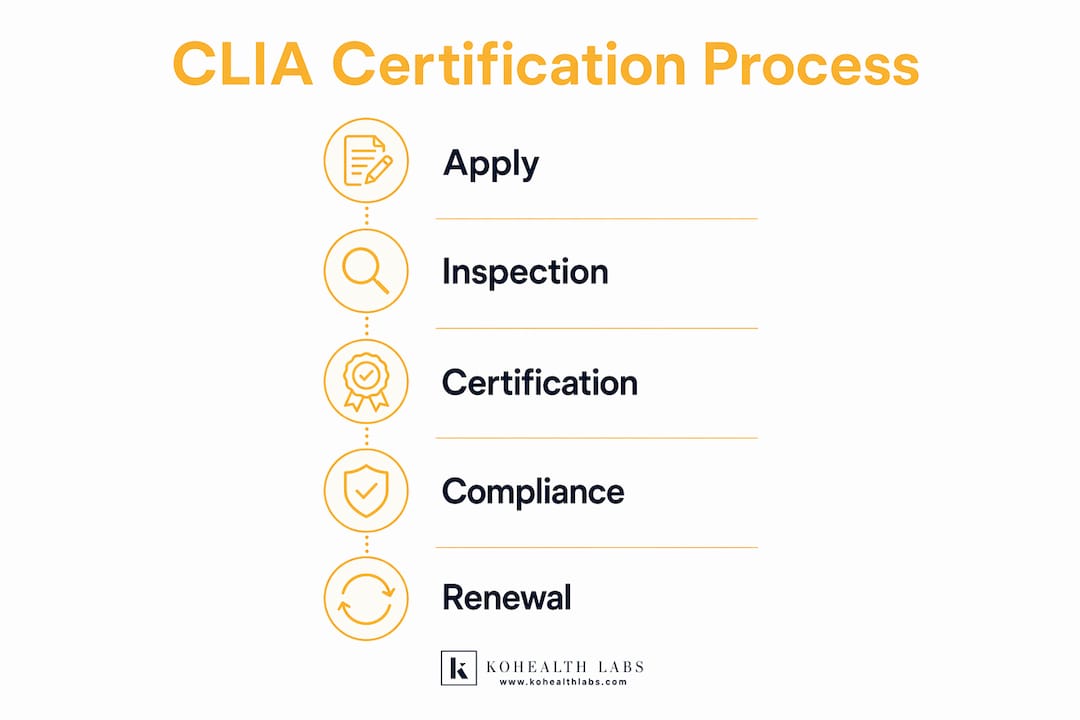
Certification is not a one-time milestone. CLIA requires periodic inspections, and labs must notify CMS whenever the laboratory director changes or the testing scope expands. Treat it as a continuous compliance program, not a credential you file away.
What does CLIA actually cover?
CLIA's core objective is straightforward: protect patients by ensuring that laboratory testing on human specimens meets consistent quality standards across the country. The legal authority comes from the Clinical Laboratory Improvement Amendments of 1988, and the operational requirements live in 42 CFR Part 493, which covers everything from certificate definitions to inspection standards.
The program applies to any facility that performs testing on human specimens for health purposes, including hospital labs, physician office labs, independent reference labs, and point-of-care testing sites. Research-only activities that produce no patient care decisions fall outside CLIA's scope, but the moment a result influences a clinical decision, CLIA applies.
Scale matters here. CMS reports the CLIA program covers approximately 320,000 laboratory entities across the United States. That breadth is exactly why standardized federal requirements exist — without them, quality would vary wildly from one facility to the next.
A few practical scope points worth knowing:
- CLIA certification is a prerequisite for billing Medicare and Medicaid for diagnostic testing. It is not a payment program itself, but CMS enforces it as a condition of participation.
- State Survey Agencies conduct inspections on CMS's behalf in most states, so your primary day-to-day contact for surveys is often your state agency, not a federal office.
- Facilities that perform only waived testing operate under lighter requirements, but they still need a valid certificate of waiver and must follow manufacturer instructions for every test they run.
Who enforces CLIA, and what does each agency do?
Three federal agencies share CLIA responsibilities, and knowing which one to call for what saves real time.
CMS administers the CLIA program end to end. It issues certificates, sets the regulatory framework, oversees State Survey Agencies, and handles enforcement actions. When you have a question about your certificate status, fee payment, or an inspection finding, CMS is your primary contact.

CDC plays a supporting role focused on technical quality. CDC partners with CMS to provide training, technical assistance, and quality resources to laboratories and public health agencies. If your staff needs guidance on quality systems or laboratory best practices, CDC's CLIA resources are a strong starting point.
FDA does not regulate the laboratory facility itself. Instead, FDA classifies the complexity of individual tests and test systems, and that classification directly determines which CLIA certificate your lab needs and how stringent your requirements are.
| Agency | Primary CLIA Role | Where to Go |
|---|---|---|
| CMS | Issues certificates, enforces regulations, oversees surveys | cms.gov/medicare/quality/clinical-laboratory-improvement-amendments |
| CDC | Technical support, training, quality resources | cdc.gov/clia |
| FDA | Classifies test complexity (waived / moderate / high) | fda.gov/medical-devices/ivd-regulatory-assistance/clia |
| State Survey Agencies | Conduct inspections on CMS's behalf | Contact your state health department |
FDA test complexity and CLIA facility requirements intersect at a critical point: the complexity category FDA assigns to a test system determines the certificate type your lab must hold, the minimum qualifications for your personnel, and the inspection standards that apply. A lab running only FDA-waived tests needs a certificate of waiver and faces minimal oversight. A lab running high-complexity tests faces the full weight of 42 CFR Part 493 personnel and quality requirements.
State licensure adds another layer in some jurisdictions. Several states have requirements that equal or exceed CLIA, and those states may conduct their own separate inspections. Always check with your state health department to confirm whether a state laboratory license is required in addition to your CLIA certificate.
Which CLIA certificate type does your lab need?
The rule is simple: apply for the certificate that matches the highest complexity testing your facility performs. Getting this wrong is one of the most common compliance errors, and it carries real consequences.
| Certificate Type | Who Needs It | Key Characteristics |
|---|---|---|
| Certificate of Waiver | Labs performing only FDA-waived tests | Minimal requirements; must follow manufacturer instructions |
| Certificate of Registration | Labs applying for compliance or accreditation | Temporary; allows testing while awaiting full inspection |
| PPM Certificate | Physicians/midlevel providers performing provider-performed microscopy | Specific test list; no proficiency testing required |
| Certificate of Compliance | Labs performing moderate or high complexity testing, inspected by CMS/state | Full 42 CFR Part 493 requirements apply |
| Certificate of Accreditation | Labs accredited by a CMS-approved accreditation organization (e.g., CAP, The Joint Commission) | Deemed status; accreditor inspects in lieu of CMS |
A few practical notes on certificate selection:
- Provider-Performed Microscopy (PPM) covers a specific, limited list of microscopy procedures performed by a physician, midlevel practitioner, or dentist during a patient visit. It does not cover all microscopy work.
- Certificate of Accreditation requires the lab to be accredited by a CMS-approved organization. The ASCP BOC and organizations like CAP and ISO 15189 are recognized pathways that also affect professional credential verification for lab personnel.
- If your lab adds a new high-complexity test while holding only a certificate of waiver, you must upgrade your certificate before running that test.
Documentation typically required when applying or upgrading:
- Completed CMS-116 application form
- Facility name, address, and director information
- List of tests performed and their complexity categories
- Valid email address for electronic delivery of certificates and communications
- Fee payment confirmation via pay.gov
How do you apply for CLIA certification?
The enrollment process is more straightforward than many labs expect, but specific steps must happen in the right order to avoid delays.
- Determine your certificate type based on the highest complexity testing you plan to perform. This decision drives everything else.
- Complete the CMS-116 application form. CMS maintains the CMS-116 form and a Certification Quick Start Guide on its CLIA pages. Download the current version directly from CMS.
- Submit the completed CMS-116 to your State Survey Agency or the appropriate CMS contractor for your region. Contact information is available through the CMS CLIA web pages.
- Register a valid email address in the CMS system at the time of application. This is not optional. CMS now delivers certificates, fee coupons, and official communications electronically. A missing or incorrect email is one of the most common causes of processing delays.
- Pay your CLIA fee online via pay.gov once CMS processes your application and issues a fee coupon. Fees vary by certificate type and test volume; the fee schedule is published on the CMS CLIA pages.
- Receive your certificate electronically. For a certificate of compliance or accreditation, an inspection must occur before the full certificate is issued; the certificate of registration covers the interim period.
Common delays to watch for:
- Incomplete CMS-116 forms, particularly missing director credentials or test lists
- No valid email address on file, which blocks electronic delivery
- Applying for the wrong certificate type and needing to restart the process
- Fee payment errors or delays on pay.gov
Pro Tip: Before submitting your CMS-116, have your laboratory director review the test list against FDA's test complexity database to confirm every test is categorized correctly. A single miscategorized high-complexity test can require a full certificate upgrade after the fact.
How do test complexity categories affect your CLIA requirements?
FDA assigns every test system to one of three complexity categories, and that assignment is the single biggest driver of your regulatory burden under CLIA.

Waived tests are simple, low-risk tests cleared by FDA for use in any setting. Examples include urine dipstick tests, blood glucose monitoring with certain devices, and rapid strep tests. Labs performing only waived tests need a certificate of waiver, follow manufacturer instructions, and face no proficiency testing requirement and no routine CMS inspection.
Moderate complexity tests cover the majority of routine clinical laboratory testing, including most automated chemistry and hematology analyzers. These labs must meet personnel qualification requirements, participate in proficiency testing for applicable analytes, and undergo regular inspections under 42 CFR Part 493.
High complexity tests include cytogenetics, histopathology, flow cytometry, and many molecular assays. The personnel requirements are the most stringent, the quality system requirements are the most detailed, and inspections are the most thorough.
A few practical implications:
- FDA's test complexity determination is published in the FDA CLIA database. Check it before adding any new test to your menu.
- Moving from waived to moderate or high complexity testing requires a certificate upgrade and triggers the full inspection cycle.
- Some tests are categorized as moderate complexity by default when no FDA complexity determination exists; labs should confirm the applicable category before running any new assay.
What are the personnel requirements under CLIA?
Personnel requirements under CLIA scale directly with test complexity. The higher the complexity, the more specific the qualifications must be, and the more thoroughly they must be documented.
Laboratory Director responsibilities apply at every complexity level, but the minimum qualifications differ:
- For high complexity testing, the director must typically hold an MD, DO, or PhD in a chemical, physical, biological, or clinical laboratory science, with specific board certification or experience requirements.
- For moderate complexity testing, the qualifications are somewhat broader but still require documented education and experience.
- The director is responsible for overall laboratory operations, quality oversight, and ensuring staff competency. This responsibility cannot be delegated away.
Technical Supervisor (required for high complexity labs) must hold qualifications similar to the director and is responsible for the technical and scientific oversight of testing.
Testing Personnel must meet minimum education and training requirements that vary by complexity. For high complexity testing, a clinical laboratory scientist or equivalent credential is typically required. The ASCP BOC credential pathways are widely recognized for verifying these qualifications.
Documentation requirements that appear on virtually every inspection:
- Written job descriptions for every CLIA-defined role
- Documented competency assessments for each testing personnel member, performed at hire and at least annually thereafter
- Records of continuing education where applicable
- Signed acknowledgment of responsibilities by the laboratory director
Staying current on workforce competency standards is an ongoing task. Resources like healthcare credential verification guides can help compliance officers build systematic documentation processes for personnel files.
What does ongoing CLIA compliance actually require?
Compliance between inspections is where most labs either build a strong program or accumulate deficiencies. The inspection itself is just the audit; the real work happens every day.
Inspections and survey schedules
Under 42 CFR Part 493, sections §493.1771–§493.1780, inspections for labs holding a certificate of compliance occur on a roughly two-year cycle. Labs with a certificate of accreditation are inspected by their accrediting organization on a similar schedule. Inspections can also be triggered by complaints, proficiency testing failures, or significant changes in lab operations.
Inspection findings fall into two tiers:
- Condition-level deficiencies represent serious failures that jeopardize patient safety or the integrity of test results. These can trigger immediate enforcement action.
- Standard-level deficiencies are less severe but still require a written plan of correction and follow-up.
Proficiency testing requirements
- Enroll in a CMS-approved proficiency testing program for every analyte on your test menu that has a PT requirement.
- Test PT samples using the same personnel, methods, and procedures used for patient specimens.
- Submit results by the PT program's deadline; late submissions are treated as failures.
- Investigate and document the root cause of any PT failure immediately.
- Implement corrective action and document it before the next PT event.
PT failures are taken seriously. Two consecutive failures for the same analyte can result in suspension of testing for that analyte and trigger a CMS inspection.
Quality system elements to maintain between inspections
- Document control: keep current versions of all procedures; archive superseded versions per retention requirements.
- Quality control records: run QC at the frequency specified in your procedures and document every result.
- Corrective action logs: document every out-of-range QC event, PT failure, and patient result complaint, along with the investigation and resolution.
- Notification obligations: notify CMS promptly when your laboratory director changes, when you add or discontinue test categories, or when your facility address changes.
How does state licensing interact with CLIA?
CLIA sets the federal floor. Some states have chosen to go further.
A handful of states, including New York and Washington, have received CLIA-exempt status from CMS, meaning their state laboratory licensure programs are at least as stringent as CLIA. Labs in those states operate under state oversight rather than direct CMS oversight, but the practical requirements are equivalent or stricter.
In most other states, CLIA and state licensure run in parallel. You need both, and they may have different renewal cycles, fee structures, and inspection schedules.
Steps to confirm your state licensure obligations:
- Contact your state health department's laboratory licensing office directly. Requirements vary significantly from state to state.
- Compare state personnel requirements against CLIA minimums. Some states require additional credentials or experience beyond what 42 CFR Part 493 specifies.
- Check whether your state conducts its own inspections in addition to or instead of CMS surveys.
- Confirm state-specific fees and renewal timelines, which are separate from CLIA fees paid via pay.gov.
Common state-level additions beyond CLIA:
- Additional application fees and annual renewal fees
- More stringent laboratory director qualification requirements
- Separate state proficiency testing enrollment requirements
- Additional reporting obligations for certain test categories or public health notifiable conditions
What happens when a lab falls out of compliance?
Noncompliance with CLIA carries real consequences, and the severity scales with how serious the deficiency is and how quickly the lab responds.
Common enforcement outcomes include:
- Civil money penalties for condition-level deficiencies or repeated standard-level failures
- Certificate suspension or revocation, which prohibits the lab from performing any testing
- Directed plan of correction, where CMS specifies the corrective steps and timeline
- State-level actions, which may run concurrently with federal enforcement
The most frequently cited inspection deficiencies are:
- Inadequate or missing competency assessment records for testing personnel
- Proficiency testing failures without documented root cause analysis and corrective action
- Quality control records that are incomplete, missing, or not reviewed by the laboratory director
- Personnel qualifications that do not meet the requirements for the certificate type held
Remediation steps when a deficiency is cited
- Read the deficiency citation carefully and identify the specific regulatory standard cited.
- Conduct a root cause analysis. Do not write a plan of correction until you understand why the deficiency occurred.
- Submit a written plan of correction by the deadline specified in the inspection report.
- Implement the corrective action and document evidence of completion.
- If you disagree with a finding, you have the right to appeal through the CMS informal dispute resolution process. File within the timeframe specified in your inspection report.
Self-correction before an inspection is always the better path. Running internal audits against 42 CFR Part 493 elements on a regular schedule gives you the opportunity to find and fix deficiencies before a surveyor does.
Where can you find authoritative CLIA resources and tools?
The resources below are the primary references for CLIA compliance. Bookmark them and check them regularly, since CMS updates guidance and fee schedules periodically.
- CMS CLIA Program Page: The central hub for certificate types, CMS-116 forms, the Certification Quick Start Guide, fee schedules, and contact information for State Survey Agencies.
- CDC CLIA Resources: Technical guidance, training materials, and quality resources for laboratory professionals. Particularly useful for quality system implementation and personnel training.
- 42 CFR Part 493 on eCFR: The full regulatory text, including all certificate definitions, inspection standards, and personnel requirements. This is the authoritative source for any compliance question.
- CMS CLIA Regulations and Federal Register Documents: Chronological list of CLIA regulatory changes and Federal Register publications, useful for tracking regulatory history.
- FDA CLIA Page: FDA's test complexity database and guidance on how FDA device classifications map to CLIA requirements.
| Contact / Tool | What It's Used For |
|---|---|
| CMS CLIA Program Page | Certificate applications, CMS-116 forms, fee schedules, State Survey Agency contacts |
| State Survey Agency | Inspection scheduling, complaint filing, state-specific licensure questions |
| CDC CLIA Resources | Technical training, quality system guidance, public health laboratory support |
| pay.gov | Online CLIA fee payment |
| FDA CLIA Test Complexity Database | Confirming complexity category for specific test systems |
| eCFR Part 493 | Full regulatory text for compliance verification and audit preparation |
How Kohealth Labs supports CLIA compliance for CROs and research labs
Managing CLIA compliance across a multi-site clinical trial or a growing CRO is administratively intensive. Every vendor relationship, every test panel, and every data handoff introduces a potential compliance gap. Kohealth Labs addresses this directly through a single-contract integrated diagnostics model that consolidates laboratory services, radiology, and analysis-ready data delivery under one agreement.
Here is how Kohealth Labs maps to specific CLIA compliance checkpoints:
- Validated workflows and standardized reporting reduce the documentation burden for quality system maintenance and support audit readiness under 42 CFR Part 493.
- AI-assisted data quality checks identify deviations in real time, supporting the corrective action and QC review requirements that appear on nearly every CLIA inspection.
- Courier specimen pickup and phlebotomy services maintain chain-of-custody integrity, a common inspection focus for labs managing remote or decentralized collection sites.
- Test panels covering 100+ biomarkers are curated and validated, reducing the risk of adding an uncategorized or miscategorized test to your menu.
- Dedicated onboarding and training for CROs and sponsor labs covers CLIA-aligned documentation practices, personnel competency records, and data retention requirements from day one.
For CROs managing sponsor oversight, Kohealth Labs' central lab model provides consolidated data delivery that supports both CLIA compliance and sponsor reporting requirements simultaneously.
Pro Tip: When onboarding a new test panel through Kohealth Labs, request the test complexity documentation for every assay upfront. Having FDA complexity determinations on file before your next inspection eliminates one of the most common documentation gaps surveyors flag.
Key Takeaways
CLIA certification is an ongoing federal compliance obligation under 42 CFR Part 493, and the certificate type your lab holds must always match the highest complexity testing you perform.
| Point | Details |
|---|---|
| Match certificate to complexity | Your CLIA certificate type must reflect the highest complexity test on your menu; mismatches trigger enforcement. |
| Keep your CMS email current | Certificates and fee coupons are delivered electronically; a missing email blocks your certificate and delays renewals. |
| Enroll in proficiency testing | PT participation is mandatory for applicable analytes; two consecutive failures can suspend testing for that analyte. |
| Document personnel qualifications | Competency assessments, job descriptions, and director acknowledgments are the most frequently cited inspection deficiencies. |
| Kohealth Labs for integrated compliance | Kohealth Labs' single-contract model with validated workflows and AI-assisted QC supports CLIA audit readiness for CROs and sponsor labs. |
A practical perspective on CLIA compliance
The labs that struggle most with CLIA inspections are not the ones with the most complex testing menus. They are the ones that treat compliance as a periodic event rather than a daily operating standard.
The most common finding on inspections is not a technical failure. It is a documentation failure. A competency assessment that was performed but never recorded. A QC review that happened but left no paper trail. A director change that was not reported to CMS within the required timeframe. These are not hard problems to solve. They are process problems, and they are entirely preventable.
A few operational habits that make a measurable difference: run a monthly QC trend review rather than waiting for a failure to prompt one. Keep a single, current contact sheet with your CMS State Survey Agency number, your PT program enrollment deadlines, and your certificate renewal date. Conduct a brief internal audit against 42 CFR Part 493 elements at least twice a year, not just when an inspection is approaching. And when you add a new test, confirm its FDA complexity category before the first patient sample runs, not after.
The paperless transition CMS has made is genuinely helpful, but it creates one new vulnerability: if the email address on file with CMS is outdated, you will miss your fee coupon, your certificate renewal, and potentially an inspection notice. That single administrative detail has caused real compliance problems for labs that otherwise run clean programs.
CLIA compliance is not complicated. It rewards consistency, documentation, and the discipline to treat every day as if a surveyor might walk in tomorrow.
Kohealth Labs helps your organization stay CLIA-ready
Clinical research organizations and sponsor labs spend significant time managing vendor relationships, reconciling data from multiple sources, and preparing documentation for inspections. Kohealth Labs offers a faster path: a single contract that covers laboratory diagnostics, radiology, phlebotomy, and AI-assisted data delivery, all aligned to the documentation and quality standards CLIA requires.
Where most organizations juggle multiple lab vendors, separate imaging contracts, and manual data reconciliation, Kohealth Labs delivers analysis-ready data bundles with built-in QC checks and standardized reporting. That means fewer gaps in your compliance documentation and faster turnaround on the data your sponsors and regulators need. The integrated diagnostics model is purpose-built for CROs and clinical research programs that need CLIA-aligned workflows without the overhead of managing each service separately.
To request a compliance-ready onboarding consultation or review a test panel for your next trial, contact Kohealth Labs directly through kohealthlabs.com.
Primary references and authoritative sources
These are the canonical resources for CLIA compliance. Use them to verify regulatory requirements, confirm certificate status, and access current forms and guidance.
- CMS CLIA Program Page: Central hub for all certificate types, the CMS-116 application form, the Certification Quick Start Guide, fee schedules, and State Survey Agency contacts. Start here for any enrollment or renewal question.
- CDC CLIA Resources: Technical training materials, quality system guidance, and public health laboratory support. Particularly useful for implementing quality management systems and preparing staff for inspections.
- 42 CFR Part 493 on eCFR: The full, current regulatory text for all CLIA requirements. This is the authoritative source for personnel standards, inspection criteria, and certificate definitions.
- CMS CLIA Regulations and Federal Register Documents: Chronological archive of CLIA regulatory changes and Federal Register publications. Use this to track the history of specific requirements or confirm when a rule was last amended.
- FDA CLIA Page: FDA's test complexity database and guidance on how device classifications map to CLIA certificate requirements. Check this before adding any new test system to your menu.
- ASCP BOC Credential Pathways: Reference for acceptable clinical laboratory credentials and accreditation pathways used in personnel qualification verification.
- Kohealth Labs Integrated Diagnostics: Overview of Kohealth Labs' integrated lab and radiology services, single-contract model, and CLIA-aligned data delivery for CROs and clinical research programs.
This article provides general informational guidance on CLIA certification requirements and is not a substitute for legal or regulatory advice. Confirm current requirements with CMS, your State Survey Agency, or a qualified compliance professional for your specific situation.