

A central lab is defined as a specialized facility that receives biological samples from multiple clinical trial sites, conducts standardized analytical testing, and returns harmonized, auditable data to sponsors and regulatory authorities. The role of central lab in pharma sponsor oversight is not administrative. It is a core governance function that determines whether a trial's data will survive regulatory scrutiny. Under ICH E6(R3), sponsors must justify their monitoring approach with evidence-based risk assessments, and central lab data sits at the center of that justification. Sponsors who treat central labs as simple vendors rather than oversight partners consistently face the consequences: 31 of 125 sponsors inspected by the FDA in FY2024 received Form 483 findings for recurring oversight failures, many tied to monitoring lapses involving laboratory operations.
How central labs enhance data consistency across global trials
Local lab variability is one of the most underappreciated risks in multinational clinical trials. Different sites use different assay kits, reference ranges, and reporting units. That variability makes cross-site statistical comparisons unreliable and creates gaps that regulators flag during review.
Central labs solve this by applying harmonized assays, validated methods, and universal reporting units across every site in a trial. The result is a single, comparable dataset that regulatory reviewers can analyze without adjusting for site-level methodological differences. This standardization also protects the integrity of subgroup analyses, which are increasingly important in adaptive trial designs.

The table below shows how central lab standardization compares to local lab approaches across key quality dimensions:
| Quality Dimension | Local lab approach | Central lab approach |
|---|---|---|
| Assay methods | Site-specific, variable | Validated, harmonized |
| Reference ranges | Locally defined | Universally applied |
| Reporting units | Inconsistent | Standardized |
| Audit trail | Fragmented | Centralized |
| Biomarker capability | Limited | Broad, specialty-grade |
Beyond routine chemistry panels, central labs now serve as strategic partners in biomarker trials, providing assay validation, sample stability testing, and integration of lab data with clinical outcomes. That translational capability goes well beyond transactional testing. It gives sponsors scientific insights that local labs simply cannot generate at scale.
Key standardization benefits central labs deliver:
- Harmonized assay protocols applied identically across all sites
- Single reference range set, eliminating inter-site variability
- Validated sample handling and cold-chain logistics
- Centralized data repository accessible to sponsor oversight teams
- Specialty testing capabilities for genomic, proteomic, and immunological biomarkers
How do central labs support risk-based monitoring under ICH E6(R3)?
ICH E6(R3) formalizes centralized monitoring as a core sponsor accountability requirement. Sponsors must now explicitly link trial risks to oversight intensity, using evidence-based risk assessments rather than blanket 100% source data verification. Central labs are the primary data source that makes this possible.
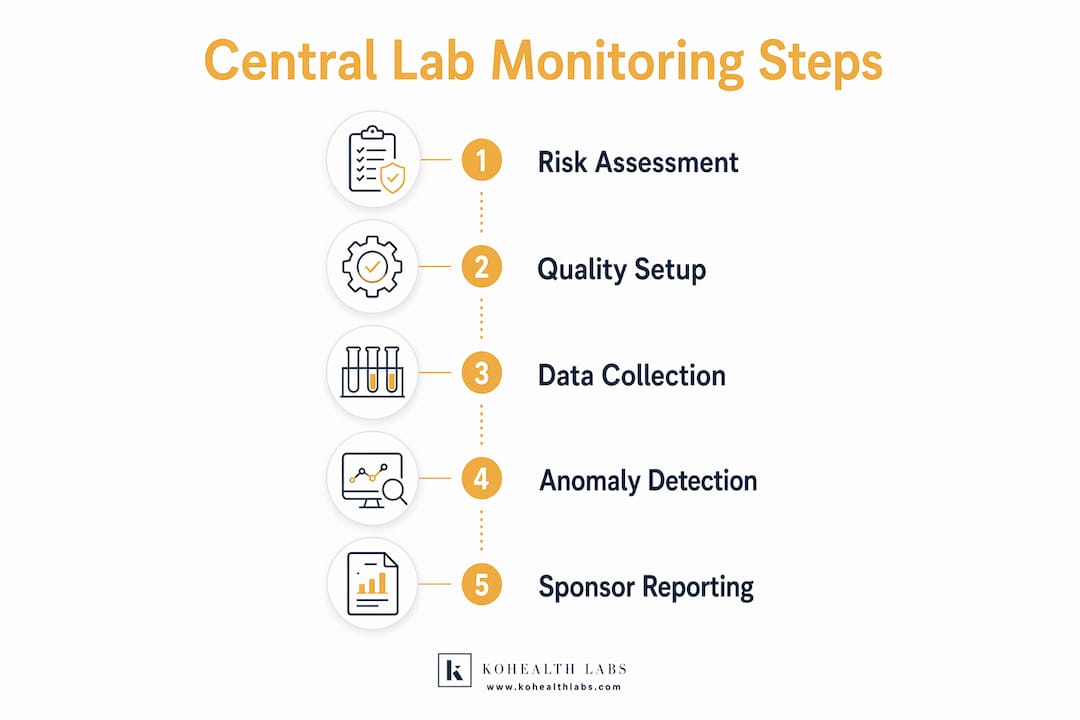
The shift matters because global trial complexity has grown faster than monitoring capacity. Transitioning from 100% source data verification to risk-based monitoring driven by centralized data analysis is no longer optional. It is the only practical way to manage the data volume generated by large, multinational studies.
Central labs integrate into risk-based monitoring frameworks through several concrete mechanisms:
- Key Risk Indicator feeds. Central lab systems export lab abnormality rates, missing sample flags, and protocol deviation alerts directly into centralized monitoring platforms. Sponsors can track these Key Risk Indicators in near real time.
- Quality Tolerance Limit triggers. When lab data crosses a predefined Quality Tolerance Limit, the central lab flags the event automatically. Sponsors receive structured alerts rather than discovering problems during site visits.
- Critical-to-Quality factor alignment. ICH E6(R3) requires sponsors to identify Critical-to-Quality factors for each trial. Central labs map their testing panels directly to those factors, so every data point has a defined oversight purpose.
- Centralized data integration. Lab results flow into unified data platforms alongside clinical and safety data, giving sponsor oversight teams a complete picture rather than siloed reports.
Pro Tip: Set Quality Tolerance Limits for your central lab's key analytes before the first patient is enrolled. Waiting until data accumulates means you are reacting to problems rather than preventing them.
75% of large sponsors have implemented or are piloting centralized and risk-based monitoring strategies. That adoption rate signals a structural shift in how sponsors fulfill their oversight obligations, and central labs are the data backbone of that shift.
What governance challenges do sponsors face in central lab oversight?
Poor sponsor governance drives recurring oversight failures more reliably than poor vendor performance. Sponsors with strong audit authority face fewer FDA Form 483 findings. That correlation is not coincidental. Internal audit independence is the single most reliable predictor of compliance outcomes.
"Structural sponsor oversight failures stem from inadequate internal audits and governance, not solely from vendor performance issues. Strong audit independence correlates directly with better compliance outcomes."
One of the most common and costly governance errors is budgeting. Including central lab analytical costs in site budgets creates double-billing risk. Site budgets cover local sample collection and shipping. Central lab analysis requires a separate direct agreement between the sponsor and the lab. Sponsors who conflate these cost streams create financial and contractual ambiguity that auditors flag.
Common governance failures sponsors must address:
- Absence of a direct commercial agreement between sponsor and central lab
- Inadequate audit schedules that treat central labs as low-risk vendors
- Failure to document oversight activities in the Trial Master File
- Relying on CRO-managed lab relationships without independent sponsor visibility
- No defined escalation path when lab Quality Tolerance Limits are breached
A network of independent, best-fit labs often outperforms integrated CRO lab models for complex, global biomarker trials. CRO internal labs may not handle niche assays or regional regulatory requirements at the level a specialized independent lab can. Sponsors running complex protocols should evaluate this trade-off explicitly during vendor qualification.
Practical steps to optimize central lab collaboration and trial compliance
Vendor qualification for central labs requires more than a standard quality audit. You need to assess assay-specific capabilities, sample stability data, cold-chain validation records, and the lab's experience with your specific therapeutic area. A lab that excels at oncology biomarkers may not be the right fit for a rare disease protocol requiring specialized metabolic assays.
Early collaboration between sponsors and central labs before protocol finalization prevents costly amendments. Assay validation timelines, sample volume requirements, and stability data all affect protocol design. Sponsors who engage central labs after the protocol is locked often discover that their sample collection windows are incompatible with the lab's stability data.
Pro Tip: Request a pre-study assay validation report from your central lab before site initiation. This document confirms that the lab's methods are fit for your specific analytes and gives you a defensible record for regulatory submissions.
Best practices for managing central lab partnerships:
- Conduct a technical audit covering assay validation, equipment calibration, and proficiency testing records
- Negotiate a quality agreement that defines turnaround times, alert thresholds, and data delivery formats
- Align the central lab's data output format with your centralized monitoring platform before the trial starts
- Require the lab to participate in protocol training alongside clinical site staff
- Schedule quarterly oversight calls with the lab's quality and operations teams throughout the trial
Centralized data platforms that unify lab, clinical, and safety data give sponsor oversight teams the visibility they need to act on signals quickly. Kohealth Labs delivers analysis-ready data bundles that combine laboratory results with radiology and clinical data in a single contract, removing the vendor fragmentation that slows sponsor response times. For sponsors managing biomarker-driven protocols, that integration directly reduces the time between data generation and oversight decision.
Key Takeaways
Central labs are not peripheral service providers. They are the data infrastructure that makes evidence-based sponsor oversight possible under ICH E6(R3) and risk-based monitoring frameworks.
| Point | Details |
|---|---|
| Standardization drives compliance | Central labs apply harmonized assays and universal reference ranges, making cross-site data comparable for regulators. |
| ICH E6(R3) requires lab integration | Sponsors must link central lab data to Key Risk Indicators and Quality Tolerance Limits to meet current regulatory expectations. |
| Governance failures are structural | Form 483 findings correlate with weak internal audit functions, not just vendor performance gaps. |
| Budget separation prevents double billing | Central lab analytical costs must be contracted directly with the sponsor, separate from site budgets. |
| Early engagement protects protocol integrity | Assay validation and sample stability data must inform protocol design before site initiation begins. |
Kohealth Labs' perspective on central lab oversight
The sponsors who struggle most with central lab oversight share one trait: they treat lab management as a procurement task rather than a clinical governance function. After working with CROs and pharma sponsors across complex, multi-site trials, the pattern is consistent. The teams that get it right build oversight into the lab relationship from day one. They define Quality Tolerance Limits before enrollment opens, they schedule independent audits regardless of the CRO's assurances, and they insist on direct contractual relationships with the lab.
The regulatory environment has made this non-negotiable. ICH E6(R3) does not give sponsors the option of delegating oversight and walking away. The sponsor remains accountable for the quality of every data point, including every lab result. That accountability cannot be contracted out.
The most underused tool in sponsor oversight is the pre-study technical audit. Most sponsors conduct a paper-based qualification review. The sponsors with the cleanest regulatory records conduct on-site audits that include live assay demonstrations and cold-chain walk-throughs. That level of rigor is not excessive. It is proportionate to the risk that a single lab failure can invalidate months of trial data.
The future of pharma sponsor monitoring runs through integrated data. Lab results, radiology reads, and clinical outcomes need to flow into a single oversight platform. Sponsors who still manage these streams separately are creating blind spots that regulators will find before they do.
— Kohealth Labs
Kohealth Labs: integrated diagnostics for sponsor oversight
Sponsor oversight depends on data you can trust, delivered fast enough to act on. Kohealth Labs provides integrated clinical diagnostics that combine laboratory services, radiology, and AI-driven data analysis under a single contract, giving your oversight team one source of truth instead of multiple vendor reports to reconcile.
Kohealth Labs covers over 100 biomarkers and applies AI to flag deviations and support compliance before they become Form 483 findings. The single-contract model removes the vendor fragmentation that slows sponsor response times and creates budget ambiguity. For CROs and pharma sponsors running complex global trials, that means faster completions, cleaner data, and stronger regulatory standing. Connect with Kohealth Labs to see how AI-powered data oversight fits your trial's monitoring framework.
FAQ
What is the role of a central lab in pharma sponsor oversight?
A central lab standardizes sample testing, generates harmonized data, and feeds Key Risk Indicators into sponsor monitoring platforms. This function is central to fulfilling ICH E6(R3) requirements for evidence-based, risk-proportionate oversight.
How do central labs support risk-based monitoring?
Central labs export lab abnormality rates, missing sample alerts, and protocol deviation flags into centralized monitoring systems. These data feeds allow sponsors to track Quality Tolerance Limits and respond to signals without relying solely on site visits.
What are the most common sponsor governance failures in central lab management?
The most common failures include missing direct commercial agreements with the central lab, inadequate audit schedules, and including lab analytical costs in site budgets, which creates double-billing risk.
How does ICH E6(R3) affect central lab responsibilities?
ICH E6(R3) requires sponsors to link trial risks to oversight intensity using centralized data, including lab results. Central labs must align their data outputs with the sponsor's Critical-to-Quality factors and Quality Tolerance Limits defined in the monitoring plan.
When should sponsors engage a central lab in trial planning?
Sponsors should engage a central lab before protocol finalization. Assay validation timelines and sample stability data directly affect protocol design, and late engagement frequently requires costly amendments after site initiation.