
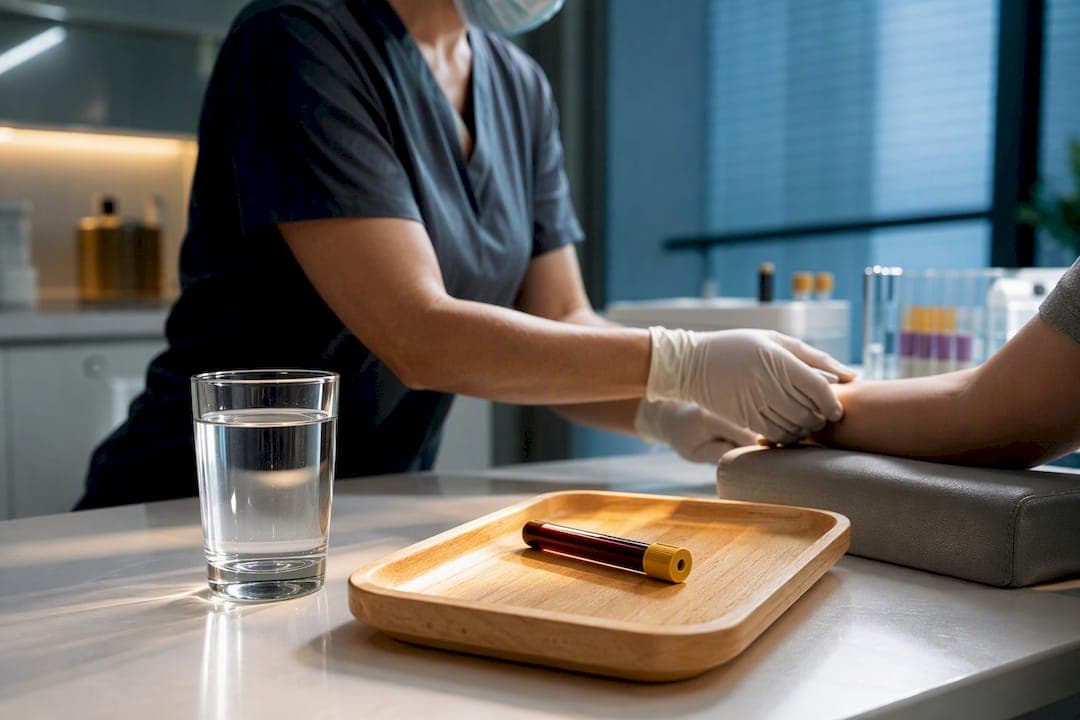
Fasting glucose, fasting insulin (and HOMA-IR calculations), triglycerides, and baseline oral glucose tolerance testing require a genuine fast, as explained in Biomarker im Alltag – Was sie für Patienten bedeuten. The standard window is 8 to 12 hours, and patients can drink plain water throughout. Most other routine work, including HbA1c, TSH, CBC, and standard chemistries, does not need fasting at all, and ordering it anyway just adds friction for no clinical benefit.
TL;DR:
- Fasting glucose, insulin, HOMA-IR, triglycerides, and OGTT baseline tests require 8 to 12 hours of fasting, with water allowed but no caloric beverages or alcohol.
- Routine tests like HbA1c, TSH, CBC, and kidney function do not need fasting and should not be unnecessarily delayed by fasting protocols.
- Clear and specific instructions, including documentation of the last meal and fasting duration, are essential to ensure sample reliability and reduce preanalytic errors.
- Over-fasting beyond 16 hours offers no benefits and can increase risks, particularly for elderly or diabetic patients needing tailored guidance.
- Clinics can improve sample quality by automating fasting instructions, reserving morning slots for fasting tests, and verifying fasting status at collection.
Which Biomarkers Actually Require Fasting?
Not every test on a requisition needs an empty stomach, and treating fasting as a default rather than a targeted decision is one of the more common preanalytical mistakes practices make. The tests where fasting genuinely changes the result cluster into a short, well-defined list.
- Fasting glucose — requires 8 to 12 hours without food or caloric beverages; a meal within that window can raise glucose enough to misclassify a patient's metabolic status.
- Fasting insulin and HOMA-IR — depends on the same fasting window as glucose, since the calculation pairs the two values directly.
- Triglycerides — a 9 to 12 hour fast is preferred for diagnostic accuracy, though routine nonfasting lipid testing is now considered acceptable for general screening under the 2016 European Atherosclerosis Society and EFLM consensus.
- Baseline sample for oral glucose tolerance testing (OGTT) — the fasting draw anchors the entire test; a compromised baseline can invalidate the whole panel.
A second tier of tests falls into "sometimes helpful" territory. Iron studies and select metabolic markers can shift modestly with recent food intake, so some practices prefer a fast for these when precision matters. That said, the effect is smaller than what you see with triglycerides or glucose, and it rarely changes a treatment decision on its own.
Fasting cut-point: When a nonfasting triglyceride result comes back above roughly 440 mg/dL (5 mmol/L), current guidance recommends repeating the test fasting before making lipid-lowering decisions based on that number.
Then there is the list clinicians should stop fasting patients for. HbA1c reflects average glucose over roughly three months, so a single meal is irrelevant. TSH, CBC, creatinine and eGFR, CRP, and PSA are minimally affected by recent food intake. Fasting these tests unnecessarily creates a real barrier for patients, particularly diabetics and older adults who tolerate prolonged fasts poorly, and it adds no diagnostic value in return.
What Should Patients Be Told Before Their Draw?
The instructions patients actually receive determine whether your fasting sample is usable or not, and vague language ("don't eat before your test") is where most preanalytic errors start. Here is language you can paste directly into appointment reminders, patient portals, or requisition notes.
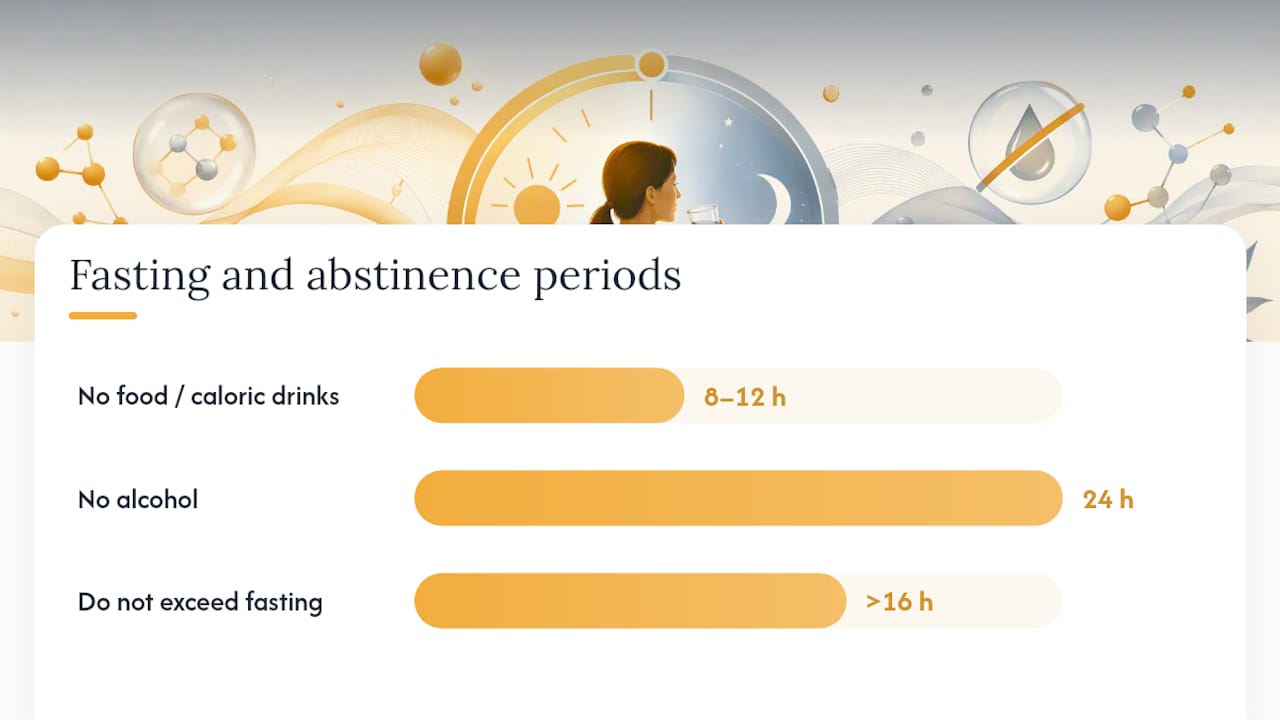
- No food or caloric beverages for 8 to 12 hours before the draw. This is the standard fasting window MedlinePlus recommends for most fasting-dependent tests.
- Plain water is allowed, including right up until arrival. A single glass consumed within an hour of the draw produces no clinically significant change in most routine analytes, so there is no reason to restrict water intake.
- No alcohol for 24 hours before the appointment.
- No smoking, gum, or strenuous exercise the morning of collection.
- Black coffee still counts as breaking the fast for glucose, insulin, and triglyceride-sensitive testing, even without sugar or cream.
- Take medications as prescribed unless the ordering clinician says otherwise. Patients on insulin or other hypoglycemic agents need individualized guidance, since a standard fast paired with a normal insulin dose can trigger hypoglycemia.
- Schedule morning appointments whenever fasting is required, and always record the time of the last meal on the requisition.
Pro Tip: Build a simple triage rule into your front-desk workflow: if a patient admits to eating within the fasting window, don't cancel automatically. Ask what and when, note it on the requisition, and let the ordering clinician decide whether to proceed, reschedule, or interpret the result with that context in mind.
One more note on duration: longer is not better. Fasting beyond 16 hours offers no analytic benefit and raises the risk of hypoglycemia or orthostatic symptoms, particularly in older or diabetic patients. Stick to the window, not the extreme.
How Can Clinics Reduce Rejected or Unreliable Samples?
Most fasting-related sample problems trace back to a workflow gap, not a lab error. Building fasting compliance into your systems, rather than hoping front-desk staff remember to mention it, closes that gap.
- Automate instruction insertion. Configure EHR order sets so fasting-dependent tests automatically append patient instructions and require a "last meal" field before the order can be finalized.
- Reserve morning slots for fasting draws and flag high-risk tests (OGTT, fasting insulin) for extra scheduling attention.
- Confirm fasting status at the point of collection. Phlebotomy staff should ask directly, document any exceptions on the tube label, and follow a clear local rule for when to proceed versus reschedule.
- Process labile analytes promptly. Delayed centrifugation and postprandial effects can persist for several hours across triglycerides, liver enzymes, and electrolytes, so specimen handling speed matters as much as fasting itself.
- Apply a consistent repeat-testing threshold. When triglycerides return above the roughly 440 mg/dL (5 mmol/L) cut-point on a nonfasting sample, route the case for a fasting repeat rather than leaving the decision to individual judgment call by call.
Why standardization matters: The EFLM Working Group on the Preanalytical Phase places responsibility for fasting protocols squarely on the ordering institution, not the lab receiving the sample. A written, practice-wide protocol, consistently applied, prevents the kind of case-by-case variability that shows up as inconsistent results across providers in the same clinic.
Resources like Kohealth Labs's breakdown of preanalytical error sources walk through where these errors typically enter the workflow, which is useful reading for practices auditing their own process.
Does Fasting Affect Lipoprotein(a) and Other Emerging Biomarkers?
Lipoprotein(a), often abbreviated Lp(a), behaves differently from triglycerides in one important respect: it is genetically determined and largely stable regardless of recent food intake. Clinicians increasingly order it as part of expanded cardiovascular risk panels, and the good news operationally is that it does not require fasting for accurate interpretation.
That distinction matters for scheduling. A patient coming in for a triglyceride-sensitive lipid panel alongside an Lp(a) order still needs to fast, but the fasting requirement is being driven by the triglyceride component, not the Lp(a) itself. If a future order includes Lp(a) alone, or paired only with markers like ApoB that are also relatively food-insensitive, there is no clinical reason to impose a fasting window on that patient.
Other emerging cardiometabolic markers, including certain inflammatory panels and advanced lipid subfractions, vary in their food sensitivity, and the evidence base for many of them is still developing. The safest default for a newer or less-established biomarker is to check the assay's own validation data rather than assume fasting rules from adjacent, better-studied tests apply automatically. When in doubt, a quick call to your laboratory partner about a specific analyte's food sensitivity takes less time than misinterpreting a result later. Kohealth Labs's testing menu lists preparation notes for individual assays, which is worth checking before assuming a new marker follows old rules.
Do Fasting Rules Change for Pediatric, Elderly, or Diabetic Patients?
The 8 to 12 hour window is a reasonable default for a healthy adult. It is not automatically safe or appropriate for every patient in your panel, and applying it uniformly can create real risk for certain populations.
Pediatric patients tolerate prolonged fasting poorly, both physiologically and behaviorally. Young children can develop hypoglycemia faster than adults, and a frightened, hungry child is also harder to draw successfully. Many pediatric protocols shorten the fasting window or schedule the earliest possible morning appointment specifically to minimize the total fasting time.
Elderly patients, particularly those who are frail or on multiple medications, face similar risk from extended fasting, including orthostatic symptoms and dehydration if water intake gets restricted along with food. Early-morning appointment slots and clear reassurance that water is permitted reduce this risk substantially, and some practices reasonably consider in-home phlebotomy for patients where a fasting visit to the clinic poses its own logistical burden.
Diabetic patients on insulin or other hypoglycemic medications need individualized instructions rather than the standard script. A patient who takes their normal insulin dose but skips the accompanying meal is at real risk of hypoglycemia during the fasting window. The safest approach is to have the ordering clinician, not the front desk, set medication timing for these patients specifically, and to document that guidance clearly on the chart.
How Do You Verify That a Patient Actually Fasted?
Verbal confirmation at check-in is the minimum standard, but it is not the same as verification, and relying on it alone leaves your data quality dependent on how well a stressed front-desk employee remembers to ask.
A short pre-visit questionnaire, delivered through a patient portal or a reminder text the evening before, works better because it gives patients time to plan their morning rather than being asked a yes-or-no question while already sitting in the waiting room. A simple three-question script covers most of what you need: When did you last eat or drink anything other than water? Have you had any alcohol in the last 24 hours? Have you taken your usual medications this morning?
At the point of collection, phlebotomy staff should ask the same questions again rather than assuming the portal answers still hold true. Patients forget, plans change, and someone who intended to fast sometimes grabs coffee with cream on the way to the appointment without thinking of it as "eating." Reconfirming at the draw catches these gaps before the sample is collected rather than after the result comes back looking odd.
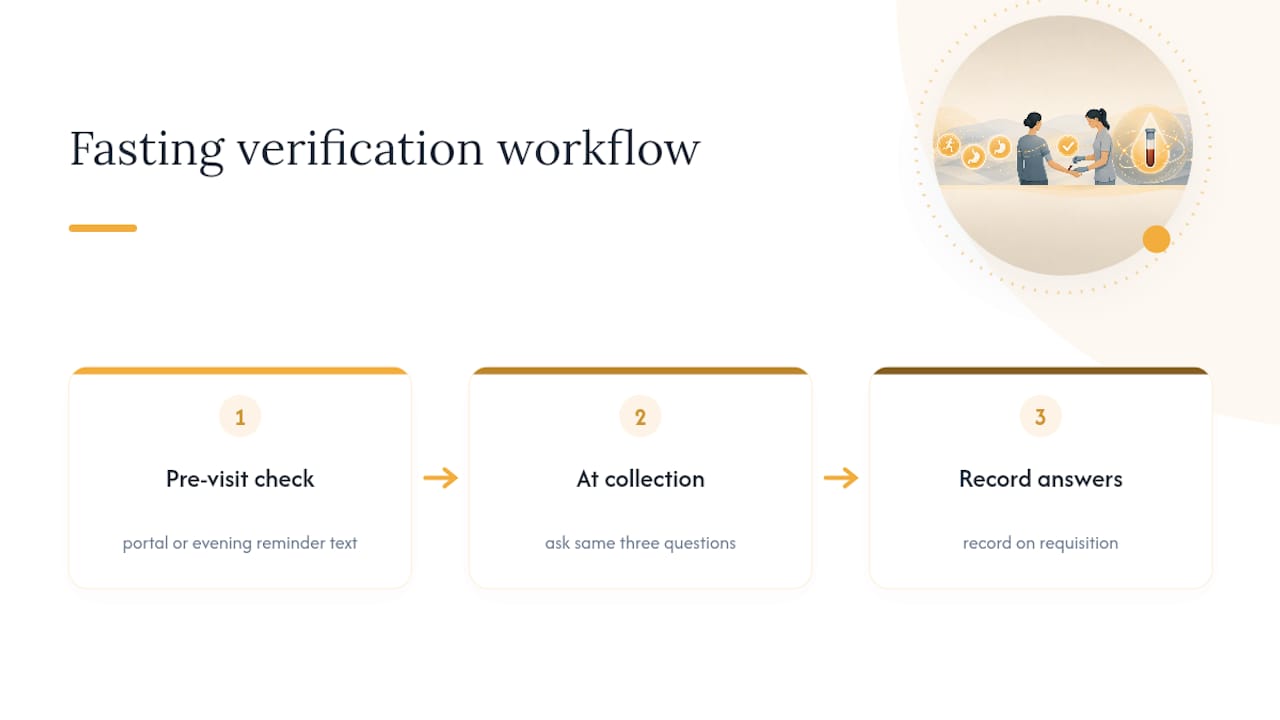
Whatever method you use, the answer needs to land somewhere permanent. A verbal "yes, I fasted" that never makes it onto the requisition is functionally the same as never having asked at all, since nobody downstream, including the interpreting clinician, has any record of it.
How Should Fasting Status Be Documented and Shared With the Team?
The single biggest gap in most clinics is not the fasting instruction itself. It is what happens to that information after the patient answers the question.
A mandatory "time since last meal" field on the requisition and in the LIS record solves most of this problem on its own. Rather than a binary fasted/not-fasted checkbox, capturing the actual time last eaten gives the interpreting clinician and the lab meaningful context instead of forcing a rejection or a guess. A triglyceride result drawn three hours after a light snack tells a different story than one drawn immediately after a large meal, and only a time-stamped field preserves that distinction.
This information needs to travel with the sample, not just live in the patient's chart. Phlebotomy staff should note any fasting exceptions directly on the tube label or the accompanying paperwork, so the detail reaches the lab even if the front-desk software and the LIS don't talk to each other perfectly. When the lab knows a sample came from an imperfect fast, it can flag the result with interpretive context rather than silently reporting a number that looks abnormal for reasons that have nothing to do with the patient's actual health.
For multi-provider practices, consistency across the team matters as much as the documentation itself. If one provider's patients get a clear written fasting script and another's get a verbal mention in passing, your triglyceride and glucose data will carry more noise from staff variation than from any real clinical difference between patient populations.
What Should Staff Do When a Patient Shows Up Not Fasting?
A patient who ate breakfast on the way to a fasting lipid panel is not a crisis. It is a routine event that a good workflow handles in under a minute, without turning it into an argument at the front desk.
The first step is triage, not automatic rejection. Ask what was eaten and when. A patient who had black coffee two hours ago is a different situation than one who had a full meal thirty minutes ago, and the right response depends on which test was ordered and how sensitive it is to recent food intake.
For tests that don't actually need fasting, like HbA1c or CBC, proceed with the draw regardless and skip the friction entirely. For genuinely fasting-dependent tests, the practical options are: draw anyway and clearly document the nonfasting status for interpretive context, or reschedule for a proper fasting appointment. Which option makes sense depends on urgency. A diabetic patient's provider deciding on medication changes today may prefer a documented nonfasting result over a two-week delay, while a routine annual lipid screen can usually wait.
Whichever path staff choose, the decision and its reasoning belong on the record, not just in someone's memory. A brief note, "patient reports coffee with cream two hours prior, proceeding per provider instruction," protects the integrity of the result and gives the interpreting clinician exactly what they need to weigh the number correctly. Building this triage logic into your standard operating procedure ahead of time means front-desk staff aren't improvising a clinical judgment call under time pressure.
The Kohealth Labs Perspective: Fixing Fasting Logistics at the System Level
Most fasting errors don't happen because a patient was careless. They happen because a clinic's systems never gave the patient, or the front-desk staff, a clean, consistent instruction to follow in the first place. That is a solvable problem, and it's one Kohealth Labs is built to help practices solve directly.
We provide provider-facing fasting instruction templates that clinics can drop straight into appointment reminders and patient portals, paired with specimen pickup scheduling that supports the early-morning draws fasting tests require. For practices juggling multiple providers and inconsistent scripts, that kind of standardized language does more for data quality than any amount of staff retraining.
We can also configure requisition fields and electronic results delivery so the "last meal" information captured at the front desk actually reaches the interpreting clinician rather than getting lost between systems.
When you're evaluating any laboratory partner on preanalytic support, ask four questions: Do they offer written fasting protocols you can adapt? Can their order flow support configurable fasting flags? Do they offer specimen pickup for the morning draws fasting tests demand? And do they have a real quality assurance process behind the samples they process?
— Kohealth Labs
Ready to Simplify Fasting Logistics at Your Practice?
Some laboratory partners provide fasting instruction templates built into your workflow, plus specimen pickup timed to the early-morning draws that fasting-dependent tests require. Instead of your staff improvising patient scripts and hoping the timing works out, you get a laboratory partner that treats preanalytic accuracy as part of the service, not an afterthought.
If your practice orders fasting glucose, fasting insulin, triglycerides, or OGTT panels regularly, request fasting instruction templates from your laboratory partner and ask about specimen pickup scheduling built around your morning appointment slots. Our pathology laboratory services team can also walk you through LIS and EHR integration, so the "last meal" field you capture at check-in flows straight through to the result your provider reads, closing a gap that causes more misread results than most clinics realize. Reach out to get your practice onboarded and see how fast a properly integrated fasting workflow can run.
This article is general information, not a substitute for advice from a qualified doctor. Consult a qualified healthcare professional about your own circumstances before acting on anything here.
Sources
- Fasting for a blood test — MedlinePlus
- European Atherosclerosis Society and EFLM consensus on lipid testing (2016) — PMC
- EFLM working group recommendations on preanalytical phase (2014)
- Influence of water intake on clinical chemistry analytes — PMC
FAQ
How Long Should Patients Fast Before a Blood Test?
Most fasting-dependent tests require 8 to 12 hours without food or caloric beverages, with plain water permitted throughout the entire window.
Which Tests Do Not Require Fasting?
HbA1c, TSH, CBC, creatinine/eGFR, CRP, and PSA are minimally affected by recent food intake and do not need fasting instructions.
Can Patients Drink Water While Fasting for a Lab Test?
Yes. A single glass of water within an hour of the draw produces no clinically meaningful change in most routine analytes, so normal water intake should never be restricted.
What Triglyceride Level Requires a Repeat Fasting Test?
A nonfasting triglyceride result above roughly 440 mg/dL (5 mmol/L) warrants a repeat fasting sample before making lipid-related treatment decisions.
Does Kohealth Labs Help Clinics Manage Fasting Logistics?
Yes. Kohealth Labs offers provider-facing fasting instruction templates, specimen pickup for early-morning draws, and requisition and LIS integration to keep fasting status documented and visible to the care team.