

For federally funded clinical trials and public-health studies, the recommended contracting model is a single-contract, integrated diagnostics provider that delivers laboratory testing, clinical imaging, and AI-produced analysis-ready data bundles under one agreement. Procurement teams that split these functions across multiple vendors face data silos, slower interim analyses, and avoidable compliance gaps. The integrated model solves all three.
Before you issue an RFP, lock in three requirements:
- Require single-contract pricing that covers lab, imaging, logistics, and data normalization.
- Mandate CDISC SDTM/ADaM and HL7 FHIR delivery for all diagnostic outputs.
- Define SLA turnaround times for both specimen results and image reads in the contract.
Contact Kohealth Labs to request an RFP response or capability briefing.
What do federal diagnostic services actually include?

In the context of clinical research, "federal diagnostic services" refers to integrated diagnostic services contracted by or for federal agencies and clinical research organizations to support clinical trials and public-health studies. The term is not a regulatory category; it is a procurement description covering a bundled scope of work.
A complete federal diagnostics contract covers:
- Clinical imaging — acquisition, DICOM transfer, and centralized image reading
This scope explicitly excludes patient-facing Medicare and Medicaid clinical service procurement. The audience here is trial sponsors and government agencies managing evidence-generation programs, not individual patient coverage decisions.
Why integrated diagnostics materially improve federally funded trials
Pivotal trials have significantly increased the number of procedures and the volume of data over the past decade and a half. Managing that load across separate lab, imaging, and data vendors is no longer operationally viable. Fragmented vendor structures create data silos, and those silos are the primary barrier to real-time safety monitoring and confident interim analyses.
Unified diagnostic platforms directly address this. When lab and imaging data flow through a single normalized pipeline, safety signals surface faster and interim decisions carry more statistical confidence.
Practical benefits of the integrated model:
- Faster study startup through pre-aligned protocols and a single onboarding process
- Fewer data queries because harmonized workflows reduce cleaning errors at the source
- Real-time safety monitoring enabled by unified data feeds rather than reconciled exports
- Regulatory readiness from day one, with CDISC and HL7 FHIR outputs built into delivery
What regulatory and data-quality standards does your vendor need to meet?
The direct answer: require protocol-aligned imaging charters, CDISC-ready datasets, DICOM files with full metadata, and 21 CFR Part 11-compliant audit trails before you sign any contract.
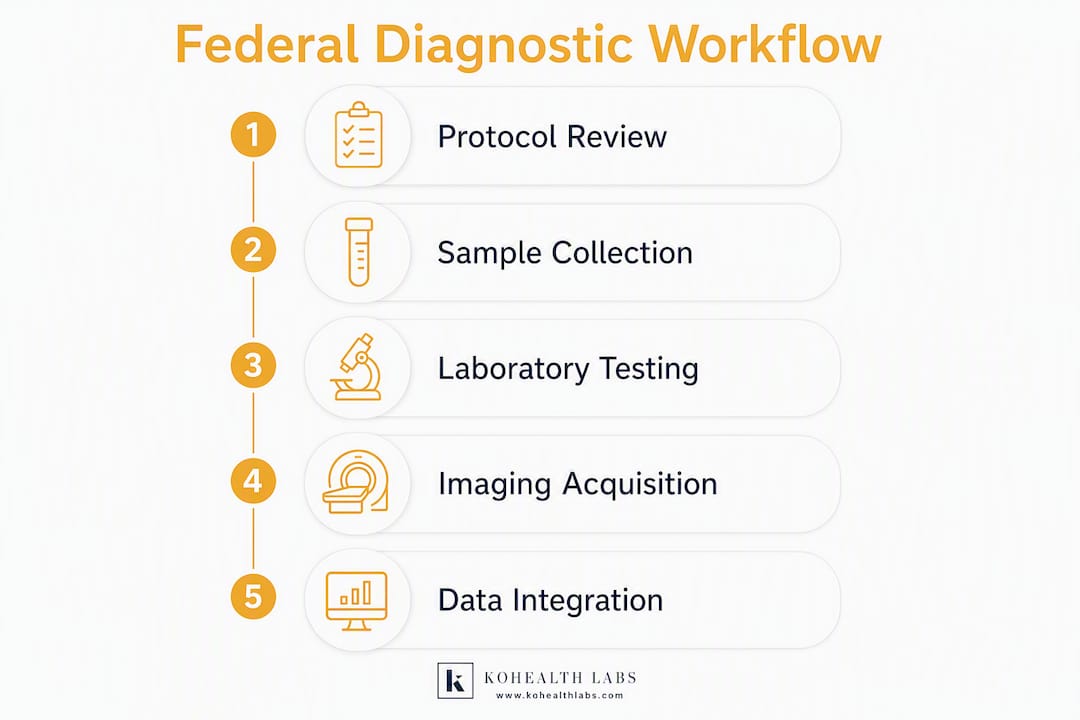
FDA guidance specifies that imaging charters must define acquisition protocols, equipment requirements, transfer mechanisms, and archiving procedures to maintain data integrity across sites. Sponsors who skip this step face the most common regulatory pitfall in imaging-endpoint trials: site-level variability that cannot be corrected after the fact.
Required deliverables checklist:
- Imaging charter covering site qualification, acquisition SOPs, and equipment standards
- Image transfer logs and archiving documentation accessible for FDA audit
- LIMS output mapping to CDISC SDTM and ADaM domains
- Chain-of-custody records for all specimens
- eCTD-ready datasets for regulatory submission
- HIPAA-compliant data handling and documented retention schedules
Security expectations extend to genomic and pharmacogenomic data. Specialty reporting workflows require version control, standards alignment, and secure transmission protocols. For labs adding PGx reporting services, these requirements apply from the first report delivered.
Pro Tip: Include imaging charter review as a standing agenda item at your end-of-Phase 2 meeting. Catching acquisition protocol gaps before Phase 3 enrollment saves months of remediation.
What operational capabilities must a federal diagnostics vendor demonstrate?
The core requirement is single-contract delivery. A vendor that cannot cover lab, imaging, logistics, and analysis-ready data under one agreement forces you to manage integration yourself, which defeats the purpose.
Mandatory capabilities to require in proposals:
- Mobile phlebotomy and site support for distributed study populations
- Nationwide imaging coverage with centralized, qualified image reading
- LIMS and DICOM integration with direct API access for sponsor EDC systems
- eCRF/EDC connectors compatible with major clinical data management platforms
- Dedicated CRO onboarding team with protocol-specific training for site staff
- AI-driven quality control that flags anomalies before data reaches the sponsor
The table below maps required outputs to standard delivery formats:
| Diagnostic Output | Source Format | Required Delivery Format |
|---|---|---|
| Laboratory results | LIMS export | CDISC SDTM / ADaM |
| Clinical images | DICOM | Annotated DICOM + reader reports |
| Imaging metadata | Site acquisition logs | DICOM header + transfer logs |
| Audit and chain-of-custody | Specimen tracking records | 21 CFR Part 11-compliant audit trail |
| Genomic / PGx results | Assay output | Standards-aligned specialty report |
| Analysis-ready bundles | Normalized multi-source data | HL7 FHIR API or sponsor-specified format |
AI-driven analysis-ready bundles save weeks in statistical review because data arrive protocol-aligned and anomaly-checked. That is the difference between a vendor delivering files and a vendor delivering evidence.
How should procurement evaluate and contract federal diagnostics vendors?
Evaluate vendors on four axes: regulatory compliance, SLA performance, data deliverable quality, and demonstrated federal trial experience. A vendor with strong lab credentials but no imaging charter experience is a partial solution.
Evaluation checklist:
- Security certifications relevant to federal data handling (SOC 2 Type II minimum)
- GxP-compliant sample handling SOPs with documented deviation management
- Disaster recovery and business continuity plans for specimen and data loss scenarios
- References from federally funded or FDA-regulated trials with similar scope
- Transition plan for mid-study vendor changes (a risk often underweighted in RFPs)
Contract clauses to negotiate:
- Data ownership: Sponsor retains full ownership of all raw and processed diagnostic data.
- Audit rights: Sponsor and federal agency retain the right to audit vendor facilities and records.
- Turnaround SLAs: Define specific timeframes for lab results, image reads, and data bundle delivery, with financial remedies for breach.
- Liability limits: Negotiate caps that reflect the cost of a delayed interim analysis, not just the cost of the test.
- Change control: Require written approval for any protocol deviation, assay substitution, or imaging equipment change.
- IP and data reuse: Prohibit vendor use of sponsor data for any purpose outside the contracted study.
Documentation of imaging transfer and archiving is critical for FDA audits. Loss of imaging records can compromise regulatory verification, so archival obligations belong in the contract, not just the SOPs.
What does implementation actually look like, and what drives cost?
Expect a phased timeline:
- Protocol alignment and charter development (2–4 weeks): Define assay panels, imaging modalities, acquisition protocols, and data delivery specifications.
- Kit procurement and logistics setup (2–3 weeks): Manufacture and distribute specimen kits; establish courier routes and cold-chain logistics.
- Site training and qualification (1–3 weeks, variable by site count): Train site staff on collection procedures, imaging acquisition, and portal access.
- Go-live and first data delivery (week 6–8 from contract execution, typical): First specimens collected, first images transferred, first data bundle delivered.
- Steady-state operations: Ongoing specimen pickup, image reads, AI QC, and data delivery per protocol schedule.
Delays most often occur at site training and kit distribution, particularly for multi-site federal studies with geographically dispersed populations.
Primary cost drivers:
- Assay complexity and the number of specialty biomarker panels required
- Imaging modality coverage (MRI, CT, PET, and ultrasound each carry different reader costs)
- Geographic footprint and courier logistics for remote or rural sites
- Data normalization effort when legacy EDC systems require custom API connectors
- Specialist reader costs for therapeutic-area-specific image interpretation
How Kohealth Labs demonstrates the integrated model in practice
Integrated delivery reduces query volume and shortens interim analysis timelines. That is the direct outcome when a single vendor manages lab, imaging, and data normalization under one protocol-aligned contract.
Kohealth Labs provides exactly this model for CROs and government agencies. Its government solutions platform combines laboratory diagnostics, radiology services, and AI-driven quality control into analysis-ready bundles built for federal trial requirements. Coverage spans 100+ biomarkers and genomic panels, with DICOM and CDISC delivery as standard outputs.
Key proof points:
- Single contract covering phlebotomy, imaging, courier logistics, and data normalization
- AI QC that flags anomalies and deviations before data reaches the sponsor's statistical team
- Dedicated CRO onboarding with protocol-specific site training
- Unified diagnostics workflows that reduce errors by harmonizing sample handling and data-cleaning rules
"AI success in clinical trials hinges on normalized inputs. Analysis-ready bundles save weeks in statistical analysis because data are already protocol-aligned and anomaly-checked before they reach the sponsor." — Clinical Trial Data Integration research
What should your RFP and RFI actually ask?
Issue an RFI first to validate capability, then follow with an RFP that makes regulatory compliance and data deliverables mandatory, not preferred.
Documents to request in the RFI/RFP:
- Sample imaging charter from a completed FDA-regulated trial
- CDISC SDTM/ADaM dataset examples with data dictionary
- Site onboarding and training plan with timeline estimates
- Security and compliance reports (SOC 2, GxP audit summaries)
- References from two or more federally funded or FDA-regulated studies
Sample RFP questions by category:
Regulatory and data quality:
- How do you ensure imaging acquisition protocols remain consistent across sites with different equipment?
- Describe your 21 CFR Part 11-compliant audit trail for specimen chain-of-custody.
- What is your process for mapping LIMS outputs to CDISC SDTM domains?
Operations and logistics:
- What is your nationwide phlebotomy and courier coverage for rural and remote sites?
- How do you manage cold-chain integrity for temperature-sensitive specimens?
SLAs and pricing:
- What are your standard turnaround times for lab results, image reads, and data bundle delivery?
- What financial remedies apply when SLA thresholds are missed?
Technical and data deliverables:
- Do you support HL7 FHIR API delivery for real-time data exchange with sponsor EDC systems?
- How does your AI QC process identify and flag protocol deviations in imaging data?
Key Takeaways
A single-contract integrated diagnostics provider delivering lab, imaging, and AI-produced analysis-ready data bundles is the most effective model for federally funded clinical trials and public-health studies.
| Point | Details |
|---|---|
| Single-contract model | Require one vendor to cover lab, imaging, logistics, and data normalization to eliminate silos. |
| Mandatory data formats | All outputs must meet CDISC SDTM/ADaM, HL7 FHIR, and DICOM standards for regulatory submission. |
| Imaging charter first | Define acquisition protocols, equipment standards, and transfer mechanisms before site activation. |
| Contract clauses that matter | Secure data ownership, audit rights, turnaround SLAs, and change-control provisions in writing. |
| Kohealth Labs | Provides the single-contract integrated model with AI QC, 100+ biomarker coverage, and CDISC/DICOM delivery for federal trials. |
Why integrated diagnostics are now a strategic necessity for federal research
The conventional wisdom in federal procurement still treats lab and imaging as separate line items. That approach made sense when trial complexity was manageable. It does not make sense now.
Pivotal trials are generating far more data than they were a decade ago, and regulatory expectations for data integrity have only grown stricter. Agencies and sponsors that continue to manage fragmented diagnostic vendors are accepting operational risk that integrated models have already solved. The regulatory pressure is real: FDA expects imaging charters, documented audit trails, and submission-ready datasets, and those expectations apply whether you have one vendor or five. The difference is that a single integrated vendor builds compliance into the workflow rather than leaving sponsors to reconcile it across contracts.
Procurement teams that shift to integrated diagnostics now reduce mission risk, shorten timelines, and arrive at interim analyses with cleaner data. That is not a marginal improvement. For a federally funded study where a delayed safety signal carries real consequences, it is the right call.
Kohealth Labs delivers the integrated model federal trials require
Kohealth Labs offers something most diagnostic vendors cannot: a single contract that covers laboratory testing, clinical imaging, AI-driven quality control, and analysis-ready data delivery built to federal regulatory standards. For CROs and government agencies that need CDISC, DICOM, and HL7 FHIR outputs without managing three separate vendor relationships, that is a concrete operational advantage.
Core capabilities relevant to federal procurement:
- 100+ biomarker and genomic panel coverage with CDISC-ready outputs
- Nationwide phlebotomy, courier logistics, and centralized image reading
- AI QC that identifies deviations before data reaches your statistical team
- Dedicated clinical trials onboarding with protocol-specific site training
- AI-driven data bundles delivered analysis-ready for immediate statistical review
Ready to respond to your RFP or schedule a capability briefing? Contact Kohealth Labs to get started.