

Specialty lab reporting is the process of generating and delivering detailed, accurate diagnostic data that directly shapes clinical decisions and patient outcomes. Roughly 70% of clinical diagnoses rely on laboratory data, making the quality and speed of lab reports a direct driver of care quality. Standards from the CDC and the American Medical Association (AMA) both treat lab reporting not as a back-office function but as a core clinical communication tool. When specialty lab reports are accurate, accessible, and integrated with electronic health records (EHR), clinicians make faster and better decisions. Kohealth Labs builds its diagnostic model on exactly this principle, combining laboratory services, radiology, and AI-driven data quality into a single, analysis-ready workflow.
How does specialty lab reporting enhance care quality in clinical workflows?
Specialty lab reporting improves care quality most directly by removing the manual steps that slow diagnosis and introduce errors. Integrating specialty lab ordering into EHR reduces order placement time by 70%, saving thousands of clinical hours annually. That time savings translates directly into faster treatment decisions and fewer delays for patients.
The operational gains go beyond speed. When lab data flows directly into a patient chart as discrete, structured data, it feeds clinical decision support tools automatically. One health system eliminated manual faxing and data re-entry and saved over 3,100 clinical hours in a single year. That is time clinical staff redirected to patient care rather than paperwork.

The benefits of lab reporting integration extend to preventive care as well. Integrated specialty ordering produced a 45% increase in preventive cancer screening tests at one health system, with easier result tracking across care teams. Discrete data in the chart means no result gets buried in a fax queue or missed during a shift change.
Key workflow improvements from EHR-integrated specialty lab reporting include:
- Elimination of manual faxing and phone-based result retrieval
- Automatic population of lab results into structured patient chart fields
- Reduced duplicate ordering caused by lost or delayed results
- Faster specialist-to-primary-care communication on abnormal findings
- Consistent audit trails for regulatory compliance
Pro Tip: Monitor your EHR-LIS interface continuously. A minor coding update in a lab information system (LIS) can silently block orders and delay thousands of reports before anyone notices the problem.
What features make specialty lab reports most useful for clinicians?
Report quality determines whether a clinician acts quickly or calls the lab for clarification. Physician satisfaction improves significantly when reports include clear layouts, annotations, and embedded clinical decision support. Speed matters, but clarity drives satisfaction more than turnaround time alone.
Effective specialty lab reports share several structural features. Rule-based, customizable templates allow labs to present results in formats that match clinical context, whether that is a nephrology panel, a lipid profile, or a complex biomarker assessment. Diagrams, reference range annotations, and flagged abnormal values reduce the cognitive work a clinician must do to interpret a result. Less cognitive load means fewer interpretation errors.
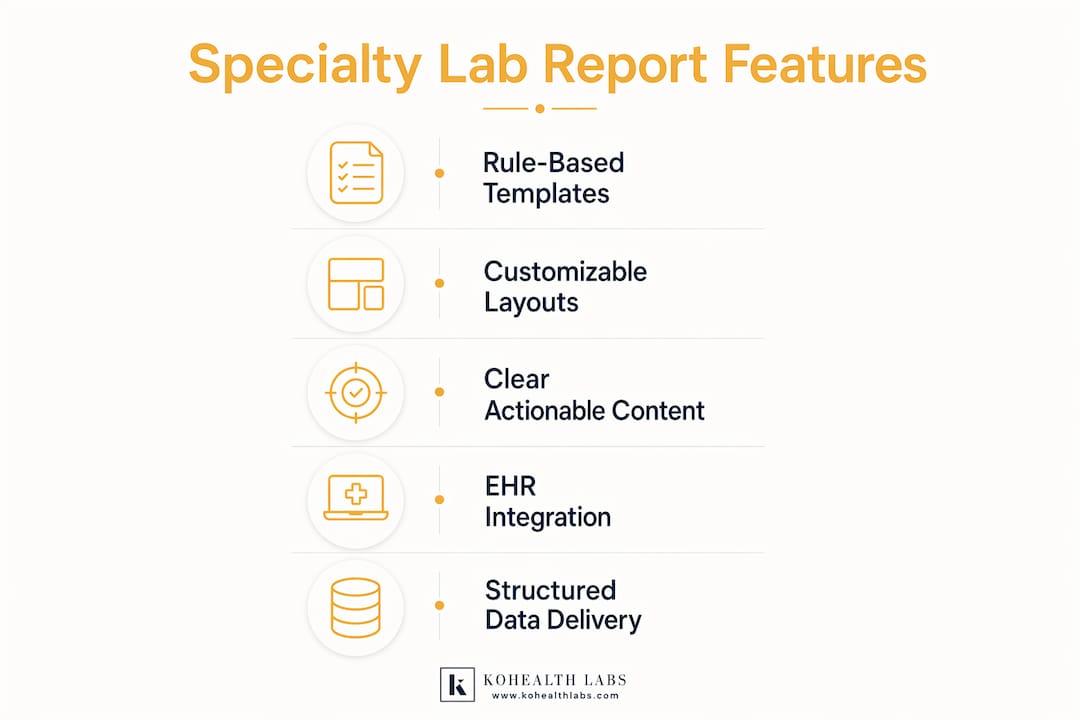
Embedded clinical decision support takes this further. When a report includes an alert tied to a critical value or a link to a relevant clinical guideline, the clinician receives both the data and the next-step context in one view. Electronic laboratory reporting (ELR) standards, including HL7 and FHIR message formats, make this kind of structured, actionable reporting possible across different health systems and public health agencies.
The most effective report formats for clinical settings include:
- PDF reports with annotated reference ranges and flagged critical values
- HL7 and FHIR structured messages for direct EHR integration
- XML data feeds for automated population of decision support tools
- Visual trend graphs for biomarkers tracked over multiple visits
Pro Tip: Prioritize report clarity and actionable content over raw speed. A fast report that requires three follow-up calls to interpret costs more time than a slightly slower report that answers the clinical question directly.
How does specialty lab reporting impact patient outcomes and care metrics?
The impact of specialty labs on care is measurable at the patient level. Because roughly 70% of clinical decisions depend on lab data, any improvement in report accuracy or delivery speed has a direct effect on diagnosis timing and treatment selection. Faster identification of acute conditions, such as acute kidney injury or sepsis markers, gives clinicians the window they need to intervene before a condition deteriorates.
Iterative specialty lab testing, which tracks specific biomarkers over time rather than capturing a single snapshot, gives clinicians a continuous view of treatment efficacy. A patient on a new medication for a metabolic condition, for example, benefits from serial biomarker assessments that show whether the treatment is working or needs adjustment. Consistent assessments allow clinicians to prevent condition deterioration rather than react to it.
The economic case for accurate lab reporting is equally clear. Precise diagnostics reduce unnecessary repeat testing, lower rates of medication errors tied to misread results, and cut hospital readmissions linked to missed findings. Allowing physicians to select appropriate specialty labs rather than restricting referrals supports faster, more precise treatment plans and lowers overall care costs. Restricted lab access delays diagnosis and breaks care continuity.
Key outcome improvements linked to high-quality specialty lab reporting:
- Faster diagnosis of acute conditions through timely critical value alerts
- Better chronic disease management through serial biomarker tracking
- Reduced medication errors from clearer, annotated result formats
- Lower readmission rates tied to complete and accurate discharge lab data
- Cost reduction through fewer redundant tests and faster treatment alignment
What operational challenges do specialty labs face in reporting?
The largest bottleneck in lab reporting is manual reconciliation of incoming data. Minor LIS coding updates can cause order holds that affect thousands of reports annually without triggering any visible alert. Labs that rely on periodic manual checks rather than continuous interface monitoring are the most exposed to this risk.
Geographic and resource disparities compound the problem. Smaller labs in rural areas face disproportionate administrative burdens, and report turnaround times in underserved regions can run 3–4 days longer than in urban centers. Complex reporting mandates slow results delivery precisely where patients have the fewest alternative care options.
Practical steps to address these challenges include:
- Deploy automated laboratory information management systems (LIMS) to replace manual data compilation. Automated LIMS reporting cuts report generation time from 10–15 minutes per report to seconds, with fewer transcription errors.
- Establish continuous EHR-LIS interface monitoring with real-time alerts for order failures or coding mismatches.
- Standardize report templates across all testing panels to reduce variation and clinician confusion.
- Audit reporting workflows quarterly to catch systemic issues before they affect patient care.
- Invest in cloud-based reporting infrastructure to reduce the hardware burden on smaller or rural labs.
Pro Tip: Audit your reporting workflows at least quarterly. Systemic issues, like a miscoded test code that routes results to the wrong provider, often persist for months before a patient complaint surfaces them.
Key Takeaways
Specialty lab reporting directly improves care quality by delivering accurate, timely, integrated diagnostic data that supports faster clinical decisions, reduces errors, and enables better patient monitoring across all care settings.
| Point | Details |
|---|---|
| EHR integration saves time | Integrating lab ordering into EHR cuts order placement time by 70% and eliminates manual data re-entry. |
| Report clarity drives decisions | Clear layouts, annotated reference ranges, and embedded alerts improve physician satisfaction and reduce interpretation errors. |
| Iterative testing improves outcomes | Tracking biomarkers over time lets clinicians adjust treatments before conditions worsen. |
| Interface monitoring prevents delays | Continuous LIS-EHR monitoring catches coding errors that can silently block thousands of orders. |
| Rural labs face access gaps | Report turnaround in underserved areas runs 3–4 days longer, creating measurable care disparities. |
The case for treating lab reports as clinical tools, not just data outputs
The framing that matters most is this: a lab report is not a document. It is a clinical communication. At Kohealth Labs, we have seen firsthand that the labs making the biggest difference in care quality are the ones that treat every report as a direct input to a clinical decision, not a record to be filed.
What we observe consistently is that report accessibility drives physician satisfaction more than speed alone. A result delivered in 30 minutes that requires a follow-up call to interpret is slower in practice than a result delivered in 45 minutes that answers the clinical question completely. Clinicians want context, not just numbers.
We also believe that integrated diagnostics for specialty care works best when labs and clinicians collaborate on report design, not just report delivery. The CDC's guidance on diagnostic excellence frames labs as communication hubs. That framing is right. A lab that asks clinicians what they need to see, and then builds reports around that answer, produces better outcomes than one that optimizes for throughput alone.
The technology exists to make this collaboration easy. AI-driven quality checks, automated LIMS workflows, and HL7-compliant EHR integration remove the friction. What remains is the organizational commitment to treat the lab report as the clinical tool it actually is.
— Kohealth Labs
Kohealth Labs and integrated specialty lab reporting
Kohealth Labs integrates laboratory services, radiology, and AI-driven data quality into a single contract, giving clinical research organizations, government agencies, and physician groups one source for analysis-ready diagnostic data.
The Kohealth Labs model covers over 100 biomarkers with standardized, EHR-compatible reporting that meets HL7 and FHIR requirements. AI-powered deviation detection flags data quality issues before reports reach clinicians, reducing the clarification calls that slow care teams down. If you want to see how unified specialty diagnostics can reduce turnaround times and improve report quality for your organization, Kohealth Labs is ready to show you what that looks like in practice.
FAQ
What is specialty lab reporting?
Specialty lab reporting is the structured process of generating, formatting, and delivering detailed diagnostic results from specialized laboratory tests to clinicians and health systems. It includes result interpretation aids, clinical decision support alerts, and EHR-compatible data formats.
How does lab reporting affect patient outcomes?
Accurate and timely lab reports directly support roughly 70% of clinical decisions, enabling faster diagnosis, better treatment adjustments, and lower rates of medication errors and hospital readmissions.
What formats support EHR integration for lab reports?
HL7 and FHIR message standards are the primary formats for EHR-integrated lab reporting. These allow structured lab data to populate patient charts automatically and feed clinical decision support tools without manual re-entry.
Why do rural labs have longer report turnaround times?
Smaller labs in rural areas carry higher administrative burdens and fewer automation resources, which extends report turnaround by 3–4 days compared to urban facilities. This creates measurable care access gaps for underserved patients.
How does automated LIMS improve lab reporting quality?
Automated LIMS systems reduce report generation time from 10–15 minutes per report to seconds, cutting manual transcription errors and improving compliance with regulatory reporting standards.