

Integrated diagnostics is the practice of unifying laboratory, imaging, pathology, and clinical data into a single connected system that gives specialty care teams a complete, real-time picture of each patient. This approach directly addresses how integrated diagnostics support specialty care by replacing fragmented data silos with a coordinated workflow where radiologists, pathologists, cardiologists, and other specialists share the same patient record. Platforms like Philips HealthSuite and solutions from Avalon Healthcare Solutions demonstrate that unified diagnostic data connects medical devices, patient monitoring, imaging, and health IT into one foundation. The result is faster decisions, fewer redundant tests, and treatment plans grounded in complete clinical evidence.
How integrated diagnostics support specialty care turnaround times
Speed is the most immediate benefit of diagnostic integration. Hospital outpatient departments allocate over 75% of visits to diagnostic testing, labs, imaging, and evaluations. That volume creates serious bottlenecks when systems do not communicate with each other.
Direct PACS and DICOM imaging integration with electronic health records removes the need for third-party viewers. Clinicians access imaging results inside the same record they use for lab values and clinical notes. Portable autorefractors take approximately 10 seconds to capture data and sync immediately to clinical records. That kind of speed sets a practical benchmark for what integrated workflows can achieve across other diagnostic modalities.
AI-enabled screening tools push turnaround times even further. Health ATM solutions generate diagnostic reports in 3–10 minutes at a cost of approximately $1.20–$1.80 per patient encounter, screening over 20 health parameters in a single session. For community clinics and outpatient departments managing high patient volumes, that cost and speed profile represents a practical model for affordable diagnostic solutions.
- PACS/DICOM integration eliminates separate viewer logins and manual image transfers
- AI-assisted triage flags urgent findings before a specialist reviews the full report
- Synchronized lab and imaging timelines reduce the back-and-forth between departments
- Outpatient safety improves when clinicians act on complete data rather than partial results
Pro Tip: Audit your current system's interoperability before purchasing new diagnostic tools. A platform that cannot exchange HL7 FHIR or DICOM data natively will create new bottlenecks rather than solve existing ones.
Does diagnostic integration actually improve multidisciplinary collaboration?
The short answer is yes, but only when data unification extends across every specialty involved in a patient's care. Integrated diagnostics connects diagnostic enterprises rather than simply adding tools. That distinction matters because adding tools without unifying data streams still leaves specialists working from incomplete pictures.

Shez Partovi of Philips has described the goal as building a connected diagnostic enterprise where radiology, cardiology, and pathology share a common data foundation. When that foundation exists, a cardiologist reviewing a stress test can see the patient's recent pathology results in the same view. Errors that arise from missing context drop significantly.
The table below shows the practical difference between siloed and integrated diagnostic workflows in a multi-physician specialty practice.
| Workflow element | Siloed diagnostics | Integrated diagnostics |
|---|---|---|
| Data access | Each department uses separate systems | All specialties access one unified record |
| Communication | Phone calls and fax between departments | Real-time alerts and shared dashboards |
| Error risk | High due to missing cross-specialty context | Lower because full patient history is visible |
| Decision speed | Delayed by manual data retrieval | Faster because data is available at point of care |
| Test duplication | Common when departments cannot see prior results | Reduced through shared diagnostic history |
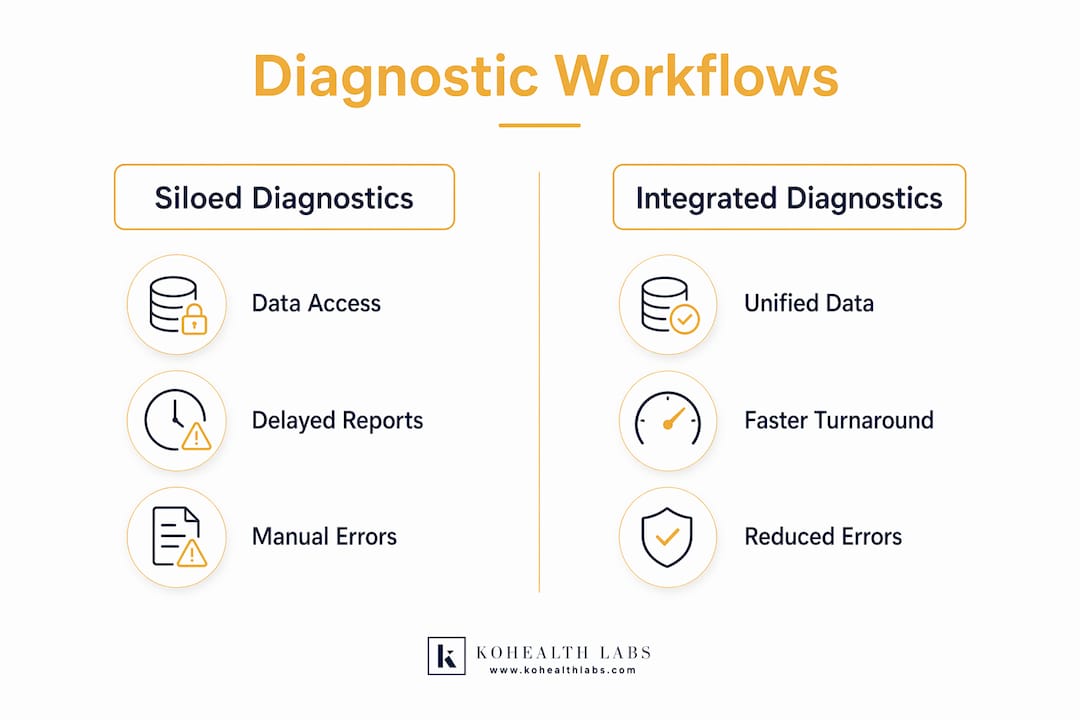
Cross-specialty diagnostic integration improves timelines and reduces errors precisely because it eliminates the manual handoffs that slow down multi-physician practices. The role of consolidated diagnostics in multi-specialty care is not administrative convenience. It is a direct patient safety measure.
How does integrated diagnostics enable precision medicine in specialty care?
Precision medicine requires precise data, delivered at the right moment in a patient's care pathway. Precision diagnostics allow targeted therapies, improving the timing and quality of specialty care. That connection between diagnostic data and therapeutic decisions is what separates integrated systems from traditional lab-and-imaging setups.
Dr. Bill Kerr has written on aligning diagnostics with evidence-based treatment pathways, noting that diagnostics now shape the timing and quality of care rather than serving as passive inputs. In oncology, for example, a tumor board reviewing a patient's case needs imaging, pathology, genomic markers, and lab values in one place to make a treatment recommendation. Integrated systems make that possible without scheduling a separate data-gathering meeting.
The benefits of precision diagnostics integration in specialty care include:
- Reduced test redundancy because prior results are visible across all treating teams
- Earlier diagnosis in conditions like immunology and gastroenterology where subtle lab trends matter
- Clinical decision support tools embedded directly in the diagnostic workflow
- Treatment timing improvements when diagnostic results trigger automatic care pathway alerts
- Better patient outcomes in oncology when tumor boards access complete, synchronized data
Integrated clinical diagnostics inform evidence-based practices by making the full diagnostic picture available at the moment a treatment decision is required. That is the operational definition of precision medicine in a specialty care setting.
What are the main challenges of implementing integrated diagnostics?
Structural team alignment is often a bigger barrier than technical data integration. Conflicting reporting standards and urgency levels across specialties complicate integration efforts far more than the software installation itself. A radiology department that flags results as urgent on a different timeline than the oncology team creates friction that no platform can automatically resolve.
Billing and coding present a second major challenge. Integrated diagnostics systems reveal inefficiencies in billing and require new revenue cycle management approaches. When lab and imaging results flow through a unified system, the coding workflows that were built around separate departmental billing may no longer apply. Administrators need to audit revenue cycle processes before and after integration, not just during the IT rollout.
Diagnostic stewardship is the third challenge that administrators consistently underestimate. Without clinical decision support built into the integrated system, test over-utilization and operational costs can increase rather than decrease. Integration makes ordering tests easier, which can lead to more tests rather than better tests.
Key factors for sustainable integration include:
- Written clinical protocols that define which tests trigger which alerts
- Training programs that address workflow changes, not just software navigation
- IT infrastructure that supports HL7 FHIR data exchange across all connected systems
- A diagnostic stewardship committee with authority to review ordering patterns
Pro Tip: Assign a clinical champion in each specialty department before go-live. Technology adoption accelerates when a respected clinician in each group advocates for the new workflow from day one.
Aligning lab, radiology, and specialty clinic protocols before implementation reduces the friction that causes most integration projects to stall after launch.
What future trends are shaping integrated diagnostics in specialty care?
AI is the most significant force changing how integrated diagnostic systems operate. AI tools reduce radiologist burnout by automating routine tasks and help democratize access to advanced diagnostics. That democratization matters most for community clinics and rural outpatient settings where specialist coverage is limited.
Cloud-based platforms are making enterprise-wide data integration practical for health systems that previously lacked the IT infrastructure for on-premise integration. Telehealth-integrated diagnostics show eight real examples of how digital diagnostic platforms are already changing care delivery in 2026. Real-time remote monitoring connected to a unified diagnostic record is no longer a future concept. It is operational in multiple health systems today.
The shift toward value-based care models accelerates the case for integration. When reimbursement depends on outcomes rather than volume, health systems have a direct financial incentive to reduce redundant testing, improve diagnostic accuracy, and shorten the time from diagnosis to treatment. Integrated diagnostics is the infrastructure that makes those outcomes measurable and reproducible.
- Future diagnostic value derives primarily from digital integration to reduce errors and make data available at the point of decision
- AI-assisted triage will expand from radiology into pathology and laboratory medicine
- Wearable and remote monitoring devices will feed real-time data into integrated specialty care records
- Affordable diagnostic partnerships between health systems and technology vendors will close community care gaps
Key Takeaways
Integrated diagnostics supports specialty care by unifying lab, imaging, and pathology data into one system that reduces turnaround times, improves collaboration, and enables precision treatment decisions.
| Point | Details |
|---|---|
| Turnaround time reduction | PACS/EHR integration and AI tools cut diagnostic reporting from hours to minutes. |
| Multidisciplinary collaboration | A shared data foundation lets radiology, cardiology, and pathology work from the same patient record. |
| Precision medicine enablement | Synchronized diagnostic data reduces redundant tests and aligns results with evidence-based treatment pathways. |
| Implementation challenges | Team alignment and billing workflow updates are harder to solve than the technical integration itself. |
| Future readiness | AI automation and cloud platforms are expanding affordable diagnostic access to community and outpatient settings. |
Kohealth Labs' perspective on what integration actually requires
The technology conversation around integrated diagnostics tends to focus on platforms and data standards. That focus misses the harder problem. The clinical teams using these systems have built their workflows around fragmented data for years. Asking them to change how they communicate, prioritize, and document is a cultural shift, not a software update.
At Kohealth Labs, we see the same pattern repeatedly. Organizations that invest in clinical decision support and diagnostic stewardship alongside their technology rollout get measurably better results than those that treat integration as a pure IT project. The stewardship piece is particularly undervalued. Integration makes it easy to order more tests. Without governance, that ease becomes a cost driver rather than a quality driver.
The organizations that get this right treat integrated diagnostics as an ongoing operational commitment, not a one-time implementation. They review ordering patterns quarterly, update clinical protocols when evidence changes, and measure outcomes at the specialty level. That continuous evaluation is what separates systems that improve patient care from systems that simply consolidate data.
— Kohealth Labs
Kohealth Labs integrated diagnostics for specialty care teams
Kohealth Labs delivers integrated clinical diagnostics built for environments where data quality and turnaround time directly affect patient outcomes. The single-contract model unifies laboratory and radiology services, covering over 100 biomarkers with AI-assisted quality checks that flag deviations before they affect results.
For clinical research organizations, government agencies, and multi-specialty practices, Kohealth Labs provides analysis-ready diagnostic bundles that reduce vendor complexity and accelerate decision-making. The data and AI capabilities connect radiology, pathology, and laboratory results into a unified record that supports specialty care teams at every stage of the diagnostic process. Review the full range of diagnostic test offerings to see how Kohealth Labs supports your specialty care integration goals.
FAQ
What is outpatient diagnostic integration in a hospital?
Outpatient diagnostic integration connects lab, imaging, and clinical data systems so that outpatient departments access complete patient records without switching platforms. Hospital outpatient departments allocate over 75% of visits to diagnostic testing, labs, and imaging, making integration a direct efficiency and safety measure.
How do integrated diagnostics reduce community care gaps?
AI-enabled diagnostic tools and Health ATM solutions generate reports in 3–10 minutes at low cost, making specialty-level diagnostics accessible in community clinics and rural settings where specialist coverage is limited.
What is the role of integrated diagnostics in a multi-physician practice?
Integrated diagnostics gives every physician in a multi-specialty practice access to the same real-time patient record, reducing duplicate testing, improving communication between specialties, and supporting faster, more accurate treatment decisions.
What are the benefits of affordable diagnostic partnerships for community clinics?
Affordable diagnostic partnerships give community clinics access to AI-assisted screening, lab integration, and imaging without the capital cost of building separate departmental systems, directly reducing care gaps in underserved populations.
How does diagnostic integration support outpatient safety?
Integrated diagnostics reduces outpatient safety risks by making complete diagnostic histories visible at the point of care, eliminating the information gaps that lead to missed findings, duplicate orders, and delayed treatment decisions.