

Coordinating multi-site diagnostic research data is defined as the process of harmonizing, standardizing, and integrating diagnostic datasets collected across multiple clinical sites into a single, analysis-ready format. The industry term for this practice is multi-site diagnostic data consolidation, and it sits at the core of every credible large-scale clinical trial. Without it, data from Site A and Site B may use different coding systems, different units of measurement, and different classification schemes, making aggregation meaningless. Standards like SNOMED CT, LOINC, and FHIR R4 are not optional add-ons. They are the foundation that makes cross-site comparability possible. Regulatory frameworks including GDPR compliance requirements add another layer of complexity, particularly for international studies where patient data cannot freely cross borders.
What are the essential tools and prerequisites to coordinate multi-site diagnostic research data?
Effective multi-site data coordination starts before a single record is collected. You need a shared semantic layer across all sites, meaning every diagnostic code, biomarker label, and clinical variable must map to the same controlled vocabulary. SNOMED CT handles clinical concepts, LOINC covers laboratory observations, ICD-10 manages disease classification, and ATC standardizes drug coding. Using all four in combination eliminates the most common source of aggregation errors.
Interoperability is the next requirement. FHIR R4 is the current standard for exchanging healthcare data between systems. It defines how resources like Observation, DiagnosticReport, and Patient are structured, so data from different electronic health record systems can be read by a central aggregation layer without manual reformatting.

The choice between an integrated diagnostic platform and a fragmented multi-vendor stack has a measurable impact on research speed. Organizations using integrated platforms make strategic decisions up to 5 times faster than those managing separate vendor systems. That gap widens further when radiology and laboratory data must be combined, since each vendor typically exports in a different format.
Privacy-preserving technologies are a prerequisite, not an afterthought. Federated analytics allow each site to retain patient data locally while sharing only aggregated, anonymized results. This approach satisfies GDPR requirements and enables real-time cross-site research collaboration without exposing identifiable records.
| Feature category | What to look for | Why it matters |
|---|---|---|
| Semantic standardization | SNOMED CT, LOINC, ICD-10, ATC support | Enables valid cross-site aggregation |
| Interoperability | FHIR R4 API compliance | Connects heterogeneous EHR systems |
| Privacy architecture | Federated analytics, local pseudonymization | Meets GDPR and local data governance rules |
| Platform integration | Unified lab and radiology data layer | Eliminates format conflicts between vendors |
| Automation | ETL pipelines with validation checkpoints | Reduces manual reconciliation workload |
How to design scalable, privacy-preserving data pipelines for multi-site studies
Building a data pipeline for multi-site diagnostic research management requires an architectural decision upfront: centralized, federated, or hybrid. Each model has a distinct risk profile.
A centralized architecture pulls all raw data into one repository. It simplifies analysis but creates regulatory exposure for international studies and a single point of failure. A federated model keeps data at each site and runs computations locally, sharing only results. A hybrid model combines both: raw data stays local for privacy-sensitive variables, while de-identified aggregates flow to a central hub for analysis.
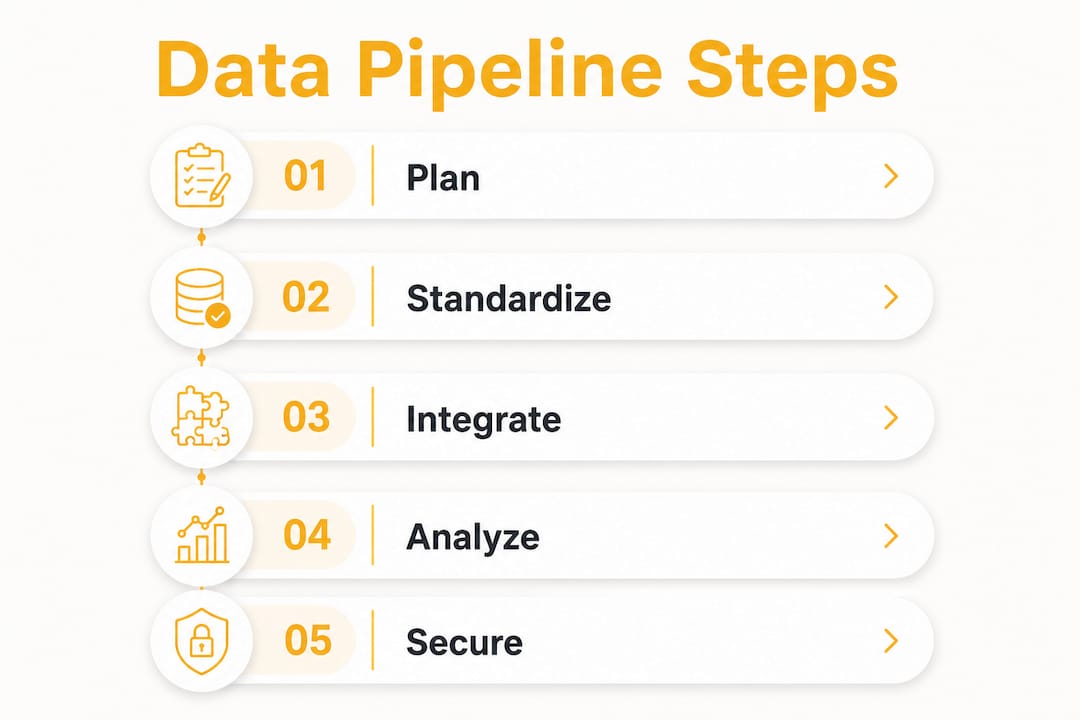
The hub-and-spoke data mesh model is the most practical architecture for most multi-site studies. It separates source systems from destination pathways, so when one site upgrades its laboratory information system, the pipeline at other sites continues without disruption. This design prevents cascading failures that routinely derail studies using tightly coupled integrations.
A well-built ETL pipeline for multi-site diagnostic data moves through six stages:
- Extraction — Pull raw diagnostic records from each site's source system using FHIR R4 APIs or HL7 interfaces.
- Transformation — Remap local codes to shared terminologies (SNOMED CT, LOINC) using pre-built mapping tables.
- Harmonization — Align units of measurement, qualitative labels, and reference ranges across sites.
- Pseudonymization — Replace direct identifiers with reversible tokens at the local site level before transmission.
- Anonymization — Apply k-anonymity or differential privacy techniques at the central aggregation layer.
- Quality control — Run automated validation rules to flag missing values, out-of-range results, and coding inconsistencies before data enters the analysis layer.
Centralizing data pipelines reduces site onboarding from 12 weeks to 10 days and cuts manual reporting requirements by 80%. That is not a marginal gain. It means a 10-site study can be fully operational in under two weeks instead of three months.
Pro Tip: Avoid manual spreadsheet merging entirely. Adopt dbt transformation layers to consolidate heterogeneous site inputs into unified relational schemas. Manual data reconciliation costs multiple analyst-days per week; dbt reduces reporting lag from days to hours.
Connecting mobile field data collection interfaces directly to a central diagnostic ledger also pays dividends. Automated field data integration reduces sample registration cycles by up to 70%, improving data accuracy and reducing disputes between sites over record ownership.
What methodologies ensure cross-site data standardization before aggregation?
Semantic alignment at the resource level is a mandatory prerequisite for valid multi-site harmonization. It must happen before aggregation, not during it. Attempting to reconcile coding differences after combining datasets produces results that cannot be trusted.
The practical starting point is a shared data dictionary. Every clinical variable, diagnostic code, and unit of measurement gets a single canonical definition. Sites map their local terminology to that dictionary before any data leaves their system. This mapping process surfaces discrepancies early, when they are cheap to fix.
Handling free-text diagnostic fields requires natural language processing enrichment. Many laboratory and radiology reports contain narrative text that does not map cleanly to structured codes. NLP tools extract structured entities from that text and assign SNOMED CT or LOINC codes, converting unstructured observations into comparable data points.
| Harmonization strategy | Key benefit | Main challenge |
|---|---|---|
| Shared data dictionary | Single source of truth for all variables | Requires upfront consensus across sites |
| FHIR R4 resource mapping | Standardizes data exchange format | Needs FHIR-compliant source systems |
| NLP enrichment for free text | Captures unstructured diagnostic content | Accuracy depends on model training data |
| Unit normalization tables | Aligns measurement scales across labs | Edge cases require manual review |
| Automated validation rules | Catches errors before aggregation | Rule design requires clinical input |
Consolidated diagnostic workflows reduce trial delays by catching harmonization failures at the site level rather than at the analysis stage. Catching a unit mismatch before aggregation takes minutes. Catching it after a database lock takes weeks.
How to quantify and adjust for site-level variability in diagnostic sensitivity
Site-level diagnostic sensitivity varies even when all sites follow the same protocol. A site using a newer analyzer model, a different reagent lot, or a slightly different technician training program will produce systematically different results for the same patient population. Failing to account for this variability skews multi-site study outcomes and can invalidate a trial's primary endpoint.
Random effects models are the standard statistical tool for quantifying site-specific sensitivity differences. They treat each site as a random sample from a population of possible sites, estimating both the average diagnostic performance and the variance around it. The likelihood ratio method and the expectation-maximization (EM) algorithm are the two most common approaches for testing and quantifying this heterogeneity.
Validation data from a subset of patients with known disease status is required to establish parameter identifiability in these models. Without it, the model cannot separate true site-level differences from random noise.
Common pitfalls to avoid when managing site-level variability:
- Ignoring site as a covariate — Treating all sites as identical inflates false-positive rates in subgroup analyses.
- Using fixed effects only — Fixed effects models cannot generalize findings beyond the specific sites in your study.
- Skipping sensitivity analyses — Always run analyses with and without site adjustment to quantify the impact of heterogeneity on your primary endpoint.
- Failing to document site-specific protocols — Undocumented protocol deviations make post-hoc adjustment impossible.
- Delaying variability assessment — Site performance should be monitored continuously, not only at study close.
Statistical modeling of heterogeneity must be standard practice in any multi-site diagnostic study. Treating it as optional is a methodological error, not a conservative choice.
Key Takeaways
Effective multi-site diagnostic data coordination requires semantic alignment with SNOMED CT and FHIR R4, privacy-preserving federated pipelines, and statistical adjustment for site-level variability before any aggregation occurs.
| Point | Details |
|---|---|
| Semantic alignment first | Map all variables to SNOMED CT, LOINC, and FHIR R4 before combining any datasets. |
| Federated architecture protects privacy | Keep patient data local and share only anonymized aggregates to satisfy GDPR requirements. |
| Hub-and-spoke pipelines prevent failures | Separating source systems from aggregation paths stops one site's upgrade from breaking the whole study. |
| Adjust for site variability statistically | Use random effects models to quantify and correct diagnostic sensitivity differences across sites. |
| Automation cuts onboarding dramatically | Centralized pipelines reduce site onboarding from 12 weeks to 10 days and cut manual reporting by 80%. |
What we have learned from coordinating diagnostic data across clinical sites
The most persistent mistake research teams make is treating data coordination as a technical problem that IT solves once, then hands off. It is an ongoing operational discipline. Sites change software. Reagent lots change. Staff turn over. Any of these events can silently break a mapping table or shift a reference range without triggering an obvious error in the pipeline.
The teams that run the cleanest multi-site studies build continuous monitoring into their data governance model from day one. They assign a data steward at each site, run automated anomaly detection on every incoming batch, and review site-level summary statistics weekly rather than quarterly. That cadence catches drift before it compounds.
Privacy-preserving AI frameworks are changing what is possible in harmonization. AI-based standardization of medical examination reports across heterogeneous datasets achieves up to 91.7% accuracy, outperforming single-center models by 14.9%. That gap reflects the power of training on diverse, multi-site data while keeping each site's raw records local. The practical implication is that federated AI models will increasingly replace manual mapping tables for complex free-text harmonization tasks.
Interdisciplinary collaboration is not a soft skill in this context. It is a hard requirement. Your data pipeline is only as good as the clinical staff who define what each variable means and the IT staff who implement the extraction logic. When those two groups do not communicate regularly, mapping errors accumulate silently until a data audit surfaces them at the worst possible moment.
The future of multi-site diagnostic data coordination belongs to teams that treat their pipeline as a living system, not a one-time build. Regulatory requirements will continue to evolve, new biomarker panels will be added, and site technology will change. The teams that build for adaptability rather than for the current protocol will finish their trials faster and with cleaner data.
— Kohealth Labs
How Kohealth Labs supports integrated multi-site diagnostic research
Clinical research sponsors and CROs managing multi-site studies face a specific problem: laboratory data and radiology data live in separate systems, governed by separate vendors, and delivered on separate timelines. That fragmentation slows decisions and creates reconciliation work that no team has time for.
Kohealth Labs addresses this directly through a single-contract model that unifies laboratory services and radiology into one integrated diagnostics platform built for clinical trials. AI-driven quality checks identify deviations in real time, reducing the compliance burden on your data management team. With coverage across more than 100 biomarkers and analysis-ready data bundles delivered to CROs and pharmaceutical sponsors, Kohealth Labs shortens the path from data collection to regulatory submission. If you are coordinating a multi-site study and need clean, consolidated diagnostic data without the multi-vendor overhead, explore Kohealth Labs' clinical trial diagnostics to see how integrated labs and radiology work together.
FAQ
What is multi-site diagnostic data consolidation?
Multi-site diagnostic data consolidation is the process of collecting, standardizing, and merging diagnostic datasets from multiple clinical sites into a single, analysis-ready repository. It requires semantic alignment using standards like SNOMED CT, LOINC, and FHIR R4 before any aggregation occurs.
Why does semantic alignment need to happen before aggregation?
Semantic alignment at the resource level is a mandatory prerequisite because combining datasets that use different coding systems produces incomparable results. Fixing coding mismatches after aggregation is technically unreliable and far more costly than resolving them at the site level first.
What is the best architecture for a privacy-preserving multi-site data pipeline?
Federated analytics models are the current standard for privacy-sensitive multi-site studies. They allow each site to retain patient data locally while sharing only anonymized aggregated results, satisfying GDPR requirements and enabling real-time collaborative analysis.
How do random effects models help in multi-site diagnostic research?
Random effects models quantify site-specific differences in diagnostic sensitivity by treating each site as a random draw from a broader population. This approach produces adjusted estimates that generalize beyond the specific sites in the study and prevents site variability from distorting primary endpoints.
How much faster is site onboarding with a centralized data pipeline?
Centralized data pipelines reduce site onboarding from 12 weeks to 10 days and lower manual reporting requirements by 80%. That efficiency gain directly shortens trial timelines and reduces the operational burden on site coordinators.