

Consolidated diagnostics is the strategic integration of biomarker testing, laboratory services, and data workflows into a single coordinated system to reduce clinical trial delays. Fragmented diagnostic processes are one of the most preventable causes of extended development timelines. Research shows that integrated companion diagnostics cut development time by 379.5 days compared to non-integrated approaches. For clinical trial managers and pharmaceutical researchers, that figure represents the difference between a therapy reaching patients on schedule and a costly, multi-year setback. The industry term for this approach is centralized diagnostics, and understanding how it works is the first step toward protecting your trial timeline.
How consolidated diagnostics reduce trial delays through data centralization
Fragmented diagnostic data is the silent driver of most preventable trial delays. When biomarker results arrive from multiple vendors in different file formats, each requiring its own data agreement and query management system, the administrative burden compounds quickly. Centralizing biomarker diagnostics reduces data management effort by 40–60% by eliminating these fragmented formats and consolidating query resolution into a single workflow. That reduction directly shortens the time between data collection and database lock.
Equipment utilization tells the same story from a different angle. Decentralized site laboratories typically run at 10–30% equipment utilization. Central lab models achieve 80–95% utilization on the same equipment. Higher utilization means faster throughput, fewer repeat runs, and less idle time between sample batches. For a trial running across 40 sites, that gap in utilization translates into weeks of recovered calendar time.

Duplicate assays are another hidden cost of fragmented diagnostics. When each site runs its own testing without a shared protocol, repeat testing becomes routine rather than exceptional. A central lab eliminates this by applying a single validated method across all sites. The result is fewer samples retested, fewer data discrepancies to resolve, and a cleaner dataset at lock.
Pro Tip: Audit your query volume by source before your next trial launch. If more than 30% of queries originate from biomarker data discrepancies across sites, centralized diagnostics will likely cut your database lock timeline by several weeks.
Kohealth Labs addresses this directly through its unified diagnostics platform, which delivers analysis-ready data bundles rather than raw outputs requiring manual reconciliation. The platform covers over 100 biomarkers and uses AI to flag deviations before they become queries.
Why regulatory alignment from day one prevents 12 to 24 month delays
Regulatory misalignment between diagnostic and pharmaceutical development teams is the biggest hidden risk in any trial using companion diagnostics (CDx). The FDA and EMA both expect contemporaneous approval of a drug and its associated CDx. When diagnostic performance studies fall behind the drug development schedule, the result is a bridging study requirement. Bridging studies caused by misalignment routinely add 12–24 months to trial timelines. That is not a rounding error. It is a program-defining setback.
The fix is structural, not reactive. Embedding diagnostic regulatory workstreams into the master trial timeline from the protocol design stage prevents the misalignment from occurring. Joint governance between the pharmaceutical and diagnostic teams, with shared milestone calendars and co-owned decision gates, keeps both tracks synchronized. Aggressive integrated programs have compressed combined approval timelines from 4–6 years down to approximately 3.5 years.
Practical governance strategies that protect timelines include:
- Assign a dedicated CDx regulatory lead at the same time as the drug regulatory lead, not after IND submission.
- Require joint sign-off on any protocol amendment that affects biomarker collection or assay timing.
- Schedule quarterly alignment reviews between the pharmaceutical and diagnostic teams throughout Phase II and Phase III.
- Document CDx performance data in a format that mirrors FDA submission requirements from the first analytical run.
Pro Tip: If your diagnostic vendor cannot provide a regulatory affairs contact with CDx submission experience, treat that as a program risk. Regulatory naivety on the diagnostic side is the most common cause of bridging study requirements.
Cross-specialty diagnostic integration requires this kind of deliberate planning. Treating diagnostics as a procurement decision rather than a regulatory workstream is where most delays begin.
Operational and budgetary efficiencies from centralized diagnostics
The financial case for centralized diagnostics is stronger than most trial managers realize. The primary advantage is not cost savings alone. Data defensibility is the core benefit, because standardized analytical methods across multiple sites reduce the variability that burdens regulatory defense before the FDA or EMA. Clean data costs less to defend and less to resubmit.
Budget management improves significantly when diagnostic analytical costs are separated from site budgets. Separating these cost lines prevents double-billing in multi-vendor settings and gives sponsors a clear view of actual laboratory spend. Without that separation, site invoices often bundle analytical costs with site overhead, making it impossible to audit either line accurately.
Additional operational benefits include:
- Reagent economies of scale. A central lab purchasing reagents for 40 sites negotiates volume pricing that individual sites cannot access.
- Consolidated logistics. Dedicated shipping networks with validated shippers and temperature monitoring eliminate per-site courier negotiations and reduce temperature excursion risk.
- Unified quality systems. A single quality management system covering all sites simplifies audit preparation and reduces the time required for regulatory inspections.
"Exclusive reliance on internal labs can create testing bottlenecks for niche assays. A hybrid lab model combining a core central lab with pre-validated niche subcontractors improves resilience without sacrificing governance."
Kohealth Labs operates on a single-contract model that unifies laboratory and radiology services. That structure eliminates the vendor coordination overhead that typically consumes 15–20% of a trial manager's operational bandwidth.
Real-world models that accelerate timelines through unified diagnostics
The most effective emerging model for accelerating trial timelines aligns assay development with commercial kit plans from the first day of trial design. The logic is straightforward. If the assay used in your Phase II trial cannot be commercialized as a kit without significant modification, you will face a rework cycle between Phase III completion and regulatory submission. Aligning assay development with future kit commercialization from the outset eliminates that cycle entirely.
The Leica Biosystems and CellCarta CDx Bridge partnership is a concrete example of this model. By integrating assay development and commercial diagnostic development into a single coordinated program, the partnership reduces duplicated work and keeps both tracks on a shared regulatory timeline. The outcome is fewer late-stage surprises and better regulatory readiness at submission.
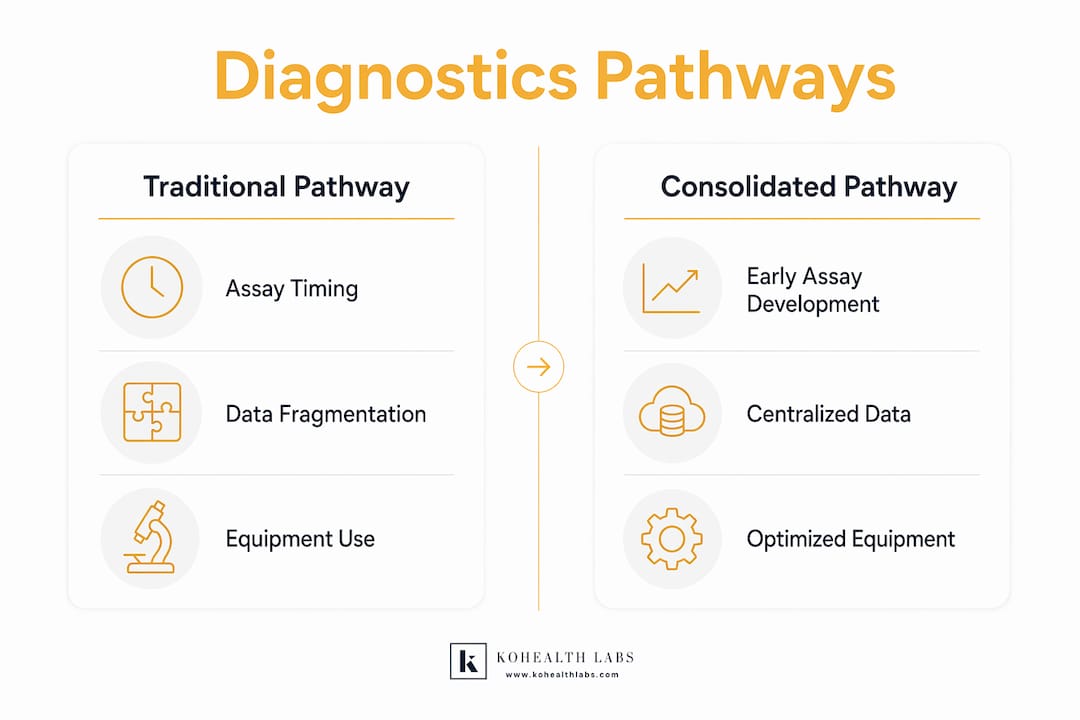
The contrast between traditional and consolidated development pathways is significant:
| Factor | Traditional pathway | Consolidated pathway |
|---|---|---|
| Assay development timing | After drug Phase II completion | Concurrent with Phase I/II |
| Regulatory submission alignment | Sequential drug then CDx | Contemporaneous submission |
| Bridging study risk | High | Low to minimal |
| Data format standardization | Per-site variation | Single validated method |
| Timeline to approval | 4–6 years typical | Approximately 3.5 years |
Sponsors who adopt consolidated pathways also report a measurable reduction in duplicated analytical work. When the same validated assay runs across all trial sites and feeds directly into the commercial kit specification, the analytical development team does the work once rather than twice. That single change protects months of development time.
Aligning lab and radiology protocols from the start of trial design is the operational equivalent of this principle. Kohealth Labs builds this alignment into its service model, delivering integrated data bundles that are ready for regulatory review without additional formatting or reconciliation.
Key takeaways
Consolidated diagnostics reduce trial delays by eliminating fragmented data systems, aligning regulatory workstreams early, and standardizing analytical methods across all trial sites.
| Point | Details |
|---|---|
| Centralization cuts data effort | Centralizing biomarker diagnostics reduces data management effort by 40–60%, shortening database lock timelines. |
| Early regulatory alignment is critical | Embedding CDx regulatory workstreams from day one prevents bridging studies that add 12–24 months. |
| Data defensibility drives value | Standardized methods across sites reduce regulatory defense burden, not just operational cost. |
| Budget separation prevents errors | Separating diagnostic costs from site budgets eliminates double-billing and improves financial transparency. |
| Assay-to-kit alignment protects timelines | Aligning assay development with commercial kit plans from trial outset eliminates late-stage rework cycles. |
The operational truth most trial teams learn too late
The most common mistake we see is treating diagnostics as a logistics problem rather than a regulatory and data architecture decision. Trial teams spend months negotiating site-level testing contracts, then discover at database lock that their biomarker data cannot be harmonized across sites because each lab used a slightly different method. By that point, the options are expensive: repeat testing, bridging studies, or delayed submission.
The financial and regulatory consequences of fragmented diagnostics are predictable. They are also almost entirely avoidable. The teams that protect their timelines are the ones that make centralized diagnostics a design requirement at the protocol stage, not a corrective action after Phase II.
What we have also observed is that the conversation about consolidated diagnostics often stalls at cost. Sponsors ask whether centralization is cheaper than site-level testing. That is the wrong question. The right question is whether the data produced by site-level testing will survive regulatory scrutiny. In our experience, it frequently does not. The cost of a bridging study or a complete response letter from the FDA dwarfs any savings from decentralized testing.
The trend we are watching closely is AI-driven data integration across unified diagnostic networks. As AI tools mature in their ability to flag deviations in real time and cross-reference biomarker results against protocol requirements, the gap between centralized and decentralized diagnostic quality will widen further. Sponsors who build centralized diagnostic infrastructure now will be positioned to adopt these tools without rebuilding their data architecture from scratch.
The practical recommendation is simple. Bring your diagnostic team into the protocol design meeting. Not the procurement meeting. The design meeting.
— Kohealth Labs
Kohealth Labs supports faster trials with integrated diagnostics
Clinical trial managers and pharmaceutical researchers working to protect their timelines need a diagnostic partner that operates as part of the trial infrastructure, not as a separate vendor to coordinate.
Kohealth Labs delivers integrated clinical diagnostics for CROs and pharma teams through a single-contract model that unifies laboratory and radiology services. The platform covers over 100 biomarkers, applies AI-driven deviation detection to maintain data quality, and delivers analysis-ready data bundles that reduce the time between sample collection and regulatory submission. Kohealth Labs also supports regulatory alignment by structuring data outputs to meet FDA and EMA submission standards from the first analytical run. Contact Kohealth Labs to discuss how integrated diagnostics can be built into your next trial design.
FAQ
How do consolidated diagnostics reduce trial delays?
Consolidated diagnostics eliminate fragmented data systems and duplicate assays by centralizing biomarker testing under a single validated method. Research shows this approach cuts development time by 379.5 days compared to non-integrated diagnostic programs.
What is the biggest regulatory risk in companion diagnostic development?
Failing to align diagnostic performance studies with the drug development schedule is the primary risk. Misalignment requires bridging studies that add 12–24 months to trial timelines.
How does centralizing diagnostics reduce trial costs?
Central labs achieve 80–95% equipment utilization compared to 10–30% in decentralized models, and they separate analytical costs from site budgets to prevent double-billing. These two changes together reduce both operational waste and financial reconciliation errors.
What is a hybrid lab model in clinical trials?
A hybrid lab model combines a core central laboratory with pre-validated niche subcontractors for specialized assays. This structure maintains centralized quality governance while preventing testing bottlenecks for complex or low-volume diagnostic needs.
When should diagnostic regulatory workstreams be integrated into a trial timeline?
Diagnostic regulatory workstreams should be embedded at the protocol design stage, before IND submission. Teams that integrate CDx regulatory planning from day one compress combined approval timelines from 4–6 years to approximately 3.5 years.