

Streamlined CRO diagnostic data delivery is defined as the end-to-end process of moving clinical diagnostic results from collection through analysis-ready output with minimal manual intervention, maximum traceability, and full regulatory compliance. The industry term for this practice is clinical data management, and it sits at the center of every successful trial. When data moves fast and cleanly, trials close faster, safety signals surface earlier, and sponsors get the transparency they need. Kohealth Labs integrates laboratory and radiology services under a single contract, covering over 100 biomarkers, to give CROs exactly this kind of ready-to-use data. Standards like CDISC, HL7, and FHIR define the technical rails that make interoperable, audit-ready delivery possible.
What are the essential prerequisites for CRO diagnostic data delivery?
The right architecture is the starting point. Modern CROs rely on lakehouse models that combine the flexibility of data lakes with the structure of data warehouses. Re-platforming to lakehouse architectures cuts total cost of ownership by 25% and accelerates sponsor onboarding by over 40%. That kind of efficiency gain is not incremental. It changes how many sponsors a CRO can support simultaneously.
Middleware is the connective tissue between systems. Platforms built on HL7 and FHIR standards create audit-ready environments by connecting clinical events to compliance rules in real time. Without middleware, data teams spend hours reconciling records manually before every regulatory submission. With it, that reconciliation happens automatically as data flows through the pipeline.

Security controls are non-negotiable. Role-based access, single sign-on, and network policies define clear boundaries for cross-cloud and cross-region data exchanges. These controls protect sensitive participant data and satisfy FDA 21 CFR Part 11 and ICH E6(R3) requirements for electronic records.
The table below compares the core feature categories you should evaluate when selecting data delivery tools and middleware solutions.
| Feature category | What to look for |
|---|---|
| Interoperability | Native HL7/FHIR support, CDISC CDASH/SDTM mapping |
| Security | Role-based access, single sign-on, encrypted data transit |
| Scalability | High-volume record processing, multi-sponsor support |
| Audit readiness | Automated metadata capture, provenance tracking |
| Integration | API-first design, file-based fallback for legacy systems |
- Governance from day one. Metadata capture must begin at ingestion, not at submission. Retrofitting governance after the fact costs far more than building it in.
- Platform-agnostic design. Avoiding platform lock-in lets you integrate emerging data sources and meet diverse sponsor requirements without re-architecting your entire stack.
- Unified diagnostics. Combining lab and radiology data under one data model reduces the number of integration points and the risk of format mismatches.
Pro Tip: Before selecting any middleware platform, map every data source your CRO touches, including lab instruments, EDC systems, and imaging platforms. A tool that cannot ingest all of them natively will create the manual work you are trying to eliminate.
How to implement automated data pipelines in CRO environments
Automated pipelines are the operational core of efficient clinical data management. A well-designed pipeline handles ingestion, transformation, validation, and delivery without human intervention at each step. Automated pipelines process approximately 30,000 clinical records in under 2 minutes. That throughput makes real-time safety monitoring and rapid sponsor reporting achievable at scale.
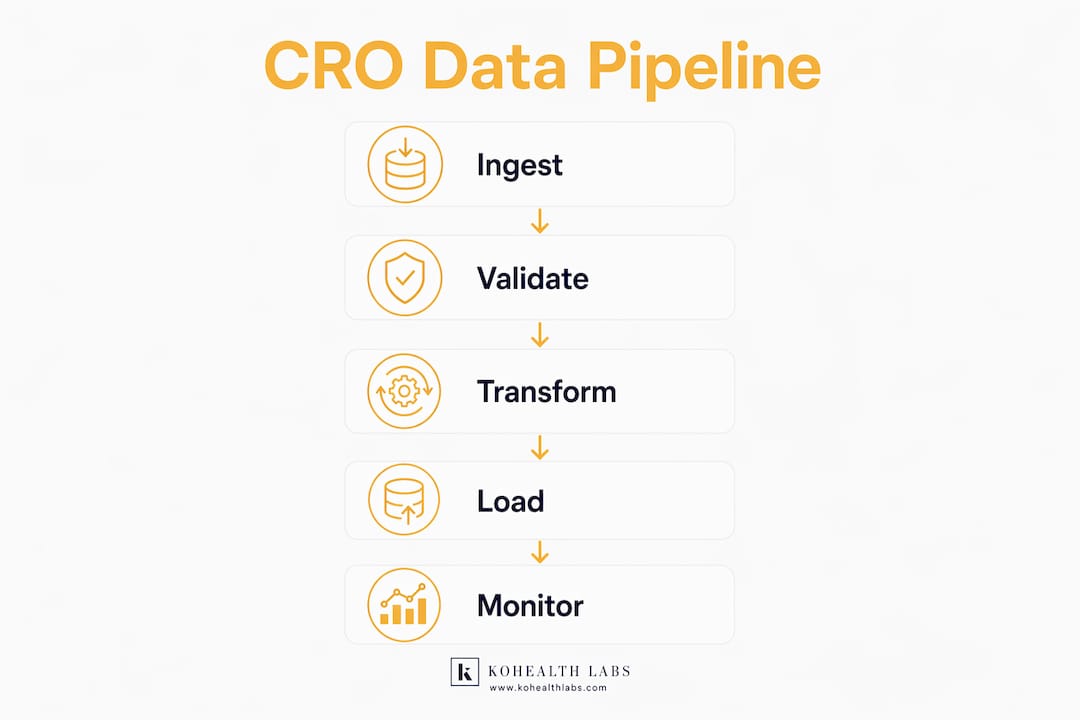
The Bronze, Silver, Gold staging model gives your pipeline clear structure. Bronze holds raw ingested data exactly as received. Silver applies cleaning, deduplication, and standardization rules. Gold contains analysis-ready outputs mapped to CDISC standards and ready for sponsor delivery or regulatory submission. Each layer has defined quality checks, so errors are caught early rather than discovered during an audit.
Building a reliable pipeline requires a disciplined sequence:
- Define your data contracts. Agree with each sponsor on formats, frequencies, and delivery endpoints before a single record flows. Ambiguity here causes downstream failures.
- Build ingestion adapters for every source. API connections handle modern EDC and lab systems. File-based adapters cover legacy instruments that cannot support real-time feeds.
- Apply common data models at the Silver layer. Map incoming fields to CDISC CDASH at ingestion and SDTM at transformation. This prevents format drift across sponsors.
- Automate validation rules. Range checks, cross-field logic, and missing-data flags should fire automatically. Manual review should handle exceptions only, not routine checks.
- Monitor pipeline health continuously. Set alerts for processing delays, record volume anomalies, and validation failure rates. Catching a broken feed in minutes beats discovering it days later during a data lock.
The most common implementation failure is skipping upstream metadata capture. Neglecting metadata provenance leads to costly manual reconciliation during regulatory audits. Every record needs a traceable origin from the moment it enters your system.
Pro Tip: Use a staging environment that mirrors production exactly. Test every new sponsor integration against realistic data volumes before going live. A pipeline that works with 500 test records can fail unexpectedly at 30,000 production records if you have not stress-tested it.
How can EHR-integrated dashboards reduce administrative friction in trials?
EHR-integrated dashboards give research teams a live view of trial data without switching between systems. The efficiency gains are concrete. EHR dashboards can reduce patient candidate identification from 156 clicks to a single hover, compressing screening work that once took days into about an hour across 20 or more active trials. That is not a minor convenience. It directly accelerates enrollment and reduces the administrative burden on clinical coordinators.
Real-time alerts embedded in clinical workflows change how teams respond to safety signals. Instead of waiting for a weekly data export, coordinators see out-of-range lab values or missed visit flags the moment they occur. That speed supports proactive safety monitoring and keeps trials on schedule.
Key benefits of platform-agnostic dashboard solutions include:
- Aggregated data views. Pull lab results, imaging reports, and EDC data into a single interface without requiring each system to share a common format.
- Role-specific displays. Investigators see clinical summaries. Data managers see query rates and missing-data counts. Sponsors see enrollment progress and key safety metrics.
- Automated eligibility screening. Rules-based filters apply inclusion and exclusion criteria across the EHR population, surfacing qualified candidates without manual chart review.
- Collaboration tools. Shared dashboards reduce the back-and-forth between data management and biostatistics teams. Fragmented workflows between these functions risk trial timelines. Integrated views close that gap.
Kohealth Labs supports this model by delivering unified diagnostic data that feeds directly into sponsor and CRO dashboards, removing the need for manual data pulls from separate lab and imaging vendors.
What best practices ensure compliance and data quality in CRO data delivery?
Compliance is not a final-step review. It is a continuous property of a well-designed pipeline. Audit-ready workflows capture provenance and metadata at every stage, from the moment a sample is collected through final submission. When an auditor asks where a specific data point came from, your system should answer that question automatically, not after a week of manual investigation.
Middleware orchestration layers are the most reliable way to enforce compliance rules at scale. Connecting clinical events to real-time compliance enforcement gives CROs a strategic advantage in audit readiness and operational reliability. The alternative, applying compliance checks manually at submission, creates bottlenecks and introduces human error.
Risk-based quality management, known as RBQM, shifts quality monitoring from periodic review to continuous oversight. AI-driven tools identify deviations as they occur, flag statistical anomalies in enrollment data, and prioritize sites that need attention. AI-ready data platforms require common data models and metadata standards to enable this kind of continuous quality monitoring. Without those standards, AI tools cannot reliably interpret data from different sources.
"Scaling automation without upfront governance risks amplifying data quality issues. Human-in-the-loop validation remains critical to ensure accuracy in AI-driven pipelines."
Avoid the platform trap. Committing to a single vendor's proprietary data format locks your CRO into their roadmap and pricing. Platform-agnostic architectures let you swap components, add new data sources, and meet sponsor-specific requirements without rebuilding from scratch. Build to standards, not to vendor specifications.
Key Takeaways
Efficient CRO diagnostic data delivery requires integrated pipelines, standards-based middleware, and continuous compliance monitoring working together from data ingestion through sponsor delivery.
| Point | Details |
|---|---|
| Start with architecture | Lakehouse models cut costs by 25% and speed up sponsor onboarding by over 40%. |
| Automate at scale | Automated pipelines process 30,000 records in under 2 minutes, enabling real-time reporting. |
| Capture metadata early | Metadata provenance from ingestion prevents costly manual reconciliation during audits. |
| Use EHR dashboards | Integrated dashboards reduce candidate screening from 156 clicks to one hover, saving hours per trial. |
| Build platform-agnostic | Standards-based, vendor-neutral architectures protect CROs from lock-in and support future data sources. |
The cultural shift no one talks about enough
At Kohealth Labs, we have seen the same pattern repeat across CRO engagements. The technology conversation starts early and goes deep. Teams debate lakehouse versus cloud warehouse, HL7 versus FHIR, API versus file-based delivery. Those are real decisions with real consequences. But the harder change is cultural, and it rarely gets the same attention.
Most clinical data teams were built around periodic file deliveries. A data lock happens, files go out, sponsors wait. That rhythm is deeply embedded in how teams are staffed, how timelines are set, and how quality is checked. Shifting to continuous real-time data streams requires more than new software. It requires teams to think differently about when data is "ready" and who is responsible for its quality at any given moment.
We have also learned that automation without governance is a fast way to scale problems rather than solve them. Human-in-the-loop validation is not a sign that your automation is failing. It is a sign that your team understands where machines need a check. The CROs that get this right are the ones that treat data quality as a shared, ongoing responsibility rather than a final-step gate.
The future belongs to teams that combine fast, standards-driven infrastructure with disciplined human oversight. That combination is what makes trials faster, safer, and more transparent for everyone involved.
— Kohealth Labs
Kohealth Labs: integrated diagnostics built for CRO data workflows
Clinical data teams working with Kohealth Labs get more than a lab vendor. They get a single-contract partner that unifies laboratory and radiology diagnostics into analysis-ready data bundles, purpose-built for CRO and pharma workflows.
Kohealth Labs delivers AI-driven data orchestration that flags deviations automatically, maintains audit-ready metadata from collection through submission, and connects directly to sponsor systems without manual data pulls. The result is faster trial completions, cleaner data, and less time spent on reconciliation. Explore the full range of clinical trial diagnostic services Kohealth Labs offers, or review the complete list of tests available to see how integrated diagnostics fit your next protocol.
FAQ
What does it mean to streamline CRO diagnostic data delivery?
Streamlining CRO diagnostic data delivery means automating the movement of clinical diagnostic results from collection through sponsor-ready output using standards like CDISC, HL7, and FHIR. The goal is faster turnaround, fewer manual steps, and continuous audit readiness.
How fast can automated clinical data pipelines process records?
Automated pipelines can process approximately 30,000 clinical records in under 2 minutes, compared to hours or days with manual workflows. That speed supports real-time safety monitoring and faster sponsor reporting.
What is the biggest compliance risk in CRO data pipelines?
Neglecting upstream metadata capture is the most common and costly compliance risk. Without provenance tracking from ingestion, teams face expensive manual reconciliation when auditors request data lineage during regulatory review.
How do EHR-integrated dashboards improve trial efficiency?
EHR dashboards reduce patient candidate identification from 156 clicks to a single hover, compressing multi-day screening work into about an hour across 20 or more active trials. They also surface real-time safety alerts without requiring manual data exports.
Why does platform-agnostic architecture matter for CROs?
Platform-agnostic architectures prevent vendor lock-in, letting CROs integrate new data sources and meet diverse sponsor requirements without rebuilding their entire data infrastructure. Standards-based design protects long-term flexibility and reduces switching costs.