
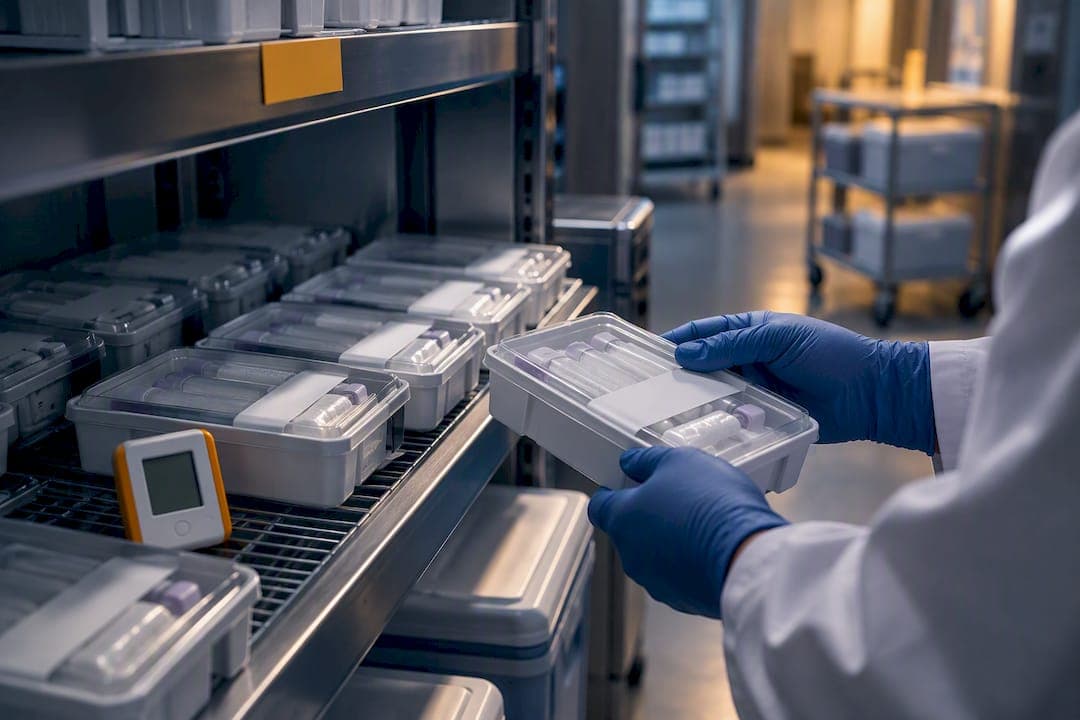
The fastest way to cut missed collections and wasted kits is to fix visibility first: know exactly what's on hand at the study, site, and depot level, then automate resupply so nobody is guessing. Add standardized kitting and barcode tracking on top of that, and most of the failure points below disappear. Start small: run a one-week inventory visibility audit at a single site, or pilot automated kit tracking on one active study before rolling it out further.
TL;DR:
- Accurate inventory visibility at study, site, and depot levels is essential, and automating resupply reduces guesswork and waste.
- Using serialized barcode tracking and automated expiry alerts helps prevent lost kits, overordering, and dispensation errors.
- Vendor-managed inventory models work best for multi-site studies with variable enrollment, whereas site-built kits suit small, low-cost trials.
- Controlling the entire kit management process with clear SOPs, KPI monitoring, and phased pilots ensures smooth rollout without disrupting active visits.
- Inventory systems must meet regulatory audit requirements, including timestamped change logs and detailed chain-of-custody records.
What Is Lab Kit Management in Clinical Trials, and Where Does It Break Down?
Most sites still run lab kit inventory the way they ran it a decade ago: a spreadsheet, a clipboard, and someone's memory of what shipped last Tuesday. That approach works fine until a study scales past a handful of participants, at which point the cracks show fast. Lab kit management trials that rely on manual tracking tend to fail in the same predictable spots, and recognizing them is the first step toward fixing them.
The most common breakdowns include:
- Expired kits going unnoticed until a coordinator opens the box for a scheduled visit, forcing a same-day scramble or a missed collection.
- Over-ordering to create a safety buffer, which quietly inflates budgets and generates disposal costs no one accounted for.
- Lost or damaged kits during shipping or storage, often discovered only when a visit is already underway.
- Dispensation errors, where the wrong kit lot is used or a kit is logged as available when it was already assigned.
These aren't minor annoyances. A missed collection can mean a protocol deviation. An expired kit used by mistake can jeopardize sample integrity and, by extension, data quality across the study. With Clinicaltrials tracking a steadily growing volume of registered studies, the operational strain of manual kit tracking only compounds as trial complexity rises. Sites and sponsors that don't already track kit accuracy rate, on-time kit availability, and waste percentage have no way to know whether their process is improving or quietly getting worse.
IRT/RTSM, LIMS, or Sample-Management Software: Which One Actually Fixes This?
None of these tools do the same job, and that's exactly why sites get confused about which one to buy. IRT/RTSM systems govern randomization and drug or kit assignment logic. LIMS and SDMS platforms manage sample data, chain of custody, and lab results. Sample-management platforms sit closer to inventory itself, tracking physical kit counts, locations, and status. Most well-run studies end up using more than one, connected rather than standing alone.
Whichever category you're evaluating, a few features are non-negotiable:
- Barcode or serialized ID tracking on every kit, not just cartons.
- Separate visibility tabs for study, site, and depot inventory levels.
- Status fields that distinguish dispensed, damaged, expired, and unavailable stock.
- Automated low-stock and expiry alerts, not manual spot checks.
- API or courier integration so shipping data updates inventory automatically.
- An audit trail that satisfies 21 CFR Part 11 expectations, including timestamped changes and reason codes.
TrialKit's inventory configuration shows a practical version of this: CSV import for bulk kit setup, on-site barcode scanning, and direct mapping of inventory to randomization allocations so participant forms populate automatically instead of requiring double entry.
Pro Tip: Before buying any platform, ask the vendor to show you a corrected dispensation error end to end. If they can't demonstrate the audit trail in under two minutes, expect friction during your own inspections.
Deployment speed matters too. A platform that takes six months to configure will outlast its usefulness before it goes live on a shorter study. Prioritize integration with your existing LIS/EHR and courier tracking over feature count.
Kitting Models: Centralized, Vendor-Managed, or Built On-Site?
Sponsors generally choose among four kitting approaches, and the right one depends on study size, site count, and how much operational risk you're willing to carry locally.
- Centralized sponsor kitting — the sponsor assembles and ships kits directly to sites. It offers tight control over lot consistency but adds lead time and shipping risk for geographically spread trials.
- Vendor-managed inventory (VMI) — a kitting partner monitors site-level consumption data and triggers resupply automatically, often through ASN/EDI data feeds, before a site even notices it's running low.
- Depot or third-party logistics (3PL) kitting — kits are staged regionally, cutting transit time and giving sponsors a buffer against single-site disruptions.
- Site-built kits — coordinators assemble kits locally from bulk supplies, which keeps costs low on small studies but scales poorly and is the most error-prone option of the four.
When evaluating a kitting partner, check accuracy history, average lead time, how they handle returns and disposal, and whether their sustainability practices reduce expired-stock waste. Kitting best practices from manufacturing and 3PL operations point to barcode verification and pre-staged scheduling as highly effective strategies. VMI tends to deliver a stronger return once a study runs across multiple sites with variable enrollment. It matters far less on single-site pilots, where the overhead of setting up automated resupply may exceed the waste it prevents.
How Should You Structure Inventory Visibility at Study, Site, and Depot Levels?
Treat inventory visibility as three separate but linked views, not one flat list. Oracle Clinical One's kit management workflow structures it this way for a reason: sponsors need study-wide visibility, CRAs need site-level detail, and depots need shipping and stock-level accuracy, and conflating them is how kits get double-counted or lost in the handoff.
- Study Inventory gives sponsors and CRAs the aggregate view across every participating site, useful for spotting supply imbalances before they become shortages.
- Site Inventory tracks what a specific location has on hand right now, including what's reserved for upcoming visits.
- Depot Inventory shows what's staged and ready to ship, which is where resupply timing gets planned.
Inventory statuses matter as much as counts. A kit marked "dispensed" should be locked from reuse. "Damaged" and "temporarily unavailable" need distinct workflows since one triggers disposal and the other just triggers a hold. "Not in use" flags kits pulled from circulation without destroying them, useful when a protocol amendment changes kit requirements mid-study.
When a dispensation error happens, someone needs clear authority to correct it, with the correction logged and reasoned, not just overwritten. Serialized kits make this far easier to trace than non-serialized batches. Rotate stock using FEFO (first expired, first out) rather than first-in-first-out. It's a small habit that prevents a disproportionate share of expiration waste.
How Do You Roll Out Better Kit Management Without Disrupting Active Visits?
Don't flip the switch on every site at once. Pick one study, or better, one site within a study, and run it for four to six weeks before expanding. This limits the damage if your new process has a flaw, and it gives you real numbers instead of guesses.
- Scope the pilot narrowly. One site, one study arm, clear start and end dates.
- Track four KPIs from day one: kit accuracy rate, kit on-time availability rate, shortage rate, and waste percentage.
- Write the SOP before you scan a single barcode. Cover receiving, staging, scanning, resupply triggers, and error correction in one document coordinators can actually reference mid-visit.
- Train hands-on, not just via slide deck. Walk staff through a real kit from receipt to dispensation, then let them do it themselves while you watch.
- Run weekly QA checks during the pilot, then move to monthly once the process stabilizes.
Kit accuracy and on-time availability are the two numbers to watch first. Manufacturing kitting operations that track these metrics consistently catch supply problems before they cause a shortage, rather than after.
Coordinators adopt new processes faster when they have a one-page quick reference taped near the storage unit, not buried in a shared drive. That small detail determines whether your SOP gets followed at 7 a.m. before the first patient arrives.
What Regulatory Requirements Apply Specifically to Lab Kit Management?
Kit management isn't exempt from the same audit expectations that govern the rest of your trial data. Any system tracking dispensation, status changes, or inventory corrections needs an audit trail that meets 21 CFR Part 11 standards: timestamped entries, attributable user actions, and a documented reason for every change. This applies whether you're using a dedicated inventory platform or a hybrid of spreadsheets and a sample-management tool, though the latter makes compliance considerably harder to demonstrate during an inspection.
Sample-management vendors increasingly build this in by default. LabKey's Sample Manager advertises audit-ready sample timelines alongside HIPAA-aligned hosting, which matters once kit data starts intersecting with participant health information.
Beyond Part 11, sites need documented SOPs covering every kit-handling step: receipt, storage conditions, staging before a visit, dispensation, and disposal of expired or damaged stock. Inspectors don't just want to see that a process exists; they want to see that staff followed it consistently, which means your SOP and your actual practice need to match. A gap between the two, even a small one, is one of the more common findings in trial monitoring visits.
Documentation should also capture chain-of-custody handoffs, particularly when kits move between a depot, a courier, and a site. Missing paperwork at any single handoff point creates a defensibility problem later, even if the kit itself was handled correctly. Building this into your SOP from the start, rather than retrofitting it after a finding, saves considerable rework.
How Do You Maintain Security and Chain of Custody for Trial Kits?
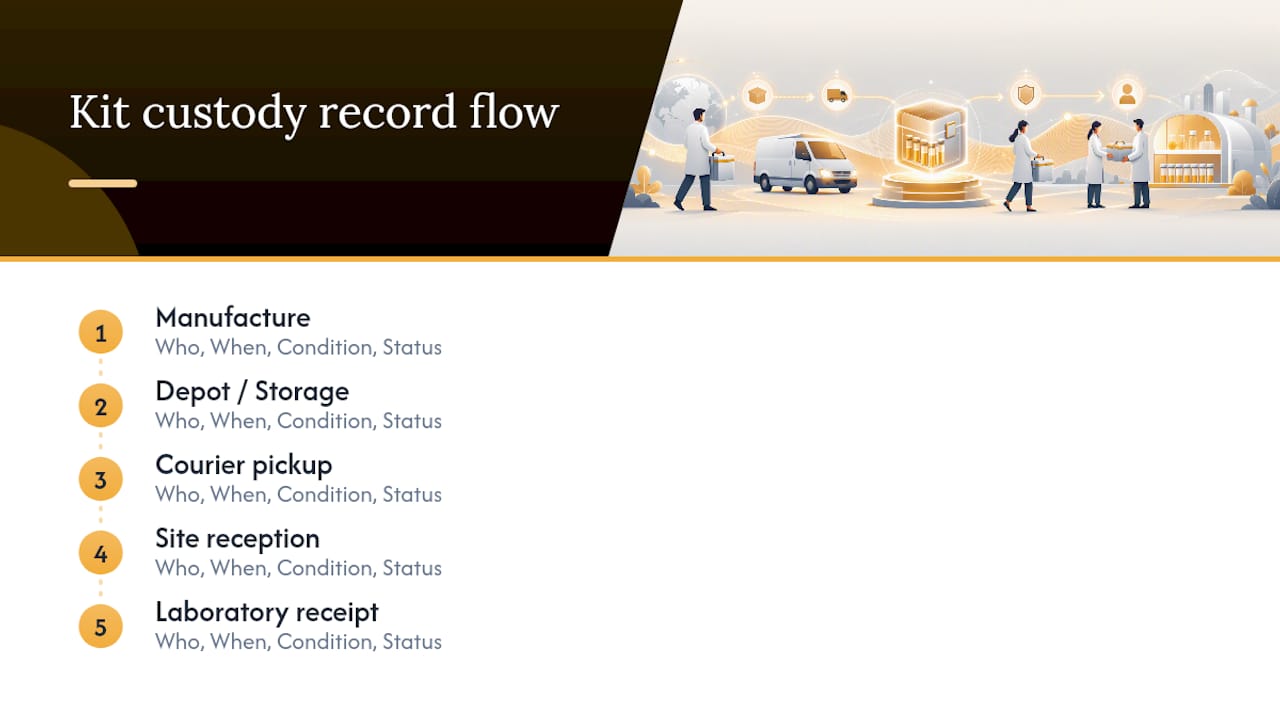
Chain of custody for a lab kit works the same way it does for any biological sample: every handoff needs a name, a timestamp, and a status. That sounds simple until a kit passes through five hands between manufacture and collection, which is the norm rather than the exception on multi-site studies.
Serialized IDs are the foundation. A unique, scannable identifier on every kit lets you trace it from depot to site to lab without relying on lot numbers alone, which can cover hundreds of kits and obscure exactly which one went where. Barcode scanning at each transfer point, rather than manual logging, cuts the error rate significantly and creates a timestamped record automatically.
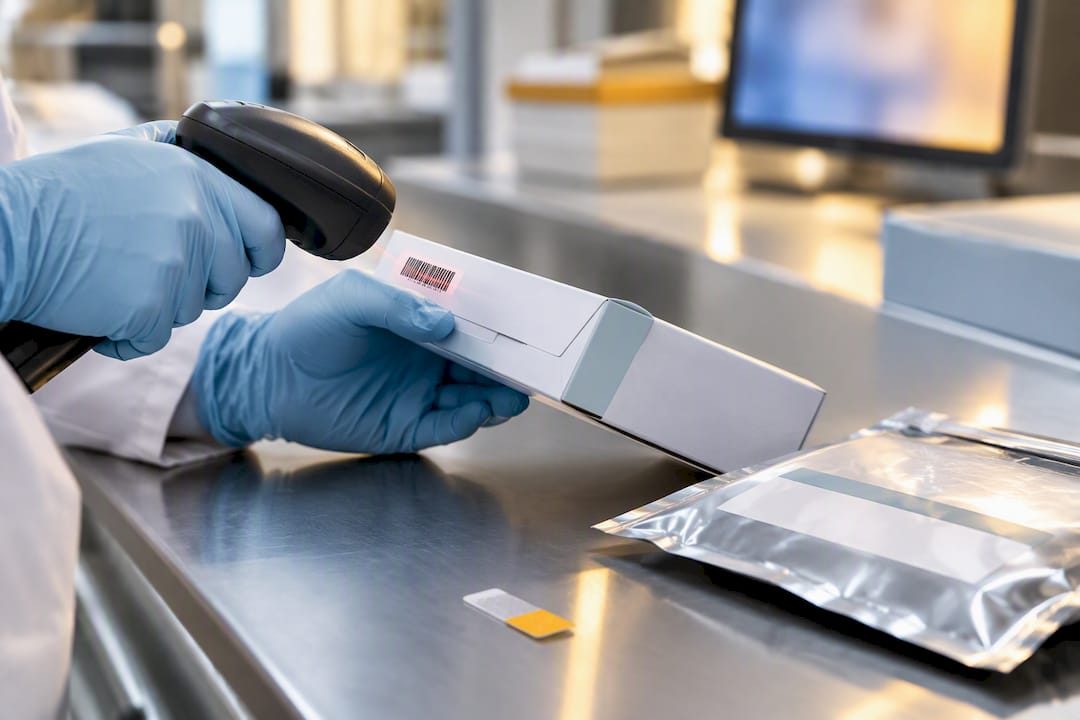
Physical security matters just as much as digital tracking. Kits should be stored in access-controlled areas, with temperature-sensitive components monitored continuously rather than checked on a schedule. A break in the cold chain that goes unnoticed for even a few hours can compromise sample integrity in ways that aren't visible until results come back inconsistent.
Courier integration closes the gap between "shipped" and "received." When a kit's tracking status updates automatically in your inventory system rather than requiring a coordinator to manually confirm delivery, you eliminate the window where a kit's location is genuinely unknown. That window is exactly where lost kits tend to disappear, whether through misdelivery or simple paperwork failure.
Document every custody transfer with enough detail to reconstruct it later: who handled the kit, when, and under what condition it arrived. If a kit is ever flagged during monitoring, that record is what determines whether it's a quick explanation or a serious finding.
How Should Kit Data Connect to Your Broader Clinical Trial Systems?
Kit inventory data that lives in isolation from your clinical data systems creates duplicate work and reconciliation headaches, and it's one of the most avoidable inefficiencies in trial operations. When a kit is dispensed, that event should flow into your EDC or CTMS without a coordinator manually re-entering it in a second system.
The integration case study from Southern Research's use of LabKey's Sample Manager illustrates this well: centralizing kit and sample tracking through one integration layer let the organization automate quality checks and coordinate multiple vendors without the fragmented Excel workflows that used to eat coordinator time. That's the model worth aiming for, regardless of which specific platforms you use.
Practical integration points to prioritize include linking inventory to randomization data (so a dispensed kit automatically updates the participant's visit record), connecting to LIS/EHR systems for result delivery, and syncing with courier tracking APIs for real-time shipment status. Kohealth Labs's healthcare data integration work with CRO and sponsor partners centers on exactly this kind of handoff, coordinating kit logistics and sample data across vendors so information doesn't stall at the boundary between systems.
Modern inventory platforms are increasingly built around this expectation. IDBS's Polar Inventory and similar tools decrement inventory automatically at the point of lab use and track freeze/thaw cycles and storage locations tied to experiment records. Benchling's inventory tools take a similar approach, linking inventory directly to experiment data to cut manual reconciliation and improve traceability. The traceability benefit compounds over a study's lifetime, since every linked record is one less thing to manually cross-check during an audit.
How Do You Budget Realistically for Lab Kit Operations?
Kit budgets tend to blow up in one of two directions: over-ordering as insurance against shortages, or under-budgeting for the disposal and replacement costs that come with expired stock. Both mistakes stem from the same root problem, which is treating kit supply as a one-time procurement decision rather than an ongoing operational line item.
Start budgeting with your baseline waste percentage, not your enrollment target. If a comparable study historically wasted 8 to 12 percent of kits to expiration or damage, that number needs to be built into your forecast rather than treated as an acceptable loss to absorb later. Sites that don't track this figure tend to discover it the hard way, mid-study, when the finance team asks why reorders keep coming in above plan.
Budget line items worth separating explicitly include kit procurement, shipping and courier fees, disposal costs for expired or damaged stock, and the labor cost of manual reconciliation when systems don't talk to each other. That last item is easy to underestimate. A coordinator spending even a few hours a week reconciling spreadsheet counts against actual stock adds up across a multi-year trial in ways a line-item budget rarely captures upfront.
Vendor-managed inventory arrangements often shift some of this cost structure by folding resupply logistics into a predictable service fee rather than a series of ad hoc reorders. Whether that trade-off makes financial sense depends on study scale. A single-site pilot rarely justifies the overhead; a ten-site trial with variable enrollment usually does. Building a contingency line for shipment delays or a mid-study protocol amendment protects the budget from the disruptions that show up in nearly every trial eventually.
What Contingency Plans Protect You When Kit Supply Gets Disrupted?
Every supply chain has a weak point, and in clinical trials it's usually the assumption that the next shipment will arrive on schedule. It won't always. Building a contingency plan before a disruption happens, rather than during one, is what separates a manageable delay from a missed visit window.
Start with a risk inventory specific to your study: single-source suppliers, cold-chain dependencies, sites in regions with unreliable courier service, and kits with short shelf lives that leave little margin for shipping delays. Each of these deserves a documented fallback, whether that's a secondary supplier relationship, a regional depot buffer, or a pre-approved substitution protocol reviewed by the study team.
Real-time visibility is the mechanism that makes contingency plans actionable rather than theoretical. If your inventory system flags a site approaching a shortage threshold automatically, you have days to react instead of hours. Without that alert, the first sign of trouble is often a coordinator calling to say a scheduled collection can't happen. Automated low-stock alerts built into modern inventory platforms exist specifically to close that gap.
Regional depot staging, discussed earlier as a kitting model, doubles as a contingency measure. A depot with a two-to-three-week buffer of stock can absorb a shipping delay from a central sponsor location without any site ever noticing a disruption occurred. That buffer costs money to maintain, but it's considerably cheaper than a protocol deviation or a missed primary endpoint collection.
Finally, build the escalation path into your SOP, not into an email chain improvised during a crisis. Everyone on the study team should know, in advance, who authorizes an emergency reorder, who approves a substitution, and how fast a decision needs to happen once a shortage flag appears.
An Honest Take on Where Sites Overinvest and Underinvest
The industry spends a lot of energy debating which software platform to buy and comparatively little energy on the boring discipline that makes any platform work: consistent SOPs, weekly KPI review, and a pilot that's actually allowed to fail small before scaling. Software fixes visibility. It does not fix a site that skips its QA checks. Treat kit accuracy and on-time rate as monitored operational KPIs, not one-time setup metrics, and most of the failure modes in this article stop recurring.
Kohealth Labs: A Lab Partner Built for Trial-Level Kit Operations
Some lab partners provide sites and sponsors more than standalone software: an actual specimen pickup and testing operation on the other end of the kit, not just a tracking dashboard. Once a kit is dispensed and collected, courier pickup, fast turnaround testing, and electronic results delivery close the loop that inventory software alone leaves open.

For CROs and sponsors piloting a new kit-management workflow, Kohealth Labs supports the operational side directly, offering LIS and EHR integration so results and kit-dispensation data land where your team already works, along with dedicated onboarding support to configure that integration around your specific study protocol. Explore the clinical trial laboratory services Kohealth Labs offers, or take the next concrete step: schedule a specimen pickup for your next collection cycle and see how the handoff performs before committing to a full rollout.
This article is general information, not a substitute for advice from a qualified doctor. Consult a qualified healthcare professional about your own circumstances before acting on anything here.
Sources
- Oracle Clinical One: manage kits at the site and study level
- TrialKit inventory configuration
- Kitting in manufacturing: what it is, how it works, and why it matters
FAQ
What Is Lab Kit Management in Clinical Trials?
It's the process of tracking, storing, dispensing, and resupplying testing kits across study, site, and depot locations so collections happen on schedule without waste. It covers everything from barcode tracking to audit trails and resupply automation.
What Software Do Clinical Trial Sites Use to Track Lab Kits?
Sites typically combine IRT/RTSM systems for randomization-linked kit assignment with LIMS, SDMS, or dedicated sample-management platforms for physical inventory tracking. Tools like Oracle Clinical One and TrialKit illustrate how these systems structure inventory by study, site, and depot level.
How Do You Reduce Kit Expiration Waste?
Rotate stock using FEFO, first expired, first out, rather than first-in-first-out, and set automated expiry alerts well before a kit's shelf life runs out. Vendor-managed inventory arrangements that resupply based on real consumption data also reduce the over-ordering that drives most expiration waste.
Does Kohealth Labs Support Clinical Trial Kit Logistics?
Yes. Kohealth Labs offers specimen pickup, fast turnaround testing, and electronic results delivery for clinical research organizations and sponsors, along with LIS and EHR integration to connect kit and results data with existing systems. Details are available through its clinical trial laboratory services page.
What KPIs Should Sites Track for Kit Management?
The core four are kit accuracy rate, kit on-time availability rate, shortage rate, and waste percentage. Tracking these from the start of a pilot, rather than after a problem surfaces, is what kitting best-practice research points to as the difference between a proactive process and a reactive one.