

Buy integrated diagnostics now if your protocol requires central lab or imaging endpoints. A single-vendor, analysis-ready data bundle with AI-driven QC, CDISC/SDTM-mapped outputs, and a documented audit trail is the fastest path to submission-ready endpoints that satisfy FDA and EMA expectations while reducing site queries and database lock time.
Three immediate next steps:
- Build a vendor qualification checklist that requires CLIA/CAP accreditation, computerized system validation (CSV) documentation, and sample SDTM mapping files.
- Define a pilot scope: two to four sites, one imaging modality, one lab panel, with phantom and kit validation completed before first patient in.
- Insert two non-negotiable contract items: a full traceability and audit trail clause, and turnaround SLAs with financial consequences for missed windows.
Pro Tip: Request a blinded sample dataset from any vendor under consideration. If they cannot deliver a properly de-identified, SDTM-mapped file within five business days, that is a capability gap, not a scheduling issue.
Key Takeaways
Integrated diagnostics with AI-driven QC and CDISC-ready outputs is the most direct path to submission-ready endpoints, fewer queries, and faster database lock in Phase II and III trials.
| Point | Details |
|---|---|
| Buy integrated diagnostics now | Protocols with central lab or imaging endpoints require a single-vendor bundle to meet FDA/EMA traceability expectations. |
| Run a real pilot before award | Test phantom scans, kit validation, and SDTM mapping on 50–100 records before committing to full enrollment volume. |
| Mandate SLAs with consequences | Turnaround time, QC pass rate, and first-submission acceptance targets must carry financial penalties in the SOW. |
| AI QC requires CSV evidence | Any AI QC system without 21 CFR Part 11 validation documentation is unqualified for a pivotal trial. |
| Kohealth Labs | Delivers bundled lab and imaging data with AI QC, SDTM mapping, and dedicated onboarding under a single contract. |
Why does healthcare data integration change trial outcomes?
Fragmented diagnostic suppliers create the single most preventable source of protocol deviations in Phase II and III trials. When labs and imaging operate under separate quality management systems, site-level bias accumulates quietly: inconsistent acquisition parameters, mismatched reference ranges, and incompatible file formats all generate queries that push database lock weeks or months past plan.
Centralized, integrated diagnostic management standardizes image acquisition, biomarker testing, and specimen handling to produce analysis-ready data and reduce site-level bias, a necessity in multicenter Phase III trials. A validated Clinical Trial Imaging Management System (CTIMS) deployed across multiple multicenter trials confirms that centralized imaging management improves regulatory compliance and enables standardized acquisition, transfer, and archival workflows.
Data volume is rising. A TransCelerate/Tufts collaborative study found that Phase III protocols now gather millions of datapoints on average, with non-core labs and imaging among the highest contributors to site burden. Centralizing processing is the most direct lever sponsors have to control that complexity.
Regulatory agencies increasingly expect standardized oversight for pivotal studies. Integrated, centralized diagnostic vendors provide the traceability FDA and EMA require for primary endpoint defense. Fewer vendors also means a single escalation path, unified kits, and one quality management system — which translates directly to fewer queries and faster lock.
Pro Tip: When writing your protocol, specify "central lab and central imaging core lab" as the data source for primary endpoints. That single line protects your submission from site-level variability arguments during review.
What must an integrated diagnostics partner deliver?
The deliverables below should appear verbatim in every statement of work (SOW) and bid response you evaluate.
| Deliverable | Required Format | Why It Matters |
|---|---|---|
| Imaging series | DICOM with full metadata headers | Enables CTIMS ingestion, QC, and CDISC export |
| Lab datasets | CDISC/SDTM-mapped, validated | Required for FDA/EMA submission packages |
| Annotated imaging reads | Structured report + adjudication notes | Supports independent review and audit trail |
| Genomics/biomarker outputs | Validated, annotated flat files | Prevents post-lock reprocessing requests |
| De-identification logs | Timestamped, site-level | Demonstrates HIPAA compliance and chain-of-custody |
CTIMS platforms that meet regulatory requirements support anonymization, transfer, archiving, independent review workflow, and CDISC-compliant exports — the full feature set your SOW must require. Data transfer should use secure SFTP or validated REST APIs, with 21 CFR Part 11 compliance documented for every system that captures or transmits trial data. API-driven architectures reduce manual transfers and data silos by connecting EDC, lab systems, and imaging repositories directly.
Digital pathology adds a specific wrinkle: scanner format standardization and DICOM interoperability remain active challenges, so require explicit file-format commitments in the SOW, not just "digital pathology capable."
Pro Tip: During start-up, require the vendor to run a phantom scan and a kit verification sample before any patient specimen is collected. Failures caught here cost days; failures caught post-enrollment cost months.
How do you qualify sites and standardize acquisition?
Site qualification is where most data quality problems are either prevented or created. A vendor that hands sites a PDF and calls it training is a vendor that will generate queries.
Site qualification checklist items to verify before first patient in:
- Modality-specific phantom scans completed and reviewed centrally
- Kit delivery confirmed, lot numbers logged, cold-chain documentation on file
- Staff competency records for phlebotomy, specimen handling, and imaging acquisition
- Local instrument calibration logs reviewed against protocol-specified reference ranges
- Requisition templates distributed and confirmed in use at each site
SOPs that must be distributed at study startup:
- Imaging acquisition parameters (field strength, slice thickness, contrast protocol)
- Specimen handling and transport (time-to-centrifuge, temperature, labeling)
- De-identification steps and responsible party at each site
- Escalation path for deviations, with contact names and response windows
A centralized team managing roughly 7,000 imaging studies per year at a comprehensive cancer center demonstrated that standardized processes and dedicated oversight reduce imaging deviations and transfer delays. That operational model is what you should require from any vendor you contract. For multi-site diagnostic data coordination, the difference between a vendor with a real site-training program and one without shows up in query rates within the first three months of enrollment.
What should AI-driven quality control actually do?
AI QC is not a marketing feature. It is a documented, validated capability with measurable performance metrics — and you should treat any vendor who cannot produce those metrics as unqualified.
Core AI QC functions to require:
- Real-time anomaly detection for imaging acquisitions (slice gaps, motion artifacts, protocol deviations)
- Automated QC flags for lab results outside pre-specified ranges, with resolution workflow documented
- Pre-ingest normalization of units, reference ranges, and file formats across sites
- Audit logging of every flag, reviewer action, and resolution timestamp
AI-driven integration performs real-time quality control, identifying imaging or laboratory discrepancies early to prevent errors that delay late-stage submissions. Without integration, diagnostic data remain siloed in incompatible formats; unifying diagnostic streams reduces site and participant burden and improves outcome accuracy.
Validation evidence to request: algorithm performance metrics (sensitivity, specificity on a labeled test set), examples of flagged discrepancies with resolution timelines, and full CSV documentation for the AI system under 21 CFR Part 11. A vendor who says "our AI is proprietary" without providing validation documentation is describing a black box, not a qualified system.
For a deeper look at how AI supports diagnostics across specialties, the operational case for validated automated QC is well established across lab, imaging, and pathology workflows.
What regulatory evidence must sponsors demand?
Regulatory readiness often fails at the site level: improper de-identification, inconsistent requisition forms, and missing calibration logs are the most common causes of data deficiencies during FDA review. Proactive site training and standardized templates at study initiation reduce long-term query volume.
Essential regulatory artifacts to require in every SOW:
- Full audit trail with timestamps, user IDs, and change history for all data modifications
- CSV/validation reports for every system that captures, processes, or transmits trial data
- SOPs for specimen handling, imaging acquisition, de-identification, and adjudication
- Calibration logs for all instruments used at central and site labs
- Reviewer sign-off records and adjudication notes for blinded independent reads
- Chain-of-custody documentation from specimen collection through final data delivery
Accreditations and certifications to require:
- CLIA and CAP accreditation for central laboratory operations
- Modality-specific imaging QA programs (ACR accreditation or equivalent)
- HIPAA-compliant data handling with documented breach response procedures
Laboratory quality management across pre-analytical, analytical, and post-analytical phases reduces errors and supports reliable trial outcomes. Automated result review and integrated data systems are the practical implementation of that principle.
What are realistic turnaround times and logistics requirements?
Standard logistics steps to specify in your SOW:
- Kit delivery to site: confirmed 72 hours before first collection window
- Specimen collection to courier pickup: same-day or next-morning, per protocol
- Cold-chain management: temperature monitors in every shipment, deviation alerts to central lab within two hours
- Time-to-lab target: 24–48 hours for safety labs, 48–72 hours for specialty panels
Imaging transfer options include direct DICOM upload via site workstation, PACS pull by the central imaging team, or CTIMS integration for sites with existing infrastructure. Transfer speed depends on site bandwidth, PACS compatibility, and whether the vendor has a dedicated site liaison managing the handoff.
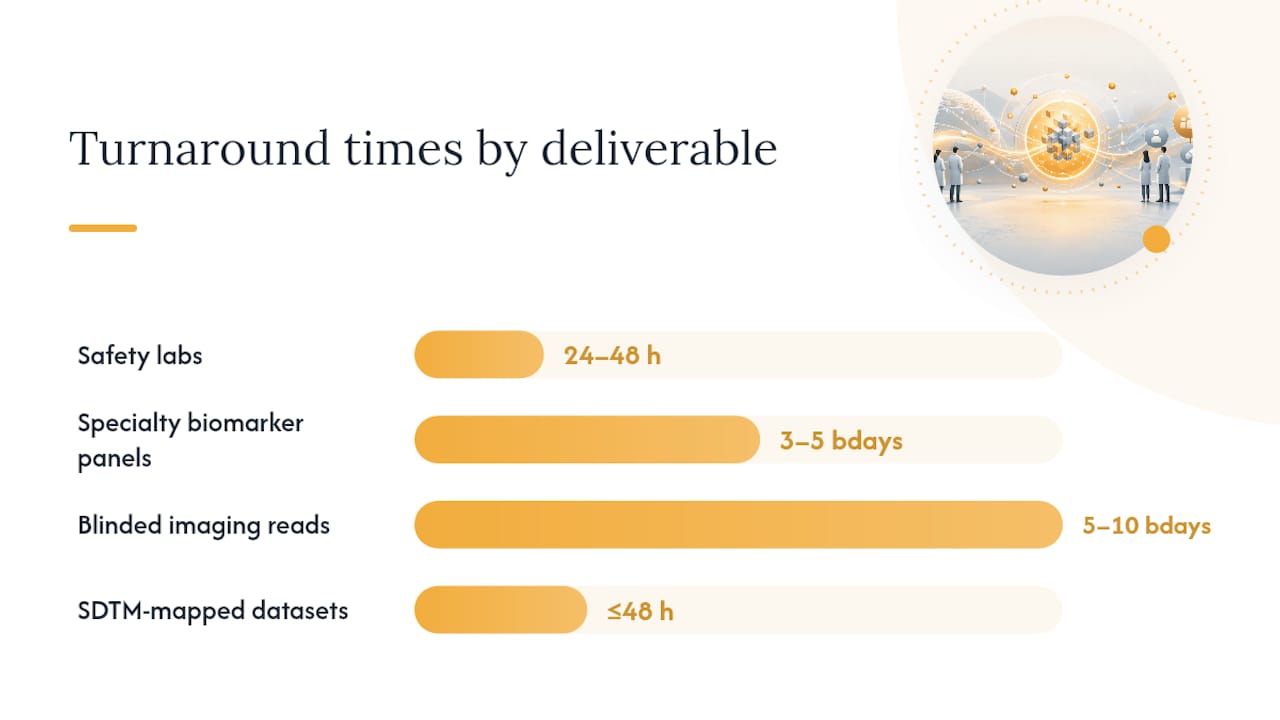
Turnaround time expectations by deliverable type:
- Safety labs: 24–48 hours from receipt
- Specialty biomarker panels: 3–5 business days
- Blinded independent imaging reads: 5–10 business days, depending on read complexity
- SDTM-mapped datasets: within 48 hours of QC sign-off on source data
Faster data delivery directly improves trial outcomes by enabling earlier safety reviews and reducing the gap between data collection and sponsor visibility. Common bottlenecks include customs delays for international specimens, site PACS incompatibility, and late de-identification at the site level — all of which a qualified vendor's SOPs should address before enrollment.
What cost drivers and contract clauses should you expect?
Primary cost drivers in integrated diagnostics contracts:
- Assay complexity and panel size (per-sample costs scale with biomarker count)
- Imaging read volume and modality mix (PET reads cost more than plain film)
- Phantom and kit validation at startup (often a fixed setup fee)
- Courier, cold-chain, and customs for international sites
- Cloud vs. on-premises storage for long-term archival
- AI model hosting and maintenance fees
Common pricing models are per-sample, per-read, and bundled tiers. Per-sample works for straightforward lab panels; per-read suits imaging-heavy protocols; bundled tiers offer predictability for large Phase III programs with defined endpoint sets. For KPI reporting and visualization, Power BI vs. Tableau comparisons can help your team select the right dashboard tool for tracking vendor performance data.
Sample contract clauses to include in every SOW:
- SLA clause: specify turnaround time by deliverable type, QC pass rate targets, and financial consequences for missed windows.
- Data ownership clause: all raw data, processed outputs, and audit logs are sponsor property upon delivery.
- Change-control clause: protocol amendments trigger a formal scope review with written approval before any cost or timeline change takes effect.
- Audit rights clause: sponsor retains the right to audit vendor facilities, systems, and records with 10 business days' notice.
- Indemnity clause: vendor indemnifies sponsor for data loss, breach, or regulatory findings attributable to vendor error.
- IP clause: any AI model trained on sponsor trial data cannot be used for other clients without written consent.
Which KPIs tell you whether your vendor is performing?
Track these KPIs in monthly governance meetings with your vendor. When a metric falls below target, require a written corrective-action plan within five business days, with a root-cause analysis and a defined resolution date. Operational benchmarks for 2026 provide useful reference points for setting realistic SLA thresholds during contract negotiation.
What vendor red flags should stop a contract award?
Most integration failures are predictable. The warning signs appear during the RFP stage if you know what to look for.
Vendor red flags that should trigger a contract pause:
- No CSV documentation for AI QC systems or data management platforms
- Inability to provide a sample SDTM-mapped lab dataset during the RFP process
- Missing chain-of-custody logs or de-identification SOPs
- Site training program limited to written materials with no competency verification
- No modality-specific imaging QA program or phantom scan protocol
Operational pitfalls sponsors create themselves:
- Relying on sites to perform de-identification without central verification
- Skipping vendor-specific analytical verification of test kits before enrollment
- Underestimating customs and warehouse delays for international specimen shipments
- Treating the pilot as a formality rather than a genuine capability test
Vendor-specific analytical variability — staining inconsistencies, scanner artifacts, lot-to-lot reagent differences — is a common pitfall. Rigorous analytical verification of test kits and imaging modalities across sites before enrollment prevents data noise that can obscure outcomes.
How do you run an RFP and pilot that actually validate a supplier?
One-page RFP essentials:
- Required deliverables list with file formats, schemas, and SDTM mapping samples
- Validation samples: one phantom scan, one blinded lab panel, one de-identified imaging series
- Acceptance criteria: QC pass rate, turnaround time, and SDTM mapping accuracy
- CSV evidence for all data management and AI QC systems
- Governance model: named project manager, escalation path, and reporting cadence
Pilot scope and success criteria:
- Two to four sites, one imaging modality, one lab panel
- Phantom and kit validation completed before first patient specimen
- AI QC baseline established: flag rate, resolution time, and false-positive rate documented
- SDTM mapping validated for a subset of 50–100 records against sponsor's mapping specification
Suggested pilot timeline and decision gates:
- Site qualification and phantom testing: weeks 1–3
- First patient specimens and imaging: weeks 4–6
- Data reconciliation and query review: weeks 7–8
- Governance review and scale-up decision: week 9
What clinical operations experience actually teaches you
The checklists in this article reflect a consistent pattern: sponsors who treat integrated diagnostics as a commodity purchase — selecting on price alone — spend the back half of their trial resolving the problems that a qualified vendor would have prevented at startup.
Site training is the most underinvested line item in diagnostic vendor contracts. A vendor who qualifies sites with a one-hour webinar and a PDF will generate queries. The vendors who reduce query rates are the ones who send a clinical scientist to each site for instrument verification, run a live phantom scan, and confirm competency before the first patient is enrolled. That upfront investment pays back in weeks, not quarters.
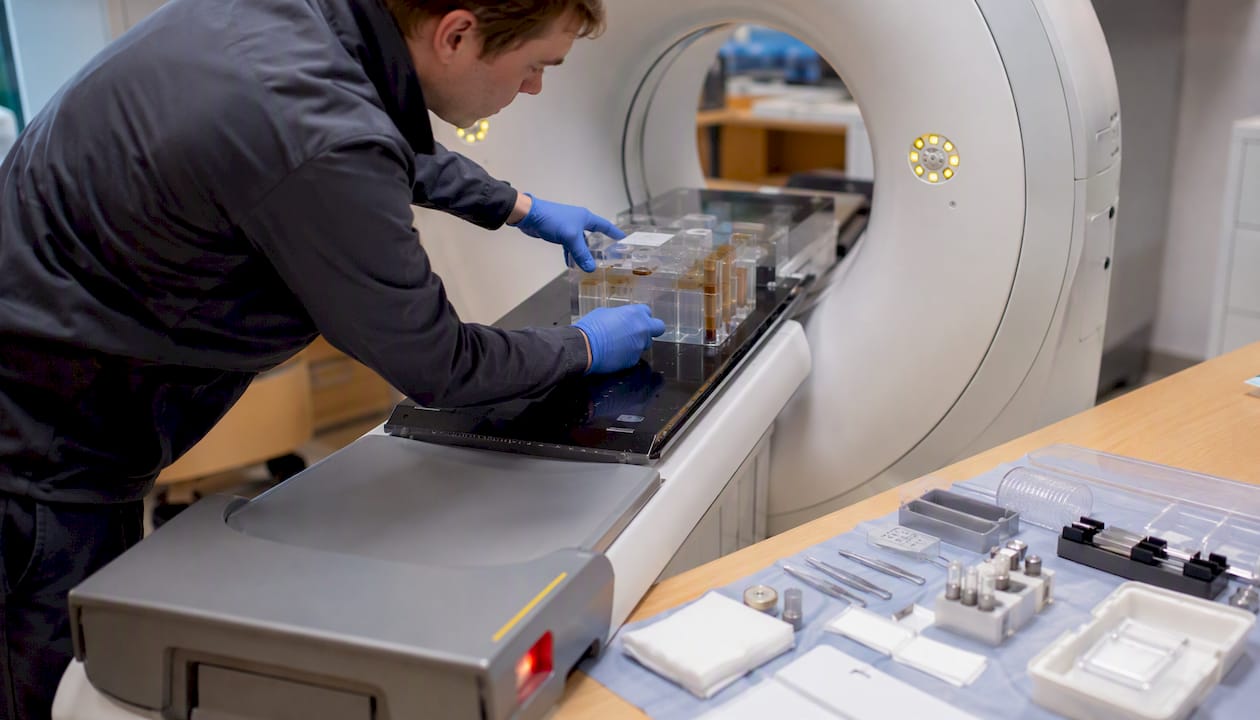
Early phantom testing is equally telling. A vendor who resists phantom testing before enrollment — citing cost or timeline pressure — is signaling that their QC process depends on real patient data to catch problems. That is the wrong order of operations.
Governance cadence matters more than most sponsors expect. Monthly KPI reviews with a named vendor project manager, a standing agenda, and a corrective-action log create accountability that ad hoc emails never do. The single integrated vendor model reduces the number of escalation paths from three or four to one, which shortens resolution timelines and keeps the sponsor's operations team focused on the trial rather than vendor management.
Kohealth Labs delivers analysis-ready diagnostic bundles for your next trial
Sponsors and CROs who need submission-ready data without managing separate lab and imaging vendors have a direct option. Kohealth Labs combines central laboratory services, radiology, AI-driven QC, and CDISC/SDTM-mapped data delivery under a single contract, covering over 100 biomarkers and genomics panels alongside modality-specific imaging reads.
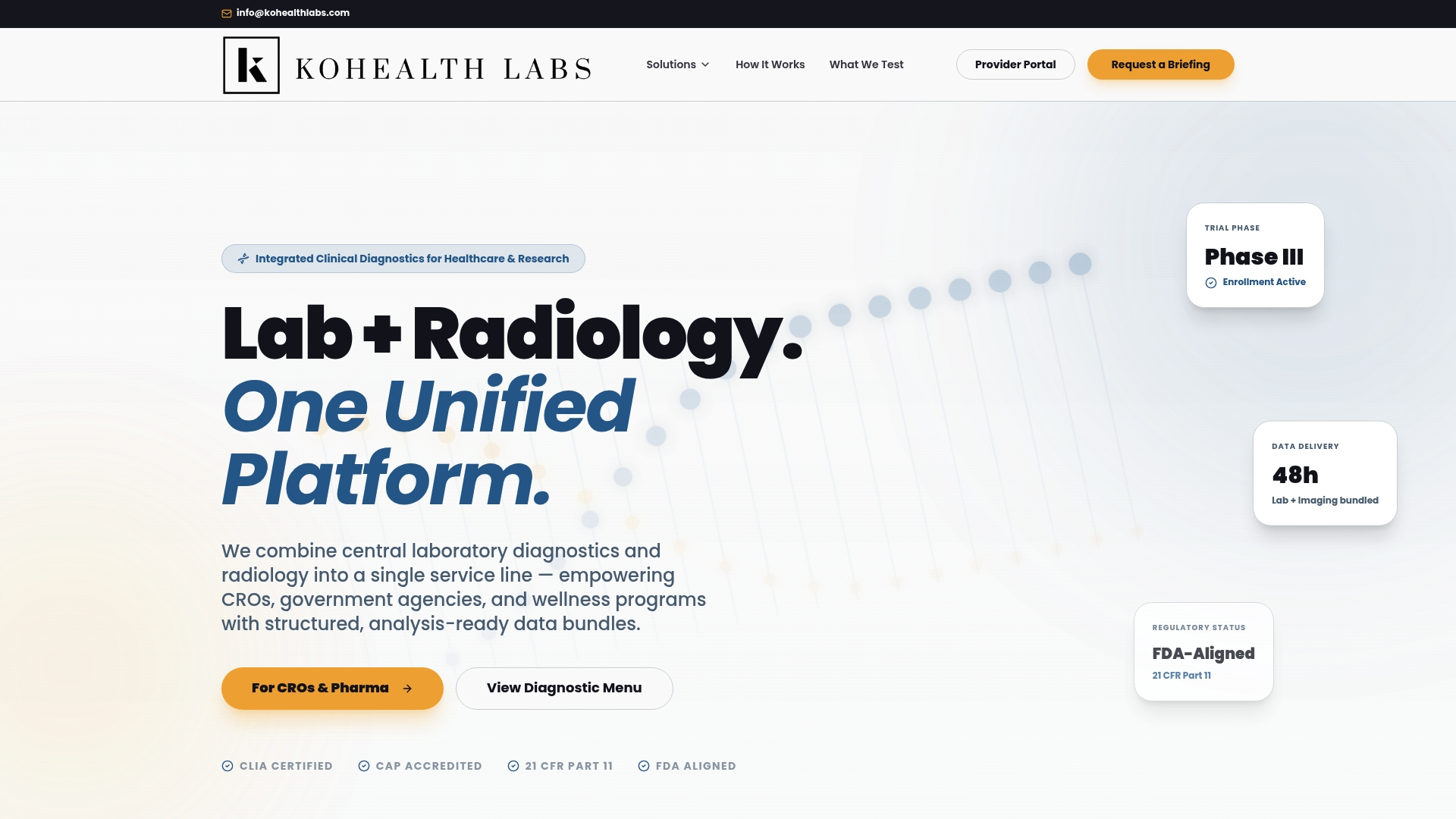
In an introductory call, request the following: a sample SDTM-mapped dataset from a comparable trial, CSV documentation for the AI QC platform, a sample SLA with turnaround time commitments by deliverable type, and a pilot scope proposal for your protocol. Kohealth Labs offers dedicated onboarding, courier specimen pickup, and a provider portal that connects directly to your EDC. Visit Kohealthlabs to request a pilot scope and pricing model for your next Phase II or III program.