

The single-contract diagnostic model is a unified agreement that consolidates laboratory, radiology, and data services under one contract for pharmaceutical clinical trials. In practice, this means sponsors and CROs manage one vendor relationship instead of coordinating separate contracts for drug trials and companion diagnostics. The model addresses a real operational problem: combined drug and diagnostic studies carry regulatory complexity that multiplies when services are split across vendors. Regulatory frameworks including EU CTR, IVDR, and ICH E6 (R3) each impose distinct compliance requirements, and a single-contract diagnostic model in pharma trials creates the coordination structure needed to meet all of them without losing trial momentum.
What is the single-contract diagnostic model in pharma trials?
The single-contract diagnostic model consolidates biomarker analysis, sample logistics, radiology, and data management under one agreement between a sponsor and a specialized provider. The industry also refers to this structure as a unified diagnostic services agreement or integrated diagnostic contract. Both terms describe the same core design: one contract, one accountability chain, one data pipeline.
The operational scale this model can support is significant. Multi-year contracts in this category cover global multicenter studies across 11 countries and 30 or more sites, with contract values reaching €2.7 million through 2031. That scale reflects how seriously sponsors treat diagnostic consolidation as a trial efficiency strategy.

The model matters most in combined drug and companion diagnostic studies. These trials require parallel regulatory submissions: drug trials go through CTIS under EU CTR, while diagnostic performance studies go through separate national competent authorities under IVDR. A single-contract provider coordinates both tracks, preventing the regulatory misalignment that derails timelines when teams treat diagnostics as a secondary service.
What are the essential requirements for implementing this model?
Implementing a contract-based pharma study under this structure requires meeting regulatory, operational, and data management prerequisites before a single line of the contract is signed.
Regulatory compliance across two frameworks
No unified EU submission pathway currently exists for combined drug and companion diagnostic studies. Sponsors must submit drug trials via CTIS and diagnostic performance studies through separate national competent authorities. The IVDR performance study module in EUDAMED is delayed until 2027–2028, which forces country-specific submissions and directly impacts trial start timelines. A single-contract provider must have regulatory affairs capacity in each target country to manage this fragmentation.
The 2025 amended UK Clinical Trials Regulations add another layer. They require sponsors to adopt a risk-based quality management approach that integrates diagnostic data systems within ICH E6 (R3) GCP. This means diagnostic platforms must be validated, fit for purpose, and auditable, not just functional.
Operational tools and data systems
| Requirement | What it means in practice |
|---|---|
| Biomarker analysis capacity | Coverage across 100 or more biomarkers with traceable, analysis-ready outputs |
| Sample logistics | Cold chain management and chain-of-custody documentation across all sites |
| Radiology integration | Centralized imaging reads coordinated with lab data under one data pipeline |
| Fit-for-purpose data systems | ICH E6 (R3) validated platforms for data capture, deviation flagging, and audit trails |
| Regulatory affairs support | Country-specific submission management under both EU CTR and IVDR |
- Confirm the provider holds accreditations relevant to each country in scope.
- Verify that data systems carry risk validation documentation before contract signing.
- Require the provider to demonstrate prior experience with IVDR performance study submissions.
Pro Tip: Request a regulatory submission timeline from your provider before contract execution. If they cannot map CTIS and IVDR submission milestones side by side, they are not ready to manage a combined study.
How to execute a single-contract diagnostic model step by step
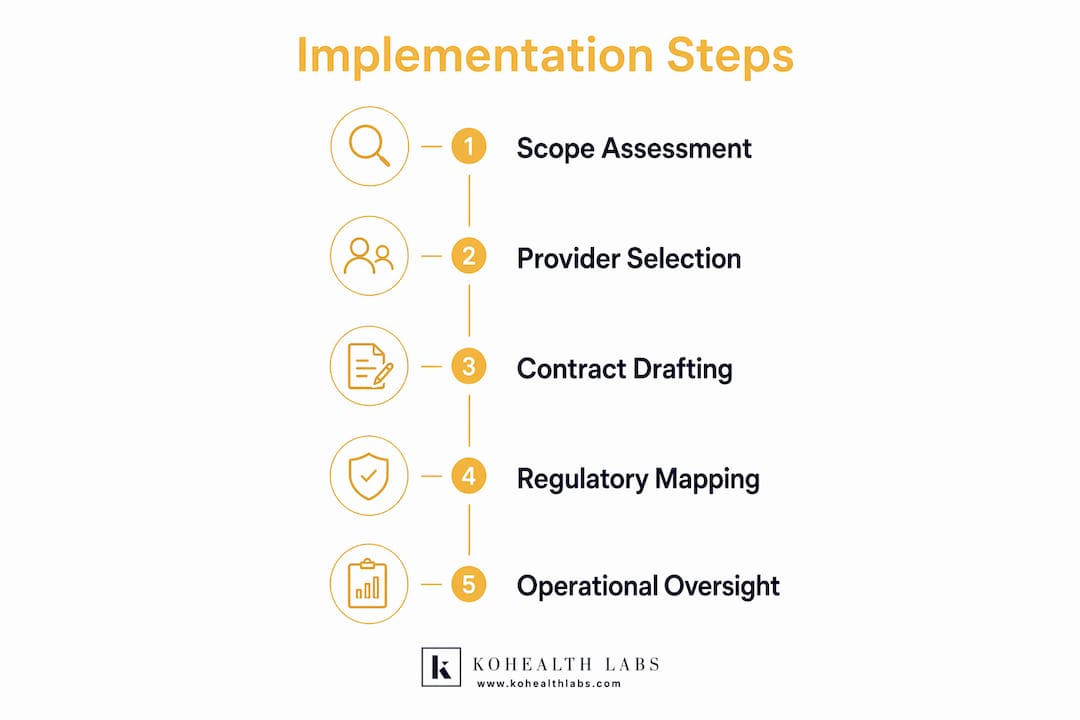
Execution follows a clear sequence. Skipping steps early creates compounding problems later, particularly in multinational studies where regulatory and operational timelines intersect.
-
Assess trial scope and diagnostic needs. Map every diagnostic requirement before approaching providers. Identify which biomarkers, imaging modalities, and sample types the protocol demands. This assessment determines whether a provider's existing infrastructure matches your trial's actual needs.
-
Select a specialized single-contract provider. Evaluate providers on regulatory coverage, biomarker range, data system validation, and prior multicenter experience. A provider managing 30 or more sites across multiple countries needs proven logistics infrastructure, not just laboratory capacity.
-
Negotiate contract terms with agile scaling built in. Contract terms must allow scaling of diagnostic services in line with trial enrollment and progress. Multi-year agreements commonly include progressive revenue recognition, with initial deposits exceeding €100,000 paid upon signing. Build in adjustment mechanisms so enrollment fluctuations do not trigger renegotiation.
-
Coordinate regulatory submissions across CTR and IVDR tracks. Assign a regulatory lead within the provider's team for each country. Submission timelines for drug and diagnostic tracks must be mapped together from day one, not managed in parallel silos.
-
Activate sample logistics and biomarker workflows. Establish chain-of-custody protocols, cold chain specifications, and site-level training before the first patient is enrolled. Delays in sample handling at site level propagate through the entire data pipeline.
-
Integrate risk-based quality management. ICH E6 (R3) principles require that all computerized systems used in clinical trials be risk-validated and fit for purpose. Apply this standard to every diagnostic data platform in the contract scope.
-
Monitor and scale dynamically. Review diagnostic service utilization at each enrollment milestone. Adjust site-level resource allocation without renegotiating the master contract.
| Execution stage | Responsible party |
|---|---|
| Scope assessment | Sponsor medical and operations team |
| Provider selection | Sponsor procurement and regulatory affairs |
| Contract negotiation | Sponsor legal and finance |
| Regulatory submissions | Provider regulatory affairs, per country |
| Sample logistics activation | Provider operations and site coordinators |
| Quality management integration | Sponsor QA and provider data team |
| Dynamic scaling | Joint sponsor-provider oversight committee |
Pro Tip: Build a joint oversight committee with the provider before trial start. Monthly reviews of submission status, sample turnaround times, and data deviation rates catch problems before they become protocol deviations.
What are the common challenges when adopting this model?
The most frequent failure point is treating companion diagnostics as a simple service addition. Sponsors who underestimate the regulatory complexity of combined studies create bottlenecks that delay both the drug and diagnostic tracks simultaneously. Diagnostic regulatory synchronization from day one is not optional. It is the structural requirement that makes the model work.
"Single-contract models provide regulatory resilience by bridging gaps between drug and diagnostic regulations across global markets, essential for advanced therapy trials. The model's value is only realized when regulatory strategy for both tracks is aligned from the protocol design stage, not retrofitted after submission."
Common mistakes and practical fixes:
- Mistake: Submitting drug and diagnostic regulatory packages on separate timelines. Fix: Map CTIS and IVDR submission milestones on one shared project plan before contract execution.
- Mistake: Selecting a provider based on laboratory capacity alone, without verifying radiology and data system integration. Fix: Require a technical architecture review of the provider's data pipeline as part of due diligence.
- Mistake: Writing fixed-volume contracts that cannot absorb enrollment variability. Fix: Include tiered service volumes with predefined adjustment triggers in the master agreement.
- Mistake: Deploying AI diagnostic tools without human oversight protocols. Fix: Require that all AI outputs carry traceable, auditable documentation. AI models like DxDirector-7B assist diagnostic reasoning but require human oversight to maintain accountability in clinical trials.
Pro Tip: Assign a single point of contact at the provider for all regulatory and operational queries. Fragmented communication across provider departments is the fastest way to lose synchronization between drug and diagnostic tracks.
How does integrated diagnostics accelerate pharma trials under this model?
Cross-specialty integrated diagnostics combining labs, radiology, and data under a unified service contract improve regulatory resilience and trial speed by enabling interoperable data sharing and coordinated workflows. This integration reduces redundancy and enhances multinational data integrity and trial oversight. The efficiency gain is structural, not incidental.
The specific benefits of full diagnostic integration include:
- Faster data availability. Lab and imaging results feed into one data platform, eliminating manual reconciliation between separate vendor systems.
- Reduced deviation rates. Unified data pipelines with AI-assisted deviation flagging catch errors before they reach the clinical database. Expert consensus confirms that AI integration must serve as a compliance support tool with traceable and auditable outputs, not as an autonomous decision-maker.
- Stronger regulatory submissions. Interoperable data from labs, radiology, and biomarker analysis produces cleaner, more complete datasets for both CTIS and national competent authority submissions.
- Multinational coordination. A single data platform accessible across all sites removes the version control and data transfer delays that fragment multinational trial oversight.
- Agile safety monitoring. Consolidated diagnostic data supports real-time safety signal detection across sites, which is critical for advanced therapy trials where early signals carry high clinical weight.
Kohealth Labs builds this integration across laboratory services, radiology, and AI-assisted data management, covering over 100 biomarkers within a unified clinical diagnostic framework designed for CROs and pharma sponsors.
Key Takeaways
The single-contract diagnostic model succeeds when regulatory alignment, operational integration, and contract flexibility are built in from the start, not added after problems emerge.
| Point | Details |
|---|---|
| Regulatory alignment is foundational | Map CTIS and IVDR submission milestones together before contract execution to prevent timeline gaps. |
| Contract terms must allow scaling | Build tiered service volumes and adjustment triggers into the master agreement to handle enrollment variability. |
| Integrated data systems are required | All diagnostic platforms must meet ICH E6 (R3) risk-validation standards to protect data integrity. |
| AI supports but does not replace oversight | AI diagnostic tools require human review and auditable outputs to meet GCP accountability standards. |
| Early coordination prevents bottlenecks | Treating companion diagnostics as a secondary service is the leading cause of combined study delays. |
What Kohealth Labs has learned from integrated diagnostic contracts
The conventional wisdom in clinical operations is that vendor consolidation is primarily a cost play. That framing misses the real value. The sponsors who get the most out of a single-contract model are the ones who treat it as a regulatory strategy first and a procurement decision second.
What Kohealth Labs has seen consistently is that the trials with the smoothest execution are the ones where the sponsor's regulatory affairs team and the provider's regulatory team are aligned on submission sequencing before the protocol is finalized. That alignment is harder to achieve than it sounds. Drug and diagnostic regulatory tracks have different timelines, different competent authorities, and different documentation standards. Forcing them into a shared project plan requires someone with authority over both tracks. That person rarely exists on the sponsor side without a specialized provider filling the gap.
The role of AI in this model is also frequently misunderstood. AI tools that flag deviations and support data quality reviews are genuinely useful. But they work because they surface problems for human review, not because they resolve them autonomously. Sponsors who deploy AI without building human oversight into the workflow create audit risk, not efficiency. The accountability chain must remain clear at every step.
The sponsors who succeed with this model share one characteristic: they select providers with demonstrated multinational regulatory experience, not just laboratory scale. Laboratory capacity is table stakes. Regulatory coordination across 10 or more countries is the differentiator.
— Kohealth Labs
Kohealth Labs: integrated diagnostics built for pharma trial efficiency
Clinical trial sponsors managing combined drug and diagnostic studies need a partner who handles the full diagnostic scope, not just one part of it.
Kohealth Labs delivers integrated clinical diagnostics for CROs and pharma sponsors, combining laboratory services, radiology, and AI-assisted data management under one contract. The platform covers over 100 biomarkers, supports multinational site coordination, and produces analysis-ready data bundles that meet ICH E6 (R3) and IVDR compliance standards. Sponsors working with Kohealth Labs get a single point of accountability for all diagnostic services, from sample logistics through regulatory submission support. Visit kohealthlabs.com to see how the model works in practice.
FAQ
What is a single-contract diagnostic model in pharma trials?
A single-contract diagnostic model consolidates laboratory, radiology, and data services under one agreement for a clinical trial. It gives sponsors one accountability chain for all diagnostic functions instead of managing separate vendor contracts.
How do EU CTR and IVDR affect combined drug and diagnostic studies?
No unified EU submission pathway exists for combined studies. Drug trials submit through CTIS under EU CTR, while diagnostic performance studies go through separate national competent authorities under IVDR, with the EUDAMED module delayed until 2027–2028.
What does ICH E6 (R3) require for diagnostic data systems?
ICH E6 (R3) requires that all computerized systems in clinical trials be risk-validated and fit for purpose. Diagnostic data platforms within a single-contract model must meet this standard to protect trial data integrity.
How does AI fit into a single-contract diagnostic model?
AI tools assist by flagging data deviations and supporting diagnostic reasoning, but they require human oversight and auditable outputs to meet GCP accountability standards. AI functions as a compliance support tool, not an autonomous decision-maker.
What contract terms prevent delays in multicenter diagnostic studies?
Contracts must include tiered service volumes with predefined adjustment triggers to handle enrollment variability across sites. Progressive revenue recognition structures, with initial deposits at signing, are standard in multi-year agreements covering global multicenter studies.