

Timely diagnostic data delivery research is defined as the study and implementation of systems that ensure diagnostic information reaches clinicians and researchers with minimal latency to support fast, accurate clinical decisions. This field sits at the intersection of clinical informatics, data engineering, and patient safety. The CDC's Diagnostic Excellence (DxEx) program identifies timeliness as a core pillar of accurate diagnosis, alongside multidisciplinary collaboration across labs, radiology, and clinical teams. Current benchmarks include Kafka-based ingestion lags below 5 seconds at p95 and end-to-end data freshness under 60 seconds. HPC-driven pipelines now process genomic data at 420 GB/hour while reducing ICU alert time by 40%, making the stakes of this research field concrete and measurable.
What is timely diagnostic data delivery research and how is it defined?
Timely diagnostic data delivery research covers the methods, architectures, and quality controls that minimize the gap between data generation and clinical use. The industry term for this gap is "clinical latency," and reducing it is the primary goal of the field.
Two distinct metrics define timeliness in practice. Event-time lag measures the delay between when a clinical event occurs and when the data system registers it. Processing latency measures how long the pipeline takes to transform raw data into a usable result. Both must be monitored separately. Tracking only one gives a false picture of pipeline health.
Service level agreements (SLAs) formalize these targets. A well-designed clinical SLA specifies sub-minute freshness targets, typically requiring Kafka-based ingestion lag below 5 seconds at p95 and total end-to-end freshness under 60 seconds at p95. These numbers are not arbitrary. They reflect the window within which a clinician can act on an ICU alert before a patient's condition deteriorates.
Pro Tip: Monitor p95 latency, not average latency. Averages hide the worst-case delays that cause clinical alert failures. A pipeline with a 2-second average but a 45-second p95 will miss critical alerts regularly.
| Clinical setting | Typical ingestion lag target | End-to-end freshness target |
|---|---|---|
| ICU monitoring | <5s (p95) | <60s (p95) |
| Genomic sequencing | <30s (p95) | <5 minutes (p95) |
| Radiology imaging | <10s (p95) | <2 minutes (p95) |
| Lab results delivery | <15s (p95) | <3 minutes (p95) |
What technical architectures enable fast diagnostic data delivery?
HPC-based AI pipelines are the current standard for high-throughput clinical data processing. These systems process genomic data at 420 GB/hour and support real-time analysis across ICU monitoring, medical imaging, and rare disease genomics simultaneously. That throughput is not achievable with traditional batch processing.

Event-driven streaming architectures have replaced batch pipelines in most modern clinical environments. Instead of collecting data and processing it in scheduled runs, streaming systems process each data event the moment it arrives. Apache Kafka is the most widely deployed technology for this pattern in healthcare. The shift matters because batch pipelines introduce predictable delays that are invisible until a patient outcome is affected.
Real-time lakehouse architectures take this further by unifying streaming and historical data in a single system. A lakehouse allows a clinician's decision support tool to query both a patient's live sensor feed and their full longitudinal record in one call. Autonomous quality management layers sit inside these architectures to detect anomalies before bad data reaches a clinician.
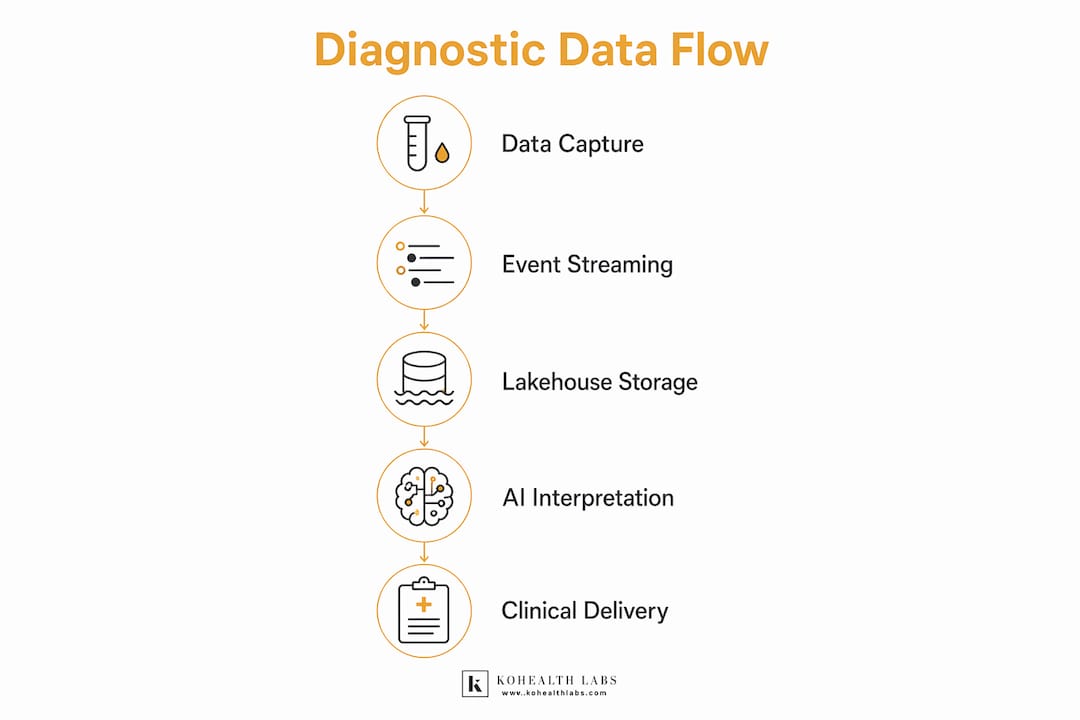
Semantic normalization is the step most teams underinvest in. High-speed ingestion is clinically useless without standardized metadata and terminology that lets systems from different vendors interpret the same data field consistently. Without it, a lab result from one system cannot be compared to a result from another.
The main data sources integrated into clinical pipelines include:
- Electronic Health Records (EHRs): Structured patient history, medication records, and clinical notes
- Medical imaging: DICOM files from CT, MRI, and X-ray systems requiring high-bandwidth transfer
- Genomic sequencing: Large file formats requiring HPC compute for variant calling and annotation
- Internet of Medical Things (IoMT): Continuous streams from wearables, bedside monitors, and infusion pumps
- Laboratory information systems: Structured numeric results with reference ranges and flags
Pro Tip: Iterative pipelines that process only delta updates, rather than reprocessing entire datasets, cut computational cost significantly. This approach is standard in genomic reanalysis tools and applies equally to any large clinical dataset.
How does AI improve diagnostic data accuracy and speed?
AI improves diagnostic data delivery by automating the interpretation step that previously required a specialist to review raw results manually. The DiReCT dataset, containing 511 annotated clinical notes across 25 disease categories, is a benchmark resource for training large language models to perform interpretable diagnostic reasoning directly from clinical text. That kind of structured annotation is what separates a model that generates plausible text from one that supports a clinical decision.
Automated reanalysis is the most concrete example of AI accelerating diagnostic timelines. The Talos genomic reanalysis tool increases diagnostic yield in rare diseases by 5.1% and reduces the median time between a new gene-disease discovery and a patient diagnosis to 32 days. Before automated reanalysis, that gap was measured in years. The tool works by processing only the changes in variant databases rather than rerunning the full analysis, which keeps compute costs manageable.
Knowledge graph frameworks add a layer of explainability that pure machine learning models lack. An AI-driven knowledge graph integrating heterogeneous healthcare data achieved an F1-score of 0.79 for detecting diabetic conditions while providing guideline-aligned reasoning that clinicians can audit. Explainability is not a luxury in clinical settings. Regulators and clinicians both require a traceable rationale before acting on an AI recommendation.
| AI approach | Data type | Key outcome |
|---|---|---|
| Large language models (DiReCT) | Clinical notes | Interpretable diagnostic reasoning across 25 disease categories |
| Automated reanalysis (Talos) | Genomic variants | 5.1% yield increase; 32-day median diagnosis time |
| Knowledge graph frameworks | Multi-modal EHR data | F1-score 0.79; explainable clinical decision support |
What are the main challenges in reliable diagnostic data delivery?
Speed without integrity is not timeliness. It is noise. The most dangerous failure mode in clinical data pipelines is a silent quality failure, where data arrives on time but is wrong, incomplete, or misformatted. Autonomous quality management systems address this by continuously monitoring data distributions and flagging deviations before they propagate downstream.
Interoperability remains the hardest unsolved problem in the field. Clinical data originates in systems built by dozens of vendors using different terminology standards, coding systems, and file formats. Semantic normalization, the process of mapping all incoming data to a shared canonical model, is the technical solution. Without it, high-speed ingestion produces clinically useless output because no two systems agree on what a data field means.
Cryptographic guarantees are an emerging requirement for pipeline trustworthiness. As data moves through multiple processing stages, each transformation must be verifiable. Pipelines that cannot prove data was not altered in transit create regulatory and liability exposure for clinical research organizations. The balance between speed and trust in diagnostic pipelines is an active area of research, not a solved problem.
Practical challenges that clinical and technical teams face regularly include:
- Reprocessing large genomic or imaging datasets when a pipeline error is discovered retroactively
- Maintaining SLA compliance across geographically distributed trial sites with variable network quality
- Reconciling data from legacy lab systems that do not support streaming protocols
- Managing regulatory documentation requirements for each pipeline change in a GxP environment
- Ensuring that AI model outputs remain valid as underlying data schemas evolve
How does timely data delivery apply to clinical trials and diagnostic programs?
Clinical trials depend on timely diagnostic data delivery to maintain safety monitoring and protocol compliance. A delayed lab result or imaging read can trigger a protocol deviation, delay a dosing decision, or obscure an adverse event signal. Integrated diagnostics, combining labs, radiology, and data AI in a single workflow, removes the handoff delays that occur when these services operate through separate vendors. Kohealth Labs builds this integration into its core model, enabling CROs and pharma sponsors to receive analysis-ready data bundles without managing multiple contracts or reconciling data from disconnected systems.
The CDC's DxEx program formalizes what clinical teams have known operationally for years. Diagnostic excellence requires accurate and timely diagnosis using the fewest resources, with explicit collaboration across labs, radiology, and clinical staff. That definition maps directly onto what integrated diagnostic platforms deliver technically.
Semantic interoperability research is the next frontier. Current pipelines handle speed well. The gap is in making fast data universally interpretable across institutions, trial sites, and health systems. Research in FHIR-based canonical data models and ontology alignment is closing that gap, but adoption across the industry remains uneven.
Pro Tip: When evaluating a new diagnostic data architecture, test interoperability before throughput. A pipeline that ingests data at 420 GB/hour but cannot map results to your trial's data standard creates more work than it saves. Interoperability is the threshold requirement; speed is the differentiator.
For teams looking to understand how telehealth-integrated diagnostics apply these principles in real clinical workflows, practical examples from 2026 show how distributed trial sites maintain data freshness across modalities.
Key Takeaways
Timely diagnostic data delivery research requires integrated pipelines, strict SLA monitoring at p95, and semantic normalization to produce data that is both fast and clinically usable.
| Point | Details |
|---|---|
| Define timeliness with p95 metrics | Target ingestion lag below 5 seconds and end-to-end freshness under 60 seconds at p95, not averages. |
| Shift to event-driven streaming | Replace batch pipelines with streaming architectures to eliminate predictable, avoidable delays. |
| Prioritize semantic normalization | High-speed ingestion without standardized metadata produces data that clinical systems cannot use. |
| Use AI for iterative reanalysis | Automated tools like Talos add 5.1% diagnostic yield in rare diseases by processing only delta updates. |
| Integrate labs, radiology, and data AI | Single-contract integrated diagnostics remove handoff delays that slow clinical trials and safety monitoring. |
The case for treating data delivery as a clinical discipline
At Kohealth Labs, we have seen firsthand what happens when diagnostic data delivery is treated as an IT problem rather than a clinical one. The pipeline meets its SLA on paper. The data arrives in under 60 seconds. And then a trial site flags that the lab values are not mapping correctly to the study's data standard, and the team spends two weeks reconciling records that should have been clean from day one.
The field's focus on throughput benchmarks is justified. Processing genomic data at 420 GB/hour and cutting ICU alert times by 40% are real achievements with real patient impact. But the teams that get the most value from fast pipelines are the ones that invested equally in data quality and interoperability before they invested in speed. Speed amplifies whatever is already in the pipeline. If the data is clean and well-structured, fast delivery accelerates decisions. If it is not, fast delivery accelerates errors.
The most underappreciated challenge in this field is the human coordination layer. Technical teams can build a real-time lakehouse. Clinical teams can define the SLAs. The gap is usually in the middle, where neither group fully understands the other's constraints. Closing that gap requires deliberate collaboration structures, not just better software. That is where integrated diagnostic partners add value that no architecture alone can provide.
— Kohealth Labs
Kohealth Labs and integrated diagnostic data for clinical research
Kohealth Labs integrates laboratory services, radiology, and data AI into a single clinical diagnostic platform built for CROs, government agencies, and pharma sponsors.
The platform's single-contract model eliminates the vendor coordination that slows data delivery in multi-site trials. AI-driven quality checks identify deviations in real time, and analytics covering over 100 biomarkers produce analysis-ready data from the moment results are generated. For teams working to reduce clinical latency and improve trial efficiency, Kohealth Labs' data AI capabilities are built specifically for that purpose. Reach out to learn how integrated diagnostics can support your next clinical program.
FAQ
What is timely diagnostic data delivery research?
Timely diagnostic data delivery research is the study of systems and methods that minimize the delay between data generation and clinical use. It covers pipeline architecture, SLA design, AI-assisted interpretation, and data quality management.
What latency benchmarks define timely data delivery in clinical settings?
Industry SLAs target Kafka-based ingestion lag below 5 seconds at p95 and total end-to-end data freshness under 60 seconds at p95. Monitoring p95 rather than average latency is critical because averages mask the outlier delays that cause clinical alert failures.
How does AI improve diagnostic data delivery?
AI automates interpretation and reanalysis steps that previously required manual specialist review. Tools like Talos increase rare disease diagnostic yield by 5.1% and reduce the time from new gene-disease discovery to patient diagnosis to a median of 32 days.
Why does semantic normalization matter for fast diagnostic pipelines?
High-speed data ingestion is clinically useless without standardized metadata and terminology. Semantic normalization ensures that data from different vendor systems maps to a shared model, making results comparable and actionable across platforms and trial sites.
How does integrated diagnostics support timely data delivery in clinical trials?
Integrating labs, radiology, and data AI in a single workflow removes the handoff delays that occur when these services operate through separate vendors. This approach reduces turnaround time, supports real-time safety monitoring, and produces analysis-ready data bundles for CROs and pharma sponsors.