

Bottom line: 21 CFR Part 11 lets FDA-regulated organizations use electronic records and electronic signatures in place of paper when the regulation's controls are implemented and documented. The governing text treats electronic records as trustworthy and legally equivalent to paper only when your systems meet specific, verifiable criteria. There's no partial credit here. Either your validation package, audit trails, access controls, and signature linking hold up under review, or your electronic records don't qualify as a substitute for paper at all.
The FDA's own guidance on Part 11 scope narrowed enforcement focus over the years, but it never removed the underlying obligation. If a predicate rule like cGMP or GCP requires a record, and you keep that record electronically, Part 11 applies.
What "sufficient controls" actually means in practice:
- Validated systems with documented evidence the software does what it claims, consistently
- Secure, time-stamped audit trails that capture who changed what, when, and why, without obscuring the original entry
- Access controls tied to individual accounts, not shared logins
- Signature-to-record linking so an electronic signature can't be copied or transferred to falsify a different record
Data integrity teams often frame all of this through ALCOA+: records should be Attributable, Legible, Contemporaneous, Original, Accurate, plus Complete, Consistent, Enduring, and Available. If you're running systems in the cloud, remember the shared-responsibility caveat. Your vendor's infrastructure controls don't automatically satisfy your Part 11 obligations. You still need contractual evidence and validation on your end.
Key Takeaways
Part 11 compliance rests on validated systems, tamper-evident audit trails, individual-level access controls, and signature/record linking, all mapped to ALCOA+ and documented well enough to survive an inspection.
| Point | Details |
|---|---|
| Scope follows predicate rules | Part 11 applies whenever cGMP, GCP, or GLP requires a record you're keeping electronically. |
| Audit trails must preserve history | Never overwrite original data; log every change with a timestamp and user ID. |
| Validation is ongoing, not one-time | Rebuild regression tests into change control so software updates don't silently break validated status. |
| Self-discovery reduces enforcement risk | Documented CAPA and early FDA reporting typically fare better than inspector-found gaps. |
| Cloud vendors need contractual proof | Require SLAs, raw log access, and demonstrated controls, not just marketing claims. |
What Records and Signatures Does 21 CFR Part 11 Compliance Cover?
Part 11 applies to any electronic record created, modified, maintained, archived, retrieved, or transmitted under an FDA regulation, according to §11.1 of the regulation itself. That's broader than most people assume. It's not limited to signed documents. It covers lab instrument outputs, EMR entries tied to a clinical trial, manufacturing batch records, and audit logs generated automatically by validated software.
The key trigger isn't the format of the record. It's whether a predicate rule requires that record to exist in the first place. Predicate rules are the underlying FDA regulations, cGMP for manufacturing, GCP for clinical trials, GLP for nonclinical lab studies, that create the recordkeeping obligation. Part 11 doesn't invent new documentation requirements. It governs how you satisfy existing ones electronically.
That distinction matters for scoping your compliance effort:
- If a predicate rule requires a signature on a document, and you sign it electronically, Part 11's signature controls apply.
- If a system generates data that a predicate rule requires you to retain (chromatography results, vital signs captured during a trial visit), that data falls under Part 11's record controls even if nobody ever "signs" it.
- Internal, non-regulatory records, like a scheduling tool with no predicate-rule tie, generally fall outside scope, though many organizations apply Part 11 discipline anyway for consistency.
Closed systems, where your organization controls access, look different from open systems, where the people accessing records aren't under your direct control. Open systems need additional protections: encryption for data in transit, digital signature standards strong enough to verify authenticity, and often more rigorous identity verification before granting access. A lab operating a controlled internal LIMS is a closed system. A telehealth portal where patients upload their own records from personal devices tips toward open-system territory, and that shift changes your control requirements substantially.
What Controls Does an FDA Auditor Expect to See?
Auditors don't ask whether you've heard of Part 11. They ask you to produce evidence. Here's the checklist that maps directly to what inspectors look for during a records review.
- Validation documentation. You need proof the system performs as intended, consistently, and produces accurate results. That means a validation plan, test scripts, results, and a summary report tied to the specific software version in production, not a generic vendor brochure.
- Audit trails that don't obscure history. Every edit to a record needs a secondary, secure, time-stamped entry showing the original value, the new value, who made the change, and when. Deleting or overwriting the original entry defeats the entire point.
- Retention matched to the record's lifecycle. Audit trails must be kept at least as long as the electronic records they document, and they need to be available for agency review and copying on request.
- Access controls tied to individuals. Shared credentials are one of the most common findings inspectors flag. Every account needs to map to one identifiable person, with authority checks confirming that person can only perform actions their role permits.
- Device and operational checks. Systems should verify that data is coming from an authorized source and that sequential steps happen in the correct order, not just that a valid password was entered.
- Training records for anyone who touches the system. Personnel need documented, role-specific training before they get access, and that training needs to be refreshed when the system changes materially.
- Human-readable copies on demand. If an inspector asks for a record, you need to produce it in a format a person can actually read and understand, not raw database exports.
Each of these controls ties back to ALCOA+ in a specific way. Validation supports Accuracy. Audit trails support Attributability and Contemporaneous recordkeeping. Access controls support Originality by preventing unauthorized alteration. If you can walk an auditor through that mapping control by control, you've essentially pre-answered their next three questions.
Pro Tip: Build your validation documentation around the actual predicate-rule record you're protecting, not around the software in the abstract. Auditors want to see that you validated the system for its specific regulated use, not that you ran a generic IT test suite.
How Do You Validate Electronic Systems Under Part 11?
A validation package that actually holds up during inspection includes four things: documented requirements, test cases that map to each requirement, a traceability matrix connecting the two, and defined acceptance criteria signed off before testing begins. Skip any one of these and you're left improvising when someone asks "how do you know this system works?"
The classic IQ/OQ/PQ framework (Installation Qualification, Operational Qualification, Performance Qualification) still applies, but modern software rarely gets installed once and left alone. Cloud platforms push updates continuously, sometimes without much warning. The practical adaptation: treat your OQ and PQ evidence as a living file, not a one-time event, and build regression testing into your change control process so every update gets re-validated against your original acceptance criteria before it touches production data.
Cloud vendors introduce a shared-responsibility wrinkle that a lot of validation plans miss. You need contractual evidence, not just marketing claims, covering:
- System architecture and data flow descriptions detailed enough to support your own risk assessment
- Service level agreements that specify uptime, backup frequency, and incident response timelines
- Contractual access to raw, unaltered audit logs, not just a vendor-generated summary report
- Documented proof that the vendor's controls, encryption, backup, access management, actually function as claimed, not just as advertised
Change control is where a lot of validated systems quietly drift out of compliance. A software patch that changes how timestamps are recorded, or an integration update that alters how data moves from your lab instrument to your EMR, can invalidate your original test evidence without anyone noticing until an inspector asks. Organizations evaluating a regulatory-compliant laboratory partner should ask specifically how that partner documents and re-validates after every material system change, not just at initial go-live.
Pro Tip: Ask any cloud vendor for a sample audit log export before you sign a contract. If the export doesn't show a clear, unalterable record of who changed what and when, your validation package will have a hole you can't fill later.
How Should Audit Trails and Electronic Signatures Be Designed?
An audit trail that satisfies Part 11 has to be secure, computer-generated, and time-stamped, and it has to record the original entry alongside every subsequent change rather than replacing it. That last piece trips up more systems than any other single requirement. A field that simply shows the current value, with no visible history, fails this standard even if a hidden log exists somewhere in the database.
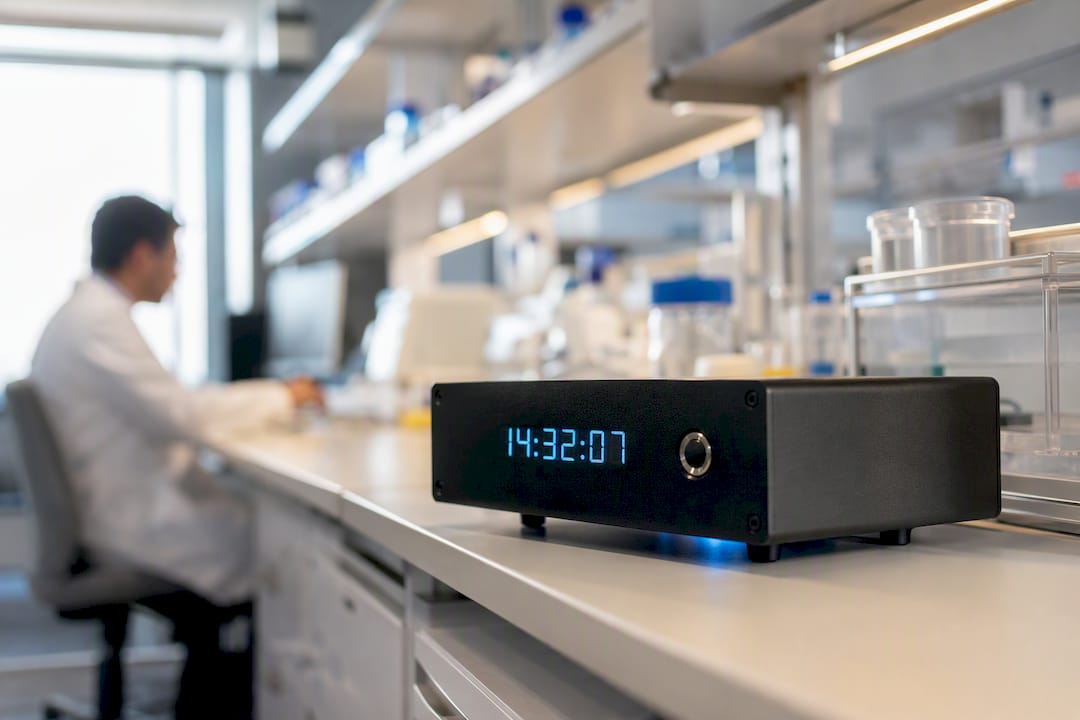
Electronic signatures carry their own manifestation rules under the eCFR's Part 11 sections. A valid signature has to display the signer's printed name, the date and time the signature was executed, and the meaning associated with the signature, approval, review, or authorship, for example. That information needs to appear on any human-readable version of the record, not buried in a separate log file the reviewer never sees.
Signature-to-record linking is the mechanism that keeps a signature from being lifted and reused on a different document. Systems typically accomplish this through cryptographic hashing that ties the signature data structurally to the specific record content, so any attempt to reattach that signature elsewhere breaks the link and flags as invalid.
Identity controls round out the requirement set:
- Each electronic signature must be unique to one individual and never reused or reassigned
- Organizations must obtain a signed certification from each signer confirming their electronic signature carries the same legal weight as a handwritten one
- Password-based systems need periodic credential checks and safeguards against unauthorized use, including lockouts after repeated failed attempts
- Biometric signature methods must be designed so they can only be used by the genuine owner of that biometric
Industry explainers consistently point to audit-trail integrity as the single most scrutinized element during FDA records reviews, more than signature mechanics or system architecture. That's worth remembering when you're deciding where to spend your limited validation budget.
What Does a Part 11 Implementation Roadmap Look Like?
Getting from "we think we're compliant" to "we can prove it" follows a predictable sequence. Skipping steps to save time almost always costs more time later, usually during a corrective action after an inspection finding.
- Scope your systems and records. Inventory every system that creates, stores, or transmits records tied to a predicate rule. Flag which ones handle GCP, GLP, or cGMP data specifically, since that determines your control requirements.
- Run a risk assessment on each in-scope system. Rank systems by the severity of harm if a record were falsified, lost, or inaccessible, and prioritize remediation accordingly. A clinical trial's primary endpoint data deserves more urgency than an internal scheduling log.
- Remediate the highest-risk gaps first. Common early fixes include eliminating shared login credentials, turning on audit-trail features that exist but aren't activated, and closing gaps in signature/record linking.
- Assemble your validation deliverables. Requirements documents, test scripts, traceability matrices, and signed acceptance criteria for every system that touched the risk assessment's top tier.
- Train personnel on both the system and the underlying regulation. Document who was trained, on what, and when, tied to specific role responsibilities.
- Set monitoring KPIs and a review cadence. Track audit-trail completeness, failed login attempts, and validation status by system, and review quarterly at minimum for high-risk systems.
- Build a self-discovery habit into your quality system. The FDA's data integrity guidance makes clear that organizations catching and reporting their own gaps, with documented CAPA and timely remediation, generally fare better than those where an inspector finds the problem first.
Organizations managing healthcare data integration across multiple systems tend to hit this roadmap faster when governance sits with one accountable owner rather than being split across IT, quality, and lab operations with no single decision-maker.
What Do FDA Inspectors Most Often Flag on Part 11 Reviews?
The findings repeat across FDA's published data integrity notifications with striking consistency: incomplete or disabled audit trails, shared user accounts that make it impossible to attribute an action to one person, and validation documentation that doesn't match the software version actually running in production.
A Form 483 typically follows an on-site inspection and lists specific observations tied to regulatory citations. A warning letter escalates from there when the agency concludes the violations are serious enough, or the company's response insufficient enough, to warrant formal notice. Either way, the agency expects a documented remediation trail: root cause analysis, a corrective and preventive action plan, verification testing proving the fix worked, and evidence packaged so a future inspector can trace the whole sequence without asking follow-up questions.
The organizations that fare best under enforcement scrutiny aren't the ones with zero findings. They're the ones that found the gap themselves, documented it honestly, and fixed it before anyone from the agency asked.
Practical evidence inspectors tend to accept includes signed CAPA closure reports, before-and-after screenshots of corrected audit-trail configurations, and training logs showing every affected employee completed retraining after the fix. What they don't accept: verbal assurances that "it's fixed now" with no paper trail behind it.
How Integrated Diagnostics Reduce Part 11 Risk
Fragmented vendor relationships create fragmented documentation, and fragmented documentation is where Part 11 gaps hide. When a lab, a radiology provider, and a data platform each keep separate records under separate contracts, reconciling audit trails across three systems during an inspection turns into a scramble.
Kohealth Labs addresses this by combining laboratory diagnostics and radiology under a single contract, which means one set of validated processes and one audit trail chain instead of three. The AI-driven deviation detection built into Kohealth Labs' data services flags anomalies in test results before they become a self-discovery finding your quality team has to explain later, supporting the Accuracy and Completeness pillars of ALCOA+ directly. Regulatory-aligned delivery practices, including CLIA-certified lab operations, map cleanly onto the access-control and validation expectations Part 11 already requires.
Pro Tip: When evaluating a diagnostics partner, ask specifically how they document deviation flags. A partner that can show you a sample deviation report with timestamps and resolution steps has already done part of your Part 11 evidence-gathering for you.
Organizations comparing lab partners can review how CLIA certification standards intersect with electronic recordkeeping requirements before committing to a vendor relationship.
Why Most Part 11 Advice Misses What Actually Matters
Most guides treat Part 11 as a paperwork exercise: check the boxes, file the validation report, move on. That framing misses the point. The regulation exists because unreliable electronic data undermines patient safety and trial validity, and inspectors read your documentation looking for evidence of that underlying reliability, not just procedural completeness.
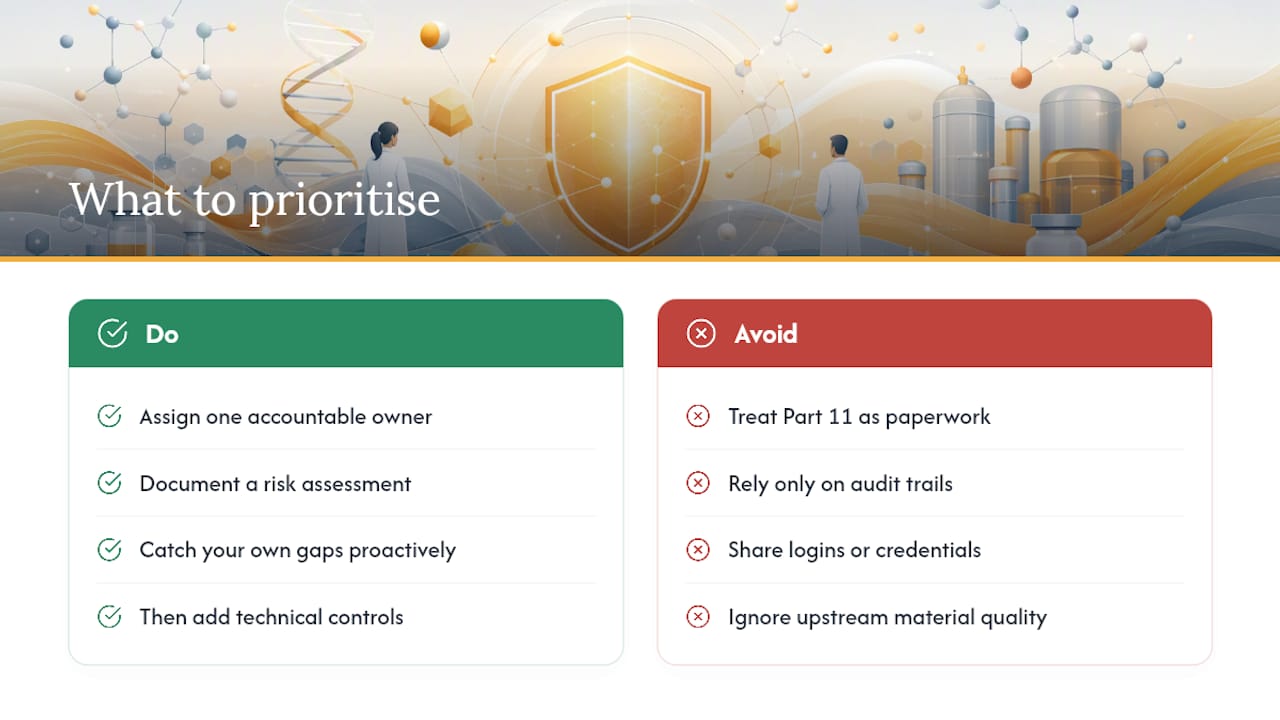
The conventional advice oversells audit trails as a purely technical fix. A perfectly logged system staffed by people who share login credentials because the "real" login is a hassle still fails, because attribution breaks down at the human level, not the software level. Poor-quality upstream materials create the same kind of downstream data problem; research on impurities in clinical study materials shows how quality gaps earlier in a process quietly corrupt the integrity of everything measured after.
If you're prioritizing one thing first, make it governance: one accountable owner, a documented risk assessment, and a genuine habit of catching your own gaps before an inspector does. The technical controls follow naturally once that ownership exists.
— Kohealth Labs
Ready to reduce fragmented documentation across your diagnostic vendors? Kohealth Labs' integrated pathology laboratory services combine lab and radiology data under one contract, one validated process, and one audit trail, giving CROs, sponsors, and healthcare practices a compliance-ready foundation instead of three separate ones to reconcile.
This article is general information, not a substitute for advice from a qualified lawyer. Consult a qualified legal professional about your own circumstances before acting on anything here.