

A regulatory compliant laboratory for U.S. clinical trials meets CLIA/CMS federal standards, applicable FDA GxP requirements, and validated 21 CFR Part 11 electronic systems, while maintaining a documented Quality Management System aligned to CLSI Quality System Essentials and producing inspection-ready evidence on demand. The fastest route to that standard is an integrated lab and imaging partner that brings all of it under one contract, one QMS, and one chain of custody. Before you sign anything, ask for the evidence package: CLIA certificate, CAP proficiency results, Part 11 validation summary, and draft SLA terms with KPI benchmarks.
What does "regulatory compliant laboratory" actually mean for U.S. clinical trials?
The phrase covers a layered set of requirements, not a single certificate. Here is how each layer maps to what auditors will check.

CLIA and CMS. CLIA '88 establishes federal standards for every U.S. facility that tests human specimens. CMS enforces CLIA with CDC support. A current CLIA certificate is the non-negotiable baseline for any clinical lab involved in a trial.
CAP accreditation and proficiency testing. CAP accreditation signals a lab has passed independent on-site inspection and participates in external proficiency testing programs. It is not legally required, but most sponsors treat it as the practical gold standard for laboratory quality assurance.
FDA GxP and GLP distinctions. Good Laboratory Practice under EPA PART 792 governs nonclinical safety studies and requires a Quality Assurance Unit, inspection access, and archived raw data. GCP governs clinical trial conduct. Both apply depending on the study phase, and your lab partner must be clear about which framework governs each service.
21 CFR Part 11. Compliance with 21 CFR Part 11 is mandatory for electronic records in FDA-regulated labs. Validated controls, audit trails, controlled access, and electronic signatures are all required, not optional.
CLSI QSE and ISO 17025. A Quality Manual aligned to CLSI QSE serves as the definitive document during inspections and supports continuous operations. ISO 17025 becomes relevant for cross-border submissions or higher-tier accreditation. Viewing compliance through a holistic QMS that governs instruments, processes, data, and documentation is the approach that holds up under scrutiny.
Operational checklist to verify a lab is truly compliant
Use this during vendor qualification, RFP review, or pre-award audits.
| Control Area | What to Request | Why It Matters |
|---|---|---|
| Documentation | Quality Manual, current SOPs, CAPA logs, internal audit schedule | Auditors check document control first |
| Technical controls | IQ/OQ/PQ records, method validation, calibration logs | Proves instruments produce reliable data |
| Data integrity | LIMS/QMS validation records, Part 11 audit trails, access controls, backup policy | Protects electronic records from manipulation |
| Specimen handling | Chain-of-custody logs, courier KPIs, temperature monitoring records | Sample integrity is a top auditor target |
| Personnel | Training matrices, competency assessments, role-based access logs | Documented proof of qualified staff |
| Proficiency | PT/accuracy results, method comparison data, turnaround-time SLA | Demonstrates ongoing test performance |
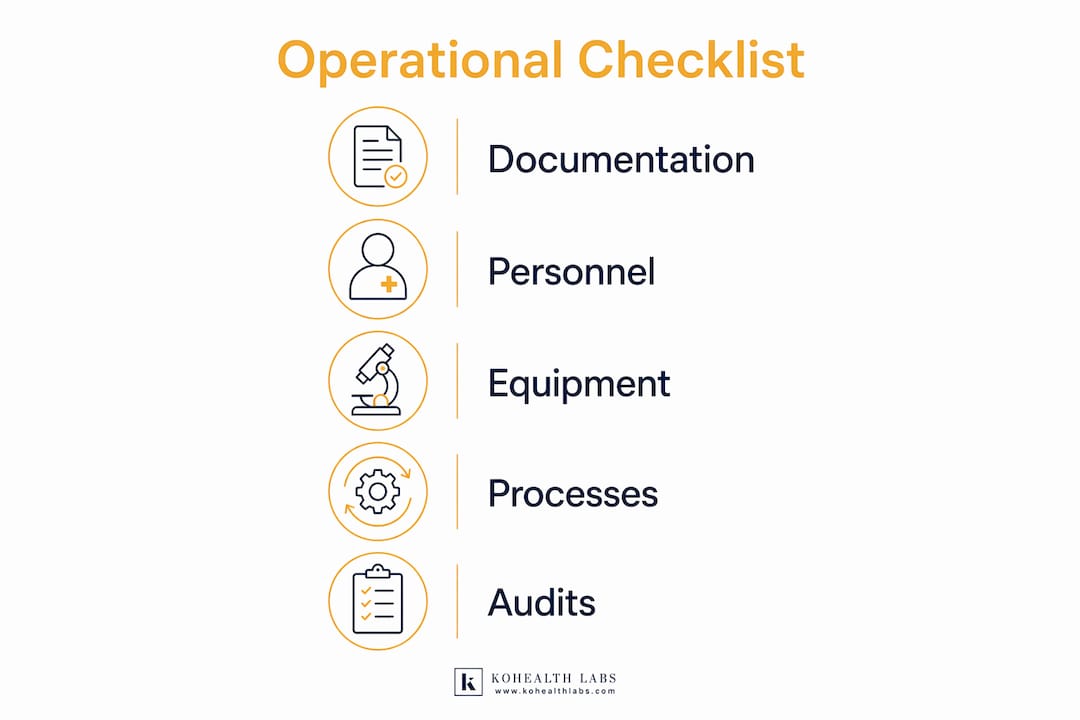
Labs must maintain SOPs, calibration logs, staff training records, and perform internal audits to stay inspection-ready. The documentation is as important as the test result itself.
Key items to confirm:
- CLIA certificate is current and covers the test categories you need
- CAP accreditation letter and most recent proficiency testing results are available
- Part 11 validation summary covers the LIMS, QMS, and any electronic signature workflows
- Instrument qualification packages (IQ/OQ/PQ) are complete and current
- CAPA log shows open items, closure dates, and linked SOP updates
Implementing LIMS alongside QMS early is strongly recommended. Retrofitting digitization into a mature manual lab is more expensive and increases compliance risk during the transition.
How integrated lab and imaging services reduce your regulatory risk
Single-vendor integration is not just a procurement convenience. It directly reduces the number of compliance gaps that can appear between service providers.
| Compliance Requirement | Fragmented Vendor Model | Integrated Lab + Imaging Model |
|---|---|---|
| 21 CFR Part 11 audit trails | Separate systems, reconciliation required | Unified audit trail across lab and imaging data |
| Chain of custody | Multiple handoff points, gap risk | Single chain of custody, one courier protocol |
| Data format standards | Inconsistent formats across vendors | Centralized, analysis-ready data bundles |
| CAPA management | Siloed corrective actions | One QMS governs all services |
| Inspection readiness | Multiple evidence packages to compile | Single evidence package, indexed and ready |
When lab and radiology operate under one QMS, protocol deviation risks drop because scheduling, courier logistics, and data handoffs are coordinated rather than independently managed. AI-driven QC flags deviations at the point of data capture, so sponsors receive analysis-ready bundles rather than raw files requiring manual reconciliation. That directly accelerates submission timelines.
The alignment of lab and radiology protocols under a single contract also means your BAA, DUA, and data retention terms cover both modalities in one agreement, not two separate negotiations.
How to stay inspection-ready for FDA, CLIA, and sponsor audits
Inspectors do not announce their priorities in advance, but their focus areas are well-documented.
Common inspector targets: raw data availability, CAPA documentation and closure evidence, QAU reports, chain-of-custody logs from specimen receipt through disposal, and personnel qualification records. Auditors focus on sample integrity and training, and they expect indexed, indisputable evidence that every step followed validated SOPs.
Most common deficiencies cited:
- Missing or incomplete audit trails in electronic systems
- CAPA records that document the problem but not the verified closure
- Sample traceability gaps between collection, transport, and receipt
- SOPs that are outdated or not linked to current instrument configurations
- Training records that exist but are not tied to specific SOP versions
Pre-inspection actions to take now:
- Run a mock internal audit against your lab partner's QMS documentation
- Request an indexed evidence package: sample logs, validation reports, PT results, QMS metrics
- Confirm CAPA closure triggers automatic SOP and training record updates
- Verify document version control is enforced in the LIMS and QMS
- Obtain readiness sign-off from the lab's QAU before the inspection window opens
Pro Tip: Integrating compliance into daily workflows with automated documentation that ties CAPA closure to SOP and training record updates is the single most effective way to avoid repeat citations. Ask your lab partner to demonstrate this linkage, not just describe it.
Contracts and vendor oversight clauses you need to enforce
A contract that references CLIA and CAP without enforceable KPIs gives you very little protection. Build these terms in from the start.
| Contract Element | What to Specify |
|---|---|
| Regulatory attestations | Written confirmation of current CLIA, CAP, and 21 CFR Part 11 compliance status |
| Data agreements | BAA and DUA covering both lab and imaging data, validated SFTP/API transfer with audit logs |
| Turnaround-time SLA | Defined TAT by test category with escalation triggers |
| Courier KPIs | On-time pickup rate, temperature excursion reporting threshold, sample integrity rate |
| CAPA closure timeline | Maximum days from identification to verified closure |
| Right to inspect | Explicit language granting sponsor and CRO audit access with reasonable notice |
| Breach notification | Defined window for reporting data or sample integrity incidents |
OIG guidance is clear that compliance programs must address ethical conduct, billing accuracy, and fraud prevention alongside technical controls. Your contract should reflect that scope, not just testing specifications.
Periodic audits, third-party proficiency testing requirements, and a defined reporting cadence should all appear in the agreement. A central lab that supports sponsor oversight with documented audit rights simplifies the sponsor's own compliance obligations considerably.
How to evaluate and select a compliant integrated diagnostics partner
Start with documentation requests, not sales presentations.
Priority questions for vendor interviews:
- Can you provide your current CLIA certificate, CAP accreditation letter, and most recent PT results today?
- Where is your 21 CFR Part 11 validation summary, and which systems does it cover?
- How does your LIMS enforce SOP version control and link CAPA closure to training record updates?
- What are your courier on-time performance rates and temperature excursion rates over the past 12 months?
- Can you share a sample chain-of-custody log from specimen receipt through final disposal?
Red flags to watch for:
- Refusal to share validation evidence before contract execution
- Manual-only record systems with no electronic audit trail
- Proficiency testing results that are inconsistent or unavailable for recent cycles
- CAPA records that describe problems without documented, verified closure
- Vague answers about which regulatory framework governs each service
Onboarding timeline. A typical qualification and onboarding process for an integrated lab and imaging partner covers: vendor qualification review (2–4 weeks), method transfer and validation (4–8 weeks), system integration and training (2–4 weeks), and a parallel-run period before full activation. Request an itemized onboarding quote alongside the SLA draft, noting that fees vary depending on scope.
For molecular and PCR-based assays, assay-specific validation steps and GLP/CLIA implications add time to the method transfer phase. Factor that into your trial startup timeline.
Why Kohealth Labs fits the regulatory compliant laboratory standard
Kohealth Labs maps directly to the compliance requirements CROs must verify.
| Compliance Requirement | Kohealth Labs Capability |
|---|---|
| CLIA alignment | CLIA-aligned laboratory operations covering the test categories required for clinical trials |
| 21 CFR Part 11 | Validated electronic systems with audit trails, access controls, and electronic signature workflows |
| QMS and SOPs | Documented Quality Management System with current SOPs and CAPA management |
| Chain of custody | Coordinated courier logistics with specimen tracking from pickup through result delivery |
| Integrated data readiness | AI-driven QC and analysis-ready data bundles covering lab and imaging in one package |
| Provider portal | Centralized access for investigators, sponsors, and CRO teams with role-based controls |
The single-contract model means your BAA, DUA, SLA, and audit rights cover both laboratory and radiology under one agreement. Over 100 biomarkers and genomics panels are available alongside imaging, so sponsors receive a unified data bundle rather than reconciling outputs from separate vendors. Specialty lab reporting practices built into the workflow support the documentation standards your regulatory submissions require.
Request the Kohealth Labs evidence package, SLA draft, and onboarding timeline through the clinical trials solutions page to begin vendor qualification.
Key Takeaways
A regulatory compliant laboratory for U.S. clinical trials requires verified CLIA/CAP credentials, validated 21 CFR Part 11 systems, a documented QMS, and enforceable SLA terms before a single specimen is collected.
| Point | Details |
|---|---|
| CLIA and CAP are the baseline | Request the current CLIA certificate and CAP proficiency results before any other evaluation step. |
| Part 11 validation must be documented | Ask for the validation summary covering LIMS, QMS, and electronic signature workflows. |
| QMS evidence beats verbal assurances | Require the Quality Manual, current SOPs, CAPA log, and internal audit schedule in writing. |
| Sample traceability is an auditor priority | Confirm chain-of-custody logs cover specimen receipt through disposal with no handoff gaps. |
| Kohealth Labs as your integrated partner | Kohealth Labs delivers CLIA-aligned lab and imaging services under one contract with AI-driven QC and analysis-ready data bundles for clinical trials. |
The case for compliance as a design principle, not a checkbox
Most CROs approach lab vendor qualification as a procurement task: collect the certificates, check the boxes, move on. That approach works until an inspection surfaces a CAPA that was closed on paper but never verified, or a chain-of-custody gap between a courier handoff and sample receipt. By then, the trial timeline has already absorbed the damage.
The more useful frame is to treat compliance as a design criterion when selecting a partner, not a condition you verify after selection. An integrated lab and imaging provider with a unified QMS, automated CAPA-to-SOP linkage, and a single chain of custody is structurally less likely to produce the gaps inspectors find. The compliance architecture is built in, not bolted on.
Fragmented vendor models create compliance surface area at every handoff. Every additional vendor is another QMS to audit, another data format to reconcile, another SLA to enforce. The operational case for integration and the regulatory case for integration are the same case.
Ready to qualify Kohealth Labs as your integrated diagnostics partner?
Clinical trial timelines are too tight to spend months reconciling lab and imaging data from separate vendors. Kohealth Labs gives CRO procurement teams a single contract that covers laboratory diagnostics, radiology, AI-driven QC, and analysis-ready data bundles, with the regulatory documentation to support sponsor submissions from day one.
Three steps to get started: request the Kohealth Labs evidence package (CLIA certificate, QMS summary, Part 11 validation overview, and sample SLA terms), schedule a qualification call with the clinical trials team, and confirm your onboarding timeline and setup scope. The integrated diagnostics solutions page has everything you need to begin. You can also review the specialty testing menu to confirm panel coverage before your first conversation.
This article is general information for clinical research and healthcare professionals. Confirm current regulatory requirements with the applicable primary source or a qualified compliance professional for your specific trial and jurisdiction.
Useful sources
- Clinical Laboratory Improvement Amendments (CLIA) | CDC
- PART 792 — Good Laboratory Practice Standards | GovInfo
- Good Laboratory Practice and Compliance Monitoring | OECD
- 21 CFR Part 11 and Regulatory Compliance Overview | QBench
- Lab Quality Manual Guide | APHL
- Laboratory Quality Management System | CDC/WHO
- Building and Sustaining Laboratory Compliance | Lab Manager
- Laboratory Compliance: Requirements, Laws & Tips | Cohen Healthcare Law
- How to Design a Laboratory Compliance Framework from Scratch | QI-A
- Laboratory Compliance: The Complete Laboratory Guide | LabOS
- Compliance Program Guidance for Clinical Diagnostic Laboratories | OIG