

ALCOA+ is the nine-attribute data integrity diagnostic that regulators use to judge whether a clinical trial record can be trusted: Attributable, Legible, Contemporaneous, Original, Accurate, Complete, Consistent, Enduring, and Available. Inspectors from the FDA, EMA, and PIC/S apply it against existing predicate rules rather than as a standalone regulation, and records that satisfy it are the ones that hold up during submission review and site inspections alike.
TL;DR:
- Ensuring attribution and traceability during data transfer between systems is critical to prevent common compliance issues.
- Routine, scheduled audit-trail reviews are more effective than ad hoc checks for maintaining data integrity and avoiding inspector findings.
- Fixing data flow points, such as system handoffs and exports, is more crucial than solely improving SOPs or system configurations.
- Disabling audit trails, shared user logins, backdated entries, and missing metadata are among the most frequent, preventable root causes of ALCOA+ failures.
- Integrated diagnostics that preserve metadata and automate quality checks reduce risks associated with manual data re-entry and system misconfigurations.
What Are ALCOA and the ALCOA Plus Principles?
The original ALCOA acronym dates back to FDA data integrity discussions in the 1990s, built around five attributes that a trustworthy record needed: Attributable, Legible, Contemporaneous, Original, and Accurate. As clinical systems shifted from paper to electronic data capture, those five stopped covering the full lifecycle of a record. Regulators and industry groups added four more: Complete, Consistent, Enduring, and Available. Together those nine make up ALCOA+, and the "plus" elements exist specifically to make sure data is whole, coherent, preserved, and retrievable long after it was first recorded.
You'll also see references to ALCOA++ or ALCOA-C in newer guidance and industry commentary. These variants tack on Traceable and Secure, addressing chain-of-custody questions and cyber-integrity risks that barely existed when the original five attributes were written. ISPE has documented this evolution as a direct response to connected systems, cloud storage, and AI-assisted diagnostics that didn't exist when the framework was first drafted. None of these extensions replace ALCOA+. They sit on top of it, reflecting the reality that a record's trustworthiness now depends as much on system architecture as on who signed what and when.
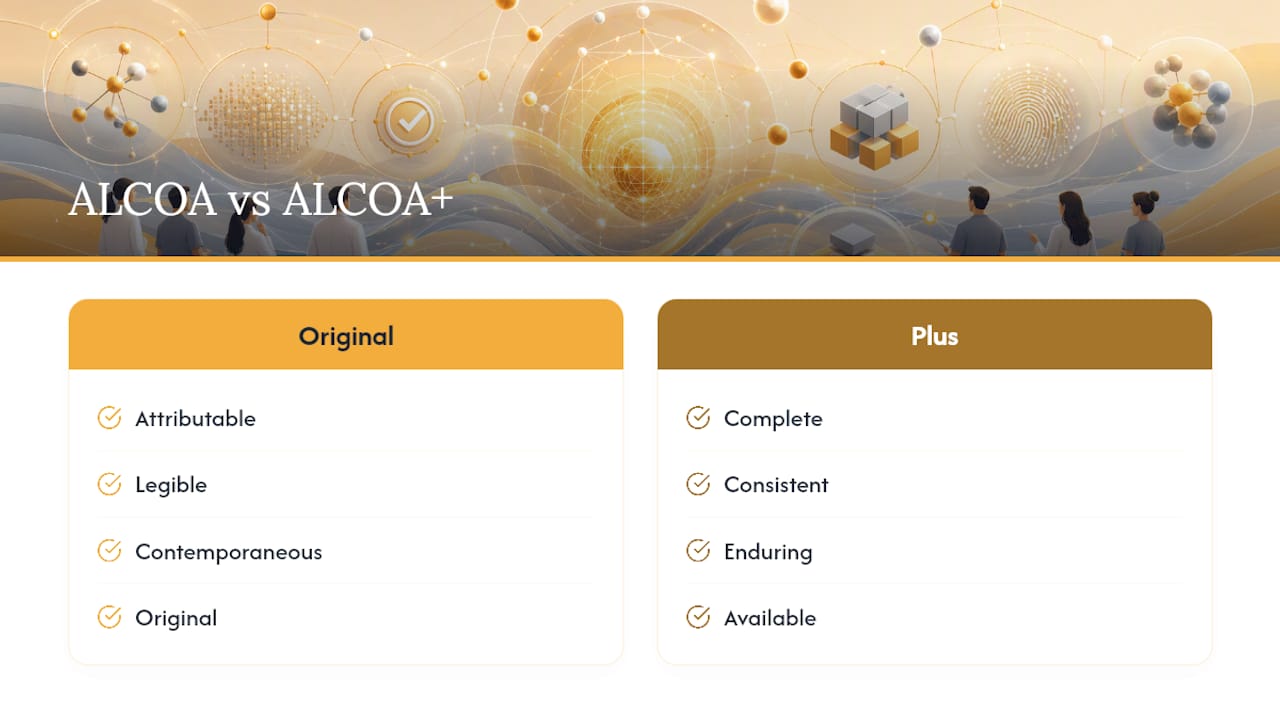
Breaking Down Each ALCOA Plus Attribute With Clinical Examples
Each attribute answers a different question an inspector will ask about a given record. Here's what that looks like in practice across lab, imaging, and EDC data:
- Attributable — Every entry needs to trace back to the specific person or system that created it. A phlebotomy draw logged under a shared login fails this test immediately, even if the blood draw itself was performed correctly.
- Legible — The record has to be readable and understandable for the entire retention period, not just at entry. A faxed lab requisition that fades within two years doesn't meet this bar.
- Contemporaneous — Data gets recorded at the time the activity happens. A vitals reading entered into the EDC three days after a subject visit, with no explanation, is a contemporaneity failure regardless of accuracy.
- Original — The first-captured record, or a verified true copy, has to be preserved. For imaging, that means the raw DICOM file, not just the radiologist's summary report.
- Accurate — The data reflects what actually happened, free of transcription error. Instrument output that gets manually re-keyed into a CTMS introduces exactly the risk this attribute is meant to catch.
- Complete — Nothing gets left out, including failed runs, repeat tests, and integration parameters. A chromatography result submitted without its failed injection logs is incomplete even if the final passing run looks clean.
- Consistent — Timestamps and sequencing have to make logical sense across systems. If the lab system and the EDC report different time zones for the same sample, reviewers will flag the mismatch.
- Enduring — Records need to survive for their full retention period on durable, accessible media. Enduring failures typically surface as a corrupted archive or a discontinued software format nobody planned for.
- Available — Data has to be retrievable, on request, in a usable format. An archived dataset that takes three weeks and a vendor support ticket to restore does not meet this bar during an active inspection.
Hybrid workflows, where paper source documents feed an electronic system, deserve particular attention. The audit context (who transcribed what, and when) has to travel with the data, not get lost at the point of digitization.
What Do FDA, EMA, and PIC/S Expect From ALCOA Plus Compliance?
Regulators don't treat ALCOA+ as a rule you check off. They treat it as a lens for interpreting rules that already exist, like 21 CFR Part 11 for electronic records and signatures, and 21 CFR 211 for GMP documentation. FDA guidance is explicit that data must remain complete, consistent, and accurate from the moment of creation through archival, and that audit trails and metadata are part of the regulated record itself, not optional supporting material.
One detail catches sponsors off guard more than any other: inspectors don't just check whether an audit trail exists. They check whether anyone actually reviewed it on a defined schedule and documented that review. A trail that's turned on but never examined offers little more protection than no trail at all.
EMA's guideline on computerized systems in clinical trials reinforces the same expectation for validated exports and metadata retention, and PIC/S guidance across member authorities follows a comparable logic. The throughline across all three bodies: ALCOA+ is diagnostic, predicate rules are the actual law, and the framework's job is helping you demonstrate you've met them.
How Do You Build ALCOA Plus Controls Into Your Systems?
Meeting ALCOA+ in a modern clinical data environment comes down to layering system configuration on top of written procedure. Neither one works alone. A validated system with no review SOP is just as exposed as a strong SOP running on an unvalidated system, since compliance ultimately depends on procedures and management oversight, not the software alone.
- Configure systems for attribution and traceability. Unique user IDs, role-based access controls, validated audit trails, secure synchronized timestamps, and compliant electronic signatures form the technical baseline.
- Manage the full data lifecycle. Capture metadata at the point of creation, validate every export path, maintain tested backups, and build a documented migration plan before you ever need one.
- Write procedures people will actually follow. SOPs for data entry and review, a defined audit-trail review cadence, recurring training, and a clear deviation-handling process turn technical controls into defensible practice.
Pro Tip: Schedule audit-trail review as a recurring calendar event, not an ad hoc task triggered by an inspection notice. Reviewers who only look at trails right before an audit tend to miss the pattern of small, cumulative issues that a routine review would have caught months earlier.
Integrated diagnostic bundles that combine lab and imaging data delivery cut down one of the most common failure points here: manual re-keying. Every time a result gets retyped from a lab printout into an EDC field, you introduce a new opportunity for an accuracy or consistency error. A centralized data delivery approach that preserves metadata from the point of generation removes that step entirely.
What Inspection Findings Signal ALCOA Plus Failures?
A handful of root causes show up again and again in data integrity observations, and most of them are avoidable with routine discipline rather than expensive new systems.
- Disabled audit trails. Turning off logging to "clean up" a system is one of the fastest paths to a serious finding.
- Shared user accounts. If two people can log in as "labtech1," attribution is broken from the start.
- Backdated entries. Contemporaneous records don't allow for retroactive cleanup, even when the underlying result is correct.
- Missing failed runs or metadata. Submitting only the passing result while omitting failed injections or repeat tests breaks completeness.
The fix for most of these is procedural: re-enable trails permanently, enforce individual logins through validated access controls, and require documented justification for any entry made outside its expected window to ensure compliance. Making audit-trail review a scheduled, logged activity, rather than a reactive scramble, is what turns a policy on paper into evidence an inspector can actually verify.
Implementation Checklist for Clinical Trial Data Integrity
Getting from policy to practice works best as a sequence, not a simultaneous scramble.
- Map your critical records and identify exactly what counts as the "original" and where its metadata lives.
- Validate systems and confirm audit trails are active, configured correctly, and cannot be disabled by end users.
- Test time synchronization across every connected system and run a retrieval drill before you need one for real.
- Set a fixed audit-trail review cadence and assign clear ownership.
- Train staff on SOPs and update those procedures whenever a system or workflow changes.
| Priority | Action | Why it matters |
|---|---|---|
| 1 | Identify critical records and originals | Defines the scope of everything else |
| 2 | Validate system audit trails | Establishes attributable, traceable data |
| 3 | Run retrieval and retention drills | Confirms data is truly available and enduring |
| 4 | Set review cadence and train staff | Turns controls into sustained practice |
How Integrated Diagnostics Support ALCOA Plus Compliance
Kohealth Labs approaches this from the data-delivery side of the equation. Our single-contract model bundles lab and radiology results into analysis-ready packages, which means metadata and audit context travel with the record instead of getting lost across separate vendor handoffs. AI-driven quality checks flag deviations before they reach your CTMS, and validated exports give reviewers a defensible trail to examine. For sponsors evaluating how integrated diagnostics reduce data integrity risk across a multi-site trial, this is the mechanism worth understanding first.
Why Most Teams Get ALCOA Plus Backwards
Most guidance on this topic treats ALCOA+ like a compliance checklist you run through once a quarter. This is backwards, and it's the single biggest reason observations keep repeating across otherwise well-run trials. The nine attributes were never meant to be graded individually. They're meant to be evaluated as a lifecycle: a record that's Contemporaneous but not Enduring, or Original but not Available on request, has still failed the test.
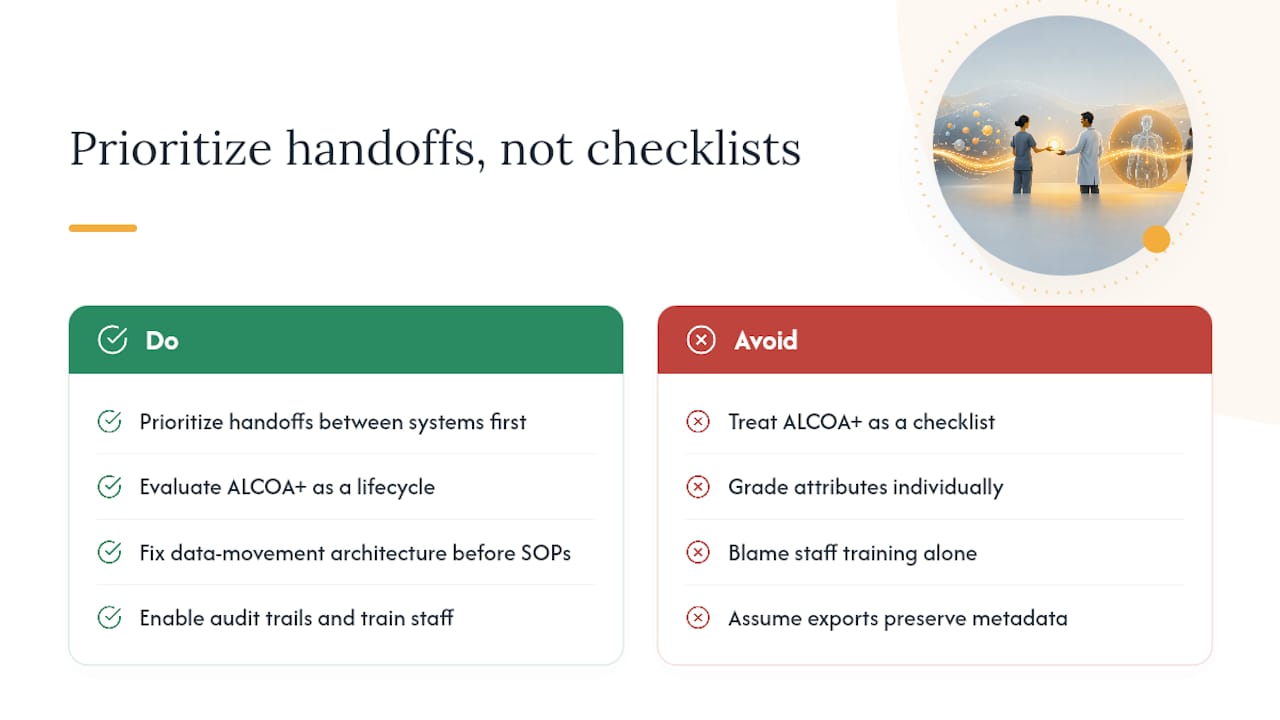
The conventional advice to "enable audit trails and train staff" isn't wrong, but it's incomplete. It skips the harder problem, which is that most integrity failures happen at the handoff points between systems, not within any single system. A lab result that's perfectly attributable inside the LIMS can lose its metadata the moment someone exports it into a spreadsheet for the CTMS. That's not a training failure. It's an architecture failure.
If you take one thing from this framework, prioritize the handoffs before you polish the SOPs. Fix where data moves between systems first, then tighten the procedures around it.
— Kohealth Labs