

A compliant audit trail is a secure, computer-generated, time-stamped record that reconstructs who created, modified, or deleted an electronic record, and when. Regulators including the FDA, HHS under HIPAA, and the SEC all expect this same core structure. If your system can't produce a unique user ID, an automated timestamp, and a preserved change history on demand, it fails inspection before anyone reads a single log entry.
TL;DR:
- Systems must generate and preserve unique user IDs, automated timestamps, and uneditable change histories to meet core audit trail requirements.
- FDA 21 CFR Part 11 demands validated, tamper-evident audit trails that are readily available for review during inspections, not reconstructed afterward.
- Proper audit trails require capturing record actions, before-and-after values, context data, and reasons for changes, with storage in non-editable logs.
- Retention periods should align with the longest applicable regulation, using secure, encrypted, and separate storage to ensure integrity and compliance.
- Implementing audit trails from system design through automation and anomaly detection improves forensic investigation and simplifies regulatory audits.
What Are the Core Elements of an Audit Trail Requirement?
Every regulator asking about audit trail requirements is really asking the same underlying question: can you reconstruct exactly what happened to a record, and prove nobody tampered with it afterward? That reconstruction depends on a specific set of captured fields, not a general sense that "logging is on."
The NIST glossary defines an audit trail in terms of the properties that make reconstruction possible: attribution to a specific actor, a reliable timestamp, and a record that resists alteration. Build your data model around these elements:
- Unique user identity. Every action ties to one named person, never a shared login. Shared "labtech" or "admin" accounts break attribution and are one of the fastest ways to fail an FDA inspection.
- Action type and record identifier. The log states whether a record was created, modified, or deleted, and which record it touched.
- Before and after values. Where a field changed, the trail keeps both the prior and new value, not just the fact that "a change occurred."
- Tamper-evident, automated timestamp. The clock is system-generated, not user-entered, and synchronized across servers with a documented time source.
- System context. The trail captures the application or module, workstation or IP address, and a transaction ID linking related events.
- Reason for change, where your SOPs require a justification for edits to finalized data.
A properly designed system stores this information in a non-editable table or a change history that flags any attempt at tampering, with a clear link back to the original record. Miss any one of these elements and you've built a log, not an audit trail.
What Does FDA 21 CFR Part 11 Require for Audit Trails?
Part 11 treats the audit trail as the mechanism that makes an electronic record legally equivalent to a signed paper original. The regulation's core demand is that trails be computer-generated, time-stamped automatically, and preserved in a form available for FDA review during an inspection, not reconstructed after the fact from memory or scattered spreadsheets.
The FDA's guidance on data integrity and audit trails makes clear that regulators care about the integrity of the whole process, including any data that gets excluded or invalidated along the way. A silently deleted outlier result is a bigger red flag than a documented one.
When an inspector asks for Part 11 evidence, expect to produce:
- Validation artifacts showing the system was tested to confirm audit-trail capture works as designed.
- SOPs governing who can access, review, and (if ever) disable audit trail functions.
- Audit-trail exports in both human-readable report form and native electronic format.
- User access records, including provisioning, deprovisioning, and privilege changes.
- Change-control documentation tying system updates to revalidation of trail integrity.
Legacy systems that predate modern audit-trail capabilities need documented, risk-based compensating controls, such as manual logbooks cross-checked against system reports, rather than a claim that "the old system doesn't do that." A 21 CFR Part 11 compliance overview walks through how research teams build this evidence package before an inspection ever gets scheduled. Retained test cases and export samples from validation, kept on file rather than recreated after an inspection notice arrives, help avoid last-minute scrambling.
What Do HIPAA Audit Controls Require for PHI Access Logs?
The HIPAA Security Rule requires "audit controls," a broad standard that gives covered entities latitude in how they log, but not in whether they log. HHS guidance specifies that any system recording or using electronic protected health information must record and allow examination of activity within that system.
In practice, "adequate" logging means capturing who viewed, exported, printed, or altered a PHI record, not just who logged into the application. A system that logs login events but not individual chart access satisfies the letter of nothing.
These logs matter most after something goes wrong. When a breach investigation starts, your logs are the evidence that determines the notification timeline: how many records were exposed, over what window, and whether the exposure was accidental or malicious. Weak logging turns a scoped breach into a "we can't rule out" disclosure covering every patient in the database.
- Retain access logs conservatively; state breach notification laws vary, and a shorter retention window can leave you unable to answer a regulator's question.
- Store logs independently of the systems they monitor, so a compromised application account can't also erase its own trail.
- Document periodic review of access logs, not just their existence, since HHS auditors ask for evidence of review, not just capability.
- Test log integrity on a schedule, confirming exports match what the live system shows.
How Often Should GxP Audit Trails Be Reviewed?
FDA guidance ties audit-trail review directly to quality oversight, not IT convenience. An HPLC run's audit trail, for example, should show every reprocessing attempt, integration parameter change, and result rejection, and someone with quality authority needs to see that history before the batch record closes.
The FDA's guidance for industry frames review responsibility around segregation of duties. Here's how that typically breaks down:
- Process owners conduct first-line review, catching operational anomalies close to where the work happened.
- The quality unit performs independent review before batch release, specifically looking for excluded or invalidated data lacking documented scientific justification.
- Exception investigations get logged separately, with sign-off retained alongside the master batch record, not filed elsewhere and referenced by memory.
Where CGMP specifies a review frequency for a given record type, follow it. Where it doesn't, set a risk-based interval calibrated to how consequential the data is. High-risk analytical runs deserve review closer to real time; routine environmental monitoring logs can tolerate a longer cycle if your risk assessment says so and documents why.
Pro Tip: Don't let "risk-based review" become shorthand for "less review." Document the risk assessment itself. An inspector who sees a thin audit-trail review policy without the underlying risk logic behind it will assume you skipped the analysis rather than performed it.
How Do SEC and SOC Rules Treat Electronic Audit Trails?
Financial recordkeeping rules approach audit trails from a different angle than healthcare regulations, but land on a similar demand: prove records weren't altered after the fact. SEC rule amendments give broker-dealers an alternative to strict WORM (write-once-read-many) storage, provided the audit-trail path meets specific conditions.
- Under the audit-trail alternative, the system must capture and preserve every original record together with a complete history of any modification, indexed and time-sequenced.
- Firms must be able to furnish records and their audit trails in both human-readable and reasonably usable electronic formats when a regulator requests them, not just a printout.
- Using a third-party storage vendor doesn't shift the compliance burden; the SEC requires a written undertaking from that vendor confirming it will provide the same access.
The lesson for healthcare and life-sciences teams reading SEC rules isn't that the rules apply directly. It's that regulators across industries converge on the same standard: preserved history, provable integrity, and on-demand production in a format someone other than your own IT team can actually use.
How Long Should You Retain Audit Trail Records?
Retention periods should follow whichever driver imposes the longest requirement: FDA record-retention rules, HIPAA state variances, contractual sponsor obligations, or your organization's own litigation-hold policy. When these conflict, default to the longest applicable period rather than the shortest defensible one.
Storage architecture matters as much as duration. Options include WORM storage, append-only timestamped logs, and encrypted backups replicated to a separate environment from the production system generating the data. One analysis of trial data delays found that remediation after an audit-trail gap is discovered often consumes much more time than building the retention architecture correctly from the start.
Producing records for inspection means exporting in a format that preserves metadata, not a flattened CSV that strips timestamps and user IDs to make the file smaller.
- Confirm your export function keeps every required field, tested against a sample record before an inspector asks for one.
- Store at least one export copy outside your primary system, refreshed on a documented schedule.
- Run periodic producibility tests: pull a record from three years ago and confirm it opens, reads, and reconciles against the original.
- Verify encryption doesn't block a compliant reviewer's access when they need it fastest.
How Do You Build Audit Trails Into Systems From the Start?
The single most expensive audit-trail mistake is designing a system first and grafting on compliance controls later. The ISPE GAMP RDI Good Practice Guide on Data Integrity by Design argues for embedding audit-trail capture into a system's lifecycle from procurement onward, rather than retrofitting it after a validation gap surfaces. Retrospective validation of a legacy lab or imaging system, once it's already in production, tends to cost more and carry more risk than choosing a system that captures immutable trails natively.
Technical controls that support this approach include:
- Unique logins tied to strong identity management, eliminating shared credentials entirely.
- Synchronized time sources (NTP) across every server and device generating timestamped records.
- Immutable or tamper-evident log storage, separate from the application database it monitors.
- Role separation so the people who can generate records aren't the same people who can review or approve the audit trail covering those records.
Operationally, exception reporting beats manual log review at any meaningful scale. A unified diagnostics workflow that combines lab and imaging metadata can generate thousands of log entries per study day; no reviewer reads all of it line by line. Automated exception reports flag out-of-range changes, off-hours edits, and repeated reprocessing attempts, letting a human focus on what actually deserves attention. AI-assisted anomaly detection extends this further by learning what "normal" activity looks like for a given system and surfacing genuine outliers instead of routine noise.
Pro Tip: Before you validate a new system, ask the vendor to demonstrate its audit trail on a test record: create it, modify it twice, delete a field, and pull the export. If the demo takes more than a few minutes to set up, expect your own validation testing to take considerably longer.
Validation evidence should include documented change control, test scripts specifically targeting audit-trail capture, defined acceptance criteria, and a periodic re-test of producibility, not a one-time check performed at go-live and never revisited.
How Do Audit Trail Rules Differ Across International Jurisdictions?
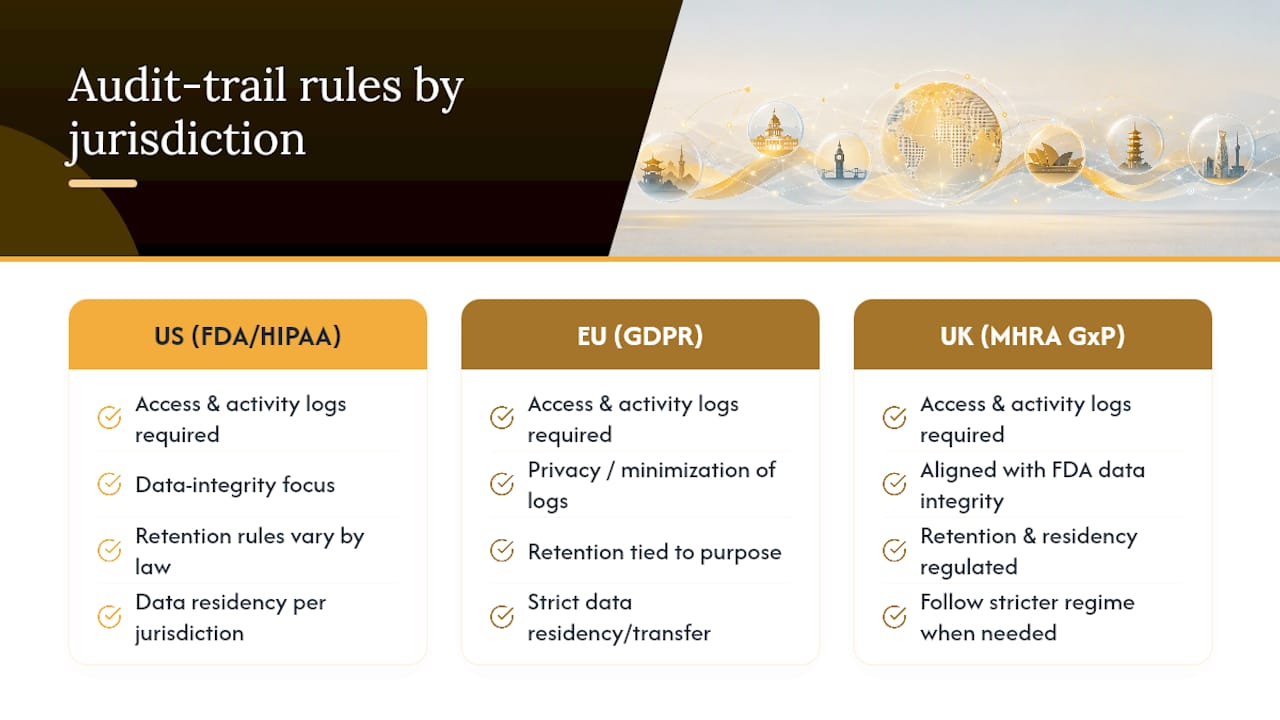
Audit trail expectations share a common backbone across regulators, but the details diverge enough to matter for multinational trials and global health data operations. The EU's General Data Protection Regulation approaches audit trails partly through a privacy lens rather than a pure data-integrity lens: logs recording access to personal data must themselves respect data-minimization principles, meaning you can't justify capturing more personal detail than the audit purpose requires.
The UK's Medicines and Healthcare products Regulatory Agency (MHRA) publishes GxP data integrity guidance closely aligned with FDA thinking, and its data integrity guide reinforces that audit trails must be switched on by default, never editable by end users, and reviewed on a risk-based schedule when full manual review of every entry is impractical. That risk-based review language gives compliance teams useful cover, provided the risk assessment is documented rather than assumed.
Where jurisdictions genuinely diverge is retention triggers and data residency. GDPR imposes constraints on where personal data (including audit logs containing personal identifiers) can be stored and transferred, which matters directly for any organization running trials across US and EU sites with a single consolidated logging system. A trial spanning both regions needs a data architecture that satisfies the stricter of the two regimes, not an average of the two. Sponsors running multi-country studies should map audit-trail retention and storage rules jurisdiction by jurisdiction before selecting a single global system, rather than assuming one region's compliance posture covers another.
How Do You Secure Audit Trail Data Against Cyber Threats?
An audit trail that can be edited or deleted by an attacker with elevated access isn't a compliance asset. It's a liability that gives a false sense of security. Securing the trail itself deserves the same rigor as securing the records it describes.
Start with access segmentation: the accounts capable of modifying production records should never be the same accounts with write access to the audit log storage. Store logs on infrastructure separate from the application generating them, ideally with different administrative credentials, so a single compromised account can't both alter a record and erase the evidence of that alteration.
Encryption protects logs in transit and at rest, but only if key management doesn't become its own single point of failure. If one administrator holds every decryption key, you've recreated the shared-account problem at a higher level. Role separation and multi-person key custody reduce that exposure.
Privacy considerations run alongside security ones, particularly for healthcare data. Logs that capture PHI access inevitably contain sensitive information themselves, meaning your audit trail storage needs the same encryption and access controls as the PHI it's tracking, not a lighter standard because "it's just logs." Regular penetration testing should explicitly target log infrastructure, not just the primary application, since attackers who understand audit trails often go straight for the evidence trail before touching the data itself.
What Role Do Audit Trails Play in Forensic Investigations?
When something goes wrong, whether it's a data breach, a falsified result, or a disputed clinical finding, the audit trail becomes the primary evidence for reconstructing exactly what happened and when. Investigators don't start with the record itself; they start with its history.
A well-built trail lets an investigator establish a precise timeline: when a record was created, who touched it, what changed at each step, and whether any access occurred outside expected patterns, such as a modification at 2 AM from an account that normally works daytime hours. That timeline either supports or contradicts whatever explanation is being offered, and it does so with a level of specificity that memory and informal notes never provide.
Forensic value depends entirely on trail integrity captured before the incident, not scrambled together afterward. If logs can be edited retroactively, any investigation built on them is compromised from the start, and a defense attorney or opposing regulator will make exactly that argument. This is why tamper-evidence isn't a nice-to-have feature; it's what makes the trail usable as evidence at all.
Incident response teams increasingly treat audit trail review as the first step in any investigation, not a supporting document pulled in later. A trail that clearly shows the scope of an exposure, down to the exact records and fields touched, can be the difference between a narrow, defensible breach notification and an overly broad one issued because nobody could prove what wasn't accessed.
What Technology Trends Are Shaping Audit Trails?
AI-based anomaly detection is the most consequential shift happening in audit trail review right now. Rather than a human scanning thousands of log lines for something unusual, machine learning models trained on normal system behavior can flag genuine outliers: an unusual sequence of edits, an access pattern that doesn't match a user's typical role, a batch of deletions clustered in a suspicious window. This doesn't replace the reviewer; it changes what the reviewer spends time on.
Blockchain-based audit trails have generated real interest for their tamper-evidence properties, since a distributed ledger makes retroactive alteration mathematically difficult rather than merely procedurally forbidden. Adoption in regulated healthcare and pharma settings remains limited in practice, largely because integrating blockchain infrastructure with existing validated systems adds real complexity, and regulators haven't yet issued detailed guidance on how blockchain-based trails satisfy existing Part 11 or GxP expectations. Expect this to remain a niche solution for specific high-value use cases rather than a near-term replacement for conventional tamper-evident logging.
Continuous monitoring platforms, often built on SIEM (security information and event management) architecture originally designed for cybersecurity, are increasingly repurposed for compliance-grade audit trail review. This convergence makes sense: the same infrastructure that detects an intrusion attempt can flag an unauthorized data modification, and organizations running both functions on separate platforms are duplicating effort that a unified monitoring layer could absorb.
How Unified Diagnostics and AI Make Audit Trails Actionable
Integrating lab and radiology data multiplies metadata volume fast. Every specimen, every image, every result carries its own audit trail, and reconciling them manually across separate vendor systems is where most compliance teams lose weeks they don't have.
Kohealth Labs built its model around the opposite assumption: design the audit trail into the data pipeline before the first sample arrives, not after a sponsor asks for evidence. A single-contract structure spanning lab and imaging services means one validated data flow instead of three vendor exports to reconcile by hand, and AI-driven quality checks surface deviations closer to real time than a quarterly manual review ever could.
For CROs and sponsors evaluating vendor readiness, the right question isn't "do you log activity." It's "can you show me a reconstructable, exception-flagged trail across every diagnostic modality in this trial, on demand."
— Kohealth Labs
Simplify Audit-Ready Data Delivery With Kohealth Labs
Kohealth Labs is the alternative to juggling separate lab and imaging vendors for trials that need audit-ready data from day one. A single contract covers phlebotomy, courier specimen pickup, and radiology alongside laboratory testing across more than 100 biomarkers, so your compliance team reconciles one validated data stream instead of three vendor exports with three different audit-trail formats.
AI-driven quality checks flag deviations before they become a batch-release problem, and analysis-ready data bundles arrive structured for the kind of reconstruction an FDA inspector or sponsor audit actually demands. This matters most for complex trials with high metadata volumes, multi-site studies facing regulatory scrutiny, or wellness programs that need EMR-integrated results without building that integration in-house.
If your team is evaluating vendor readiness ahead of an audit, start with Kohealth Labs's integrated diagnostics solutions to see how onboarding, training, and compliance support fit your study timeline.
Where to Find the Primary Audit Trail Regulations
Skip the secondhand summaries when you're building your own compliance evidence. Go to the source documents directly:
- FDA guidance: Data integrity and audit trails — the definitive text on audit-trail definitions, review frequency, and CGMP expectations.
- GAMP RDI Good Practice Guide: Data Integrity by Design — for lifecycle-first system design and legacy-system risk guidance.
- HHS: HIPAA Security Rule — for audit control requirements tied to ePHI.
- SEC final rule on electronic recordkeeping — for the WORM versus audit-trail alternative and production requirements.
- NIST glossary: audit trail — for a precise technical definition when specifying system requirements.
- MHRA GxP data integrity guide — for UK and international GxP alignment questions.
Match the question to the source rather than treating them as interchangeable; each agency answers a different piece of the compliance picture.
This article is general information, not a substitute for advice from a qualified doctor. Consult a qualified healthcare professional about your own circumstances before acting on anything here.