

A CAP-accredited laboratory is a clinical lab that has met the College of American Pathologists' peer-reviewed standards for diagnostic quality and patient safety, verified through on-site peer inspections conducted every two years. That distinction carries real weight: CAP holds deeming authority from CMS, meaning a CAP inspection satisfies federal CLIA requirements. You can confirm any lab's current status in minutes using the CAP Accredited Laboratory and Biorepository Directory.
Three facts help frame why this matters:
- Patients receive results from labs held to documented quality controls, proficiency testing, and traceable corrective actions, not just minimum federal floors.
- Clinicians can use CAP status as a fast filter when selecting reference labs or evaluating trial-site testing partners.
- Clinical research organizations (CROs) and sponsors depend on CAP-accredited labs for data integrity, regulatory acceptance, and faster trial completion.
What is the CAP Laboratory Accreditation Program?
The College of American Pathologists is a physician-led organization representing more than 18,000 pathologists. Its Laboratory Accreditation Program (LAP) is the largest private laboratory accreditation program in the United States, and it operates on a peer-based model: practicing laboratory professionals inspect other labs, not government auditors.
The program works through CAP Accreditation Checklists, which cover every major discipline a lab might operate, from hematology and microbiology to molecular pathology and flow cytometry. Labs self-assess against these checklists, then undergo an unannounced or scheduled on-site inspection by a team of trained peer inspectors. The inspection cycle typically recurs periodically, and labs must maintain compliance continuously between visits.
What separates CAP from a simple regulatory checkbox is its design philosophy. CAP standards evolve with scientific advances, pushing labs toward continuous quality improvement rather than a static compliance floor. A lab that earns CAP accreditation is not just meeting yesterday's requirements; it is committing to a living quality framework.
How does CAP compare to CLIA and ISO 15189?
Understanding the relationship between these three programs helps you ask sharper questions when evaluating a lab.
| Dimension | CAP Accreditation | CLIA (CMS) | ISO 15189 |
|---|---|---|---|
| Legal status | Voluntary accreditation | Federal requirement (mandatory for most US labs) | Voluntary international standard |
| Scope | Technical testing, QC, personnel, documentation, biosafety, LIS | Minimum federal standards for testing quality and personnel | Technical competence plus full quality management system (QMS) |
| Authority / recognition | CMS deeming status; substitutes for federal CLIA inspection | Enforced by CMS; baseline for US lab operation | International recognition via ILAC; no US regulatory substitution |
| Inspection cycle | Peer on-site every two years | CMS or deemed-authority inspection cycle | Three-year cycle with surveillance assessments (via CAP 15189 program) |
| Best fit | US clinical and reference labs seeking quality leadership | Any US lab performing regulated testing | Labs in international trials or cross-border reference testing |
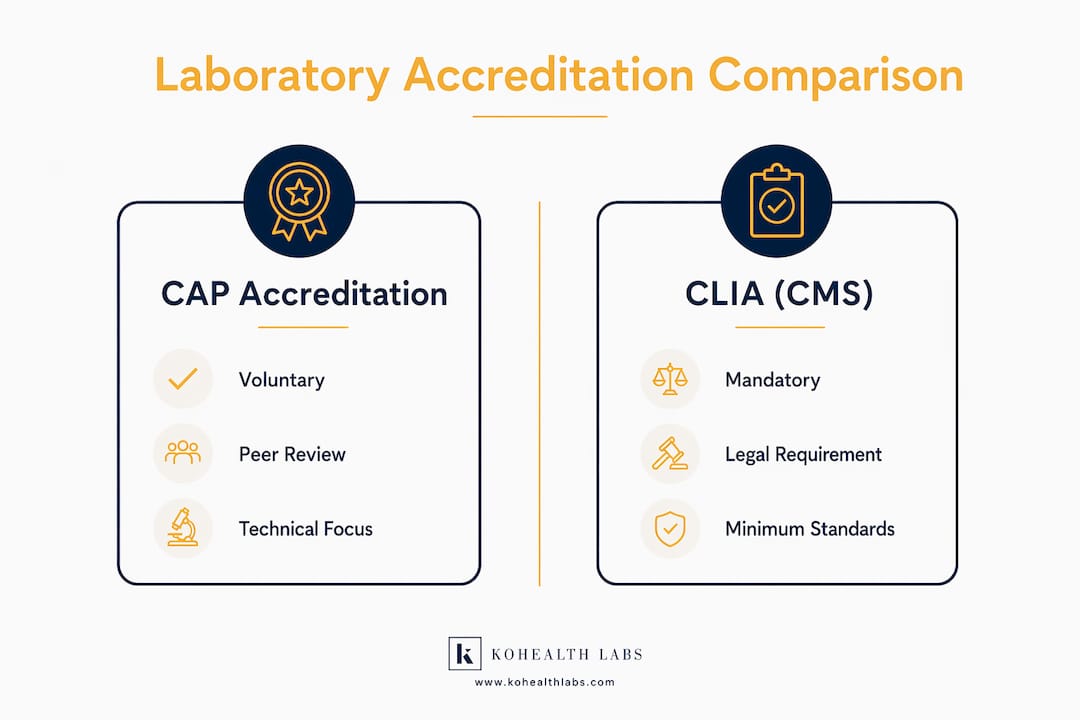
CLIA is the legal floor. Every US lab performing regulated testing must comply with it. CAP accreditation goes further: because CAP holds CMS deeming authority, a CAP inspection satisfies the federal CLIA inspection requirement, which is why so many high-volume reference labs pursue it.
ISO 15189 adds a different dimension. Where CAP focuses on technical testing disciplines, ISO 15189 requires a comprehensive quality management system that covers the entire lab as an integrated operation. A2LA describes ISO 15189 as the gold standard for international technical competence and quality management, and its adoption is growing among labs participating in multinational trials.
The CAP 15189 program bridges both worlds: it maps to ISO 15189:2022 and treats core CAP accreditation as a prerequisite, so labs can pursue both credentials through a single accreditor.
Pro Tip: If your lab supports international clinical trials or cross-border reference testing, ISO 15189 through the CAP 15189 pathway gives you both US peer-inspection rigor and globally recognized QMS credentials without managing two separate accreditation bodies.
What do CAP inspectors actually look for?
CAP inspections are not a general audit. Inspectors work through detailed, discipline-specific checklists and look for documented evidence in six core areas.
Quality control (QC): Inspectors review QC logs for every test system, checking that controls were run at required intervals, that results fell within acceptable ranges, and that out-of-control events triggered documented corrective actions.

Proficiency testing (PT): Labs must participate in an approved PT program and achieve acceptable scores. Repeated PT failures are a direct path to accreditation suspension.
Personnel qualifications: Every staff member performing testing must have documented credentials and competency assessments. Inspectors check training records, competency evaluations, and continuing education documentation.
Documentation and records: Policies, procedures, and records must be current, accessible, and complete. A procedure that exists in practice but not on paper is a finding.
Biosafety: Inspectors assess whether the lab handles hazardous materials, sharps, and infectious agents according to documented safety protocols.
Laboratory information systems (LIS) and result reporting: Validated LIS workflows, result transmission accuracy, and critical value notification processes all fall under inspection scope.
The checklist scale is substantial. Achieving CAP accreditation requires demonstrating compliance across thousands of individual checklist standards, making the process a significant operational undertaking. That depth is precisely what gives CAP certification its credibility with clinicians and sponsors.
How do laboratories achieve and maintain CAP accreditation?
The path from application to accreditation follows a defined sequence, though the timeline varies by lab size and complexity.
- Application and enrollment. The lab submits an application to CAP and enrolls in the required proficiency testing programs for its testing disciplines.
- Proficiency testing participation. The lab begins PT cycles immediately. Acceptable PT performance is a prerequisite for accreditation, not just a maintenance requirement.
- Self-assessment using CAP checklists. The lab conducts an internal gap assessment against the relevant CAP Accreditation Checklists, identifying deficiencies before the inspection team arrives.
- Pre-inspection remediation. Gaps found during self-assessment are corrected: policies are updated, training records completed, QC documentation organized, and LIS validations documented.
- On-site peer inspection. A CAP-trained team of laboratory professionals conducts the inspection, typically over one to two days depending on lab size. Inspectors review records, observe workflows, and interview staff.
- Inspection report and corrective actions. The lab receives a report listing any deficiencies. Each finding requires a documented root-cause analysis and corrective action plan submitted to CAP within a defined timeframe.
- Accreditation decision. CAP reviews the corrective action responses and issues an accreditation decision. Accreditation is granted when all deficiencies are resolved to CAP's satisfaction.
- Ongoing surveillance and renewal. Accreditation runs on a two-year inspection cycle. Between inspections, labs must maintain PT participation, update procedures as test systems change, and document continuous QC compliance.
What triggers suspension or revocation? Repeated PT failures, failure to submit corrective actions within required timeframes, or evidence of serious patient safety risks can result in CAP placing a lab on probation, suspending accreditation, or revoking it. CAP notifies CMS when accreditation status changes, which can trigger a federal inspection.
How can you verify a laboratory's CAP accreditation?
The CAP Accredited Laboratory and Biorepository Directory is the authoritative public tool for verification. You can search by lab name, city, state, or CAP number and confirm whether a lab currently holds accreditation.
One important limitation: the directory confirms accreditation status but does not list which specific tests are performed at each site. If you need to confirm that a particular test is performed at a specific location, CAP recommends contacting your physician or local public health facility to identify the right lab.
For clinical clients working with large reference labs, verification is often simpler. Many high-volume reference labs, including ARUP Laboratories, publicly post their current CAP and CLIA certificates, so you can download credentials directly without submitting a formal request.
Watch for testing chains. When a local lab sends specimens to a reference lab for specialized testing, the accreditation that matters is the reference lab's, not just the local lab's. Ask specifically which facility performs the test and verify that facility's CAP status separately. If accuracy or trial data integrity is at stake, request a copy of the CAP certificate for the performing lab.
Common compliance challenges labs face during CAP inspections
Most labs that struggle during CAP inspections share a recognizable pattern: compliance was treated as an inspection-time event rather than a continuous practice.
The most frequent nonconformances fall into these categories:
- Documentation gaps: Procedures that are outdated, missing signatures, or not accessible at the point of care.
- Inconsistent QC: QC performed but not documented in real time, or out-of-control events with no recorded corrective action.
- PT failures: Unacceptable scores in one or more testing disciplines, often in low-volume or rarely performed tests.
- Personnel competency records: Missing annual competency assessments, especially for staff who rotated or were cross-trained.
- LIS and reporting discrepancies: Critical value notification logs that are incomplete, or reference ranges in the LIS that do not match current validated procedures.
A typical remediation path starts with root-cause analysis: was the failure a training issue, a process design issue, or a system issue? From there, labs build a corrective action plan tied directly to the relevant CAP checklist item, retrain affected staff, and implement a monitoring mechanism to confirm the fix holds. For PT failures, labs often add internal QC challenges using the same analyte to rebuild confidence before the next PT cycle.
The labs that sustain accreditation without drama are the ones that treat CAP checklists as a year-round operational guide, not a pre-inspection checklist to dust off every 24 months. That mindset shift, from reactive to continuous, is what separates labs with clean inspection records from those cycling through corrective actions.
What does CAP accreditation mean for patients, clinicians, and research?
For patients, CAP accreditation means the lab processing your results operates under documented QC, participates in external proficiency testing, and has a traceable record of corrective actions when something goes wrong. That is a materially higher standard than CLIA alone requires.
For clinicians, CAP status is a practical shortcut when selecting reference labs or evaluating central lab partners for pharma sponsor oversight. Three questions worth asking any lab when test accuracy or trial data integrity matters:
- Is your lab currently CAP-accredited, and can you provide your certificate number for directory verification?
- Which specific facility performs this test, and is that facility also CAP-accredited?
- Do you participate in CAP proficiency testing for this analyte, and what were your most recent PT scores?
For clinical research, the stakes are higher still. Study sponsors and regulatory agencies expect trial-site labs to meet recognized accreditation standards. CAP accreditation supports data integrity, chain-of-custody documentation, and audit readiness. In multi-site trials, a lab's CAP status often determines whether it qualifies as a central or reference lab for the study. Unified diagnostic workflows that integrate accredited lab data with radiology and biomarker analytics further reduce data queries and accelerate study timelines.
Integrated diagnostics and accreditation: a Kohealth Labs perspective
CAP accreditation establishes the quality floor for individual laboratory disciplines. What it does not address on its own is the systems-level challenge that clinical trials increasingly face: integrating lab results, radiology reads, and multi-biomarker data into a single, analysis-ready stream without introducing reconciliation errors or vendor-management delays.

This is where ISO 15189-style quality management systems complement CAP requirements. ISO 15189 requires the lab to think about quality across the entire testing process, from specimen receipt through result delivery, which maps directly onto the data reconciliation challenges in integrated diagnostics. When a lab's QMS covers not just the analyzer but the LIS-to-EHR data path and the radiology interface, outlier detection happens earlier and data queries drop.
Kohealth Labs observes this pattern consistently. When lab, radiology, and analytics operate under a single validated workflow rather than separate vendor contracts, data reconciliation that typically takes days compresses to hours. AI-enabled quality checks flag deviations at the point of data entry rather than during end-of-study data cleaning, which is where trial timelines most often slip. How integrated diagnostics support specialty care teams follows the same logic: fewer handoffs between systems means fewer opportunities for errors to compound.
Consider a Phase II oncology trial running across six sites. Each site uses a different reference lab, and radiology reads come from a separate vendor. Data reconciliation queries account for a significant share of the study's timeline overrun. Consolidating to a single accredited partner with validated LIS-to-radiology data paths eliminates the cross-vendor reconciliation step entirely, and CAP-accredited QC documentation satisfies sponsor audit requirements without additional data cleaning.
Pro Tip: When evaluating a diagnostic partner for a clinical trial, ask specifically whether their LIS-to-EHR and radiology data paths are validated and documented under their accreditation program. A CAP certificate alone does not guarantee integrated data quality; the QMS scope does.
Key Takeaways
CAP accreditation is the strongest quality signal available for US clinical laboratories, combining peer-based inspections, federal deeming authority, and a continuous improvement framework that CLIA alone does not provide.
| Point | Details |
|---|---|
| Verify before you trust | Use the CAP Accredited Laboratory and Biorepository Directory to confirm current accreditation status by lab name or CAP number. |
| CAP vs. CLIA vs. ISO 15189 | CLIA is the federal minimum; CAP exceeds it with peer inspections every two years; ISO 15189 adds full QMS scope for international trials. |
| Directory has limits | CAP accreditation status does not confirm which tests a site performs; always verify the performing facility for specialized or reference testing. |
| Research labs need more | For clinical trials, ask about PT scores, LIS validation, and integrated data paths, not just accreditation status. |
| Kohealth Labs integration | Kohealth Labs combines CAP-aligned lab services with radiology and AI-enabled data quality under a single contract, reducing trial data queries and vendor complexity. |
Why accreditation is the foundation, not the finish line
Accreditation is often framed as a credential, something a lab earns and displays. That framing undersells what it actually represents. A CAP-accredited laboratory has agreed to be inspected by its peers, to document every quality failure, and to fix problems in a way that is traceable and auditable. That is not a marketing claim; it is an operational commitment with real consequences if it lapses.
What gets underestimated is how much accreditation status matters at the edges of clinical care, not in routine testing where most labs perform adequately, but in the cases where a result drives a high-stakes decision: a rare disease workup, a trial eligibility screen, a biomarker that determines treatment selection. Those are exactly the moments when QC documentation, PT participation, and a validated LIS matter most, and when a lab's accreditation history tells you something a certificate number alone cannot.
The practical implication for clinicians and sponsors is straightforward: treat CAP accreditation as a necessary condition, not a sufficient one. Verify it, then ask the follow-up questions about PT scores, inspection history, and integrated data workflows. The labs that answer those questions confidently are the ones worth building a long-term relationship with.
Kohealth Labs and accredited integrated diagnostics for clinical trials
Clinical trials and specialty care programs need more than a single accredited lab. They need lab results, radiology reads, and biomarker data delivered as a single, analysis-ready package, with one contract, one point of accountability, and AI-enabled quality checks that catch deviations before they become data queries.
Kohealth Labs delivers exactly that. By combining CAP-aligned laboratory services with integrated radiology and AI-driven data quality across more than 100 biomarkers, Kohealth Labs gives CROs, government agencies, and specialty care programs the consolidated diagnostic infrastructure that accelerates trial timelines and reduces vendor complexity. One contract replaces multiple vendor relationships. Validated LIS-to-radiology data paths replace manual reconciliation. And accreditation-backed QC documentation satisfies sponsor and regulatory audit requirements from day one.
If you are evaluating diagnostic partners for an upcoming trial or specialty program, explore Kohealth Labs' integrated diagnostics solutions to see how a single-contract model can reduce your data management burden and get your study to results faster.
Authoritative sources and further reading
The sources below are the primary references for the facts and program details covered in this article. Each is worth bookmarking if you are verifying a lab's credentials or evaluating accreditation programs.
-
CAP Laboratory Accreditation Program: The official program page describing the peer inspection model, checklist framework, and CMS deeming authority. Start here for program requirements and enrollment information.
-
CAP Accredited Laboratory and Biorepository Directory: The public-facing verification tool. Search by lab name, city, state, or CAP number to confirm current accreditation status.
-
CAP 15189 Accreditation Program: Details on CAP's ISO 15189:2022-aligned program, including the three-year cycle, surveillance assessments, and the list of currently accredited laboratories.
-
CMS / CLIA Program: The federal regulatory framework that all US clinical labs must comply with. Explains CLIA requirements and how deemed-authority programs like CAP satisfy federal inspection obligations.
-
A2LA Clinical Testing Accreditation: A2LA's overview of ISO 15189 and its role as an international standard for technical competence and quality management in medical laboratories.
-
Kohealth Labs Integrated Diagnostics: Kohealth Labs' service overview for CROs, pharma sponsors, and specialty care programs seeking accredited, integrated lab and radiology solutions.