

Choose a central lab for endpoint-critical assays and biomarker panels where cross-site consistency drives your primary results, and choose local labs for urgent safety tests where turnaround time protects patients. Most trials need both. Document that split in a Lab Strategy Memo, tie it to your risk register with measurable key risk indicators, and you have a defensible, inspection-ready rationale instead of an ad hoc vendor list.
TL;DR:
- Central labs provide improved consistency and regulatory simplicity for efficacy and biomarker tests, while local labs offer faster results for safety-critical and time-sensitive assays.
- Managing sample logistics is crucial, with cold-chain shipping risks, customs delays, and labeling errors being common failure points that require advance contingency planning.
- Using a hybrid lab strategy enhances data harmonization and reduces query volume by implementing automated tracking and direct data transfers, but it demands rigorous oversight and standardized protocols.
- Lab choice impacts patient recruitment and retention, especially during screening, because local results enable quicker decisions and improve patient engagement.
- Regular lab performance monitoring and integrated diagnostics platforms streamline multi-site operations, lowering administrative burden and risk of data errors across complex trials.
Central Lab vs Local Lab: What Each One Actually Does
A central lab is a single, dedicated facility that processes samples from every site in your study using one method, one instrument platform, and one set of reference ranges. Sponsors lean on central labs for assays that require tight cross-site consistency, because a single lab eliminates the method-to-method drift that shows up when ten different facilities run the same test ten different ways.
A local (or site) lab is the hospital, clinic, or regional facility physically attached to (or near) the trial site. It runs tests the same day, often within hours, because the sample never leaves the building.
Here's how the split typically plays out by assay type:
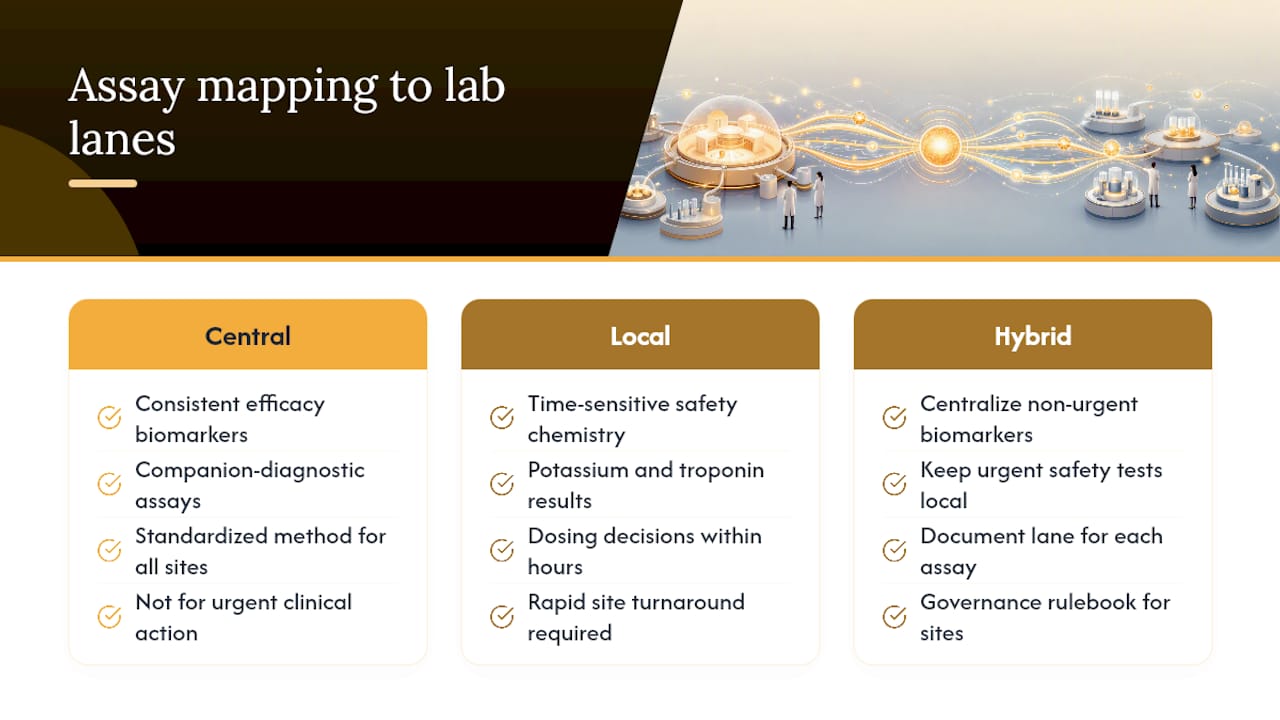
- Central lab territory: efficacy biomarkers, PK/PD panels, genomic and specialty assays, stratification markers tied to randomization
- Local lab territory: complete blood counts before dosing, electrolytes, coagulation panels, anything feeding an immediate go/no-go safety decision
- Gray zone: liver function panels, some inflammatory markers, tests where both speed and precision matter and sponsors often duplicate testing at both lanes
Oncology trials with biomarker-driven endpoints lean heavily central, since precision and consistent stratification matter more than speed when the biomarker determines who gets randomized where.
Central Lab vs Local: Where Each Model Wins and Loses
Every sponsor eventually asks the same question: which model actually protects data quality without wrecking the timeline? The honest answer is that both models solve different problems, and picking one to "win" the whole trial is usually the wrong call.
Central lab strengths:
- One method, one set of reference ranges, far fewer query cycles tied to unit mismatches or calibration drift
- Easier regulatory story: a consolidated methodology reduces cross-site variability and gives reviewers one validation package instead of a dozen
- Simpler proficiency testing and audit trail, since you're auditing one lab instead of forty
Local lab strengths:
- Same-day results for tests where waiting even 48 hours creates clinical risk
- No shipping dependency, so no cold-chain excursions or courier delays to manage
- Better fit for country-specific or regionally mandated assays that a central lab may not run
Where the hidden costs live: Central models save money on method variability but add courier fees, kit builds, and customs handling per shipment. Local models save on logistics but multiply your oversight burden. You're now managing proficiency testing, CLIA renewals, and audit cycles across every single site lab instead of one facility.
| Factor | Central lab | Local lab |
|---|---|---|
| Turnaround time | Variable (shipping dependent) | Hours |
| Cross-site consistency | High | Variable by site |
| Query volume | Lower | Higher (unit/range mismatches) |
| Oversight burden | Concentrated, one vendor | Distributed, many vendors |
Industry guidance increasingly frames the real trade-off as governance quality, not model choice: a well-governed hybrid beats a poorly governed pure model of either kind.
How Do You Manage the Sample Chain Between Sites and Labs?
Every central lab decision is really a logistics bet. You're betting that a sample can survive the trip from injection site to processing lab without degrading, and that bet gets riskier with every mile and every border crossing.
Three failure points cause most central lab problems:
- Temperature excursions on the longest shipping leg, particularly for sites in rural or low-infrastructure regions where courier pickup windows slip
- Customs delays at international borders, which can turn a 24-hour shipment into a 4-day ordeal for a biomarker with a tight stability window
- Kit and labeling errors at the site level, where a mislabeled tube or missing barcode triggers a query that could have been avoided with better kit design
Sponsors that model these lanes in advance, rather than discovering them mid-trial, fare far better. Mapping transport lanes and cold-chain contingencies before enrollment turns a reactive scramble into a planned workflow with backup couriers already contracted.
Pro Tip: Build a secondary courier lane into your protocol before your first patient enrolls. A single-carrier dependency is the most common reason central labs miss their turnaround targets, and it is entirely preventable with a backup contract signed on day one.
When a region's infrastructure simply cannot support reliable cold-chain shipping, that's your signal to shift the affected assays to a local lab, even if the rest of your study runs central. Our specimen cold chain guide breaks down monitoring practices and contingency planning in more depth.
Why Data Harmonization Determines Your Query Volume
Every lab result eventually has to land in the same dataset, speaking the same language, using the same units. That's harder than it sounds when you're pulling from multiple labs with different instruments and different habits.
Central labs make this easier because they typically deliver pre-mapped LOINC codes and CDISC LB domain formatting straight out of their LIMS, which cuts down the manual cleaning your data management team would otherwise do line by line.
Hybrid estates need more engineering risks with reagent choice, not less:
- A versioned reference-range registry that tracks unit conversions and instrument-specific normal ranges across every lab in the network
- Automated alerts triggered whenever a local lab swaps a reagent lot or recalibrates an instrument, since that shift can silently move an entire site's results outside your expected range
- Direct LIMS-to-EDC feeds via standing data transfer agreements, replacing manual file drops that introduce transcription errors
Maintaining a versioned per-lab reference-range registry with automated instrument-change alerts is the single highest-leverage move for a hybrid estate. It catches drift before it becomes a query backlog three months deep. Our post on multi-site lab standardization covers the platform levers that make this practical rather than theoretical.
What Accreditations Should Sponsors Verify Before Site Activation?
Before you sign a lab agreement, request current documentation, not a sales deck. That means active CLIA certification, CAP accreditation with assay-specific scope, and ISO 15189 status where applicable, all matched against the exact analyte list you plan to run.
Research-only assays don't always carry diagnostic-grade certification, so your protocol needs to state clearly which results are for clinical decision-making and which are exploratory. That distinction affects what "GCLP" (Good Clinical Laboratory Practice) documentation the lab owes you.
For inspection readiness, keep this package current for every lab in your network:
- Current CLIA/CAP/ISO scope letters matched to your assay list
- Proficiency testing results for the last two cycles
- CAPA logs for any deviations tied to your study samples
- KRI dashboards showing turnaround time and excursion trends over time
The FDA's guidance on decentralized trial elements makes clear that specimen handling and remote testing models need documented planning, not improvisation, to satisfy inspectors.
How to Build a Lab Strategy Decision Framework
Stop deciding lab assignments assay by assay in real time. Build the rule once, apply it consistently, and document it.
- Tag every analyte as endpoint-critical, safety-critical, or exploratory before finalizing your protocol. Endpoint and stratification markers go central; safety markers with tight action windows go local.
- Set a turnaround threshold for each safety assay. If a result needs to inform a dosing decision within 4 hours, it cannot travel to a central lab, period.
- Write the Lab Strategy Memo. State the rule, the rationale, and the exceptions, then attach it to your trial master file.
- Feed the risk register. Every lab decision becomes a tracked KRI: excursion rate, hemolysis reject rate, DTA resubmission rate.
- Build a vendor oversight scorecard that tracks each lab's performance against the thresholds you set in step 2.
Pro Tip: Tag analytes in your protocol, not in a spreadsheet someone forgets to update. Analytes tagged directly in the protocol survive amendments; spreadsheets don't.
Our breakdown of pharma sponsor oversight expectations walks through what auditors expect to see in each of these artifacts.
How Integrated Diagnostics Reduce Hybrid Friction
Running a hybrid model well means managing multiple contracts, multiple invoices, and multiple data formats at once, and that overhead is exactly what integrated diagnostics platforms are built to absorb. Combining lab and radiology diagnostics under one contract does more than simplify billing.
- One contract covering lab, imaging, and data delivery removes the vendor-reconciliation work that eats data management hours every month
- AI-driven quality checks flag deviations before they become queries, producing analysis-ready data bundles instead of raw files your team has to clean manually
- Analytics spanning more than 100 biomarkers give sponsors one place to review results instead of stitching together outputs from separate vendors
This is exactly how integrated diagnostics including labs, radiology, and data accelerate clinical trials: fewer handoffs mean fewer places for a result to get delayed or misfiled.
Does Lab Choice Actually Affect Recruitment and Retention?
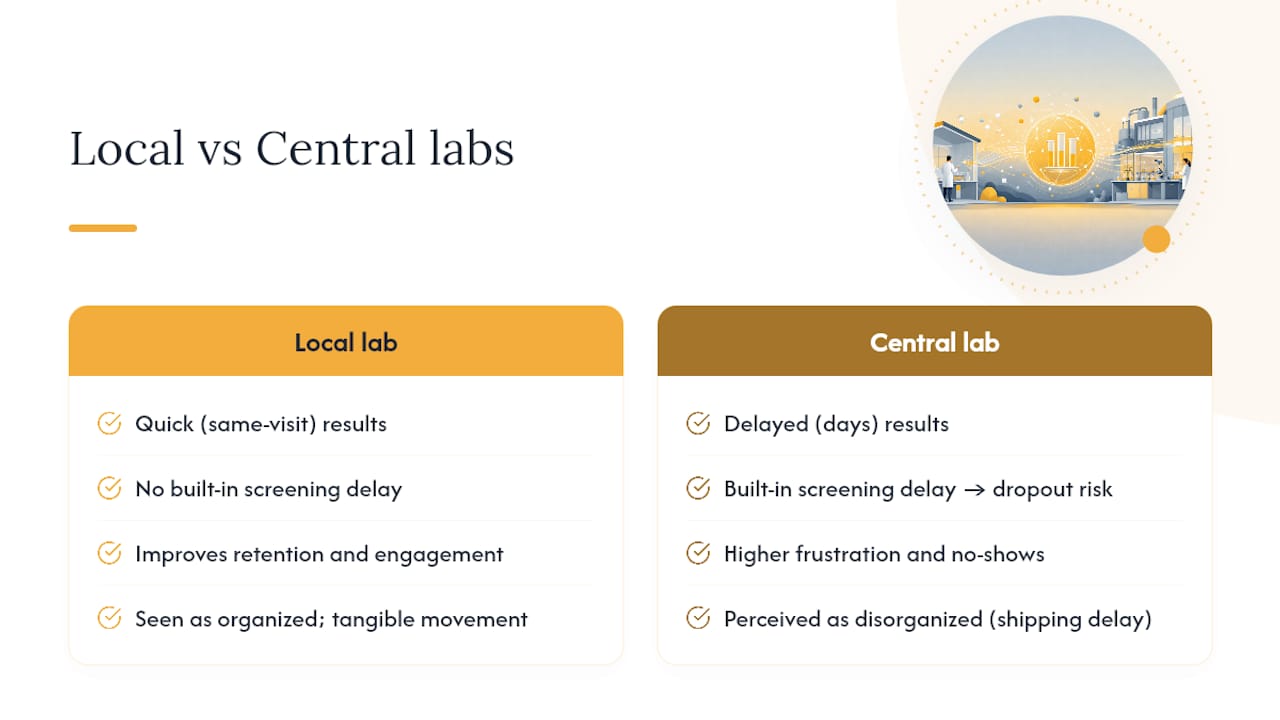
It does, more than most protocol teams anticipate. A local lab draw means a patient walks into a clinic, gets a blood draw, and often knows a preliminary result before they leave the building. A central lab draw means the patient gives blood, then waits, sometimes days, for a result that determines whether they continue in the study.
That gap matters most at screening. If your eligibility criteria depend on a central lab result, you've built a delay into the very first patient interaction, and every day of delay increases dropout risk before the patient has even started treatment. Sites report frustration when patients travel for a screening visit and then wait a week to learn whether they qualify, especially in trials competing for a limited patient population.
Retention follows a similar pattern for safety monitoring visits. Patients who get near-instant local lab feedback tend to feel more engaged with the trial, because they see tangible movement. Patients waiting on central lab turnaround for routine safety panels sometimes interpret the delay as the site being disorganized, even when the delay is a shipping and processing artifact that has nothing to do with the site staff.
The fix isn't abandoning central testing. It's routing the assays that touch the patient experience, screening eligibility markers, urgent safety panels, through local labs while keeping efficacy endpoints central. Sites that make this split explicit in their patient communication (explaining which results come back fast and which take longer) see fewer complaints and fewer no shows at follow-up visits.
How Does Lab Model Choice Affect Statistical Power?
Every biostatistician has seen a trial where the treatment effect got muddied not by the drug, but by measurement noise introduced across sites. That's the quiet risk hiding inside a local-only lab strategy for endpoint assays.
When ten sites each run the same biomarker on different instruments with different calibration schedules, you introduce inter-lab variability directly into your primary endpoint data. That variability doesn't cancel out. It adds noise, which means you need larger sample sizes to detect the same treatment effect, or you risk a false negative on a drug that actually works.
Central testing addresses this by consolidating the method into one validated process, which removes an entire category of variance from your statistical model before you ever run the analysis. This matters most for trials with tight effect sizes, where the signal-to-noise ratio is already thin.
The flip side is real too. If your central lab's shipping delays cause samples to degrade before analysis, you've traded inter-lab variance for a different kind of measurement error, one tied to sample stability rather than instrument calibration. A degraded sample doesn't announce itself; it just produces a slightly wrong number that looks plausible.
Statisticians reviewing your analysis plan should know, assay by assay, which lane each measurement traveled through. That detail belongs in your statistical analysis plan, not buried in an operations document nobody on the biostatistics team reads.
What Do Real Trials Show About Central vs Local Outcomes?
Multicenter oncology trials with biomarker-stratified randomization illustrate the central lab case clearly. When a trial randomizes patients based on a companion diagnostic result, every site running that assay differently introduces a real risk of misclassifying patients into the wrong treatment arm. Centralizing that single assay, while leaving routine safety labs local, has become close to standard practice for exactly this reason.
Contrast that with a decentralized or hybrid cardiovascular safety trial, where potassium and troponin results need to inform dosing decisions within hours. A central lab turnaround measured in days simply doesn't fit that clinical reality, regardless of how much more consistent the central method might be. Sponsors running these trials typically keep safety chemistry local at every site and centralize only the efficacy biomarkers that don't carry a time-sensitive clinical action.
The pattern across both examples is the same: the trials that run smoothly aren't the ones that picked "central" or "local" as a philosophy. They're the ones that mapped each specific assay to the lane matching its actual clinical and statistical demands, then wrote that mapping down so every site, every lab, and every auditor was working from the same rulebook. Hybrid governance, not model purity, is what separates the trials that finish on schedule from the ones stuck reconciling data six months past database lock.
Operationalizing the Hybrid Model: A Working Recommendation
Set a monthly quality forum with a named scorecard owner for every lab in your network, tracking turnaround time, excursion rates, and query aging against contract thresholds. Pair that with a quarterly audit cadence and service credits written into the contract for chronic misses. If you want a working Lab Strategy Memo template to start from, request one before your next protocol amendment locks the assay list.
— Kohealth Labs
KoHealth Labs: One Contract for Lab, Radiology, and Trial-Ready Data
If the sections above made one thing clear, it's that hybrid models succeed or fail on coordination, not on the lab science itself. A single integrated diagnostics provider can help remove that coordination burden. Integrated diagnostics platforms combine lab testing, radiology, and AI-driven data delivery into a unified contract with analysis-ready data bundles.
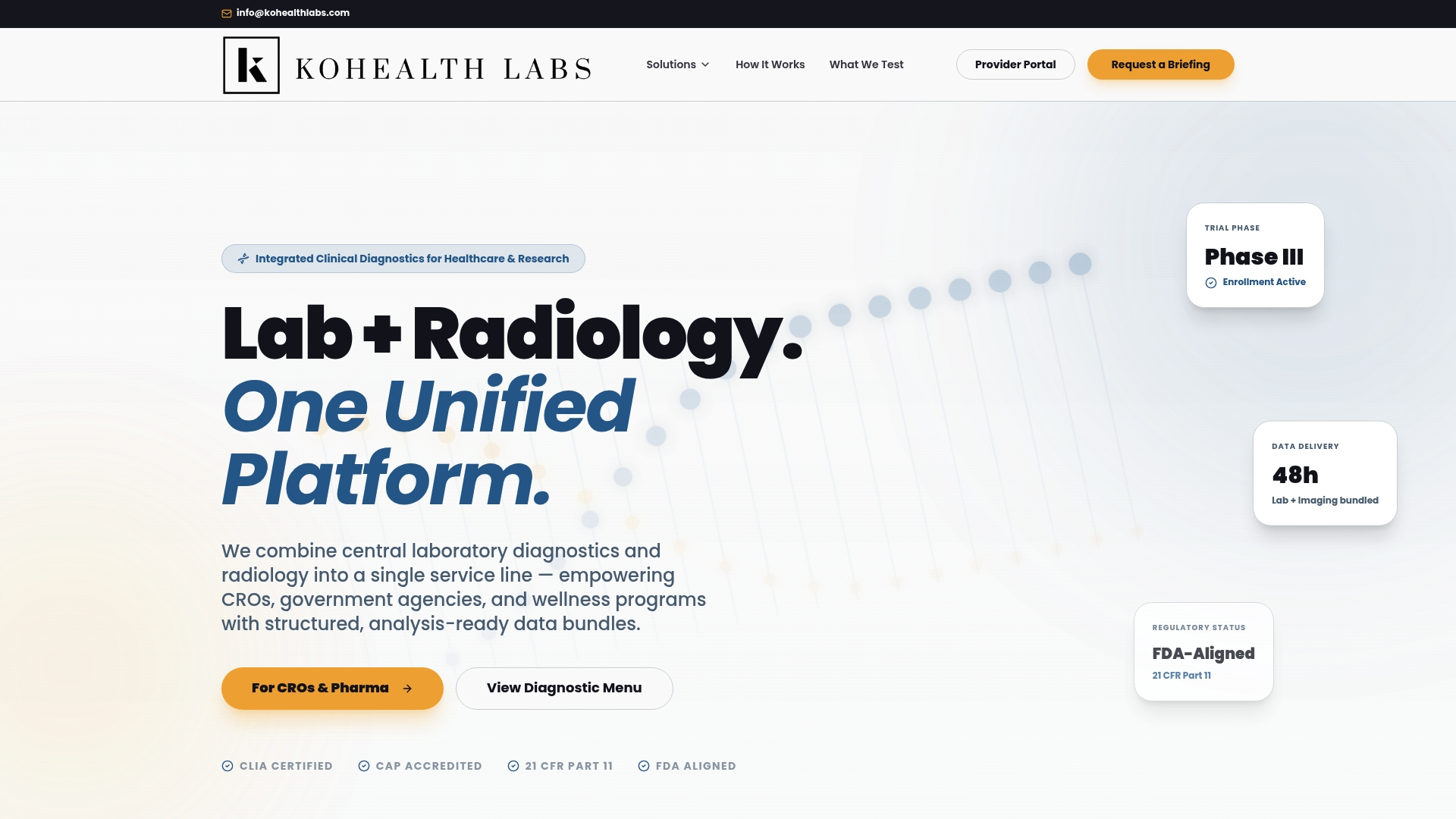
That single-contract structure means fewer invoices to reconcile, fewer vendor calls to schedule, and fewer places for a sample or a result to fall through the cracks. AI-driven quality checks flag deviations early, reducing query cycles that affect database lock timelines, and analytics spanning numerous biomarkers give teams a unified review platform instead of patching together outputs from multiple labs and imaging vendors.
For sponsors managing multi-site pathology needs, our pathology laboratory services team can walk through how your specific assay mix maps to a central, local, or hybrid strategy. Get in touch to scope your next protocol's lab strategy before your site activation timeline locks in.
Where to Verify These Claims
For deeper technical or regulatory detail, consult the peer-reviewed case for central lab standardization, the Applied Clinical Trials analysis of hybrid governance, and the FDA's decentralized trials guidance.