
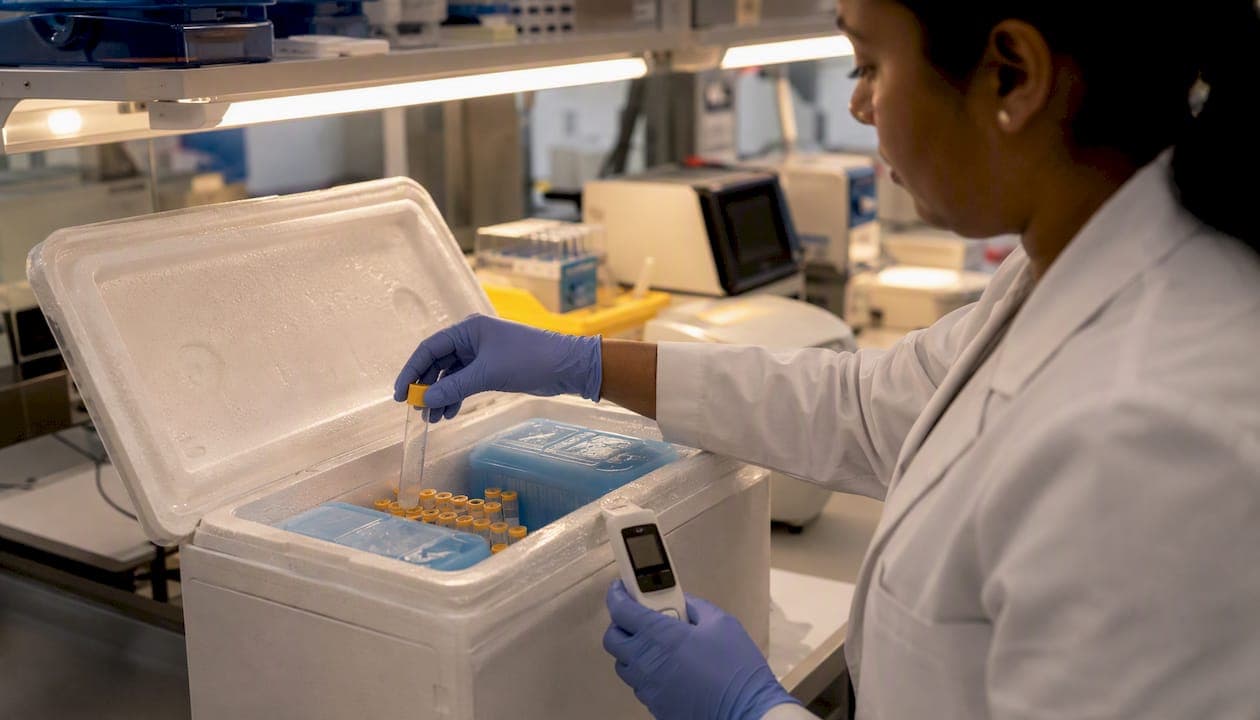
A specimen cold chain is the unbroken sequence of temperature-controlled conditions that keeps a biological sample viable from collection through receipt and processing. Three controls are non-negotiable on every shipment: a validated packout matched to the specimen's required temperature band, continuous monitoring with documented data, and a controlled handoff that maintains chain of custody at every transfer point.
Before you release any shipment, confirm these three things:
- The specimen's validated temperature band (room temperature 15–25°C, refrigerated 2–8°C, frozen ≤−20°C, or ultra-low ≤−70°C) is documented on the packing list.
- The packout type and coolant load have been qualified to cover the worst-case transit time.
- A monitoring device is active, placed correctly, and its data will be retrievable at receipt.
Pro Tip: Write the temperature band and expected transit duration on the outside of the outer packaging in addition to the packing list inside. Receiving staff can make a faster, better-informed acceptance decision without opening the box first.
Key Takeaways
A reliable specimen cold chain requires validated packouts matched to each analyte's temperature band, continuous monitoring with documented data, and LIMS-integrated records that make every disposition decision defensible.
| Point | Details |
|---|---|
| Match packout to temperature band | Use CDC and USP tiers (CRT 15–25°C, refrigerated 2–8°C, frozen ≤−20°C, ultra-low ≤−70°C) and never substitute coolant types. |
| Validate to worst-case conditions | Qualification runs must cover summer and winter ambient extremes, not average transit conditions. |
| Monitor continuously and log data | Electronic data loggers placed adjacent to specimens provide the evidence needed for a defensible accept/reject decision. |
| Integrate cold chain data into LIMS | Linking logger data to specimen accession records converts cold chain compliance from a paper file into an audit-ready quality asset. |
| Kohealth Labs as integrated partner | Kohealth Labs delivers courier pickup, validated packouts, temperature monitoring, and analysis-ready data bundles under a single contract for CROs and clinical programs. |
What the specimen cold chain is and why it matters for sample integrity
Temperature excursions do not just inconvenience a lab. They invalidate results. A single out-of-range event during transport can degrade analytes, alter cell morphology, shift enzyme activity, or cause hemolysis, any of which produces data that cannot be used. CLSI guidance on specimen handling (PRE04) documents how the preanalytical phase, including transport and storage, directly affects test trueness and must be addressed in laboratory SOPs.
The operational consequences compound quickly. A rejected specimen means a redraw, which delays patient care or trial enrollment. In a clinical trial, a single site's repeated rejections can trigger a protocol deviation, require regulatory notification, and push a study's database lock weeks or months. For a CRO managing multiple sites, that risk multiplies across every collection point.
The cost of a cold chain failure is almost always higher than the cost of preventing it. Validated packaging, a calibrated data logger, and a carrier SLA add a modest per-shipment cost. A redraw adds phlebotomy time, patient burden, site coordinator hours, and potentially a protocol amendment. For PCR testing in clinical trials, where preanalytical integrity is especially critical, the stakes are even higher.
Statistic callout: CLSI's PRE04 standard identifies the preanalytical phase as the source of the majority of laboratory errors, with transport and storage conditions among the leading contributors to specimen rejection.
Key operational risks when cold chain management is inadequate:
- Analyte degradation producing false-low or false-high results
- Specimen rejection at the receiving lab, triggering redraws
- Protocol deviations and regulatory notifications in clinical trials
- Lost enrollment windows when time-sensitive samples cannot be replaced
- Chain-of-custody gaps that undermine data defensibility in regulated studies
Standard temperature tiers every lab team should know
"Cold" is not a single setting. The USP cold-chain and supply-chain toolkit (GC1079.2) and CDC specimen packing guidance both define four canonical temperature tiers, and your packout must match the tier your analyte requires, not the tier that happens to be convenient.
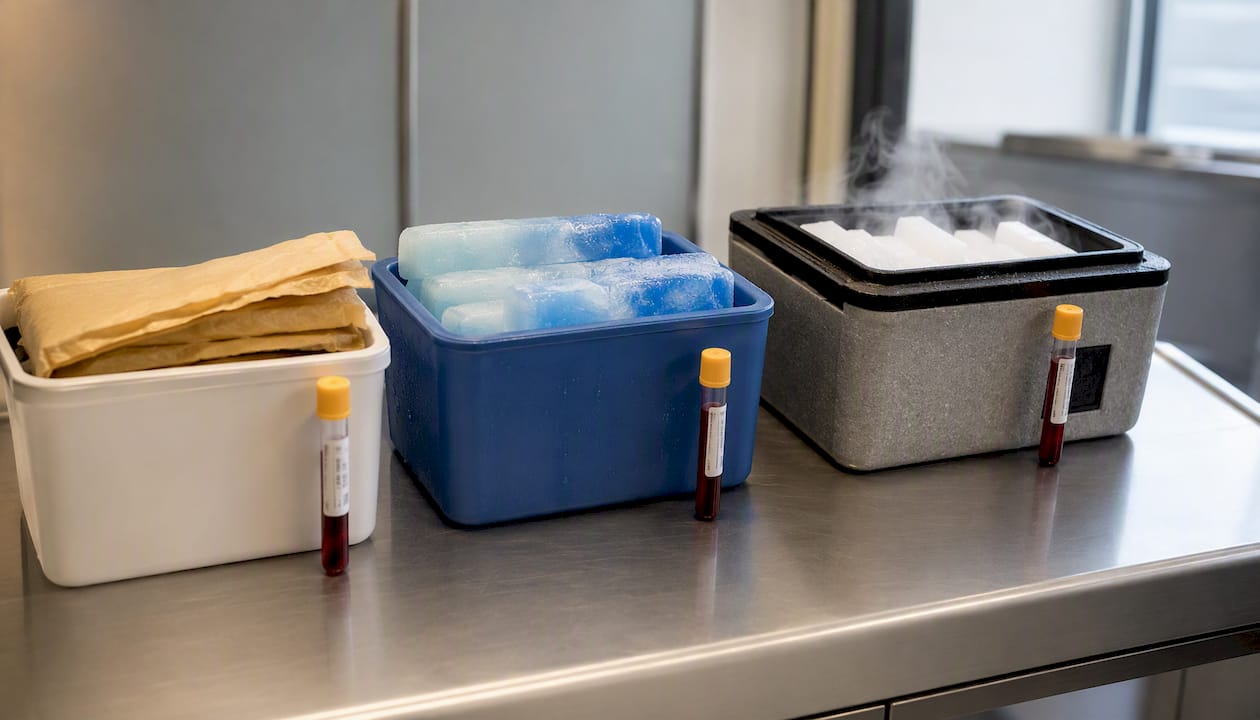
The most common mismatch in practice is using dry ice for a specimen that requires only refrigerated conditions. Dry ice maintains temperatures well below −20°C. Placing a refrigerated-only specimen on dry ice can freeze it, which is itself a temperature excursion that invalidates the sample just as surely as warming it. Always confirm the analyte's validated range before selecting coolant.
A few additional points worth keeping in mind:
- Some specimens tolerate brief excursions; others do not. RNA preparations, for example, degrade rapidly above −70°C even for short periods.
- Whole blood for certain molecular assays may require CRT transport with a strict time-to-processing window, not refrigeration.
- ICH Q5C guidance on biological product stability directly informs how validated temperature bands should be set for biologic specimens and reagents, particularly in clinical trial contexts.
Four stages of the specimen cold chain and what each one requires
The cold chain runs through four distinct stages: collection and initial stabilization, on-site storage and packout, transport, and receipt with processing disposition. A break at any stage compromises the entire chain.
Stage 1: Collection and initial stabilization
- Collect into the correct tube or container for the analyte.
- Pre-condition the specimen to its target temperature before packaging (e.g., centrifuge and chill serum before placing in a refrigerated packout).
- Label the primary container with patient/subject ID, collection date and time, and specimen type.
- Document collection time; many analytes have maximum time-to-processing windows.
Stage 2: On-site storage and packout
- Store at the validated temperature until the packout is assembled.
- Pre-condition the packout (pre-chill the cooler, pre-freeze gel packs, or pre-cool dry ice containers).
- Place the monitoring device and confirm it is active before sealing.
- Complete the packing list and chain-of-custody documentation.
Stage 3: Transport
- Hand off to a qualified carrier with a documented SLA for temperature-controlled shipments.
- Notify the receiving lab with tracking number, expected arrival time, and number of specimens.
- Monitor shipment status; use carrier APIs or real-time logger alerts where available.
- For multi-day frozen shipments, plan for dry ice top-up at intermediate stops.
Stage 4: Receipt and processing disposition
Acceptance checklist at receipt:
- Outer packaging intact, no visible damage or leaks.
- UN markings and hazard labels present and legible.
- Temperature logger data downloaded and reviewed before disposition.
- Dry ice level (if applicable) noted and documented.
- Shipment arrived during business hours as pre-arranged.
- Packing list matches actual contents.
- Chain-of-custody form signed and dated by receiving staff.
Pro Tip: Train receiving staff to download logger data before unpacking specimens. Once the box is opened and specimens are moved to storage, the thermal record of the intact shipment is gone. The logger data is your evidence.
Triple packaging, physical requirements, and regulatory rules for specimen shipments
Every clinical specimen shipment requires three layers of containment: a leakproof primary container, a leakproof secondary container with absorbent material, and a rigid outer packaging that has been tested to withstand a 4-foot drop. This is not optional guidance. It is the minimum standard required under IATA Packing Instruction 650 for Category B biological substances and is consistent with CDC packing requirements.
Each layer serves a specific function:
- Primary container: holds the specimen directly; must be leakproof and labeled with specimen ID and collection data.
- Secondary container: surrounds the primary; must also be leakproof and contain enough absorbent material to absorb the full volume of the primary if it fails.
- Rigid outer packaging: protects the secondary from physical damage; minimum 2-inch insulating wall thickness for temperature-sensitive shipments; must pass a 4-foot drop test.
Regulatory callouts you must address in your SOPs:
- UN3373 is the marking for Category B biological substances (most clinical specimens). It must appear on the outer packaging as a diamond-shaped mark with "UN3373" and "Biological Substance, Category B" text.
- UN1845 is the designation for dry ice (solid CO₂). Per 49 CFR 173.217, packages containing dry ice must permit gas release to prevent pressure buildup, must be marked with UN1845 and the net quantity of dry ice in kilograms, and must comply with carrier quantity limits by mode of transport.
- Category A infectious substances (UN2814 or UN2900) require a higher packaging specification and are subject to additional DOT and IATA requirements beyond the scope of most routine clinical specimen shipments.
Statistic callout: The 4-foot drop test is a minimum physical qualification standard under IATA PI 650. Packaging that has not been tested to this standard is not compliant for air transport of biological substances, regardless of how well it insulates.
Pro Tip: Attach the packing list, chain-of-custody form, and any required permits inside the outer packaging and tape a duplicate packing list to the outside. Carriers and customs agents can verify contents without breaking the seal, which speeds acceptance and reduces handling delays.
Step-by-step packing workflows for refrigerated, frozen, and room-temperature shipments
The right packout starts with the specimen's validated temperature band and the worst-case transit duration. Match those two variables first, then select coolant and container.
Refrigerated shipments (2–8°C)
- Pre-chill the insulated container for at least 2 hours before packing.
- Pre-condition gel packs to 2–8°C (not frozen); frozen gel packs will push the interior below 2°C.
- Place the sealed secondary container (with specimens inside) in the center of the cooler.
- Surround the secondary with pre-conditioned gel packs on all sides, including top and bottom.
- Place the temperature logger adjacent to the secondary container, not against the cooler wall.
- Seal the outer packaging, apply UN3373 marking, and attach documentation.
- Confirm transit time is within the packout's validated hold time before releasing.
Frozen shipments (dry ice, ≤−20°C)
- Pre-freeze specimens to the target temperature before packing.
- Line the bottom of the insulated container with dry ice.
- Place the sealed secondary container on top of the dry ice layer.
- Surround and cover the secondary with additional dry ice on all sides.
- Place the temperature logger inside, adjacent to the secondary packaging.
- Leave the outer packaging closure loose enough to allow CO₂ gas to vent; do not hermetically seal a dry-ice shipment.
- Mark the outer packaging with UN1845 and the net dry-ice weight in kilograms per 49 CFR 173.217.
- For transit beyond 24 hours, plan for dry ice top-up; document the top-up in the chain-of-custody record.
Dry ice quantities vary by container size and ambient conditions. Vendor qualification data (ISTA 7D or equivalent) should drive your specific load, not estimation. As a general operational reference, overnight shipments in a standard 10-liter insulated shipper typically require 5–8 pounds of dry ice; 48-hour shipments may require 10–15 pounds, depending on ambient temperature and insulation performance. Always use your packout's validated data.
Room-temperature shipments (15–25°C)
- No coolant is required, but the packout must still protect against ambient extremes.
- In summer or high-ambient conditions, a CRT packout may still need a thermal buffer to prevent the interior from exceeding 25°C.
- Document the expected ambient range for the transit route and confirm the packout has been validated for that range.
- A temperature indicator or logger is still recommended for regulated studies.
Pro Tip: Stage all packout materials (pre-conditioned gel packs or dry ice, logger, documentation, labels) in a dedicated area before you begin packing. Rushing to find materials mid-packout is how specimens get left at room temperature longer than intended.
Passive vs active packaging: how to choose the right thermal shipper
Passive packaging uses insulation and a fixed coolant load to maintain temperature for a defined hold time. Active packaging uses a powered refrigeration or heating system to maintain temperature indefinitely. The right choice depends on transit time, ambient conditions, specimen value, and regulatory requirements.
Passive systems are cost-effective and appropriate for the majority of clinical specimen shipments when the transit time falls within the validated hold time. Types include:
- Expanded polystyrene (EPS) foam coolers: low cost, widely available, adequate for overnight refrigerated or frozen shipments with appropriate coolant.
- Molded polyurethane (PUR) foam shippers: better insulation performance than EPS, longer hold times, preferred for 48-hour or extended frozen shipments.
- Vacuum-insulated panels (VIP): highest passive insulation performance; used for ultra-low or high-value shipments where hold time must be maximized with minimal coolant.
Active systems are appropriate when:
- Transit time is unpredictable or may exceed passive hold time.
- The specimen requires continuous temperature control regardless of duration (e.g., living cell cultures, certain biologics).
- Regulatory requirements mandate continuous control without reliance on coolant depletion.
Decision criteria at a glance:
- Transit time within validated hold time → passive system.
- Transit time variable or exceeds hold time → active system or redesign the logistics route.
- Ultra-sensitive material (RNA, living cells) → VIP passive or active, with dual loggers.
- High ambient temperature extremes → upgrade insulation tier or switch to active.
- Regulatory requirement for continuous control → active system with alarm and data record.
CASRAI guidance on cold-chain shipping for biological reagents recommends using vendor qualification data (ISTA 7D or equivalent) rather than estimation when sizing coolant and insulation, and pairing qualification with continuous monitoring for critical shipments.
Temperature monitoring devices, excursion documentation, and incident response
Monitoring converts a subjective accept/reject decision into a documented, defensible one. Without a data record, a receiving lab can only guess whether a shipment stayed in range. With one, disposition is based on evidence.
Indicators vs electronic data loggers:
- Chemical or electronic indicators (e.g., single-use irreversible indicators) show only whether a threshold was crossed, not when or for how long. They are low cost and appropriate for lower-risk or non-regulated shipments.
- Electronic data loggers record a continuous time-temperature profile. They show the duration and magnitude of any excursion, which is the information needed to make an evidence-based accept/reject decision. Required for regulated clinical trial specimens.
Alarm thresholds and acceptance criteria should be set to the specimen's validated temperature band with a small buffer inside the limits. For example, a 2–8°C specimen might trigger an alert at 1°C and 9°C, giving the team time to respond before the specimen actually goes out of range.
Incident response checklist when an excursion is detected:
- Isolate the affected specimens; do not process until disposition is complete.
- Download the logger data immediately and preserve the original file.
- Notify the sending site with the logger data and a description of the excursion (time, duration, magnitude).
- Document the chain-of-custody entry noting the excursion and the time of notification.
- Consult the analyte's stability data and the study protocol to determine whether the excursion is within acceptable limits.
- Record the disposition decision (accept, reject, or conditional accept pending sponsor review) with the rationale.
- Initiate a corrective action if the excursion reflects a systemic packaging or carrier failure.
Pro Tip: For critical frozen shipments, use two independent loggers placed in different locations inside the container. If one fails or is lost, the second provides the data record. Field SOPs for international specimen shipments routinely require dual loggers for dry-ice boxes for exactly this reason.
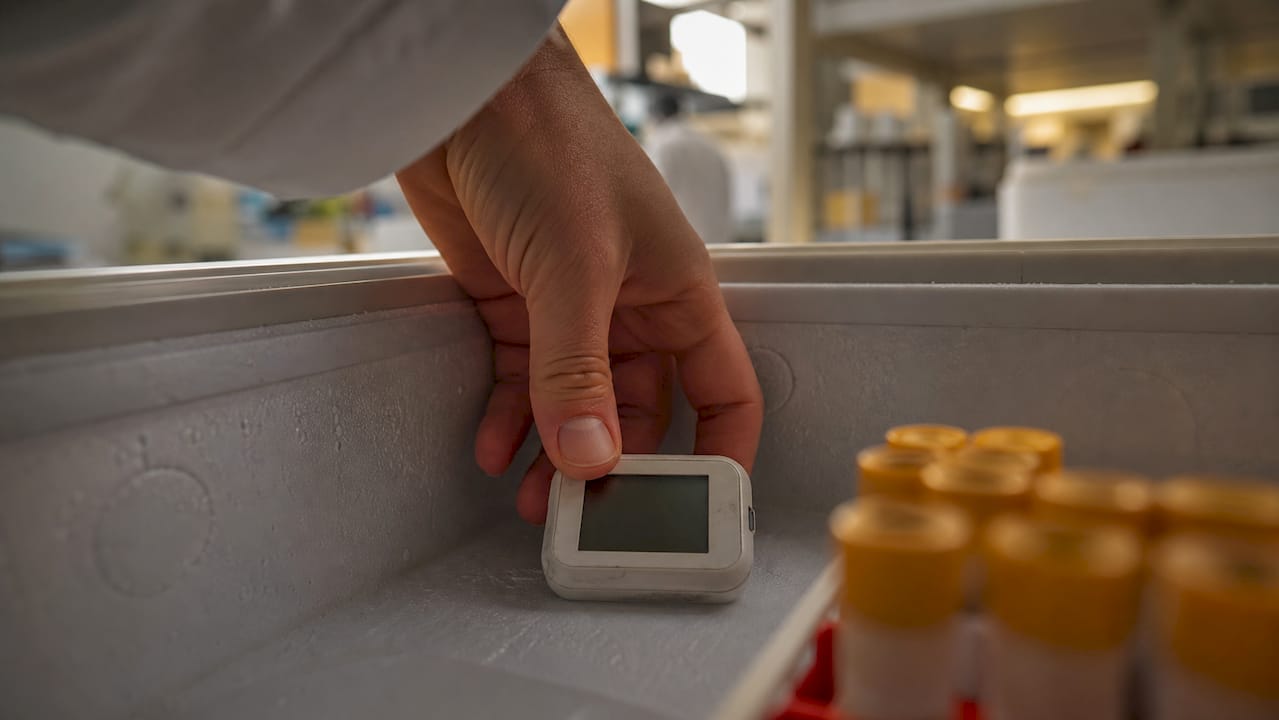
Continuous data logging integrated into a LIMS or provider portal converts that data into a defensible, audit-ready disposition record, a material benefit for clinical-trial operators managing multiple sites and analytes simultaneously.
Key U.S. and international standards that govern specimen cold chain
Every SOP governing biological specimen transport should reference at least the following standards and regulations. These are not optional background reading; they are the documents regulators, auditors, and sponsors will ask to see cited.
Standards to include in your SOPs:
- CDC Specimen Packing and Shipping Guidance: defines temperature descriptors (room 15–25°C, refrigerated 2–8°C, frozen ≤−20°C, ultra-low ≤−70°C), triple packaging requirements, and dry-ice handling instructions. The primary U.S. reference for clinical specimen packout.
- IATA Packing Instruction 650 (PI 650): governs air transport of Category B biological substances. Specifies packaging construction, UN3373 marking, and documentation requirements. Updated annually; always reference the current edition.
- 49 CFR 173.217 (DOT): U.S. hazardous materials regulations for dry ice (UN1845), including venting requirements, net-weight marking, and carrier quantity limits by mode.
- USP General Chapter <659> and GC1079.2: defines packaging and storage requirements and supply-chain temperature bands used across pharmaceutical and clinical laboratory contexts.
- CLSI PRE04: addresses preanalytical variables including specimen transport and storage; the standard labs cite when writing SOPs for sample handling and acceptance criteria.
- ISPE Good Practice Guide: Cold Chain Management: risk-based framework for integrating cold chain into regulated product and study lifecycles; directly applicable to clinical trial specimen logistics.
- ICH Q5C: stability guidance for biological products; informs validated temperature bands and acceptance criteria for biologic specimens and reagents.
SOPs should reference the edition year of each standard and assign a named role (quality manager or laboratory director) responsible for reviewing and updating references when new editions are published. For CLIA-certified laboratories, SOP currency is a direct inspection criterion.
Most common cold chain failures and how to prevent them
The three dominant failure modes in specimen cold chain logistics are time overruns, temperature excursions from packaging mismatch, and monitoring gaps. All three are process design problems, not bad luck.
Common failure scenarios and their mitigations:
- Specimen sits on a loading dock over a weekend. Mitigation: schedule shipments to arrive during the receiving lab's business hours; build a buffer into hold-time design so the packout can tolerate a 24-hour delay without exceeding limits.
- Dry ice load is undersized for the actual transit time. Mitigation: use vendor qualification data (ISTA 7D or equivalent) to determine coolant load; never estimate. Practical cold-chain shipping guides consistently identify undersized coolant as the leading cause of frozen-specimen excursions.
- Gel packs are frozen instead of pre-conditioned to 2–8°C. Mitigation: include gel-pack conditioning as a documented, timed step in the packout SOP; assign a named person responsible for confirming pack temperature before use.
- Logger is placed but not started, or placed against the cooler wall rather than adjacent to specimens. Mitigation: make logger activation and placement a checklist item with a sign-off; train staff on the difference between wall temperature and specimen temperature.
- Wrong coolant type for the specimen's temperature band. Mitigation: post a quick-reference chart at the packout station showing each analyte's required band and the approved coolant for that band.
- Carrier SLA not enforced; shipment routed through an unplanned hub. Mitigation: use carriers with documented temperature-controlled SLAs; include routing requirements in the carrier qualification record.
If your packout is validated for 48 hours and your carrier SLA is 24 hours, you have a meaningful safety margin for delays. If your validated hold time equals your transit time, any delay becomes an automatic excursion.*
How to validate your packaging and shipping methods
Validation is non-negotiable, and it must be designed around worst-case transit conditions, not average ones. A packout that performs at 20°C ambient will fail in a July tarmac hold at 38°C or a January overnight at −15°C.
ISPE's risk-based cold chain framework recommends integrating packaging validation into the regulated study or product lifecycle from the design phase, not as an afterthought before first shipment.
Validation protocol checklist:
- Define the specimen's required temperature band and the maximum acceptable excursion (duration and magnitude).
- Define worst-case ambient profiles: summer high (typically 38–40°C for U.S. ground transport) and winter low (typically −20°C or below for northern routes).
- Select calibrated instrumentation (data loggers with NIST-traceable calibration).
- Run qualification shipments with representative loads under both worst-case ambient profiles.
- Analyze the time-temperature profile from each run.
- Apply acceptance criteria and document pass/fail for each run.
- Retain all logger data files, calibration certificates, and the written validation report.
Example qualification metrics to record:
| Metric | What to Record | Acceptance Criterion Example |
|---|---|---|
| Mean temperature | Average interior temp over transit | Within validated band (e.g., 2–8°C) |
| Maximum excursion | Highest recorded temperature | Must not exceed upper limit |
| Minimum excursion | Lowest recorded temperature | Must not fall below lower limit |
| Time out of range | Total minutes outside validated band | Zero, or within stability-data tolerance |
| Coolant remaining | Dry ice weight or gel-pack condition at arrival | Sufficient reserve per SOP |
A minimum of three qualification runs per worst-case condition is a common industry standard, though your quality system and the risk level of the specimens may require more. Document the rationale for the number of runs in the validation report.
Pro Tip: Retain logger data files in their original format, not just printed summaries. Auditors and sponsors may request the raw data file to verify it has not been edited. A PDF printout alone is not sufficient for a regulated study.
SOP-level best practices: documentation, training, and LIMS integration
The top operational priorities for reproducible cold chain outcomes are current SOPs, trained personnel, carrier SLAs with documented qualification, and LIMS or portal integration that captures temperature data alongside specimen metadata.
SOP content checklist:
- Scope: which specimen types and temperature bands the SOP covers.
- Roles and responsibilities: who conditions specimens, who assembles the packout, who signs the chain-of-custody manifest, who qualifies new packout configurations.
- Temperature band and coolant type for each analyte covered.
- Step-by-step packout procedure with sign-off fields.
- Logger activation, placement, and data retrieval procedure.
- Acceptance criteria at receipt and disposition decision tree.
- Excursion reporting and corrective action procedure.
- References to current editions of CDC, IATA PI 650, USP, CLSI, and DOT standards.
Training and competency requirements:
- Initial training on packout procedures, logger operation, and chain-of-custody documentation before any staff member handles a specimen shipment independently.
- Annual competency assessment, documented with a sign-off.
- Retraining triggered by any excursion attributed to a packout or handling error.
- Site coordinators at clinical trial sites need the same training as central lab staff; hospital laboratory partner guides for CROs consistently identify site-level training gaps as a leading source of preanalytical errors.
LIMS integration:
Integrating temperature logger data and shipment metadata into your LIMS or provider portal converts cold chain records from paper files into searchable, audit-ready data. Key integration points:
- Shipment ID linked to specimen accession numbers.
- Logger data file attached to the shipment record at receipt.
- Disposition decision (accept/reject) recorded with timestamp and responsible staff ID.
- Excursion events flagged automatically for quality review.
For lab testing optimization across single or multi-specialty practices, LIMS integration of cold chain data reduces manual reconciliation time and creates a defensible audit trail without additional administrative burden.
How Kohealth Labs supports specimen cold chain as an integrated diagnostics partner
Kohealth Labs integrates laboratory diagnostics, radiology, and AI-ready data delivery into a single-contract model, which directly reduces the cold chain complexity that comes from managing multiple vendors across a clinical trial or healthcare program.
For CROs, sponsors, and healthcare organizations, the practical cold chain capabilities Kohealth Labs brings include:
- Courier specimen pickup with documented chain-of-custody from the collection site, removing the coordination burden from site staff.
- Validated packouts aligned to each analyte's required temperature band, so specimens arrive within specification.
- Temperature monitoring integrated into the shipment workflow, with data captured and linked to specimen records in the provider portal.
- LIMS and portal integration that connects shipment metadata, logger data, and test results in a single, audit-ready record, supporting faster disposition decisions and trial timelines.
- AI-driven data quality checks that flag deviations, including potential cold chain impacts on result plausibility, before data is delivered to sponsors.
- Coverage across 100+ biomarkers and genomics panels, including analytes that require ultra-low temperature handling, managed under a single contract rather than split across specialty vendors.
The Kohealth Labs integrated diagnostics model is designed specifically to reduce the turnaround time and compliance complexity that multi-vendor specimen logistics creates. When cold chain data, lab results, and radiology findings are delivered as a single analysis-ready bundle, sponsors and CROs spend less time reconciling data and more time making decisions.
Pro Tip: Embed cold chain requirements into your study design and site selection process, not just your logistics SOP. A site that cannot reliably condition and package specimens to your protocol's temperature band will generate redraws regardless of how good your carrier SLA is. Kohealth Labs' onboarding process includes site-level packout review for exactly this reason.
Environmental considerations and sustainability in specimen cold chain logistics
Specimen cold chain logistics generates measurable environmental impact, primarily through single-use EPS foam coolers, dry ice sublimation (CO₂ release), and the fuel consumption of temperature-controlled transport. Labs and CROs increasingly face pressure from sponsors, institutions, and regulatory bodies to address this without compromising specimen integrity.
Practical sustainability measures that do not require sacrificing cold chain performance:
- Reusable thermal shippers: PUR and VIP-based shippers designed for return and reuse reduce per-shipment foam waste significantly. Several vendors offer validated reusable systems with documented hold-time performance equivalent to single-use alternatives.
- Right-sizing coolant loads: over-packing dry ice is both a safety concern and an unnecessary CO₂ source. Qualification data allows you to use the minimum effective coolant load rather than defaulting to excess.
- Dry ice alternatives for refrigerated shipments: phase-change materials (PCMs) calibrated to 2–8°C eliminate dry ice entirely for refrigerated packouts and are reusable after reconditioning.
- Carrier route optimization: consolidating shipments and selecting carriers with optimized routing reduces fuel consumption per specimen. Coordinating pickup schedules with courier routes rather than using on-demand shipping is a simple operational change with a real environmental benefit.
- Packaging take-back programs: some insulated shipper manufacturers offer take-back and recycling programs for EPS foam. Participating in these programs diverts material from landfill without requiring a switch to a new packaging system.
Sustainability improvements should be validated before implementation. A reusable shipper that has not been qualified to your worst-case transit profile is a compliance risk, not a green win. Document the environmental rationale alongside the performance data in your validation report so both objectives are on record.
The cold chain decisions that actually determine trial outcomes
Most cold chain failures are not shipping failures. They are design failures that show up during shipping. The packout was never validated to the worst-case ambient. The coolant load was estimated, not qualified. The logger was placed against the cooler wall, not adjacent to the specimens. The site coordinator was trained once at study startup and never assessed again.
The conventional approach to specimen cold chain treats it as a logistics problem to solve after the protocol is written. That framing is backward. Cold chain requirements should be embedded in study design, site qualification, and vendor selection before the first specimen is collected. A site that cannot reliably condition and package specimens to the protocol's temperature band will generate redraws at a rate that no carrier SLA can fix.
The other underappreciated priority is monitoring data integration. A temperature logger that produces a PDF at receipt is useful. A logger whose data flows directly into a LIMS record linked to the specimen's accession number is a quality system asset. The difference between those two states is not technology; it is whether the organization decided that cold chain data is part of the specimen record or a separate paper file.
Integrated diagnostics, where lab results, radiology, and cold chain metadata are delivered as a single analysis-ready bundle, is not a convenience feature. For a CRO managing 30 sites across multiple time zones, it is the difference between a database lock that happens on schedule and one that slips because someone is still reconciling temperature records from a site in the Pacific Northwest.
Kohealth Labs delivers integrated cold chain and diagnostics for CROs and clinical programs
Cold chain reliability and diagnostic data quality are inseparable in clinical research. Kohealth Labs gives CROs, pharmaceutical sponsors, and healthcare organizations a single contract that covers courier specimen pickup, validated cold chain packouts, temperature-monitored transport, and AI-verified analysis-ready data bundles, including lab results, radiology, and 100+ biomarker panels.

Where multi-vendor logistics creates gaps between collection, transport, and data delivery, Kohealth Labs closes them. Temperature data, specimen metadata, and test results arrive together in one portal-accessible record, so your team makes disposition and enrollment decisions faster, with full audit support.
To see how Kohealth Labs can support your next trial or clinical program, contact the Kohealth Labs team or review the specialty testing and biomarker panel coverage to confirm your analyte requirements are covered before your first shipment.