

Data reconciliation in a clinical or diagnostic lab is the process of comparing lab-generated results against site, EDC, and sponsor records to confirm they describe the same specimen, patient, and result value. The outcome is analysis-ready data: mismatches flagged, materiality thresholds applied, clinically significant exceptions signed off by a human, and every resolution logged in an audit trail a regulator can follow.
TL;DR:
- Most common reconciliation failures stem from mismatched sample IDs, units, and code mapping issues that can often be fixed through normalization and review tables.
- Defining clear roles and escalation pathways for discrepancy triage ensures prompt resolution of clinically significant issues within established service-level agreements.
- Automated tools like rule engines, AI-assisted triage, and integration connectors speed up volume handling but require human oversight for critical decisions.
- Reducing vendor handoffs by consolidating diagnostic services under fewer contracts drastically decreases data mismatches and simplifies reconciliation.
- Maintaining detailed audit trails, version histories, and proper controls ensures data integrity and compliance with regulatory standards like GCP and 21 CFR Part 11.
What Is Data Reconciliation in Clinical Lab Data Management?
Data reconciliation, in a clinical or diagnostic context, means confirming that laboratory result sets match the corresponding case report form entries, specimen requisitions, and electronic data capture (EDC) records for every subject and visit. It is narrower than general data validation. A validation check asks "is this value plausible?" Reconciliation asks "does this value match its counterpart in another system?"
The PMC review on third-party laboratory data management frames this as an ongoing responsibility during study conduct, not a one-time cleanup pass, with discrepancies resolved directly with the laboratory vendor rather than guessed at internally.
Most reconciliation programs follow a version of the same six-step workflow, adapted from general data reconciliation practice:
- Extract result sets and reference data from the LIMS, EDC, and site systems.
- Standardize formats, units, and identifiers so records can be compared on equal terms.
- Compare matched records field by field against defined tolerances.
- Triage discrepancies by severity and likely cause.
- Resolve each exception with the source system or lab vendor and document the fix.
- Validate and log the resolution in an audit trail tied to the original discrepancy.
Materiality thresholds matter here. Not every rounding difference deserves a query. Reserving investigation time for variances that could affect a clinical endpoint keeps reconciliation teams from drowning in noise.
Where Lab Reconciliation Breaks: Sample IDs, Units, and LOINC Mapping
Most reconciliation failures trace back to a handful of data elements that carry more weight than their size suggests. A single mistyped specimen ID can orphan an entire result set from its subject record.
- Sample and specimen IDs — transcription errors or barcode misreads disconnect a result from its subject.
- Collection date and time — time zone drift or manual entry lag can misalign a result with the wrong visit window.
- Site ID and kit batch number — mismatches here complicate root-cause analysis when a reagent lot is later flagged.
- Units of measure and reference ranges — a lab reporting glucose in mg/dL against a system expecting mmol/L looks like a clinical anomaly when it is really a conversion gap.
- LOINC and SNOMED mapping — inconsistent code mapping across labs makes the same analyte look like two different tests in downstream analytics.
Unit and reference-range mismatches are usually the easiest fix and the most common source of false alarms. Normalizing units at ingestion, before comparison, eliminates a large share of these before a human ever sees them. LOINC mapping is a harder problem: two labs may both use LOINC codes but map a single analyte differently, especially with reflex or panel tests. Consistent mapping tables, reviewed whenever a new lab vendor is added, are the only durable fix.
Pro Tip: Build your unit-normalization and LOINC-mapping tables before the first data extract lands, not after your first reconciliation exception report comes back full of false positives.
How Does the Laboratory Reconciliation Process Actually Run?
Reconciliation works best as a defined process with named owners at each handoff, not a shared spreadsheet everyone edits. Ambiguity about who resolves what is where discrepancies stall for weeks.
A workable role structure looks like this:
- Lab technician or lab data manager confirms the raw result extract matches internal LIMS records before it ever leaves the vendor.
- Clinical data manager (CDM) runs the cross-system comparison against EDC and flags exceptions.
- Biostatistics or medical monitoring reviews exceptions above the materiality threshold, particularly anything touching a primary or safety endpoint.
- Sponsor or CRO data lead signs off on the final resolution and closes the audit record.
Exception triage should sort discrepancies into three tiers on discovery: administrative (typos, formatting), clinically neutral (units, timing within tolerance), and clinically significant (result value discrepancies affecting safety or efficacy data). The PMC review is explicit that discrepancy resolution belongs with the laboratory vendor rather than being patched internally. Escalation paths should route clinically significant items to medical monitoring within a defined window, not sit in a general query queue.
Recommended SLA targets vary by discrepancy class, but a reasonable baseline looks like:
- Administrative discrepancies: generally resolved promptly within a few business days.
- Unit or format mismatches: resolved quickly once normalization rules exist.
- Clinically significant discrepancies: escalated urgently and resolved within a reasonable time depending on complexity.
Every resolution needs a captured audit trail entry with the original discrepancy, the investigation notes, the source of the correction, the approver's name, and the timestamp. Reducing protocol deviations at the site level, discussed in detail here, cuts the volume of exceptions reaching this stage in the first place.
Is Data Integration the Same as Data Reconciliation?
No. Integration moves and transforms data between systems; reconciliation confirms the moved data still means the same thing on both sides. A pipeline can integrate perfectly, mapping every field correctly, and still carry a reconciliation failure if the source data itself disagreed with another system before ingestion ever happened.
The practical distinction shapes where checks belong in your pipeline:
- Ingest-time sanity checks catch structural problems: missing fields, malformed dates, out-of-range values. These belong inside the integration layer, run automatically on every load.
- Pre-analysis reconciliation catches semantic problems: a result that loaded cleanly but contradicts the site's recorded value. These belong as a distinct gate before any dataset moves to biostatistics.
Treating reconciliation as integration's final step, rather than a separate discipline, is a common mistake. It causes teams to skip discrepancy investigation because "the data loaded fine." A well-run pipeline also uses reconciliation output as a lineage check, confirming that transformation logic itself hasn't quietly introduced drift between source and target over successive builds. API integration guidance for labs covers the connector layer where both disciplines meet.
What Tools Actually Automate Data Reconciliation?
Reconciliation tooling falls into a few functional categories, and most mature programs use more than one together.
- Rule engines apply deterministic comparison logic (tolerances, unit conversions, field matching) at scale across large result sets.
- Reconciliation-as-code frameworks define equivalence contracts in version-controlled code, then execute repeatable checks that produce auditable proof of source-target equivalence, an approach the Recon Core framework illustrates well for pipeline-heavy environments.
- AI-assisted exception triage ranks discrepancies by likely severity and surfaces patterns a rule engine alone would miss, such as a batch-level shift across many records rather than one bad value.
- Connectors to LIMS, HL7/FHIR interfaces, and EDC platforms feed the comparison layer without manual export cycles.
Automation buys speed on volume, not judgment on ambiguity. Analysis on AI in risk and compliance workflows makes the case plainly: AI accelerates discrepancy identification but should not make the final call on anything clinically significant. Build in explainability (why was this flagged?), full auditability of every automated decision, and a mandatory human-in-the-loop step for exceptions above your materiality line.
Pro Tip: Test any reconciliation tool against a batch of known historical discrepancies before trusting it on live data. If it misses the ones you already know about, it will miss new ones too.
Building a Data Reconciliation Checklist for Your Lab
A short, disciplined checklist beats a lengthy SOP nobody rereads. Minimum fields to capture for every reconciliation record include subject ID, specimen ID, source system, target system, discrepancy type, materiality tier, resolution action, approver, and timestamp.
Setting materiality thresholds works best with a risk-based approach: rank discrepancy types by potential clinical impact, then set tolerance bands tighter for safety and efficacy endpoints than for demographic or administrative fields. A risk-based threshold model prevents teams from spending review hours on variances that will never affect a trial conclusion.
Core checklist items:
- Define minimal required fields for every reconciliation log entry.
- Set materiality thresholds by data category before the first extract runs.
- Assign named owners for extract, compare, triage, and sign-off steps.
- Track KPIs: discrepancy rate per 1,000 records, mean time to resolution, and percentage of exceptions closed within SLA.
- Review dashboards weekly during active enrollment, monthly during follow-up phases.
- Log every automated flag and every human override, not just final resolutions.
On thresholds: teams that skip a risk-based materiality model tend to treat every variance the same, which either buries reviewers in low-value queries or lets a genuinely significant discrepancy slip through unnoticed among hundreds of trivial ones.
Vendor evaluation matters here too. Choosing a lab partner with documented SOPs and clean audit history reduces the reconciliation burden before data ever reaches your desk, a point covered in more depth in this regulatory compliance evaluation guide.
How Reconciliation Evidence Satisfies GCP and 21 CFR Part 11
Auditors don't just want clean data. They want to see how it got clean, and reconciliation records are often the clearest evidence trail in a trial's data package.
ICH E6 Good Clinical Practice guidance sets expectations for data integrity and documentation that reconciliation output should directly support: every discrepancy traceable, every resolution attributable to a named reviewer, every change timestamped. An auditor reviewing a reconciliation package typically expects:
- A complete discrepancy log, not just a summary of closed items.
- Attribution for every resolution: who approved it and on what basis.
- Version history showing what the data looked like before and after correction.
- Retention of the raw pre-reconciliation extract alongside the final dataset.
Practical 21 CFR Part 11 controls that support this include electronic signature requirements on final sign-offs, system-generated timestamps that can't be manually edited, and access controls limiting who can alter a closed reconciliation record. Retain both raw and reconciled datasets for the study's full retention period, and version every reconciliation ruleset change so an auditor can reconstruct exactly which tolerance rules applied to which batch of data.
How Integrated Diagnostics Cuts Reconciliation Work Before It Starts
The fastest way to reduce reconciliation burden is to reduce the number of vendor handoffs generating mismatches in the first place. When lab results, imaging data, and specimen logistics all run through one contract instead of three separate vendors, there are fewer seams where sample IDs, units, or timestamps can drift apart.
- A single-contract model for labs, radiology, and data delivery means one set of identifiers travels with a specimen from collection to result, instead of being re-keyed at every vendor boundary.
- AI-assisted pre-analytical QA can catch batch-level anomalies, like a reagent lot drift across dozens of samples, before they ever reach a reconciliation queue, with documented error reductions in the 60 to 70% range for the routine errors it targets.
- Human review still governs anything clinically significant; AI narrows the queue, it doesn't close it.
A diagnostics model built around this logic reduces vendor seams, maintains cleaner identifiers, and uses pre-analytical AI QA to filter routine issues, allowing human reviewers to focus on clinically significant exceptions.
Why Fewer Vendor Handoffs Beat Better Reconciliation Tools
The reconciliation tooling conversation tends to fixate on smarter matching algorithms and faster triage dashboards. That's useful, but it treats the symptom. Every discrepancy traced back far enough starts at a handoff: a specimen moving from courier to lab, a result moving from LIMS to EDC, an imaging file moving from radiology to the sponsor's data warehouse. Each handoff is a chance for an identifier to drift or a unit to get misread.
The uncomfortable truth is that a lot of reconciliation effort is really vendor-seam management wearing a data science costume. Teams that invest heavily in triage automation while leaving five separate vendor contracts in place are treating a structural problem with a tooling patch. Consolidating diagnostic services under fewer contracts does more to shrink the discrepancy count than any rule engine upgrade, because it removes the seams rather than getting faster at patching them. AI has a real role here, but only as a filter that narrows what humans review, never as the final word on a clinically significant flag.
— Kohealth Labs
Fewer Vendors, Cleaner Data: The Kohealth Labs Approach
An alternative to juggling separate lab, imaging, and data vendors for trial data is offered by an integrated diagnostics approach: one contract, one set of specimen identifiers, and analysis-ready data bundles instead of multiple reconciliation queues to manage. Integrated diagnostics that combine labs, radiology, and data delivery under a single agreement remove the vendor seams where most discrepancies originate, and AI-assisted pre-analytical QA filters out routine errors before they reach a reconciliation team, with a human review step on anything clinically significant.
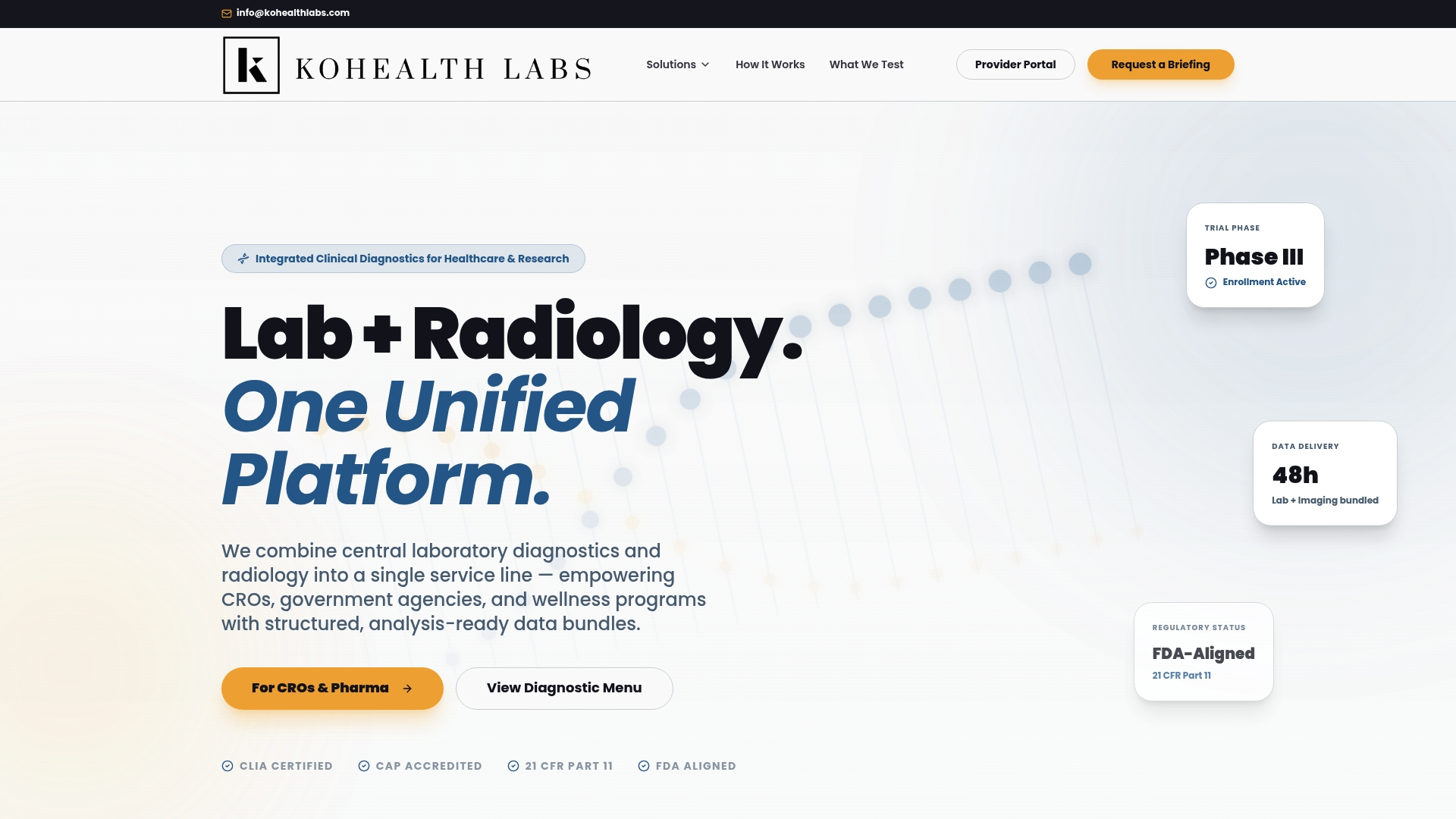
For CROs and sponsors evaluating how to cut reconciliation overhead before the next study starts, Kohealth Labs' integrated diagnostics solutions for CROs and pharma cover lab, imaging, and analytics across more than 100 biomarkers under one contract. If specimen handling and pathology data delivery are your immediate concern, the pathology laboratory services page outlines how specimen logistics and result delivery connect directly to your reconciliation pipeline. Reach out to discuss your current vendor setup and see where consolidation would remove the most friction.