
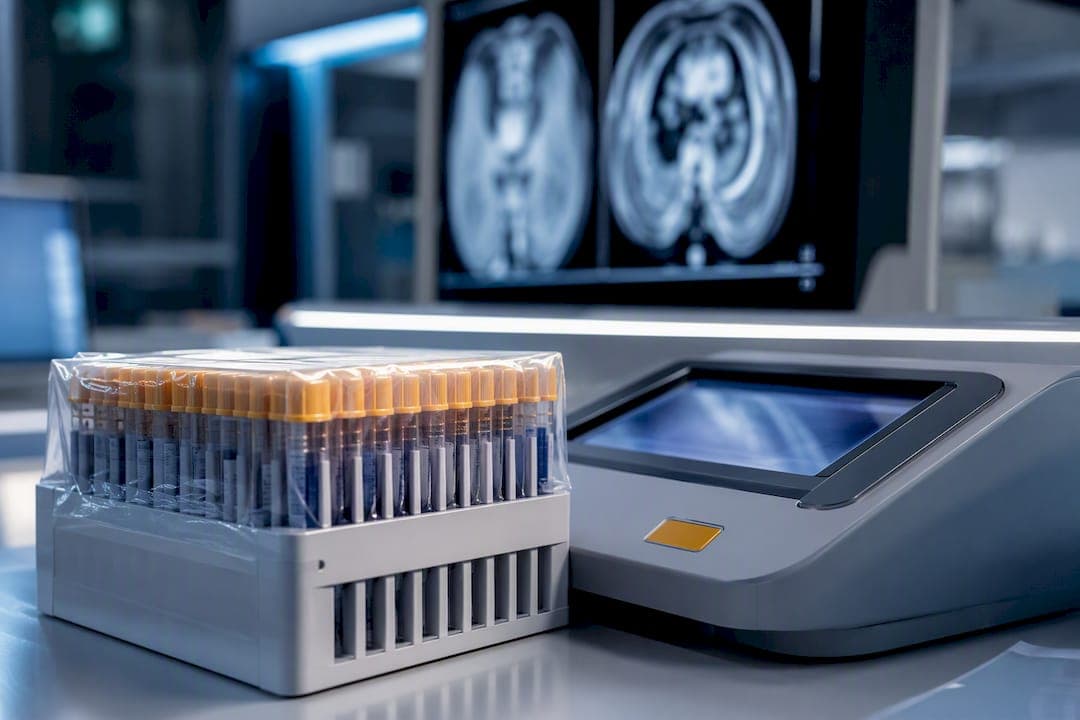
Electronic lab ordering, in the integrated diagnostics context, means placing and executing protocol-driven orders that deliver linked lab and imaging data as analysis-ready bundles for clinical research. Rather than juggling separate vendors for phlebotomy, imaging, and data reconciliation, sponsors and CROs route a single order through a system that manages collection, processing, and delivery as one coordinated event. One provider is built around this model, and the guidance below is written for teams evaluating whether to adopt it.
TL;DR:
- Proper standards for DICOM, LIMS identifiers, HL7/FHIR, and unit consistency are essential to avoid delays and inaccuracies in integrated data workflows.
- AI functions are most effective as anomaly detection tools with validated, monitored use cases, rather than fully automated decision-makers in data quality checks.
- Measuring KPIs such as turnaround time, reconciliation events, and query speed before and after implementation provides clear evidence to justify adopting integrated diagnostics.
- A single vendor capable of managing specimen collection, imaging, and data integration under one contract streamlines processes and cuts down on delays compared to multiple vendor setups.
What Electronic Lab Ordering Covers (and What It Doesn't)
This workflow involves several coordinated actors: the sponsor or CRO issuing the protocol, a central lab partner, patient service centers (PSCs) drawing specimens, imaging sites capturing scans, couriers moving samples, and the clinical data warehouse (CDW) or analytics team receiving the final output. Each plays a defined role in a chain that ends with one integrated dataset rather than scattered reports.
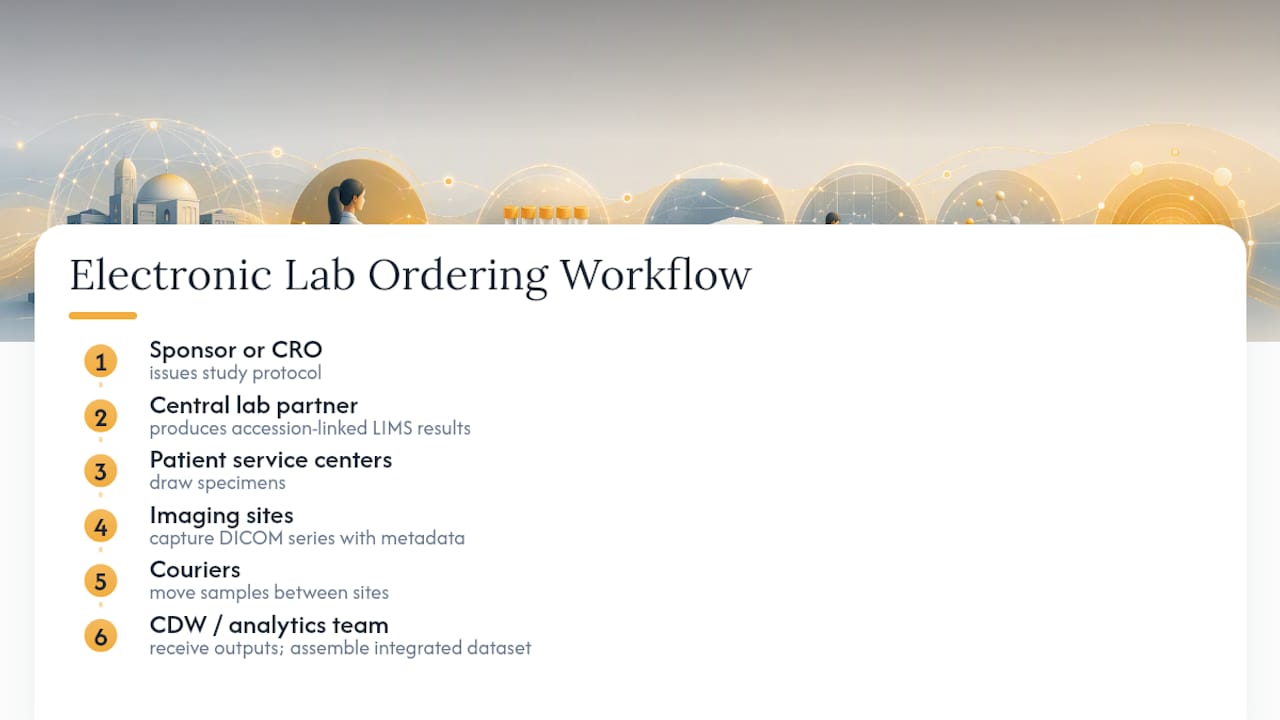
The core deliverables are accession-linked LIMS results, DICOM image series with full metadata, and a combined manifest that ties both to the same subject and visit. A mature setup delivers these as an analysis-ready dataset rather than raw files requiring manual assembly.
This is distinct from EHR CPOE modules that let clinicians create and transmit routine lab orders inside a hospital system. That is a clinician-facing workflow for individual patient care. Electronic lab ordering for integrated diagnostics is a sponsor-facing service layer built for trials, registries, and population health programs, where the goal is aggregated, protocol-driven data at scale, not a single chart entry.
How Does the Order-to-Data Workflow Actually Run?
The mechanics matter more than the label. Here's how a well-run integrated order typically moves from protocol to dataset:
- Protocol mapping. The lab and imaging requirements from the protocol get translated into specific order fields, required visit windows, and an accession numbering scheme that will follow the specimen and image through every downstream step.
- Collection and labeling. PSCs or mobile phlebotomists draw specimens using standardized labels and chain-of-custody documentation, a step where inconsistent sample labeling causes most downstream reconciliation headaches.
- Courier handoff and tracking. Specimens move to the lab under temperature and time controls, with tracking events logged at each transfer point.
- Lab and PACS ingestion. Results land in the LIMS while imaging lands in PACS, each running automated quality checks; AI-driven tools flag anomalies for human review rather than auto-resolving them.
- Bundle assembly and delivery. The final package ships as a manifest, API feed, or direct CDW extract, with lab values and imaging series linked at the accession level.
Pro Tip: Ask any prospective vendor to walk through accession numbering before anything else. If they can't explain how a single ID ties a blood draw to an MRI series months later, reconciliation will become your team's full-time job.
Data Interoperability: What Standards Actually Need to Line Up?
Linking lab and imaging data reliably depends on a small set of technical requirements that too many procurement teams skip past. Get these wrong and every feasibility query downstream becomes a manual reconciliation project.
- DICOM metadata mapping, so Series Instance UIDs and study identifiers can be joined to patient and encounter records rather than sitting in a separate imaging silo.
- LIMS identifiers consistent enough that a lab value and an imaging series can be queried together without a human matching spreadsheets by hand.
- HL7/FHIR support where the receiving system (a sponsor's CDW, a registry, an EMR) expects structured exchange rather than flat files.
- Unit and terminology harmonization, since a biomarker reported in different units across sites will corrupt pooled analysis even when every other field matches.
Practitioners mapping imaging and lab metadata to the patient-encounter level, rather than at the file or document level, avoid the manual reconciliation delays that plague looser architectures.
The payoff is measurable. Research on combined CDW-PACS querying found that mapping DICOM metadata directly into a clinical data warehouse increased returned results for multilevel queries by 112% to 573% compared to querying imaging and lab data separately. That is the difference between a feasibility query that runs in minutes and one that requires a data analyst's afternoon.
What Role Should AI Play in Data Quality Checks?
AI in this pipeline works best as a detection layer, not a decision maker. Common functions include anomaly detection across lab values, timestamp clustering to catch data entry irregularities, pre-analytic quality checks on specimen viability, and recruitment stratification against feasibility criteria.
Governance is where sponsors should focus their diligence, not the algorithm's marketing copy. Look for:
- A documented intended-use statement for each AI function, not a generic "AI-powered" claim.
- Defined acceptance criteria and a validation record tied to that specific use case.
- Post-deployment monitoring with drift detection, since a model validated at launch can degrade as site mix changes.
- A documented escalation pathway showing exactly who reviews a flagged anomaly and how fast.
Frameworks like IVEL and GAMP call for risk-proportional validation and human oversight rather than treating AI as a black box that runs unsupervised. Automated audit-trail analysis, including timestamp clustering to spot integrity issues, consistently outperforms periodic manual spot-checks for catching problems early.
Pro Tip: Request a sample of flagged-versus-cleared anomalies from a live study during vendor evaluation. A vendor with real human-in-the-loop review will have this on hand; one relying on marketing claims usually won't.

Which KPIs Prove the Model Is Working?
A pilot is only useful if you measure the right things before and after switching models. Track these against your current vendor setup:
- End-to-end turnaround time, from order placement to delivered analysis-ready bundle.
- eCRF pre-population rate, since automated feeds should reduce manual data entry substantially.
- Reconciliation events per 1,000 samples, a direct proxy for how much staff time reconciliation consumes.
- Sample tracking accuracy across courier handoffs.
- Feasibility query speed for combined lab-imaging cohorts.
The market signal supports the shift toward this model: a Bio Pharma Dive survey found roughly 80% of industry practitioners are likely to outsource diagnostic testing to partners offering broad PSC networks and automated workflows. Running a 60 to 90 day pilot against these five KPIs, benchmarked against your current baseline, gives a defensible business case for a full switch.
What Documentation Does This Need for GxP Review?
An inspector or auditor will ask for specific artifacts, and a vendor without ready answers is a warning sign, not a minor gap. Build these into your RFP language directly:
- A validation plan for every AI function touching the data, scoped to its actual use, not a blanket statement.
- Audit trails demonstrating ALCOA+ conformity: attributable, legible, contemporaneous, original, accurate, plus the newer additions of complete, consistent, enduring, and available.
- De-identification policies covering both lab and imaging data, since imaging metadata often carries hidden identifiers text-based de-identification tools miss.
- Change-control and modification protocols, showing how a model update or lab process change gets documented and re-validated.
Sponsor oversight remains the accountable function here regardless of how much a vendor automates. Contract language should require these documents as deliverables, not as available-upon-request items.
How Should You Evaluate a Vendor's Actual Readiness?
Score any prospective partner against four practical checks:
- Single-contract capability: can they deliver specimen collection and imaging under one agreement, or are you stacking two vendor relationships and calling it integrated?
- Accession-level linking: ask them to demonstrate, live, a combined feasibility query joining lab and imaging fields for a real cohort.
- Evidence on file: validation artifacts, sample audit trails, and stated SLAs for turnaround time and data completeness, not just promised ranges.
- Red flags: opaque AI validation claims, no clear accession linkage between systems, or no stated GxP pathway for how their AI functions get reviewed.
Pro Tip: During the vendor call, ask them to run a feasibility query live combining an imaging finding with a lab threshold. Watching them attempt it tells you more about their actual data model than any slide deck will.
Why This Model Deserves More Attention From Sponsors
The industry still treats lab ordering and imaging as separate procurement tracks, and that habit is costing trials time they don't have. Every reconciliation event between a LIMS export and a PACS extract is a delay that traces back to a decision made months earlier, when someone signed two contracts instead of one. This model is built on the premise that a single-contract model with AI-driven quality checks removes that friction at the source rather than patching it downstream. [Author credentials and case study placeholder]. If your team is drafting an RFP for your next trial or wellness program, request a pilot or an RFP template before you finalize vendor scope.
— Kohealth Labs
Get Analysis-Ready Data Without the Vendor Juggling
Running lab orders through one vendor and imaging through another means two contracts, two turnaround clocks, and a reconciliation team stitching the results together by hand. This approach replaces that with a single-contract model covering phlebotomy, imaging, and AI-driven data quality checks, delivered as one analysis-ready bundle instead of two files that need matching up.
Integrated diagnostics, covering labs, radiology, and data together, is what shortens the distance between specimen collection and a decision-grade dataset your team can actually analyze. That's the core promise behind combining lab and imaging services under one contract rather than coordinating separate vendors on separate timelines. If your team is scoping a trial, a government health program, or a telehealth diagnostic panel, start by reviewing Kohealth Labs' integrated diagnostics solutions or request a feasibility demo through the pathology and laboratory services page to see how a pilot would run against your current KPIs.