

End-to-end diagnostic trial support is defined as the full lifecycle management of a diagnostic clinical study, integrating every phase from protocol development to final regulatory reporting within a single, unified service model. The industry term for this approach is "full-service diagnostic trial management," and it applies specifically to in vitro diagnostic (IVD) and companion diagnostic trials governed by frameworks such as IVDR, FDA 510(k), and ISO 20916. For clinical researchers and trial coordinators, this model replaces fragmented vendor arrangements with one consolidated structure that covers scientific, regulatory, and operational functions. Kohealth Labs operates within this model, combining laboratory services, radiology, and AI-driven data management to deliver analysis-ready data bundles for CROs and pharmaceutical sponsors.
What is end-to-end diagnostic trial support, and what phases does it cover?
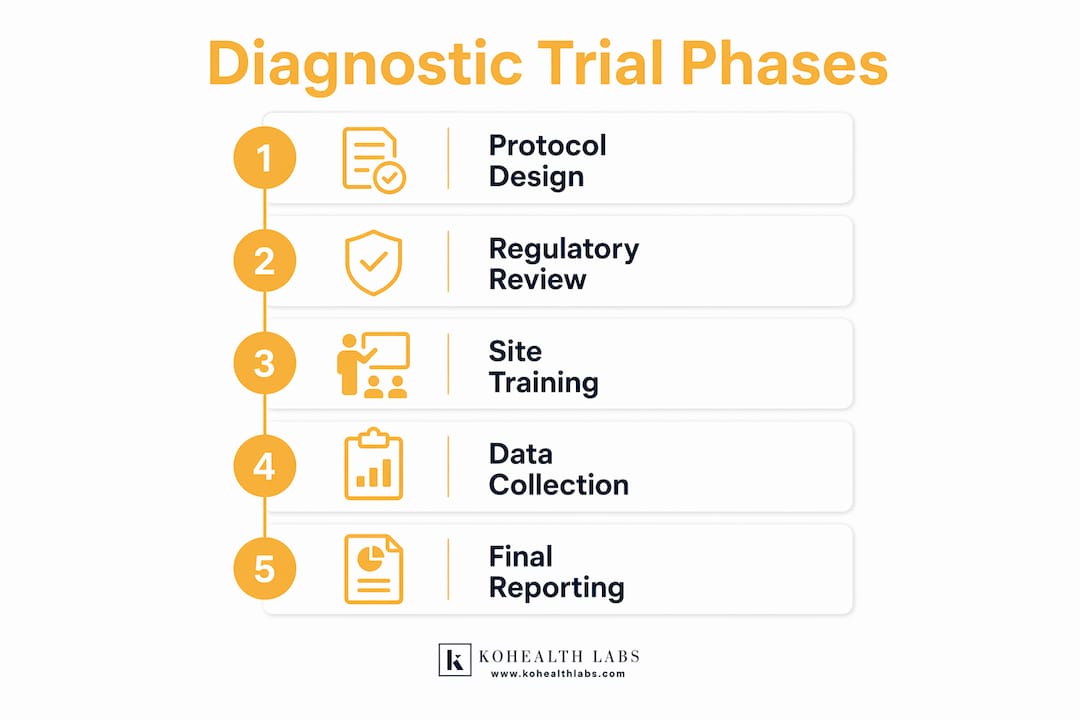
End-to-end diagnostic trial support covers every stage of a study's life, from the first protocol draft to the final submission package. Each phase integrates scientific, regulatory, and logistical functions so that no handoff between vendors creates a gap in data or compliance. That integration is what separates this model from the traditional approach of hiring separate vendors for laboratory work, radiology, regulatory consulting, and data management.

The table below maps each phase to its core services.
| Phase | Core services |
|---|---|
| Protocol design | Clinical objective setting, endpoint selection, statistical plan |
| Regulatory planning | Pathway selection (510(k), PMA, IVDR Article 58), submission strategy |
| Site feasibility and activation | Infrastructure assessment, contract execution, ethics approvals |
| Investigator training | Specimen handling, assay protocols, GCP and ISO 20916 orientation |
| Specimen logistics | Collection kits, cold chain management, chain-of-custody documentation |
| Data collection and management | EDC setup, real-time data cleaning, quality assurance |
| Monitoring | On-site and remote visits, protocol deviation tracking |
| Final reporting | Clinical performance summary, regulatory submission package |
One detail that surprises many trial coordinators: endpoint selection must relate to patient management decisions, not just technical accuracy. A test that performs well analytically can still fail regulatory review if its endpoints do not demonstrate clinical utility. Defining this early, during protocol design, prevents costly amendments later.
Pro Tip: Map every phase transition in your project plan before site activation begins. The most common delays occur at handoffs between protocol finalization and regulatory submission, not within phases themselves.
How does regulatory compliance integrate into diagnostic trial support?
Regulatory compliance is not a final checkpoint in diagnostic trial management. It is embedded at every phase, starting with pathway selection. The three primary pathways for diagnostic devices are FDA 510(k) for substantial equivalence, De Novo for novel low-to-moderate risk devices, and PMA for high-risk devices. In the EU, Performance Study Applications under IVDR Article 58 govern interventional clinical performance studies. Misalignment between intended use and the chosen regulatory pathway is one of the most frequent causes of trial delays, and it is entirely preventable with early planning.
Good Clinical Practice standards apply to diagnostic trials, but they must be supplemented with ISO 20916 compliance specific to clinical performance studies of IVD devices. ISO 20916 defines how to design studies, select reference methods, and report results for IVDs. Teams that treat GCP alone as sufficient often discover gaps during regulatory review.
In Great Britain, IVD-inclusive trial applications must be submitted through IRAS with a diagnostic device checklist and complete analytical performance data. The MHRA enforces a strict 60-day response timeline. Failure to respond within that window results in automatic rejection of the application, with no grace period.
Compliance best practices for trial coordinators:
- Flag IVD use explicitly in all regulatory submissions from the first contact with the authority.
- Submit complete analytical performance data upfront, not as a follow-up document.
- Assign a dedicated regulatory contact who monitors inquiry timelines and escalates at day 45, not day 59.
- Align endpoints with clinical outcomes during protocol design, before regulatory submission.
- Document all protocol amendments with a clear regulatory rationale to support the submission record.
Pro Tip: Request a pre-submission meeting with the FDA or a Scientific Advice meeting with the relevant EU notified body before finalizing your protocol. These meetings cost time upfront but eliminate the most expensive surprises downstream.
What are the data management challenges in integrated diagnostic trials?
Operational data management is the primary bottleneck in diagnostic trials, not the science. Sponsors consistently find that aggregating and standardizing data from multiple diagnostic sources, including central labs, local labs, and radiology, creates more friction than the underlying biology. When each source uses a different data format, reconciliation becomes a manual, error-prone process that slows the entire study.
The solution is a unified data platform that delivers real-time, analysis-ready visibility across all diagnostic streams. Integrated data management eliminates "black box" vendor practices by giving sponsors direct access to operational data as it is collected. That transparency allows trial coordinators to catch deviations early, before they compound into protocol violations or regulatory findings.
Effective diagnostic data management follows a clear sequence:
- Define data standards before site activation. Agree on units, reference ranges, and file formats for every diagnostic modality in the study.
- Configure the EDC system to match the protocol's data collection schedule, including all diagnostic windows and specimen types.
- Implement automated range checks and logic queries at the point of data entry to catch errors in real time.
- Establish a data cleaning schedule, with query resolution targets tied to the monitoring visit calendar.
- Run interim data quality audits at pre-specified intervals, not only at database lock.
- Maintain a single audit trail that covers laboratory results, radiology reads, and clinical assessments in one system.
Kohealth Labs applies AI-driven quality checks across its data and analytics platform to identify deviations automatically. That approach reduces the manual review burden on trial coordinators and shortens the time between data collection and clean database availability.
How does site selection and monitoring improve diagnostic trial outcomes?
Site readiness determines data quality before the first participant is enrolled. A site with the right equipment but undertrained staff will produce unreliable specimen data. A site with experienced staff but inadequate cold chain infrastructure will compromise assay validity. Feasibility assessments for diagnostic trials must evaluate both dimensions simultaneously, not sequentially.
The table below summarizes the key elements of site support and monitoring in a full-service diagnostic trial.
| Support element | What it covers |
|---|---|
| Infrastructure assessment | Equipment calibration, cold chain capacity, laboratory accreditation status |
| Regulatory readiness | Ethics approvals, local IVD regulations, site-specific consent forms |
| Investigator training | Specimen collection technique, assay handling, chain-of-custody procedures |
| Ongoing monitoring | Protocol adherence, data entry accuracy, specimen integrity checks |
| Research-naïve site support | Dedicated site coordinator, increased monitoring frequency, on-site training visits |
Specialized training on biospecimen handling is the single most overlooked element at research-naïve sites. Mismanagement of biospecimens produces invalid diagnostic results and wastes participant data that cannot be recovered. Training programs must cover not just collection technique but also labeling, storage temperature, and transport documentation.
Monitoring plans for diagnostic trials differ from therapeutic trial monitoring in one important way. The monitor must verify not only clinical data entries but also laboratory result transfers, radiology report linkages, and specimen chain-of-custody records. That broader scope requires monitors with diagnostic-specific training, not just GCP certification.
What practical benefits does end-to-end diagnostic trial support bring to sponsors?
The most direct benefit of single-contract diagnostic trial management is reduced administrative burden. Sponsors replace multiple vendor contracts, each with its own timeline, invoice cycle, and escalation path, with one accountable partner. That consolidation accelerates study timelines because decisions move faster when one team owns the full scope.
Key benefits for clinical researchers and trial coordinators:
- Faster site activation. Coordinated feasibility assessments across multiple countries compress timelines. One operational model assessed 38 sites across 18 countries within two months, a pace impossible with fragmented vendor management.
- Regulatory alignment from day one. Embedding regulatory expertise at the protocol design stage prevents the pathway misalignments that cause the most expensive delays.
- Cleaner data at database lock. Unified data platforms with real-time quality checks reduce the volume of outstanding queries at the end of the study.
- Consistent monitoring quality. A single monitoring team trained on diagnostic-specific requirements applies uniform standards across all sites.
- Reduced compliance risk. One contract means one compliance framework, eliminating the gaps that appear when multiple vendors interpret regulatory requirements differently.
Pro Tip: When evaluating a diagnostic trial support partner, ask specifically how they handle discrepancies between central lab results and local lab results. The answer reveals whether their data management is truly integrated or just centrally billed.
Key Takeaways
End-to-end diagnostic trial support is the most reliable way to manage IVD and companion diagnostic studies because it unifies regulatory, operational, and scientific functions under one accountable framework.
| Point | Details |
|---|---|
| Full lifecycle integration | Every phase from protocol design to final reporting operates under one service model. |
| Regulatory embedding | Pathway selection, ISO 20916, and GCP compliance must be addressed at protocol design, not submission. |
| Data management is the bottleneck | Unified EDC and real-time quality checks prevent the data reconciliation delays that slow most diagnostic trials. |
| Site training is non-negotiable | Specialized biospecimen handling training at every site protects data integrity and prevents unrecoverable losses. |
| Single-contract efficiency | One accountable partner eliminates vendor gaps, accelerates decisions, and reduces compliance risk. |
What Kohealth Labs has learned from integrated diagnostic trial management
The fragmentation problem in diagnostic trials is more persistent than most sponsors expect. Teams that have run dozens of therapeutic trials are often surprised by how different the operational demands are when a diagnostic device is part of the study. The specimen handling requirements alone add a layer of site training that therapeutic trial monitors are not equipped to verify.
Early regulatory alignment is not optional. The teams that struggle most are those that finalize their protocol before confirming their regulatory pathway. Endpoint selection, in particular, has to be driven by clinical utility from the start. A technically accurate assay with endpoints that do not connect to patient management decisions will not survive regulatory review, regardless of how clean the data is.
Real-time data visibility changes how sponsors manage risk. When coordinators can see data quality metrics as specimens are processed rather than waiting for monitoring visit reports, they catch problems at the site level before they become protocol deviations. That shift from reactive to proactive management is the practical value of integrated diagnostics, and it is what unified diagnostics in clinical research actually delivers in practice.
The most overlooked pitfall remains specimen handling training. Sponsors invest heavily in site selection and regulatory preparation, then underestimate the training time required to bring site staff to the standard the assay requires. That gap shows up in data, and it shows up late, often at database lock when nothing can be corrected.
— Kohealth Labs
Kohealth Labs: integrated diagnostic trial support for CROs and pharma
Kohealth Labs provides integrated clinical diagnostic services built specifically for CROs and pharmaceutical sponsors running IVD and companion diagnostic trials. The service model covers the full trial lifecycle, from sample collection and laboratory analysis to radiology integration, data management, and regulatory reporting, all under a single contract.
AI-driven quality checks across more than 100 biomarkers identify data deviations in real time, reducing the manual burden on your trial team and shortening the path to a clean database. If you are planning a diagnostic study and want a support model that keeps regulatory, operational, and scientific functions aligned from day one, explore Kohealth Labs' clinical trial services to see how the integrated approach works in practice.
FAQ
What is end-to-end diagnostic trial support?
End-to-end diagnostic trial support is a full-service model that manages every phase of a diagnostic clinical study, from protocol design and regulatory planning to site activation, data management, and final reporting, under one unified framework.
How does ISO 20916 apply to diagnostic trials?
ISO 20916 sets the requirements for designing and reporting clinical performance studies of IVD devices. It supplements GCP standards and must be applied alongside them for regulatory compliance in diagnostic trials.
Why do diagnostic trials require specialized site training?
Diagnostic trials involve biospecimen collection, handling, and transport procedures that differ significantly from therapeutic trial protocols. Mismanagement of specimens produces invalid assay results and unrecoverable data loss.
What causes most regulatory submission failures in IVD trials?
Incomplete analytical performance data and failure to respond to regulator inquiries within the required timeframe are the most common causes. MHRA guidelines enforce a 60-day response window, after which applications are automatically rejected.
What is the advantage of a single-contract diagnostic trial model?
A single contract places accountability for regulatory, operational, and scientific functions with one partner, eliminating the compliance gaps and communication delays that occur when multiple vendors manage separate parts of the same study.