

The recommended procurement path for government-funded clinical research is a single-contract integrated laboratory and imaging vendor, not a patchwork of separate lab, radiology, and IT contracts. That vendor must show CLIA certification, direct federal contracting experience through FSS or VA solicitation vehicles and their Special Item Numbers (SINs), validated DICOM and EDC interoperability, documented QA processes, and SLAs your program can actually enforce. Independent radiology reviews carry disagreement rates around 25 to 40 percent when sites read their own images, which is the single strongest argument for centralized, blinded review built into the contract from day one.
A winning award should lock in these elements before signature:
- CLIA certification and current state laboratory licenses in every jurisdiction where specimens originate
- Centralized, blinded independent radiology review with a defined adjudication workflow
- EDC, PACS, and DICOM interoperability validated against your sponsor's existing systems
- Documented chain-of-custody and courier logistics, including cold-chain monitoring
- FDA-aligned specimen handling and reporting protocols, in writing, not just claimed
- SLAs covering turnaround time (TAT) and QC failure rate thresholds, with remedies attached
- HIPAA, FISMA, and FedRAMP-aligned data controls where the contract touches federal systems
Kohealth Labs fits this model directly: a single-contract structure that pairs CLIA-certified lab services with centralized imaging review and AI-assisted data bundles, built specifically for CROs, sponsors, and government programs that can't afford four-vendor coordination overhead.
Key Takeaways
A single-contract integrated laboratory and imaging vendor with CLIA certification, validated EDC/PACS/DICOM integration, and enforceable SLAs reduces procurement risk more than any lowest-price bid ever will.
| Point | Details |
|---|---|
| Award one integrated vendor | A single-contract model prevents the metadata mismatches and duplicate entry that plague multi-vendor lab and imaging setups. |
| Require CLIA and state licenses | Verify current certification in every jurisdiction where specimens are collected or processed, not just the vendor's home state. |
| Mandate EDC/PACS/DICOM integration and a pilot | Require a working demonstration, not a roadmap, plus a 30 to 90 day pilot before full award. |
| Write specific SLAs and audit rights | Contract language should name exact TAT thresholds, QC failure limits, and quarterly audit access. |
| Use the vendor scorecard before award | Score compliance, interoperability, and past performance before pricing, and disqualify vendors missing phantom QA data. |
| Consider Kohealth Labs for the single-contract award | Kohealth Labs combines CLIA-certified labs, centralized imaging review, and AI-monitored data bundles under one government-ready contract. |
What Should a Government Laboratory Services RFP Require?
Prioritize technical compliance and integration depth over the lowest bid. A government laboratory services contract that saves 8% on unit pricing but can't pass a DICOM interoperability test will cost far more in rework, missed milestones, and audit findings than it ever saved.
Your RFP should demand documented proof, not narrative claims, on these items:
- Current CLIA certificate number and state lab licenses for every operating location
- Written SOPs for specimen handling that align with FDA expectations for chain-of-custody and stability
- Malpractice and professional liability insurance certificates with coverage limits stated
- A specimen logistics plan naming couriers, pickup cadence, and temperature-excursion protocols
- A described approach to EDC, PACS, and DICOM integration, including which standards it supports
- Data de-identification and re-identification controls, mapped to your specific study design
- Cloud security posture aligned to FedRAMP or FISMA where the contract requires it
Require capability demonstrations, not slide decks: phantom scans for imaging QA, a live chain-of-custody walk-through, and a site-readiness questionnaire completed under observation.
Pro Tip: Make a 30 to 90 day pre-award pilot window a condition of award, not an optional nicety. A short pilot exposes IT integration gaps and courier logistics failures before they show up mid-trial, when they're far more expensive to fix.
How Do Federal Contracting Rules Apply to Lab Services?
Government laboratory services procurements typically run through schedule or VA/FSS contracting models, and those models carry specific certification and evaluation language your team needs to plan around. The VA FSS solicitation model for medical laboratory testing generally allows continuous, open submissions tied to defined Special Item Numbers, with geographic coverage options and required documentation of CLIA status, state licensing, and specimen handling protocols.
Build these compliance items into your contract file before you issue an award:
- Active SAM registration and current e-invoicing capability
- Trade Agreements Act compliance documentation where the SIN category requires it
- Industrial Funding Fee (IFF) considerations built into FSS pricing structures
- VETS-4212 reporting obligations for qualifying contractors
- Public health emergency participation elections, where your program may need surge capacity
Vendors should also submit CSP-1 commercial sales practices documentation and a clear pricing template for test send-out (TSO) and subcontractor work, since send-out pricing is one of the most common sources of post-award billing disputes. Remember that a schedule award is not a guarantee of task orders. Your award documents should specify mobilization timelines, marketing-to-government expectations, and how performance will be measured against the SLAs you negotiated. Kohealth Labs's sponsor laboratory services approach was built around exactly this kind of federal contracting reality.
What Technical Specs Belong in the Statement of Work?
Require a validated, end-to-end imaging and lab data pipeline that connects directly to your EDC and supports DICOM and CDISC standards. A proof-of-concept architecture using OpenClinica as the EDC layer, DCM4CHEE as the research PACS, and Weasis as the web-based DICOM viewer reduced errors and shortened decision time across a five-center trial by letting investigators view DICOM images directly inside the eCRF instead of switching systems.
Your SOW should specify:
- Automatic de-identification and re-labeling of images with study IDs before transfer
- Accepted transfer protocols, including WADO, XDS-I, and WADO-RS, plus supported modalities and transfer syntaxes
- Phantom measurements, scanner qualification reports, and site-level calibration logs as recurring deliverables
- CLIA-defined method validation, instrument calibration records, and reagent lot control for lab operations
- Chain-of-custody tracking with courier SLAs and cold-chain monitoring built in, not bolted on
- A mapping strategy from lab outputs to CDISC SDTM domains, with the EDC as the primary access point for reviewers
Statistic Callout: Independent radiology reviews in oncology and other imaging-heavy trials show disagreement rates of roughly 25 to 40 percent between site reads and central review. That gap is the operational justification for requiring blinded central adjudication as a contract term, not an optional enhancement.
Sample Contract Language for Your SOW and RFP
Ambiguous compliance language is where government laboratory services contracts run into trouble months after award. Paste specific, measurable clauses into the SOW rather than relying on general references to "industry standards."
Useful clause anchors include:
- Certification clause: "Contractor shall maintain current CLIA certification and valid state laboratory licensure in every jurisdiction where specimens are collected, processed, or analyzed for the duration of this contract."
- Interoperability clause: "Contractor shall deliver de-identified DICOM images to the sponsor's designated research PACS within [TAT in business days] of image acquisition, validated against DICOM 3.0 and CDISC data standards."
- Central review clause: "All imaging endpoints shall undergo blinded independent central review with a documented adjudication process for reader disagreement exceeding [allowable disagreement rate]."
- Specimen handling clause: "Contractor shall document specimen chain-of-custody consistent with FDA guidance, including temperature logs and courier confirmation at each handoff point."
- SLA and remedy clause: "Failure to meet the QC failure rate threshold of [percentage] over two consecutive reporting periods triggers a performance improvement plan; continued failure permits liquidated damages or a performance hold."
Add a data security clause specifying HIPAA-compliant handling plus, where relevant to your program, FedRAMP or FISMA-aligned controls with encryption required in transit and at rest. Include a pre-award pilot and acceptance-testing clause defining what a passing pilot looks like, plus a transition and knowledge-transfer deliverable in case the contract ends or shifts vendors.
Pro Tip: Label placeholder fields clearly in your draft SOW (TAT in business days, allowable QC failure percentage, number of blinded readers) so legal and technical reviewers can fill contract-specific values without renegotiating clause structure later.
What Happens After Award: Onboarding and KPIs
Require a staged onboarding plan with hard acceptance gates before full enrollment begins, not a vague "ramp-up period." Onboarding milestones should include kit finalization, imaging manual sign-off, site training, courier route validation, EDC and PACS connectivity testing, and a pilot sample processing window that proves the pipeline works under real conditions.
Track these KPIs on a recurring cadence:
- Turnaround time (TAT) against contracted thresholds
- QC failure rates by test panel and by site
- Sample loss rates and chain-of-custody exceptions
- Radiology disagreement rates between site and central reads
- Data completeness and query resolution time
- Overall SLA compliance percentage
Build in the right to audit, quarterly vendor audits, and a requirement that raw assay data and imaging reads stay available in submission-ready format. A workable governance model assigns a named vendor quality manager, sets weekly operational calls between sponsor and vendor teams, and defines a time-bound escalation path when noncompliance shows up. Practitioners who've managed multi-vendor trials consistently report that unified sample flows with a single data-cleaning ruleset prevent the metadata mismatches and duplicate entries that otherwise stall query resolution for weeks.
Vendor Evaluation Scorecard for Government Contracts
A one-page scorecard keeps proposal review consistent across evaluators and defensible if a losing bidder protests the award.
Set a minimum acceptable score below which a proposal is disqualified regardless of price. Red flags that should end consideration outright: no active CLIA certificate, no phantom data supporting imaging QA claims, or a chain-of-custody process that exists only as a narrative description with no supporting documentation.
Why a Single-Contract Model Reduces Trial Risk
An integrated single-contract approach reduces vendor handoffs, prevents metadata mismatches between lab and imaging data streams, and shortens the timeline from specimen collection to submission-ready dataset. Vendor commentary on unified EDC and imaging ecosystems consistently points to reduced duplicate data entry and better visibility into image collection status when both workflows live under one system instead of two reconciled after the fact.

Hospital-level integrated diagnostic programs that combine lab results with imaging report meaningful workflow and cost efficiencies when both data types feed a single diagnostic decision, rather than arriving from separate systems on separate timelines. For a government sponsor, the practical benefits show up as one governance structure, one set of SLAs to enforce, one point of accountability for root cause analysis when something goes wrong, and a simplified submission package for FDA or EMA review instead of two mismatched ones. You can read more on how consolidated diagnostics reduce trial delays in practice.
Pro Tip: Ask finalist vendors to show historical KPI performance data from comparable programs, and specifically whether their monitoring system uses AI-driven deviation detection to flag problems before they become missed milestones.
What Procurement Teams Get Wrong About Vendor Selection
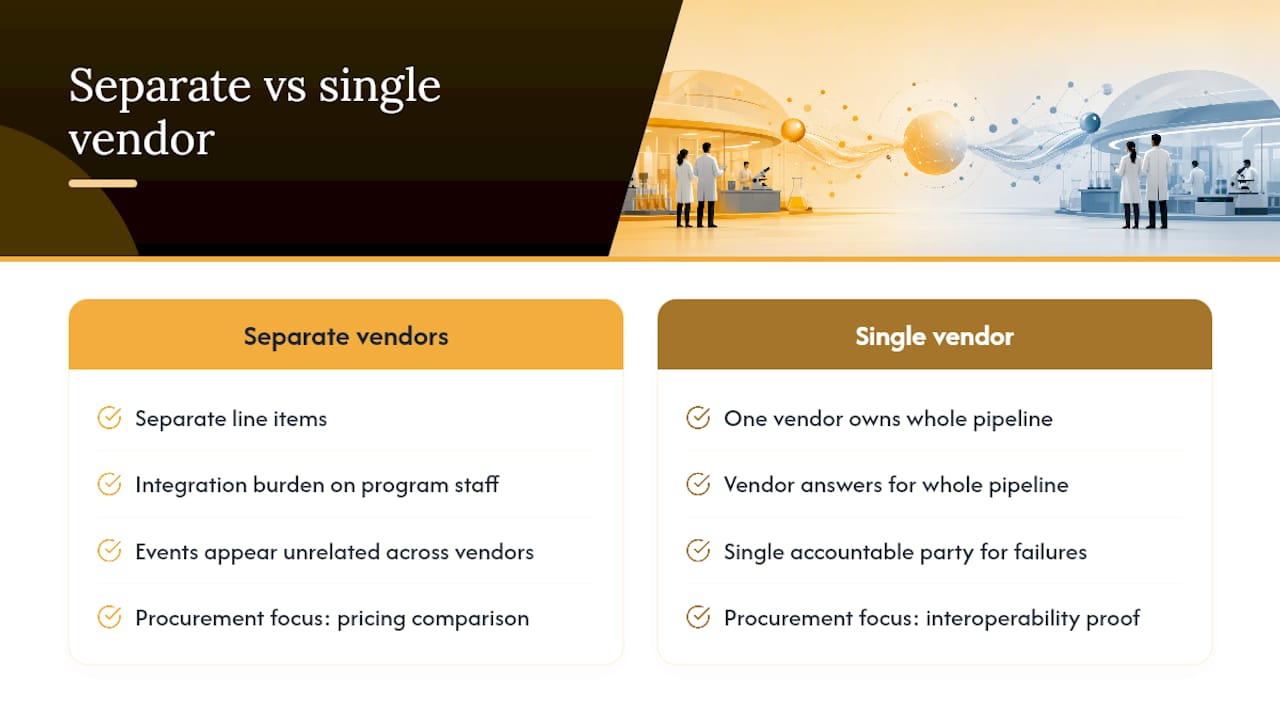
The conventional procurement instinct is to treat lab services and imaging services as separate line items that get separately competed, separately scored, and separately managed after award. That instinct made sense when labs and radiology genuinely operated as distinct disciplines with little shared data infrastructure. It doesn't hold up anymore, and treating them as separate contracts usually just moves the integration burden onto your program staff instead of your vendor.
What gets underestimated most is how much specimen and imaging logistics complexity compounds across multiple vendors. A courier delay on the lab side and a scanner recalibration on the imaging side look like unrelated events until you're the program manager reconciling two sets of metadata that don't match, on a deadline. The fix isn't more oversight staff. It's requiring, at the RFP stage, that one vendor owns the whole pipeline and answers for the whole pipeline when something breaks.
Where procurement teams should spend their scrutiny first is interoperability proof, not pricing comparison. A vendor that can show a working DICOM-to-EDC pipeline and a documented chain-of-custody process has already solved the problems that sink timelines. A vendor with a lower unit price and no interoperability demonstration is asking your program to discover those problems during enrollment, when the cost of fixing them is highest.
How Kohealth Labs Supports Government Diagnostic Contracts
Kohealth Labs operates as a single-contract integrated diagnostics partner built for exactly the compliance and interoperability bar government programs require, pairing CLIA-certified laboratory services with centralized imaging review, EDC and PACS integration, and courier-managed specimen logistics under one accountable contract.
Three proof points matter most to government buyers evaluating a partner like this: CLIA certification and state licensing compliance across every operating jurisdiction, working EDC and PACS integration rather than a roadmap promise, and a demonstrated ability to deliver submission-ready datasets and audit packages without a separate reconciliation step. Kohealth Labs's platform pulls lab and radiology data into analysis-ready bundles supported by AI monitoring that flag deviations early, which shortens the query-resolution cycle your program otherwise spends weeks on.
If your agency, CRO, or sponsor program is preparing an RFP for integrated lab and imaging services, request a capability demonstration through Kohealth Labs's clinical trial diagnostics solutions and see how the single-contract model performs against your own specification checklist before you finalize your evaluation criteria.
Sources
These sources support the specific claims made throughout this guide and can be attached to evaluation packages or referenced in SOW justification memos.