

Choose a single-contract integrated diagnostics partner that provides CAP-accredited lab services, radiology integration, AI-enabled quality control, and documented regulatory-role boundaries. That is the fastest path to audit-ready data and shorter trial timelines. Your immediate next steps:
- Issue an RFP that requires CAP accreditation certificates, proficiency testing logs, method validation reports, and insurance/indemnity documentation before shortlisting.
- Build an evidence checklist covering LIMS/LIS connectivity specs, HL7/FHIR readiness, biomarker panel breadth, and SLA terms for turnaround and corrective action.
- Set a kickoff timeline that maps contract award to method validation, site training, and first specimen shipment, with named milestones and accountability owners.
Pro Tip: Request a sample audit log and a redacted data bundle from any candidate provider before contract signature. A vendor that cannot produce these quickly is unlikely to deliver them under trial pressure.
What does "sponsor laboratory services" mean for CROs and government sponsors?
The phrase "sponsor laboratory services" describes the full scope of diagnostic and analytical support that a clinical trial sponsor procures to generate, manage, and deliver specimen-based data throughout a study. Per the NCATS definition, a sponsor is the entity that takes responsibility for initiation, management, or financing of a clinical study and may delegate tasks to other organizations. That delegation is exactly where laboratory service contracts live.
Services covered under this umbrella include:
- Central and clinical lab testing: routine chemistry, hematology, urinalysis, and specialty assays
- Specialty and molecular testing: genomics, proteomics, and biomarker panels covering a broad range of analytes
- Radiology data bundles: DICOM image acquisition, structured reporting, and linkage to clinical lab results
- Sample logistics: collection kits, cold-chain courier management, and chain-of-custody documentation
- LIMS/LIS integration: data transfer, report templates, and API connectivity to sponsor and CRO platforms
The regulatory vs. financial sponsor distinction matters directly for contracts. A regulatory sponsor handles IND/IDE submissions and FDA communications. A financial sponsor provides funding and carries indemnity obligations. Both roles can sit with one organization or be split, but the contract must name which party owns each responsibility. Confusing the two causes delays at the FDA review stage and creates gaps in liability coverage.
Deliverables you should expect from a qualified lab partner include analysis-ready datasets in agreed formats, complete audit logs with timestamps, proficiency testing records, and corrective action documentation.

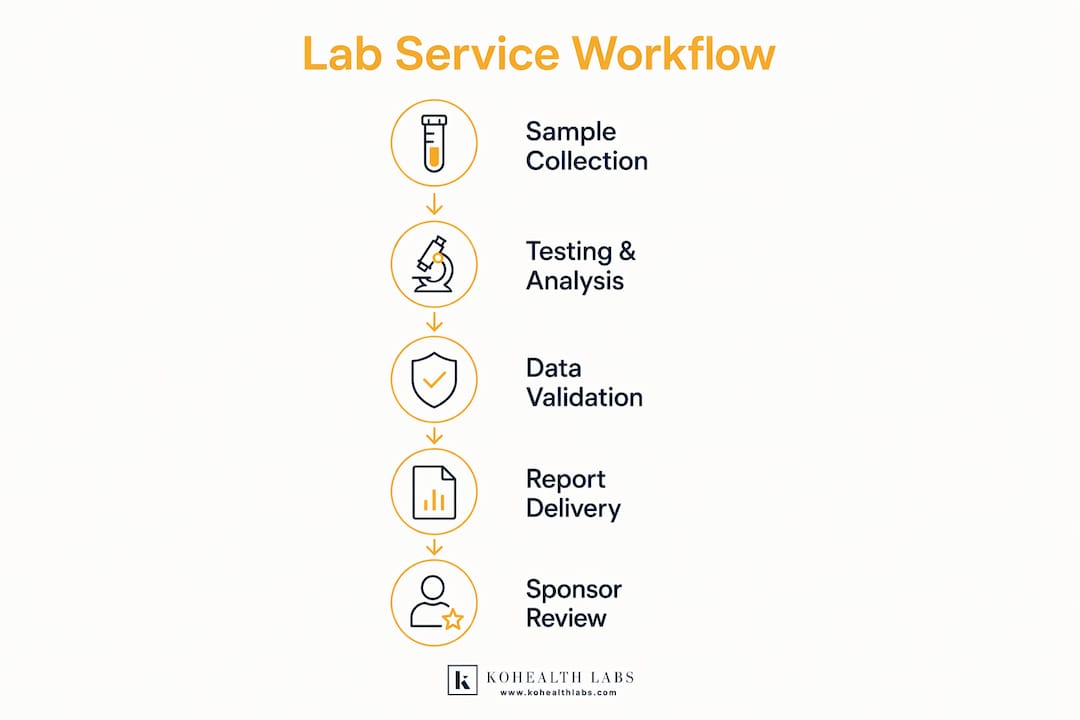
Why integrated lab and radiology services accelerate your trials
Managing separate lab and imaging vendors adds coordination overhead that compounds across every trial phase. A single-contract model eliminates that friction. When lab results and radiology data arrive in a unified, analysis-ready bundle, your biostatistics team can begin review immediately rather than waiting for format reconciliation across vendors.
Academic and industry groups that integrate diagnostic services across assay development, reproducibility testing, and clinical sample access demonstrate that combined data bundles are suitable for central analysis and regulatory submissions. The practical benefits for sponsors are direct:
- Reduced vendor overhead: one contract, one SLA, one escalation path
- Faster study start-up: a single onboarding process instead of parallel vendor negotiations
- Consolidated sample logistics: one courier network, one chain-of-custody protocol
- Unified data formats: analysis-ready outputs that feed directly into your statistical analysis plan
- Cleaner audit trails: a single source of truth for all specimen and imaging data
Data readiness is the rate-limiting step in most trial timelines. Integrated diagnostics programs that combine lab testing and radiology analytics produce analysis-ready datasets that shorten the time from sample collection to regulatory submission.
CAP accreditation and GCP alignment across the integrated provider also consolidate your inspection risk. One accredited partner means one set of proficiency testing records to verify, one corrective action process to audit, and one regulatory documentation package to maintain.
How do you evaluate and select a laboratory service provider?
Mandatory accreditation and compliance
Before any technical discussion, confirm these items:
- Current CAP accreditation certificate and most recent proficiency testing results
- CLIA certificate of compliance or accreditation
- Documented GCP-aligned processes for specimen handling and data management
- Chain-of-custody procedures from collection through final data delivery
Technical capabilities checklist
| Evaluation Area | What to Request |
|---|---|
| Biomarker panel breadth | Panel menu showing ≥100 analytes; specialty and molecular testing depth |
| Radiology integration | DICOM processing capability; structured report formats; linkage to lab data |
| Analytical validation | Method validation reports; reproducibility and precision testing records |
| Sample access | Access to clinical sample banks for method development and pre-study validation |
| Data formats | Analysis-ready output specs; HL7/FHIR readiness; secure API documentation |
Vendor selection should include evidence of analytical validation, method comparison data, and access to clinical sample repositories for novel assay development.
Operational SLAs and KPIs
Confirm turnaround times for routine and specialty testing, corrective action response timelines, sample rejection policies, and reporting cadence. These must appear as named, measurable commitments in the contract, not as general statements of intent.
Pro Tip: Ask for the provider's last three corrective action reports. How fast they identified, documented, and resolved issues tells you more about operational quality than any marketing document.
How should you structure contracts and assign sponsor responsibilities?
A well-structured laboratory services contract covers six core areas: scope of work, SLAs, change control, data ownership and IP, indemnity/insurance, and termination. Each must be explicit, not implied.
Commercial sponsors must supply trial-specific or block insurance certificates before testing begins. Labs routinely decline to start protocol-specific work until indemnity documentation is confirmed. Build this into your contract timeline, not as an afterthought.
Responsibility matrix across trial phases:
| Responsibility | Regulatory Sponsor | Financial Sponsor | Lab Partner |
|---|---|---|---|
| IND/IDE submissions | ✓ | ||
| FDA communications | ✓ | Support documentation | |
| Funding and indemnity | ✓ | ||
| Method validation | ✓ | ||
| Sample logistics | Oversight | ✓ | |
| Data delivery and audit logs | Oversight | ✓ | |
| Safety reporting | ✓ | Flag and report | |
| Archiving | ✓ | ✓ |
Before testing starts, require these documents in writing:
- Insurance/indemnity certificate (trial-specific or block coverage)
- Current CAP accreditation certificate and proficiency testing logs
- Method validation reports for all assays in scope
- Data transfer agreement covering ownership, format, and retention period
- LIMS integration specifications and acceptance test evidence
What operational logistics and timelines should you confirm?
A realistic onboarding sequence from contract award to routine testing runs through five phases:
- Contract finalization and insurance confirmation (2–4 weeks): SLAs signed, indemnity certificates received, data transfer agreement executed.
- Method validation and LIMS setup (4–8 weeks): assay validation, LIMS acceptance testing, report template configuration, and API connectivity testing.
- Site training and collection kit distribution (2–3 weeks): investigator training, collection kit delivery, and courier SLA confirmation.
- First specimen shipment and parallel testing (1–2 weeks): chain-of-custody verification, initial results review, and deviation check.
- Routine testing and data delivery (ongoing): agreed reporting cadence, query resolution, and corrective action tracking.
Specimen logistics require cold-chain documentation, courier SLAs with temperature excursion protocols, and real-time sample tracking. Reducing protocol deviations at the collection and shipping stage is one of the highest-leverage actions a sponsor can take to protect data quality.
Post-contract support should include a named escalation path for sample issues, a CAP corrective action process with defined response times, and root-cause analysis documentation for any deviation that affects reportable data.
How does AI-enabled QC and radiology integration improve data readiness?
AI-driven quality control flags analytic deviations in near real time, standardizes reporting formats across sites, and generates timestamped audit logs that reduce query cycles during regulatory review. LIMS data validation and acceptance testing steps are foundational to this: without validated data pipelines, AI flags produce noise rather than signal.
Radiology integration means delivering DICOM bundles with structured reports that are already linked to the corresponding clinical lab results. Sponsors should request:
- Timestamped audit trails for every data transaction
- Structured report formats aligned with the statistical analysis plan
- Validation reports confirming AI QC rule sets and deviation thresholds
- Secure API documentation for data transfer to sponsor or CRO platforms
The end-to-end diagnostic support model, where lab and imaging data are unified before delivery, removes a significant manual step from the sponsor's data management workflow.
When should you choose an integrated provider versus multiple specialized labs?
Follow this decision sequence during procurement:
- Map your endpoints. If the protocol combines imaging and lab biomarkers, an integrated provider eliminates format reconciliation.
- Assess biomarker novelty. Highly novel assays with no commercial method may require a specialized academic lab for development, then transfer to a central lab for routine testing.
- Count your sites. Multisite studies benefit most from a single-contract model: one SLA, one logistics network, one data format.
- Review regulatory touchpoints. If the study involves multiple FDA submissions, consolidated documentation from one partner reduces preparation time.
- Evaluate risk tolerance. A single-contract provider concentrates operational risk; confirm business continuity and backup testing capabilities before awarding.
Multiple specialized labs make sense when assays are genuinely novel, when local regulatory constraints require in-country testing, or when a niche analyte has only one validated method globally.
Pro Tip: If you are moving from a multi-vendor model to a single integrated provider, run a parallel testing period of four to six weeks before decommissioning existing vendor contracts. This protects data continuity and gives you a direct method comparison dataset.
Key Takeaways
A single-contract integrated diagnostics partner with CAP accreditation, radiology integration, AI-enabled QC, and documented regulatory-role boundaries is the most direct path to audit-ready data and shorter clinical trial timelines.
| Point | Details |
|---|---|
| Start with accreditation | Require CAP certificates and proficiency testing logs before shortlisting any lab partner. |
| Clarify regulatory vs. financial roles | Document which party owns IND/IDE submissions and indemnity in the contract before testing starts. |
| Confirm LIMS and interoperability | Request HL7/FHIR readiness, API specs, and LIMS acceptance test evidence during procurement. |
| Validate AI QC evidence | Ask for timestamped audit logs and deviation reports to confirm AI QC is operational, not theoretical. |
| Kohealth Labs | Offers a single-contract model covering CAP-focused labs, radiology integration, and AI analytics across 100+ biomarkers for CROs and government sponsors. |
The case for fewer handoffs in clinical diagnostics
The conventional wisdom in clinical trial procurement is to source the "best" vendor for each function: one lab for hematology, another for genomics, a third for imaging reads. The logic sounds rigorous. In practice, it creates a coordination burden that accumulates quietly across every trial phase, surfacing as query cycles, format mismatches, and timeline slippage that no single vendor owns.
The more defensible position is to treat data readiness as the primary procurement criterion. A lab partner that delivers CAP-accredited results, radiology data, and AI-validated audit logs in a single analysis-ready bundle is not just convenient. It removes the reconciliation step that sits between data collection and regulatory submission. That step is where timelines compress or expand, and where inspection risk concentrates.
GCP alignment and CAP accreditation are not differentiators at this point; they are the floor. What separates strong partners from adequate ones is whether their AI QC is validated and documented, whether their LIMS integration has been acceptance-tested, and whether they can produce a corrective action history on request. Those three things tell you more about operational readiness than any capability brochure.
Kohealth Labs: integrated diagnostics for sponsors who need results faster
Sponsors managing multisite phase II and III studies face a specific problem: diagnostic data arrives from multiple sources in incompatible formats, and reconciliation delays the statistical analysis plan. Kohealth Labs solves that directly. Its single-contract integrated diagnostics model covers CAP-focused laboratory services, radiology integration, and AI-enabled QC analytics, all delivered as a unified, analysis-ready data bundle.
For a multisite phase II study, Kohealth Labs handles onboarding from contract award through method validation, site training, and first specimen shipment under one SLA. Its analytics platform covers 100+ biomarkers and links lab results to DICOM imaging data, giving your biostatistics team cross-referenced outputs rather than separate files. AI-driven deviation detection flags issues before they reach the query stage, and every transaction is logged in an audit-ready format.
To request an evidence package including CAP certificates, method validation reports, and LIMS integration specs, or to schedule a technical kickoff, visit Kohealth Labs.
Authoritative references for sponsor procurement teams
Use these sources when assembling RFPs, evidence packages, or contract annexes:
- NCI Definition of Clinical Trial Sponsor: Primary definitional reference for sponsor roles; cite in contract preambles.
- NCATS Clinical Study Sponsor Glossary: Covers sponsor-investigator distinctions and delegated responsibilities.
- Codex of Clinical Research: Sponsor: Explains regulatory vs. financial sponsor roles and IND/IDE communication responsibilities.
- HRA Roles and Responsibilities: Guidance on insurance and indemnity requirements for clinical trial sponsors.
- CAP and CLIA Accreditation Overview: Plain-language explanation of CAP certification and proficiency testing requirements.
- LIMS Compliance Guide: Covers LIMS acceptance testing and data validation steps relevant to procurement.
Documents to request from every candidate vendor before contract award:
- Current CAP accreditation certificate and most recent proficiency testing summary
- Method validation reports for all assays in scope
- Insurance/indemnity certificate (trial-specific or block coverage)
- LIMS integration specifications and acceptance test evidence
- Data transfer agreement template covering ownership, format, and retention
- Sample corrective action reports from the past 12 months