

Three facts frame the current moment in the U.S.:
- Interoperability is the bottleneck, not the technology. The Office of the National Coordinator for Health IT (ONC) identifies "data liquidity" as a top strategic priority, meaning the ability to move patient data safely across systems is still the primary constraint on clinical value.
- AI adds the most value when data are analysis-ready. AI models trained on fragmented, inconsistently formatted data produce unreliable outputs. Clean, standardized inputs are the prerequisite.
- Policy is moving toward collaboration. The Centers for Medicare & Medicaid Services (CMS) is building a Digital Health Ecosystem that emphasizes shared infrastructure and voluntary alignment to improve data access across the U.S. health system.
Key Takeaways
Healthcare technology delivers its greatest value when data are standardized, integrated, and analysis-ready from the point of generation, not after manual reconciliation.
| Point | Details |
|---|---|
| Interoperability is the core bottleneck | FHIR and ONC's data liquidity priority address the main barrier: inconsistent data formats across systems. |
| AI requires clean inputs | AI quality control adds value only when source data is standardized; fragmented data produces unreliable model outputs. |
| Integrated diagnostics reduces trial delays | Single-contract lab and imaging delivery eliminates manual reconciliation, shortening time-to-database-lock. |
| CMS and ONC policy favors collaboration | The CMS Digital Health Ecosystem and TEFCA are building shared infrastructure that will lower interoperability costs over the next 3–5 years. |
| Kohealth Labs delivers analysis-ready bundles | Kohealth Labs offers a single-contract model covering 100+ biomarker panels, radiology, and AI-checked data for CROs and sponsors. |
What does healthcare technology actually include?
Healthcare technology covers a wider scope than most people expect. It is not just medical devices or hospital software. The full category includes hardware, software, platforms, services, and the data standards that connect them.
Here are the core components and how they relate:
- Medical devices and sensors. Physical instruments that generate clinical data, from MRI machines and CT scanners to continuous glucose monitors and pulse oximeters.
- Electronic Health Records (EHRs). Structured digital records of patient encounters, diagnoses, medications, and test results. EHRs are the primary repository most clinical workflows run through.
- Interoperability layers and APIs. Middleware and standards (most notably FHIR, the Fast Healthcare Interoperability Resources standard) that allow different systems to exchange data without custom point-to-point integrations.
- AI and machine learning models. Algorithms trained on clinical data to support diagnosis, triage, risk stratification, and quality control. Their accuracy depends heavily on the quality and standardization of the data they receive.
- Wearable and remote monitoring devices. Consumer and clinical-grade sensors that capture continuous physiological data outside a clinical setting, enabling remote patient monitoring (RPM).
- Telehealth platforms. Video, messaging, and asynchronous communication tools that extend care delivery beyond physical facilities.
- Cloud infrastructure and analytics. Scalable compute and storage environments that host EHRs, run analytics pipelines, and support population health management.
- Laboratory and radiology services. Diagnostic services that generate structured clinical data, including blood panels, genomic assays, pathology, and imaging reads. When these are integrated and delivered as analysis-ready bundles, they become a direct input to clinical research endpoints.
Pro Tip: Think in layers: device or sensor → data transport → data standardization (FHIR/APIs) → analytics (AI/ML) → clinical workflow. A gap at any layer limits the value of everything above it. Most implementation failures happen at the standardization layer, not the device or analytics layer.
The distinction between an EHR and middleware matters in practice. An EHR stores records; middleware translates and routes data between systems. Analytics platforms consume that data and surface insights. Understanding which layer a vendor operates in tells you where their integration risks actually sit.
Which technologies are changing clinical outcomes right now?
The peer-reviewed literature on technology and clinical practice documents impact across imaging, informatics, and monitoring. Below are the technologies with the clearest near-term clinical value, alongside concrete use cases.
AI and machine learning
AI in diagnostic imaging is the most documented application. Radiology AI tools detect findings in chest X-rays, CT scans, and mammograms with sensitivity that matches or approaches specialist reads in specific tasks, reducing time to diagnosis in high-volume settings. In clinical trials, AI-driven quality control flags protocol deviations in lab data before they affect endpoints, which shortens the review cycle.

Telehealth and remote patient monitoring
RPM for congestive heart failure (CHF) is one of the best-studied use cases. Continuous weight and vital-sign monitoring allows care teams to intervene before a patient decompensates, reducing hospital readmissions. HHS telehealth guidance emphasizes that RPM must be integrated with clinical workflows, not bolted on as a separate data stream, to maintain care quality and continuity.
Medical imaging and diagnostics
Integrated lab and imaging endpoints are particularly valuable in oncology trials, where tumor response criteria require both imaging reads (RECIST measurements) and biomarker data from blood panels. When these data streams arrive separately from different vendors, reconciliation delays can push trial timelines by weeks. Bundled diagnostic delivery addresses this directly.
Genomics and precision medicine
Next-generation sequencing (NGS) panels now inform treatment selection in oncology, rare disease, and pharmacogenomics. The clinical value depends on turnaround time and data format: a genomic result delivered in a non-standard format that cannot be ingested by the EHR or trial database is clinically useless regardless of its accuracy.
Robotics, 3D printing, and blockchain
Surgical robotics (such as robotic-assisted laparoscopic procedures) improve precision and reduce recovery time in specific procedures. 3D printing supports custom implants and surgical planning models. Blockchain is being piloted for supply-chain integrity in pharmaceuticals and for patient consent management, though broad clinical adoption remains limited.
Cloud infrastructure
Cloud platforms enable health systems to run population health analytics at scale, support multi-site clinical trials with centralized data repositories, and provide disaster recovery for EHR systems. The shift to cloud also makes it easier to deploy AI models across sites without per-site hardware investments.
Statistic callout: UCF's review of healthcare technology evolution notes that wearable devices and IoT sensors are generating continuous monitoring data that enables earlier intervention, with growing evidence in chronic-disease management — a trend accelerating as RPM reimbursement expands under CMS policy.
Integrated diagnostics (lab + imaging + curated data) creates the highest-value use cases for trials and personalized care because it collapses the reconciliation step. A sponsor receiving a single analysis-ready bundle from one contract can run statistical analysis immediately rather than waiting for data from three separate vendors to arrive, be cleaned, and be merged.
What are the measurable benefits of health technology adoption?
Abstract claims about "better outcomes" are not useful when you are evaluating a vendor or building a business case. The benefits of digital health solutions are real, but they need to be tied to specific metrics.
| Benefit Category | Example Metric | Mechanism |
|---|---|---|
| Clinical outcomes | Reduced hospital readmission rates | RPM enables earlier intervention for CHF, COPD, and diabetes patients |
| Trial acceleration | Shorter time-to-database-lock | Analysis-ready data bundles eliminate manual reconciliation across vendors |
| Access and coverage | Expanded rural care reach | Telehealth + integrated diagnostics removes geographic barriers to specialist-level testing |
| Cost efficiency | Reduced vendor management overhead | Single-contract diagnostics replaces multi-vendor coordination |
| Provider time savings | Fewer manual data entry tasks | EHR-integrated lab results eliminate duplicate data entry |
The most direct benefit for clinical research organizations and sponsors is time-to-data. When lab and imaging results arrive as a pre-reconciled, analysis-ready bundle, the gap between sample collection and statistical analysis shrinks. Protocol deviation rates also drop when AI quality checks catch errors at the point of data generation rather than during a downstream audit.
For health systems and telehealth platforms, the measurable gains are in provider efficiency and patient adherence. Clinicians spend less time hunting for results across disconnected systems, and patients in RPM programs show higher engagement when monitoring is integrated with their care team's workflow rather than siloed in a separate app.
Pro Tip: If you are a sponsor or CRO evaluating a diagnostics vendor, measure three things early in any pilot: time-to-data (from sample collection to analysis-ready delivery), data completeness rate (percentage of expected fields populated), and protocol deviation rate attributable to data quality. These three metrics predict trial timeline risk better than any vendor SLA document.
What are the risks and regulatory constraints in the U.S.?
Healthcare technology deployments in the U.S. operate inside a specific regulatory environment. Understanding the constraints is as important as understanding the capabilities.
Core risks
- Privacy and HIPAA compliance. The Health Insurance Portability and Accountability Act sets minimum standards for protecting patient health information. Any technology that stores, transmits, or processes protected health information (PHI) must meet HIPAA's Security Rule requirements.
- Data breaches and cybersecurity. Healthcare is among the most targeted sectors for ransomware and data theft. A breach affecting trial data can trigger regulatory reporting obligations and delay submissions.
- Algorithmic bias. AI models trained on non-representative datasets can underperform for specific patient populations. The FDA has flagged this as a clinical safety concern, particularly for diagnostic AI tools.
- Information blocking. ONC's information-blocking rules (21st Century Cures Act) prohibit practices that unreasonably restrict access to electronic health information. Vendors who lock data in proprietary formats may be in violation.
- Clinical safety and validation gaps. Software as a Medical Device (SaMD) must meet FDA's performance and validation standards. A tool that has not been validated on a population similar to your patient base carries real clinical risk.
FDA and CMS regulatory posture
The FDA regulates SaMD through its Digital Health Center of Excellence, applying a risk-tiered framework. Higher-risk AI tools (those that directly inform diagnosis or treatment) face more rigorous pre-market review. Lower-risk tools may qualify for enforcement discretion, but "lower-risk" does not mean "unregulated."
The CMS Digital Health Ecosystem initiative takes a different approach: it focuses on shared infrastructure, a National Provider Directory, and voluntary alignment frameworks to improve interoperability across payers, providers, and technology vendors. CMS is not primarily a technology regulator; it shapes adoption through reimbursement policy and coverage decisions.
The World Health Organization's Global Strategy on Digital Health adds an international dimension: it calls for standards-based interoperability and equitable access as prerequisites for scaling digital health solutions. U.S. organizations working in global trials or with multinational sponsors need to account for WHO guidance alongside FDA and CMS rules.
Practical red flags in vendor contracts:
- No documented FHIR API or proprietary data format with no export path
- AI models with no published validation dataset or performance benchmarks
- Incident response SLA measured in days rather than hours
- No test environment available before contract signature
- Audit logs that are not accessible to the customer
Why does interoperability matter, and how does FHIR address it?
Data liquidity, as ONC frames it, means patient data can be safely accessed and used across care settings, research platforms, and analytics systems without friction. The practical bottleneck is not hardware or compute power. It is the inconsistency of data formats across systems.
FHIR (Fast Healthcare Interoperability Resources) is the HL7 standard that defines how health data should be structured and exchanged via APIs. It uses web-standard formats (JSON, XML) and a resource-based model that maps clinical concepts (Patient, Observation, DiagnosticReport) to discrete, queryable objects. Health IT leaders consistently identify FHIR as the most scalable route to cross-system analytics and clinical research at scale.
Common FHIR implementation patterns
- SMART on FHIR. An authorization framework that allows third-party apps to launch from within an EHR and access patient data with appropriate permissions. Used widely for clinical decision support tools.
- API-based exchange. Direct FHIR API calls between systems (EHR to lab, EHR to analytics platform) that replace file-based data transfers (HL7 v2 messages, CSV exports).
- Canonical transformation. Converting legacy data formats (HL7 v2, CDA documents) into FHIR resources to enable downstream analytics without replacing source systems.
Steps to accelerate FHIR adoption
Technical actions:
- Audit your current data sources and identify which systems already expose FHIR R4 APIs.
- Map your key clinical concepts to FHIR resource types (Patient, Encounter, Observation, DiagnosticReport).
- Implement canonical transformation for legacy HL7 v2 feeds that cannot be replaced immediately.
- Test API connections in a sandbox environment before production deployment.
- Validate that your FHIR resources conform to U.S. Core Implementation Guide profiles.
Organizational actions:
- Assign a data governance owner responsible for FHIR profile decisions and change management.
- Establish a data dictionary that maps source system fields to FHIR elements.
- Train clinical informatics staff on FHIR resource structure and query patterns.
- Review vendor contracts for information-blocking compliance and API access rights.
The sector is shifting from compliance-only IT to collaboration-first digital ecosystems that make data analysis-ready for research and personalized medicine. FHIR is the technical foundation of that shift, but governance and organizational commitment determine whether it actually happens.
How do you implement health technology in practice?
Adopting new health technology without a structured plan is the most common reason implementations fail. The following sequence applies whether you are a health system deploying an EHR module, a CRO integrating a new diagnostics vendor, or a telehealth platform adding RPM capabilities.
Implementation checklist
- Define the use case and success metrics. What clinical or operational problem are you solving? What does success look like in measurable terms (time-to-result, readmission rate, protocol deviation rate)?
- Map current workflows. Document how data currently moves from collection to decision. Identify manual steps, handoffs, and reconciliation points that the technology is expected to replace or support.
- Assess data readiness. Evaluate the quality, completeness, and format of your current data. A technology that requires clean, standardized inputs will fail if your source data is fragmented.
- Run a vendor integration test. Before signing a contract, test the vendor's API or data delivery in your actual environment. Request a sandbox or pilot dataset.
- Pilot with a defined scope. Start with one site, one trial arm, or one patient population. Measure against your defined metrics before scaling.
- Scale with governance. Expand only after the pilot demonstrates the expected metrics. Establish change management processes, training plans, and escalation paths.
Questions to ask vendors
- Which interoperability standards do you support (FHIR R4, HL7 v2, DICOM)?
- What is your SLA for data delivery turnaround, and how is it measured?
- How do you document data provenance (chain of custody from collection to delivery)?
- When was your last third-party security audit, and can you share the summary?
- What is your incident response process if a data breach affects our trial data?
Red flags to watch for:
- The vendor cannot demonstrate a working FHIR API or offers only CSV exports.
- AI model validation data is described as "proprietary" with no performance benchmarks shared.
- Audit logs are not customer-accessible or are retained for fewer than 90 days.
- No dedicated onboarding or training support is included in the contract.
- The vendor has no documented process for handling protocol deviations in trial data.
How integrated diagnostics accelerates clinical trials
The single-contract integrated diagnostics model is one of the clearest examples of healthcare technology delivering measurable operational value in clinical research. Kohealth Labs offers exactly this model: laboratory services, radiology, and AI-driven analysis-ready data bundles under one contract, designed for CROs, pharmaceutical sponsors, and government agencies.
The operational logic is straightforward. A typical trial that uses separate lab and imaging vendors requires a sponsor to manage two procurement processes, two data formats, two delivery timelines, and a manual reconciliation step before analysis can begin. Each handoff is a point of delay and error. Integrated diagnostics removes those handoffs.
The Kohealth Labs process flow
| Stage | What happens | Output |
|---|---|---|
| Sample collection | Phlebotomy and imaging scheduled through a single provider portal | Specimens and images collected per protocol |
| Lab and imaging processing | Panels across 100+ biomarkers processed alongside radiology reads | Raw lab results and imaging data |
| AI quality control | AI-driven checks identify deviations, missing values, and format errors | Flagged exceptions resolved before delivery |
| Analysis-ready bundle | Data merged, standardized, and formatted for sponsor or EHR ingestion | Single delivery package per subject visit |
| EHR and sponsor delivery | Bundle delivered via EMR integration or secure data transfer | Data available for statistical analysis immediately |
Key capabilities that support this model:
- 100+ biomarker panels and genomics. Broad test coverage means sponsors do not need a second vendor for specialty assays.
- Courier specimen pickup. Removes the logistical burden from site coordinators and reduces pre-analytical variability.
- AI-driven quality checks. Deviations are caught at the data-generation stage, not during a downstream audit weeks later.
- Regulatory-aligned data delivery. Data formatted to meet FDA and sponsor requirements from the point of delivery.
- Dedicated onboarding and training. Site coordinators and clinical staff receive structured support, which reduces protocol deviations caused by collection errors.
For sponsors evaluating how to streamline CRO diagnostic data delivery, the single-contract model also simplifies budget management and contract administration. One SLA, one point of contact, one data format.
Pro Tip: When planning a trial that requires both lab and imaging endpoints, map the reconciliation step explicitly in your project plan. If it is currently a manual process, calculate how many hours it consumes per subject visit. That number is your baseline for evaluating the ROI of integrated diagnostics.
Real-world use cases across care settings
RPM for chronic disease management
A primary care practice deploys RPM for patients with type 2 diabetes and hypertension. Continuous glucose monitors and blood pressure cuffs transmit daily readings to the care team's dashboard. Clinicians intervene when readings trend outside target ranges, adjusting medications before the patient reaches a crisis point. The implementation lesson: RPM only reduces readmissions when the alert workflow is connected to a clinician who can act, not just a data dashboard that no one monitors.
AI-assisted imaging triage in emergency departments
An emergency department integrates an AI tool that screens chest X-rays for pneumothorax and aortic abnormalities, flagging high-priority cases for immediate radiologist review. The tool does not replace the radiologist; it reorders the queue so the most urgent cases are read first. The lesson: AI triage tools add the most value in high-volume, time-sensitive settings where queue management is the actual bottleneck.
Integrated lab and imaging endpoints in oncology trials
An oncology trial requires RECIST imaging measurements and CA-125 biomarker data at each assessment visit. When these arrive from separate vendors in different formats, the data manager spends significant time reconciling records before the statistician can run the analysis. Bundled diagnostic delivery eliminates this step, delivering a single pre-reconciled dataset per visit. The lesson: integrated diagnostics is most valuable at assessment visits where multiple data types must be combined for a single endpoint.

Telehealth and diagnostics in rural care
A rural health network pairs telehealth visits with integrated lab and radiology services to give patients access to specialist-level diagnostics without traveling to an urban center. A patient sees a cardiologist via video, has blood drawn at a local collection site, and receives imaging at a nearby facility. Results are delivered to the cardiologist as a single bundle before the follow-up visit. The lesson: the clinical value of telehealth in rural settings depends on whether diagnostic data can follow the patient across the care pathway.
Statistic callout: UCF's review of wearable health technology documents growing evidence that continuous monitoring via wearables and IoT sensors enables earlier intervention in chronic disease, a finding that supports the clinical case for RPM programs in both direct care and trial settings.
What technology and policy trends should you watch over the next 3–5 years?
The near-term trajectory of healthcare technology in the U.S. is shaped by a combination of maturing standards, expanding reimbursement, and active regulatory development.
- AI regulation and validation requirements. The FDA is developing clearer frameworks for AI/ML-based SaMD, including requirements for ongoing performance monitoring after deployment. Organizations deploying diagnostic AI should expect more rigorous documentation requirements within the next few years.
- FHIR maturation and TEFCA activity. The Trusted Exchange Framework and Common Agreement (TEFCA) is operationalizing nationwide health information exchange. As TEFCA networks expand, the practical barriers to cross-system data access will decrease for organizations that have already implemented FHIR.
- CMS Digital Health Ecosystem rollout. CMS's initiative to build shared infrastructure, including a National Provider Directory, will reduce the cost of interoperability for smaller health systems and independent practices.
- Growth in integrated diagnostics for trials. As sponsors face pressure to reduce trial timelines and costs, the single-contract integrated diagnostics model will see broader adoption. The role of digital health solutions in accelerating this shift is already visible in how CROs are restructuring their vendor relationships.
- Expansion of RPM reimbursement. CMS has expanded RPM billing codes in recent years, and further expansion is likely as evidence accumulates for specific chronic conditions. Organizations that build RPM infrastructure now will be positioned to capture reimbursement as coverage expands.
- WHO's Global Strategy on Digital Health continues to push for standards-based interoperability and equitable access globally, which affects multinational trial sponsors and organizations working in global health programs.
For organizations planning technology investments over the next 3–5 years, the practical implication is clear: prioritize FHIR compliance, invest in data governance before deploying AI, and evaluate diagnostics vendors on their ability to deliver analysis-ready data rather than raw results.
Who builds and runs healthcare technology systems?
Healthcare technology requires a specific set of roles that sit at the intersection of clinical knowledge, data engineering, and regulatory expertise. These are not generic IT positions.
- Clinical informaticists. Professionals who translate clinical workflows into data requirements and vice versa. They are the bridge between what clinicians need and what systems can deliver. Typically hold degrees in health informatics or nursing/medicine plus informatics training.
- Health data engineers. Build and maintain the pipelines that move data from EHRs, labs, and devices into analytics platforms. Proficiency in FHIR, SQL, and cloud data platforms (AWS HealthLake, Azure Health Data Services) is increasingly expected.
- Biomedical engineers. Design and maintain medical devices and the systems that connect them to clinical networks. Relevant for organizations deploying RPM hardware or imaging equipment.
- Regulatory specialists. Navigate FDA SaMD requirements, HIPAA compliance, and CMS billing rules. Critical for any organization deploying AI diagnostic tools or managing trial data.
- Clinical trial diagnostics managers. Oversee the collection, processing, and delivery of diagnostic data in trial settings. Responsible for protocol compliance, vendor management, and data quality.
- AI and ML engineers. Develop and validate the models used in diagnostic AI, predictive analytics, and quality control systems. Clinical domain knowledge is a significant differentiator for this role.
For U.S. salary ranges, the Bureau of Labor Statistics Occupational Outlook Handbook and sites like Glassdoor and Levels.fyi provide current market data by role and region. Ranges vary significantly by geography, organization size, and specialization.
Training priorities for professionals entering or transitioning into health IT: FHIR implementation (HL7's official training resources and Coursera courses are good starting points), data governance frameworks (AHIMA offers relevant certifications), and clinical workflow fundamentals (shadowing or embedded rotations with clinical teams).
WHO guidance on workforce capacity emphasizes that standards knowledge and clinical context together are what make health IT professionals effective, a combination that is harder to hire for than either skill alone.
What ethical considerations apply to healthcare technology?
Ethics in healthcare technology is not a compliance checkbox. It is a set of ongoing decisions that affect patient trust, clinical safety, and equitable access.
Patient consent and data use. Patients have a right to know how their health data is used, including whether it trains AI models or is shared with third parties. Informed consent frameworks for digital health tools are still evolving, and many current consent processes do not adequately explain AI-specific data uses. Organizations should review consent language specifically for AI training and secondary data use.
Algorithmic transparency. A clinician using an AI diagnostic tool should be able to understand, at a meaningful level, what factors the model uses to generate its output. "Black-box" AI, where the reasoning is entirely opaque, creates accountability gaps when the model is wrong. The FDA's guidance on AI/ML SaMD encourages transparency as a design principle, not just a regulatory requirement.
Equity and access. AI models trained predominantly on data from large academic medical centers may underperform for patients from rural, low-income, or minority communities. Deploying such models without validation on representative populations can widen existing health disparities rather than narrow them. The WHO's digital health strategy explicitly frames equity as a prerequisite for meaningful scale.
Data minimization. Collecting more patient data than a specific use case requires creates unnecessary privacy risk. Good ethical practice aligns data collection scope with clinical purpose, not with what is technically possible.
Accountability structures. When an AI tool contributes to a diagnostic error, the accountability chain must be clear: who validated the model, who approved its deployment, and who monitors its ongoing performance. Organizations that cannot answer these questions should not deploy diagnostic AI in clinical settings.
Data governance and stewardship beyond HIPAA
HIPAA sets a floor, not a ceiling. Organizations that treat HIPAA compliance as their complete data governance strategy are exposed to risks that HIPAA was never designed to address.
Data ownership. HIPAA defines who must protect patient data, but it does not fully resolve who owns it. Patients have rights to access and correct their records, but the question of who controls secondary uses (research, AI training, commercial analytics) is governed by a patchwork of state laws, institutional policies, and contractual terms. California's CCPA and similar state-level frameworks add additional requirements for organizations operating in those states.
Sharing frameworks. The 21st Century Cures Act and ONC's information-blocking rules create a right to data access, but they do not mandate a specific sharing architecture. Organizations need documented data-sharing agreements that specify permitted uses, retention periods, and de-identification standards for each data-sharing relationship.
Data stewardship roles. Effective governance requires named individuals responsible for data quality, access decisions, and compliance monitoring. A Chief Data Officer or equivalent role, supported by a data governance committee with clinical representation, is the standard model for health systems of meaningful size.
De-identification standards. HIPAA's Safe Harbor and Expert Determination methods are the U.S. standard for de-identifying patient data for research. Neither method is foolproof for high-dimensional genomic or imaging data, where re-identification risk is higher. Organizations sharing such data should apply additional technical safeguards (differential privacy, data use agreements with re-identification prohibitions).
Research data governance. Clinical trial data carries additional governance requirements under FDA 21 CFR Part 11 (electronic records and signatures) and ICH E6 Good Clinical Practice guidelines. These requirements apply regardless of whether the trial is industry-sponsored or investigator-initiated.
Cybersecurity best practices for healthcare technology
Healthcare is one of the most targeted sectors for cyberattacks in the U.S., and the consequences of a breach extend beyond financial penalties to patient safety. A ransomware attack that takes down an EHR system mid-trial can compromise data integrity and trigger regulatory reporting obligations.
Network segmentation. Clinical systems (EHRs, imaging systems, lab instruments) should be isolated from general corporate networks. A breach that enters through an administrative workstation should not be able to reach patient data systems.
Access controls and least privilege. Every user and system account should have only the permissions required for its specific function. Privileged access (admin accounts, database access) should require multi-factor authentication and be subject to regular access reviews.
Encryption in transit and at rest. All PHI must be encrypted when transmitted across networks and when stored on servers, workstations, and portable devices. This is a HIPAA requirement, but many organizations still have gaps in portable device encryption.
Vendor security assessments. Every third-party vendor that accesses or processes PHI is a potential attack vector. Business Associate Agreements (BAAs) are required under HIPAA, but they should be supplemented by documented security assessments (SOC 2 Type II reports, penetration test summaries) before onboarding.
Incident response planning. A healthcare-specific incident response plan should define: who is notified within the first hour of a suspected breach, how systems are isolated without disrupting patient care, how trial data integrity is preserved during an incident, and what the regulatory reporting timeline is (HIPAA requires notification within 60 days of discovering a breach affecting 500 or more individuals).
Backup and recovery. Air-gapped or immutable backups of clinical and trial data are the primary defense against ransomware. Recovery time objectives (RTOs) for critical clinical systems should be measured in hours, not days.
Organizations planning new technology deployments should include a cybersecurity review as a standard step in the implementation checklist, not an afterthought after go-live.
Why integrated diagnostics is the most underused lever in clinical research
The conventional view in clinical research is that trial timelines are driven by enrollment speed and regulatory review. Both matter. But data reconciliation, the manual process of merging lab results and imaging reads from separate vendors into a single analysis-ready dataset, is a consistent source of delay that receives far less attention than it deserves.
The reason is structural. Most sponsors have managed separate lab and imaging vendors for so long that the reconciliation step is treated as a fixed cost of doing business. It is not. When lab and imaging data arrive as a pre-reconciled, AI-quality-checked bundle from a single contract, the reconciliation step disappears. The statistician receives data that is ready to analyze, not data that needs to be cleaned and merged first.
The same logic applies to protocol deviations. A deviation caught by an AI quality check at the point of data generation is correctable. A deviation discovered during a database lock review, weeks after the visit, may require a protocol amendment or a data exclusion that affects the trial's statistical power. Early detection is not just faster; it is clinically and regulatorily safer.
The technology and policy trends driving the next phase of clinical research, including FHIR-based data exchange, AI-driven quality control, and CMS Digital Health Ecosystem infrastructure, all point in the same direction: data that is clean, standardized, and analysis-ready from the moment it is generated. Integrated diagnostics is the operational model that makes that possible today, without waiting for the full ecosystem to mature.
Kohealth Labs: integrated diagnostics for CROs, sponsors, and health organizations
Clinical research teams that have worked through multi-vendor diagnostic logistics know the friction: separate contracts, separate data formats, separate timelines, and a reconciliation step that sits between data collection and analysis. Kohealth Labs is built to remove that friction entirely.
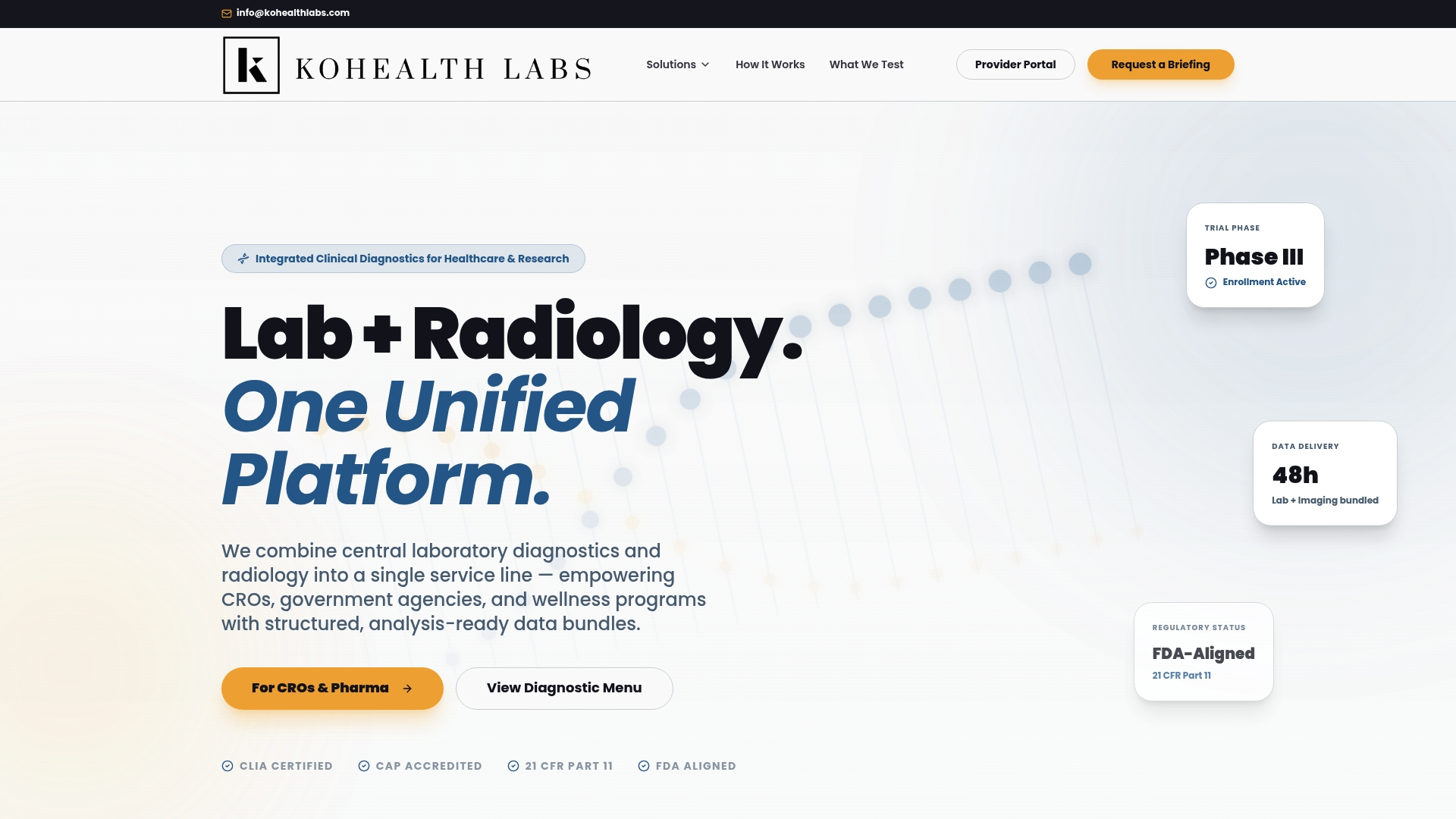
The model is a single contract covering laboratory services, radiology, and AI-driven analysis-ready data delivery, with panels spanning 100+ biomarkers and genomics. Courier specimen pickup, provider portal access, and dedicated onboarding mean site coordinators spend less time on logistics and more time on patient care. AI quality checks catch deviations before they reach the sponsor's database, and EMR integration means results are available in the clinical workflow without manual re-entry.
For CROs and pharmaceutical sponsors evaluating clinical trial diagnostics, the practical question is simple: how much time does your current reconciliation process consume per subject visit, and what would it mean for your timeline to eliminate it? For telehealth platforms and physician groups, integrated diagnostics means patients receive specialist-level testing without the logistical burden of coordinating multiple providers.
Contact Kohealth Labs to discuss your trial or practice diagnostic needs and request a capabilities overview.
Sources
- Health Technology Ecosystem | CMS
- Digital health and innovation | World Health Organization
- Technology and the Future of Healthcare - PMC - NIH
- ONC - Office of the National Coordinator for Health IT
This article is general information, not a substitute for advice from a qualified doctor. Consult a qualified healthcare professional about your own circumstances before acting on anything here.