
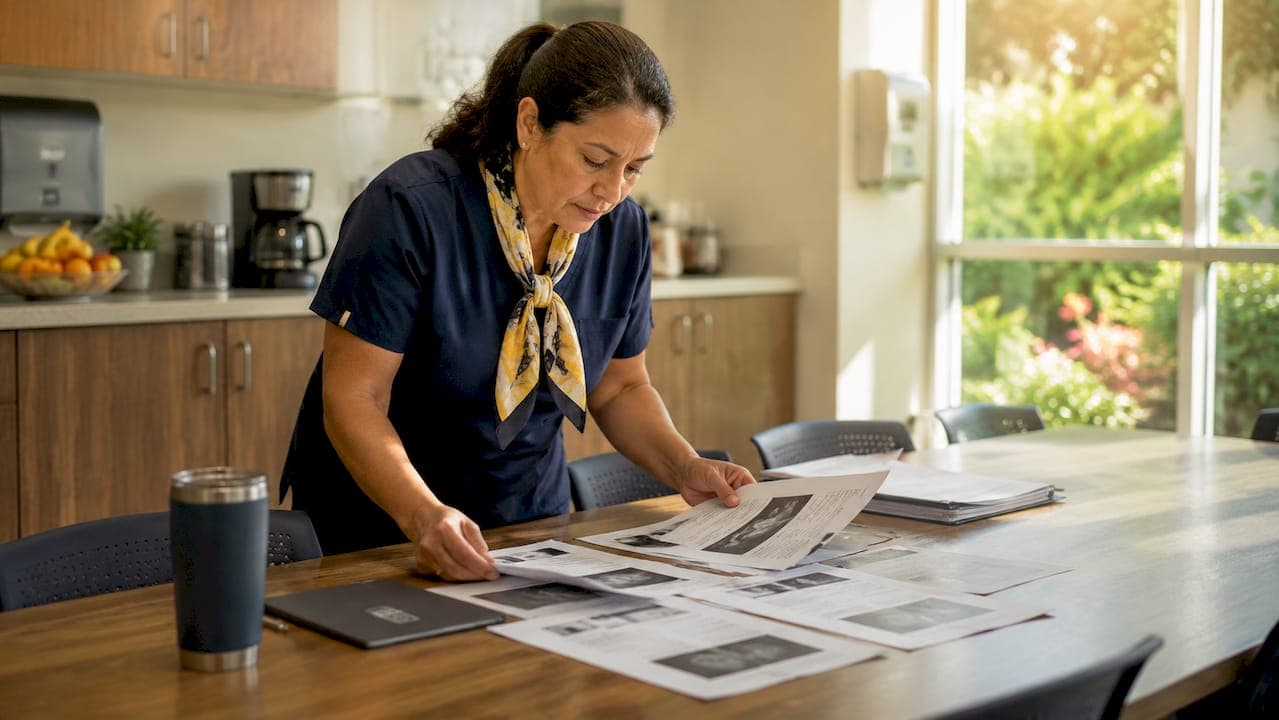
Integrated lab radiology is the practice of unifying laboratory testing and imaging diagnostics into a single, interoperable workflow to deliver faster, more complete diagnostic results. This model directly addresses how integrated lab radiology extends rural care reach by eliminating the fragmented handoffs that delay diagnoses in underserved communities. Keefe Memorial Hospital in Cheyenne Wells, Colorado, expanded lab services by more than 100 miles and added over 60 new tests through a structured partnership model. The CMS Rural Health Transformation Program now supports this kind of integrated diagnostic design across rural care settings nationwide. For rural providers, the payoff is clear: patients get answers faster, closer to home, and without unnecessary transfers.
What operational models enable integrated lab radiology to expand rural care reach?
Rural providers do not need to build everything from scratch. The most effective models combine regional partnerships, unified imaging platforms, and workflow redesign to extend diagnostic services without proportional cost increases.
1. Regional partnership and specimen volume orchestration
Keefe Memorial Hospital, a 25-bed critical access facility, partnered with InReach after completing an opportunity assessment of its lab capacity. The partnership structured specimen flow around a defined geographic region to generate sustainable volume. That volume made it financially viable to add more than 60 new tests and extend service coverage over 100 miles. Financial sustainability in rural labs depends less on equipment purchase and more on coordinating high-volume specimen referral networks within agreed geographic areas.
2. PACS consolidation for distributed radiology coverage
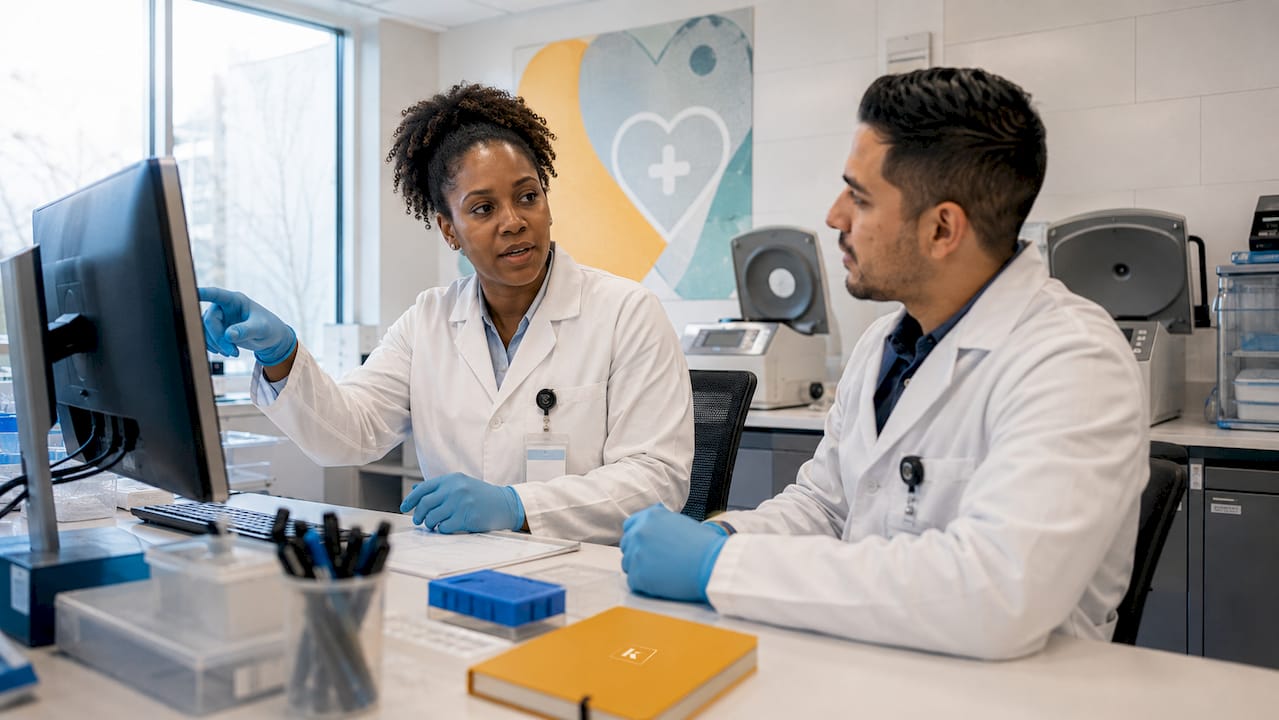
ARA Health Specialists consolidated five separate PACS platforms into a single unified reading workflow using Intelerad's platform. That consolidation gained approximately 10% operational efficiency and allowed the group to support multiple rural hospitals through teleradiology without adding daytime radiologists. Centralizing reads into a consistent, cloud-based worklist eliminates the burden of radiologists learning multiple systems. Rural hospitals gain specialist coverage they could never staff onsite.
3. Workflow redesign to reduce turnaround bottlenecks
End-to-end workflow design, not just sending images out, is the key to improving rural diagnostic reach. A 2026 Springer Nature study showed that redesigning overnight CT workflows reduced the median interval from preliminary read to teleradiology request by 29.2%, improving total order-to-result time by 17.4%. Treating each handoff point as a measurable variable, rather than an unavoidable delay, produces real gains.
Pro Tip: Before selecting a radiology partner, map every handoff point in your current imaging workflow. The step between preliminary read and teleradiology request is consistently the biggest delay in rural CT turnaround, and fixing it costs nothing extra.
How does interoperability between lab and radiology systems improve diagnostic reach?
Interoperability is the technical foundation that makes integrated diagnostics work at scale. Without it, lab results and imaging data sit in separate silos, forcing providers to piece together a clinical picture manually.
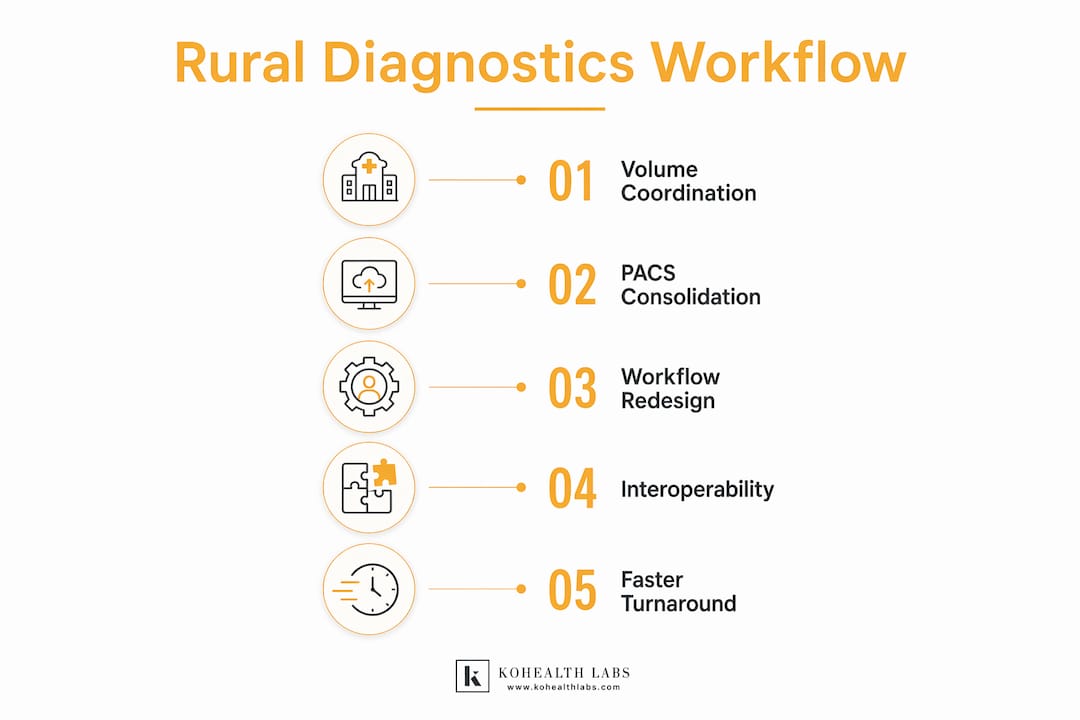
Interoperable imaging systems allow routing studies to remote subspecialists to deliver advanced diagnostics within minutes rather than days. That speed is critical for rural hospitals where onsite specialists are scarce or absent entirely. A patient presenting with a complex neurological finding no longer needs a transfer to a regional center when a subspecialist can read the scan remotely within the hour.
The benefits extend beyond speed. Unified imaging workflows and data sharing:
- Enhance diagnostic confidence by giving readers access to longitudinal patient imaging history
- Reduce diagnostic errors caused by incomplete clinical context
- Retain patients locally, protecting both outcomes and hospital revenue
- Support value-based care models by reducing unnecessary transfers and duplicate testing
- Enable care standardization across multiple rural sites served by the same radiology group
"Interoperability that enables seamless data flow and access to longitudinal patient context greatly enhances rural diagnostic confidence and workforce efficiency." — MedCity News, 2026
The CMS Rural Health Transformation Program explicitly supports integrated diagnostic workflows as part of rural care system redesign. That policy backing matters because it signals reimbursement alignment, not just clinical best practice. Rural providers who build interoperable systems now are positioning themselves ahead of the reimbursement curve.
Understanding cross-specialty diagnostic integration is a practical starting point for providers planning to connect lab and radiology data environments.
What measurable workflow improvements reduce rural diagnostic turnaround times?
The 2026 Springer Nature quality improvement study is the clearest published evidence of what workflow redesign achieves in rural radiology. The study focused on overnight CT workflows in an emergency department setting and produced two headline results.
| Workflow Variable | Improvement |
|---|---|
| Preliminary read to teleradiology request interval | Reduced by 29.2% |
| Total CT order-to-result time | Improved by 17.4% |
| Additional cost to achieve improvement | None |
These gains came entirely from process redesign, not new equipment or additional staff. The key process variable was minimizing the delay from preliminary imaging read to placing the teleradiology request. That single handoff, when treated as a measurable target, drove the entire improvement.
Faster turnaround times carry direct clinical consequences. Shorter result windows reduce time-to-treatment in emergency settings, lower the risk of patient deterioration during waits, and reduce the pressure to transfer patients prematurely. For rural hospitals, retaining patients through faster diagnostics also protects operating margins.
Lab turnaround improvements follow the same logic. When Keefe Memorial structured its regional specimen volume through InReach, quick turnaround time was a defined contract requirement, not an afterthought. Providers who treat turnaround time as a performance metric from the start of a partnership negotiate better outcomes than those who treat it as a secondary concern.
Pro Tip: Build turnaround time benchmarks into every lab and radiology partnership contract. Define the specific handoff intervals you expect, measure them monthly, and review them in quarterly performance meetings.
How can rural providers implement integrated lab radiology services effectively?
Implementation succeeds when rural providers treat integration as a system design problem, not a technology purchase. The following steps reflect what has worked in documented rural deployments.
- Conduct an opportunity assessment first. Identify your current test menu gaps, imaging volumes, and specialist coverage deficits before approaching vendors. Keefe Memorial's partnership with InReach began with exactly this kind of structured assessment.
- Define your geographic service region. Sustainable lab volume depends on coordinating specimen flow across a defined area. Without geographic boundaries, volume stays too low to justify new test offerings or equipment.
- Select a unified PACS platform. ARA Health Specialists' experience with Intelerad shows that consolidating disparate imaging environments into one cloud-based worklist is more effective than managing multiple systems. Radiologists perform better and cover more sites when they work in a single, consistent interface.
- Integrate lab data into the same clinical workflow. Radiology reads gain diagnostic value when readers can access recent lab results alongside imaging. Platforms that connect both data streams reduce the back-and-forth between departments.
- Prioritize turnaround time and customer service in vendor selection. Service quality factors determine whether a partnership sustains clinical trust. A vendor offering a broader test menu but slower results creates more problems than it solves.
- Plan for provider training and change management. Workflow redesign fails when staff revert to old habits under pressure. Build structured training into the implementation timeline and assign a clinical champion to monitor adoption.
- Avoid equipment underutilization. Rural labs that acquire new analyzers without securing specimen volume commitments end up with idle capacity. Secure volume agreements before purchasing equipment.
Reviewing telehealth-integrated diagnostics examples from 2026 gives rural administrators concrete models to adapt for their own settings.
Key takeaways
Integrated lab radiology extends rural care reach when providers combine regional partnerships, unified imaging platforms, and workflow redesign into a single, coordinated system.
| Point | Details |
|---|---|
| Partnership model drives lab expansion | Structured regional volume agreements, like Keefe Memorial's, enable new test offerings and extended geographic reach. |
| PACS consolidation scales radiology coverage | Unifying multiple imaging platforms into one worklist, as ARA Health Specialists did with Intelerad, extends rural coverage without adding staff. |
| Workflow redesign cuts turnaround times | Targeting the preliminary read to teleradiology request interval reduced total CT turnaround by 17.4% at no added cost. |
| Interoperability retains patients locally | Routing studies to remote subspecialists within minutes reduces unnecessary transfers and protects hospital revenue. |
| Turnaround time belongs in every contract | Defining specific handoff benchmarks at the contract stage produces measurable service quality outcomes. |
The case for treating integration as infrastructure, not a feature
At Kohealth Labs, we have watched rural providers approach integrated diagnostics as a nice-to-have addition to an already stretched operation. That framing is the first mistake. Integration is not a feature you bolt onto existing workflows. It is the infrastructure that makes rural care financially and clinically viable over the next decade.
The providers who are winning right now are the ones who stopped managing lab and radiology as separate cost centers and started treating them as a single diagnostic system. When you unify those workflows, you stop losing patients to transfers, you stop paying for duplicate testing, and you start generating the data quality that value-based contracts reward.
The technology is not the hard part. Platforms like Intelerad's unified PACS and AI-assisted lab analytics already exist and are proven in rural deployments. The hard part is the organizational commitment to redesign workflows, train staff, and hold vendors accountable to turnaround benchmarks. Most rural providers underinvest in that change management layer and then blame the technology when results disappoint.
Over the next five years, AI-assisted routing and automated anomaly detection will compress diagnostic timelines further. But those tools only deliver value inside a well-designed integrated workflow. Providers who build that foundation now will absorb new technology faster and at lower cost than those starting from scratch.
The rural providers who treat integration as infrastructure today will not be scrambling to catch up when reimbursement models fully shift to outcomes-based payment. They will already be there.
— Kohealth Labs
Kohealth Labs and integrated diagnostics for rural providers
Rural providers need a diagnostic partner that connects lab and imaging data into one reliable workflow, not another vendor to manage separately.
Kohealth Labs delivers integrated clinical diagnostics through a single-contract model that unifies lab services and radiology workflows, reducing vendor complexity and turnaround time in one step. The platform covers over 100 biomarkers and uses AI to flag deviations and maintain data quality across every test. Rural providers can review the full test menu and capabilities to identify where Kohealth Labs fits their current diagnostic gaps. For providers exploring how data and AI improve diagnostic accuracy, the data and AI platform overview details exactly how the system works in practice.
FAQ
What is integrated lab radiology in rural healthcare?
Integrated lab radiology combines laboratory testing and imaging diagnostics into a single, interoperable workflow. This model gives rural providers faster, more complete diagnostic results without requiring patients to travel to larger facilities.
How does PACS consolidation help rural hospitals?
Consolidating multiple PACS platforms into one unified reading environment, as ARA Health Specialists did with Intelerad, allows radiology groups to cover multiple rural hospitals through teleradiology without adding onsite staff.
What is the biggest bottleneck in rural CT turnaround times?
The delay between preliminary imaging read and placing the teleradiology request is the key variable. A 2026 Springer Nature study showed reducing that interval by 29.2% improved total order-to-result time by 17.4%.
How do rural labs build sustainable testing volume?
Sustainable volume depends on defining a geographic service region and coordinating specimen flow across that area through a structured partnership. Keefe Memorial Hospital used this model to add over 60 new tests and extend service reach by more than 100 miles.
Does the CMS Rural Health Transformation Program support integrated diagnostics?
Yes. The CMS Rural Health Transformation Program identifies needed services across rural care settings and supports right-sizing of diagnostic workflows to integrate lab and imaging services closer to patients' homes.