

Centralized diagnostics is defined as the integration of test ordering, processing, and result delivery into a single unified system shared across clinical teams. This model is the standard approach for reducing administrative burden in specialty care, and it is replacing fragmented, vendor-by-vendor setups across oncology, genetics, and multi-physician group practices. How centralized diagnostics serve specialty workflows comes down to one core mechanism: removing the manual tracking and coordination work that pulls clinicians away from patient care. Integrating specialty diagnostic ordering into the EHR cuts order times from 20 minutes to 6 minutes, saving roughly 3,100 physician hours per year in a mid-size health system. That kind of time recovery does not come from working faster. It comes from eliminating steps that should never have existed in the first place.
How centralized diagnostics serve specialty workflows: operational benefits
The most measurable gain from centralized diagnostic systems is the reduction in order processing time. When ordering is embedded directly in the EHR, physicians stop toggling between portals, faxing requests, and manually tracking status. Physicians no longer track faxes or check order stage through phone calls. They query order status directly inside the EHR, which shifts their cognitive effort from administration to interpretation.
Error reduction follows naturally from this shift. Diagnostic errors affect 5% of adult outpatients every year, and one-third of those errors cause serious harm. Centralized systems reduce error risk by standardizing the ordering pathway and removing the manual handoffs where mistakes accumulate.

The interoperability framework behind this is worth naming specifically. Epic Aura replaces point-to-point lab connections with a single centralized interface. Epic Aura's centralized network shrinks lab implementation from months to weeks and eliminates the need for custom interface builds with every new vendor. One pair of Epic lab interfaces connects all performing labs on the network.
Key operational benefits of centralized diagnostic integration include:
- Order times drop from 20 minutes to 6 minutes per specialty request
- Physicians gain real-time order status visibility inside the EHR
- New specialty and genetic labs connect through existing interfaces without IT reconfiguration
- Standardized ordering pathways reduce manual handoff errors
- Administrative staff can audit outstanding orders systematically rather than reactively
Pro Tip: Avoid the "interface tax." Every point-to-point lab connection you build requires ongoing maintenance. A centralized network like Epic Aura means you build the connection once and add new labs without rebuilding anything.
What workflow bottlenecks do centralized systems actually fix?
The most underestimated bottleneck in specialty diagnostics is the orphaned result. An orphaned result is a completed test that never receives a follow-up action because no one was assigned to track it. Designated staff performing audits within 24–48 hours of outstanding orders prevent this failure mode. The key shift is moving from a provider-centric model, where the ordering physician is solely responsible for follow-up, to a system-centric model, where administrative protocols assign tracking responsibility explicitly.
Fragmented ordering is the second major bottleneck. When physicians in a group practice each use different ordering pathways, results arrive in inconsistent formats and get routed to different inboxes. Centralized systems standardize the ordering pathway across all physicians in the group, so results arrive in a predictable format and route to the correct workflow automatically.
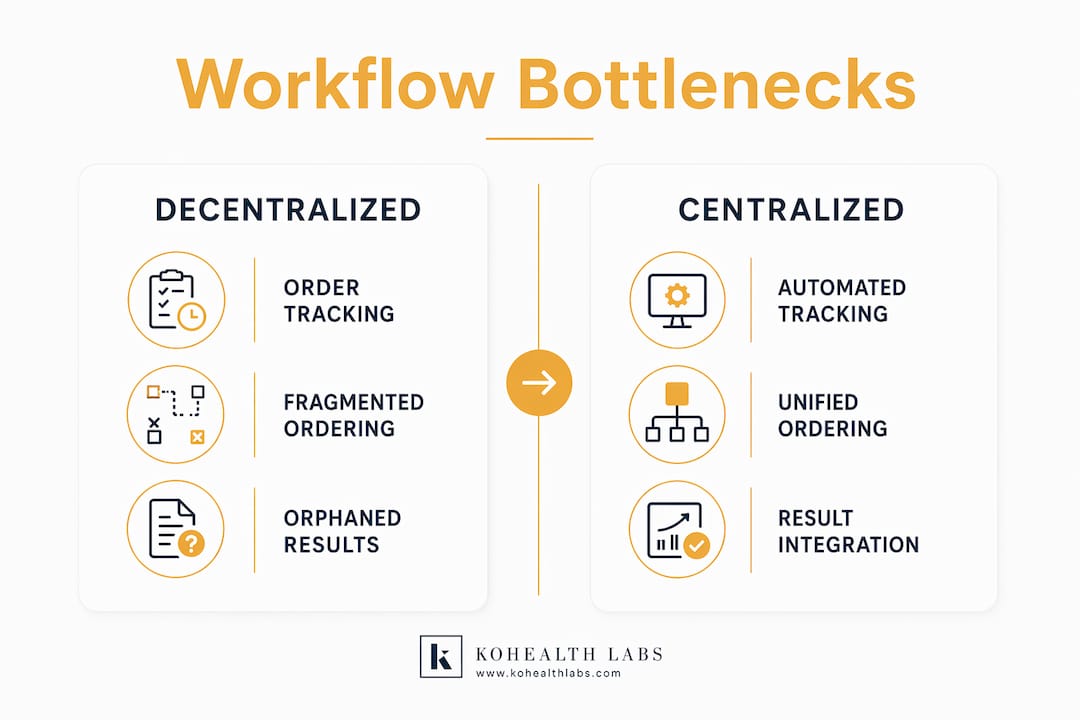
The table below compares how centralized and decentralized models handle the most common specialty workflow bottlenecks.
| Bottleneck | Decentralized approach | Centralized approach |
|---|---|---|
| Order tracking | Physician tracks manually via fax or phone | EHR displays real-time order status |
| Result routing | Results arrive in varied formats to multiple inboxes | Standardized results route to assigned workflow |
| Orphaned results | No systematic audit; relies on ordering provider | Designated staff audit all outstanding orders within 24–48 hours |
| New lab onboarding | Requires custom interface build per vendor | New labs connect through existing network interface |
| Compliance auditing | Manual review of individual provider records | System-wide audit tools track order-to-follow-up completion |
EHR tools with automated test tracking and alerts give practices the ability to audit follow-ups systematically. That capability is the difference between catching a missed result and discovering it during a malpractice review.
What is the right model for AI and human roles in specialty diagnostics?
AI integration in specialty diagnostics works best when tasks are differentiated by variance level. Task differentiation reduces vigilance fatigue and minimizes accuracy dilution in AI-human diagnostic workflows. The collaboration paradox occurs when AI is inserted into every diagnostic step, which forces clinicians into a passive monitoring role and increases the risk of confirmation bias.
The correct model assigns AI to low-variance tasks: flagging normal ranges, routing standard panels, and identifying data entry deviations. Clinicians then focus exclusively on complex interpretation, ambiguous results, and cases that require clinical judgment. This division produces better outcomes than either full automation or full manual review.
Over 80% of physicians use AI in their practice in 2026, doubling prior adoption levels. That adoption rate reflects how quickly the field has moved, but adoption alone does not guarantee accuracy gains. Task-specific deployment does.
Effective AI integration in centralized specialty diagnostics follows these principles:
- Assign AI to flag deviations in high-volume, low-complexity panels
- Reserve human review for results outside normal parameters or with clinical ambiguity
- Avoid "human in the loop" requirements for every diagnostic step, which creates automation fatigue
- Use AI to generate structured result summaries, not to make final diagnostic calls
- Audit AI performance quarterly against clinical outcomes to catch drift
Pro Tip: If your AI system requires a clinician to approve every output, you have not reduced cognitive load. You have added a confirmation step. Design workflows where AI handles defined task categories autonomously.
How do centralized diagnostics support multi-physician and multi-specialty workflows?
A shared diagnostic workflow across multiple physicians is defined as a system where all ordering, tracking, and result delivery functions operate through a single platform regardless of which physician or specialty initiates the order. This model is the foundation of integrated testing in multi-specialty group practices. EHRs centralize documentation, decision support, and order management while practice management tools handle billing and scheduling in parallel.
The types of group practice diagnostic workflows that benefit most from centralization fall into three categories:
- Parallel specialty ordering. Multiple specialists order different tests for the same patient simultaneously. Centralized systems consolidate results into a single patient record, preventing duplicate orders and conflicting interpretations.
- Sequential referral workflows. A primary care physician refers a patient to an oncologist, who then orders genomic testing. Centralized platforms carry the full order history forward, so the specialist sees prior results without requesting records separately.
- Cross-specialty panel management. Conditions like autoimmune disorders require input from rheumatology, nephrology, and pathology. Centralized diagnostics route panel results to all relevant specialists simultaneously, reducing the time between testing and coordinated treatment decisions.
Compliance improves directly from centralization because standardized templates replace ad hoc ordering. When every physician in a group uses the same order set, auditing becomes straightforward. Standardized workflows tracking diagnostic testing from order to follow-up reduce the risk of unacknowledged results and support regulatory documentation requirements. For clinical research settings, this compliance trail is not optional. It is a condition of trial participation.
You can read more about cross-specialty diagnostic integration and how unified platforms manage these workflows across physician groups.
How to implement centralized diagnostics in specialty workflows
Implementation starts with a clear decision about operational model. The distributed model combines point-of-care sample collection with centralized data management. Central labs focus on specialist interpretations while peripheral sites handle routine workflows. This hybrid approach works well for health systems with multiple clinic locations that need local convenience without sacrificing data consistency.
The second implementation decision is infrastructure management. Successful physician-led lab models use fully managed lab infrastructure, including HVAC, plumbing, compliance, and regulatory review handled by dedicated partners. This structure lets clinicians focus entirely on diagnostic interpretation rather than facility management.
Practical implementation steps for specialty teams include:
- Audit current ordering workflows to identify manual steps and interface redundancies
- Select an interoperability framework such as Epic Aura to replace point-to-point connections
- Assign dedicated administrative staff to order tracking and follow-up auditing roles
- Standardize order templates across all physicians in the group before going live
- Schedule quarterly workflow reviews to catch bottlenecks introduced by new test types or staff changes
Unified diagnostics in clinical research follow the same implementation logic, with the added requirement of audit-ready compliance documentation at every stage. The infrastructure decisions you make at the outset determine how quickly you can add new specialty labs and how much IT overhead you carry long-term.
Key Takeaways
Centralized diagnostics serve specialty workflows by replacing fragmented, manual ordering systems with unified platforms that reduce physician administrative time, prevent orphaned results, and support compliance across multi-physician group practices.
| Point | Details |
|---|---|
| Order time reduction | Centralized EHR ordering cuts specialty order times from 20 minutes to 6 minutes. |
| Orphaned result prevention | System-centric protocols assign staff to audit outstanding orders within 24–48 hours. |
| AI task differentiation | Assign AI to low-variance tasks; reserve clinician review for complex or ambiguous results. |
| Multi-specialty compliance | Standardized order templates across physician groups make compliance auditing straightforward. |
| Infrastructure management | Dedicated partners managing lab operations free clinicians to focus on interpretation. |
What centralized diagnostics actually change for specialty teams
The mental load reduction from centralized diagnostics is the benefit that gets the least attention and delivers the most value. Clinicians who stop tracking faxes and chasing order status do not just save time. They arrive at the interpretation step with more cognitive capacity. That difference shows up in diagnostic accuracy, not in time-and-motion studies.
The orphaned result problem is more common than most administrators realize. Every practice that relies on ordering physicians to self-monitor follow-ups has gaps. The fix is not better physicians. It is a system-wide protocol that assigns administrative responsibility explicitly. That protocol is only possible when your diagnostic platform gives administrators visibility into every outstanding order.
The AI integration question is where I see the most avoidable mistakes. Practices implement AI broadly and then wonder why accuracy does not improve. The answer is almost always task design. AI that monitors everything and flags everything trains clinicians to ignore flags. AI that handles defined, low-variance categories autonomously creates space for clinicians to engage deeply where it matters.
The trajectory for centralized diagnostics in specialty care points toward faster clinical trial enrollment and broader access to genomic testing. Platforms like Epic Aura already allow new genetic labs to connect without interface rebuilds. That capability will accelerate the adoption of specialty panels that were previously too complex to integrate. For administrators planning infrastructure investments now, the question is not whether to centralize. It is how quickly you can retire the point-to-point connections that are slowing you down.
— Kohealth Labs
Kohealth Labs and integrated specialty diagnostics
Specialty care teams managing complex diagnostic workflows need more than a single lab connection. They need a platform that unifies laboratory services, radiology, and data analytics into one contract and one workflow.
Kohealth Labs delivers integrated clinical diagnostics designed for physician workflows in specialty care, covering over 100 biomarkers with AI-assisted quality monitoring and compliance tracking built in. The single-contract model eliminates vendor coordination overhead and gives your team analysis-ready data bundles without the administrative burden of managing multiple service agreements. For clinical trial teams, Kohealth Labs supports accelerated trial diagnostics with audit-ready documentation at every stage. Visit kohealthlabs.com to see how integrated diagnostics fit your specialty workflow.
FAQ
What is a centralized diagnostic workflow?
A centralized diagnostic workflow is a system where test ordering, processing, and result delivery operate through a single integrated platform shared across all physicians and specialties in a practice. It replaces separate vendor connections and manual tracking with one standardized process.
How do centralized diagnostics improve compliance in specialty care?
Centralized systems use standardized order templates and automated tracking tools that create a complete audit trail from order to follow-up. Designated administrative staff can review outstanding orders within 24–48 hours, reducing the risk of unacknowledged or missed results.
What is a shared diagnostic workflow in a multi-physician practice?
A shared diagnostic workflow means all physicians in a group order, track, and receive results through the same platform, regardless of specialty. This prevents duplicate orders, standardizes result routing, and gives every clinician visibility into the full patient diagnostic history.
How does AI fit into centralized specialty diagnostics?
AI performs best when assigned to low-variance tasks such as flagging abnormal ranges and routing standard panels. Clinicians then focus on complex interpretation. Task differentiation prevents vigilance fatigue and avoids the accuracy dilution that occurs when AI is inserted into every diagnostic step.
How long does it take to implement a centralized diagnostic system?
Implementation timelines vary by platform and practice size. Frameworks like Epic Aura reduce lab onboarding from months to weeks by replacing point-to-point interface builds with a single centralized connection. Practices that audit existing workflows and standardize order templates before go-live see faster adoption.