

Integrated diagnostics is the process of unifying laboratory services, radiology, and clinical data into a single platform that improves clinic efficiency by simplifying workflows, automating routine tasks, and enabling faster communication across specialties. The industry term for this approach is "diagnostic interoperability," and it is now a recognized standard in health system performance management. Clinics that have deployed unified diagnostic platforms report order placement times dropping from 20 to 6 minutes, saving over 600 hours of staff time in nine months. Digital interoperability frameworks across 14 national referral hospitals reduced redundant lab volumes by 11.21%, producing measurable fiscal gains. For clinic managers and healthcare professionals, these numbers represent a clear operational case for integration.
How integrated diagnostics improve clinic efficiency through ordering and reporting
Diagnostic ordering automation is the fastest way to reduce administrative burden on clinical staff. When specialty ordering connects directly to an electronic health record (EHR), clinicians place orders without switching systems, logging into separate portals, or manually transcribing results. The American Medical Association reports that EHR-integrated ordering cut order placement time by roughly 70%, from 20 minutes to 6 minutes per order. That single change freed over 600 hours of staff time across one health system in nine months.
The downstream benefits extend beyond speed. Integrated platforms capture discrete, structured data rather than unstructured PDF reports. Structured data enables clinical decision support tools to fire alerts, trigger follow-up recommendations, and flag abnormal values automatically. One health system saw at-home colon cancer screening increase by 45% after integrated ordering began generating automatic follow-up prompts. That outcome came from better data capture, not additional staffing.
Embedded clinical decision support also reduces ordering errors. When a clinician selects a test, the system checks for contraindications, duplicate orders, and missing patient criteria before submission. Manual review steps disappear, and the error rate drops. The result is a cleaner order queue, faster lab processing, and fewer rejected specimens.
- Orders route directly from the EHR to the correct external lab or diagnostic device
- Structured results return to the same EHR record without manual entry
- Clinical alerts fire automatically when results cross defined thresholds
- Follow-up recommendations appear in the clinician's existing workflow
Pro Tip: Map your current order-to-result cycle before deploying any integration tool. Clinics that document each manual handoff first reduce implementation time and avoid rebuilding broken steps into the new system.
Does diagnostic integration actually reduce redundant testing costs?
Redundant testing is one of the largest hidden costs in outpatient and inpatient settings. When care teams cannot see each other's recent results, they reorder tests already completed elsewhere. Digital interoperability solves this by making all prior results visible across departments and facilities in real time.
A study of 14 national referral hospitals found that implementing a digital interoperability platform reduced redundant lab test volumes by 11.21% and improved consumable efficiency by 11.27%. The fiscal savings reached IDR 54.30 billion across those facilities. The researchers also calculated that every 1% reduction in redundancy produced a 0.85% gain in the overall diagnostic budget. That ratio gives clinic managers a reliable planning benchmark.
The table below shows the operational contrast before and after integration.
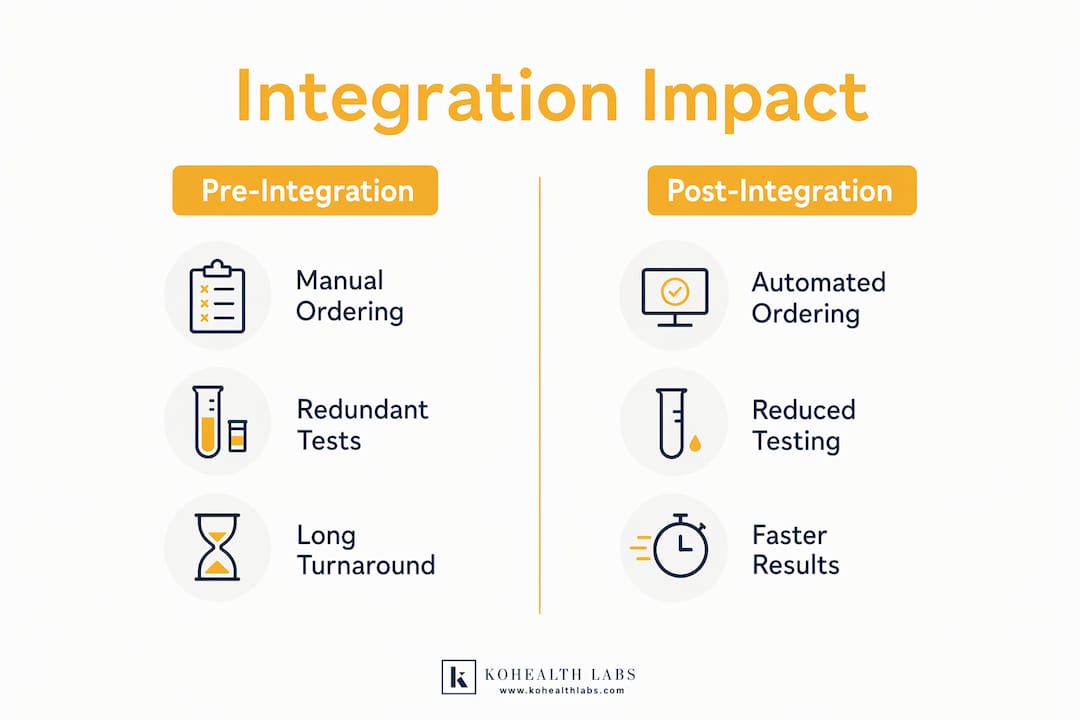
| Metric | Pre-integration | Post-integration |
|---|---|---|
| Redundant test volume | Baseline | Down 11.21% |
| Consumable efficiency | Baseline | Up 11.27% |
| Budget gain per 1% redundancy drop | Not tracked | 0.85% |
| Cross-team result visibility | Siloed | Unified across departments |
Transparency across care teams is the mechanism behind these gains. When a referring physician can see that a specialist already ordered a complete metabolic panel this week, the repeat order never happens. The benefits of unified diagnostics across specialties go beyond cost. They reduce patient exposure to unnecessary procedures and free lab capacity for genuinely new work.
How do integrated diagnostics improve outpatient throughput and resource allocation?
Patient throughput in outpatient clinics depends on how quickly staff can move patients through registration, triage, testing, and consultation. Fragmented diagnostic systems create bottlenecks at each handoff. Unified platforms remove those bottlenecks by consolidating steps.

A four-dimensional integrated one-stop outpatient service model, built on patient journey mapping, cut non-medical patient waiting times from 11.28 minutes to 7.56 minutes. Patient satisfaction scores rose from 91.95 to 95.15 points. The clinic also reduced window staff from 15 to 11, a 26.7% reduction, without any decline in service quality. These results came from redesigning the patient journey first, then deploying integrated tools to support the new flow.
Data-driven imaging and lab scheduling also increases appointment density. Integrated diagnostics use real-time data to optimize appointment intervals, filling gaps that manual scheduling misses. The outcome is higher throughput without adding clinical staff.
- Map the full patient journey from arrival to discharge to identify non-clinical delays
- Consolidate registration, test ordering, and result delivery into a single digital touchpoint
- Use integrated scheduling tools to fill appointment gaps with data-driven interval recommendations
- Automate result notifications so clinicians receive findings without checking separate systems
- Reallocate administrative staff freed by automation to higher-value patient-facing roles
Pro Tip: Patient journey mapping works best when frontline staff contribute to it. Nurses and medical assistants see workflow friction that managers miss. Include them in the mapping session before you finalize any integration plan.
Kohealth Labs supports specialty care teams with unified diagnostic data that reduces the coordination burden across departments, making one-stop service models easier to sustain at scale.
What role does decentralization play in diagnostic efficiency?
Decentralized diagnostics refers to moving testing capability closer to the patient, whether at the bedside, in a satellite clinic, or at a point-of-care station, rather than routing all specimens to a central lab. The operational benefit is a dramatic reduction in turnaround time.
Decentralized point-of-care molecular testing reduced turnaround times from 21.3 hours to 1.7 hours, a reduction of over 90%. That speed matters most in acute care, where decisions about patient isolation, ward allocation, and treatment initiation depend on rapid results. Waiting 21 hours for a result delays every downstream clinical decision. Getting it in under 2 hours changes the entire care pathway.
Decentralization also redistributes workload. Central labs handle complex, low-volume tests. Peripheral stations handle high-volume, time-sensitive tests. The split reduces congestion at the central lab and shortens queues across the system.
The comparison below shows how centralized and decentralized models differ operationally.
| Feature | Centralized lab model | Decentralized point-of-care model |
|---|---|---|
| Turnaround time | 20+ hours | Under 2 hours |
| Specimen transport required | Yes | No |
| Best suited for | Complex, low-volume tests | High-volume, time-sensitive tests |
| Impact on central lab workload | High congestion | Reduced by offloading routine tests |
The critical design principle is that decentralized tools must feed results back into the central EHR automatically. When point-of-care results populate the same record as central lab results, clinicians get a complete picture without hunting across systems. Fragmented diagnostic systems cause delays precisely because results live in separate silos. Decentralization only works when the data layer remains unified.
- Point-of-care results must write directly to the EHR, not to a separate device log
- Peripheral stations require the same quality assurance protocols as central labs
- Workload routing rules should be defined before deployment, not after
Key Takeaways
Integrated diagnostics reduce clinic costs, shorten wait times, and free staff time by unifying lab, radiology, and clinical data into a single workflow layer.
| Point | Details |
|---|---|
| Ordering automation saves staff time | EHR-integrated ordering cut order time by 70%, saving over 600 hours in nine months. |
| Interoperability reduces redundant tests | Digital platforms cut redundant lab volumes by 11.21%, generating measurable budget gains. |
| Patient journey mapping drives throughput | One-stop outpatient models reduced non-medical wait times and cut window staff by 26.7%. |
| Decentralized testing cuts turnaround time | Point-of-care molecular testing reduced result times from 21.3 hours to 1.7 hours. |
| Technology must follow workflow redesign | Deploying tools over broken processes creates new bottlenecks rather than removing them. |
What clinic managers get wrong about diagnostic integration
The most common mistake is treating integration as a technology purchase rather than a workflow redesign. Clinics that deploy new platforms without first mapping their patient journey often find that the software accelerates the wrong steps. The bottleneck moves rather than disappears.
The second mistake is measuring success by cost per test. That metric rarely drops immediately after integration. The real financial gains come from avoiding hidden costs: fewer follow-up visits, shorter hospital stays, less administrative reconciliation time, and fewer redundant orders. These savings appear in aggregate budget reviews, not in per-test line items. Clinic managers who focus only on reagent costs will undervalue the return.
The third mistake is underestimating the importance of clinician experience. The best-integrated systems are effectively invisible. Results appear in the EHR the clinician already uses. Orders submit without a second login. Alerts fire without creating noise. When integration requires clinicians to change their habits significantly, adoption slows and the efficiency gains stall. The American Medical Association's findings confirm that clinicians benefit most when integrated diagnostics populate directly into existing workflows without separate logins or manual entry steps.
My practical advice: run a 90-day pilot on one high-volume service line before full deployment. Measure order-to-result cycle time, staff hours per order, and patient wait time at each step. Those three metrics will tell you whether the integration is working before you commit to system-wide rollout.
— Kohealth Labs
Kohealth Labs and efficient integrated diagnostics for clinical research
Clinic managers and research leaders who want to move from fragmented diagnostics to a unified workflow have a clear path forward with Kohealth Labs.
Kohealth Labs integrates laboratory services, radiology, and AI-driven data analysis into a single contract, removing the vendor coordination burden that slows clinical research and outpatient operations alike. The platform covers over 100 biomarkers and delivers analysis-ready data bundles to CROs, government agencies, and wellness programs. AI quality checks identify data deviations before they affect compliance timelines. For clinic managers focused on clinical trial efficiency, Kohealth Labs provides the unified diagnostic infrastructure that turns fragmented data into faster, cleaner decisions. Visit kohealthlabs.com to see how the single-contract model fits your operational needs.
FAQ
What is integrated diagnostics in a clinical setting?
Integrated diagnostics is the unification of laboratory, radiology, and clinical data into a single platform that supports faster ordering, reporting, and decision-making. The industry term is "diagnostic interoperability," and it is the foundation of modern clinic efficiency programs.
How do integrated diagnostics reduce polyclinic costs?
Digital interoperability platforms reduce costs primarily by cutting redundant test volumes. Research across 14 referral hospitals found that an 11.21% drop in redundant lab orders produced a 0.85% budget gain for every 1% of redundancy removed.
How much staff time can integrated ordering save?
EHR-integrated specialty ordering reduced order placement time from 20 minutes to 6 minutes per order, saving over 600 hours of staff time across one health system in nine months.
Why does patient journey mapping matter for outpatient throughput?
Patient journey mapping identifies non-clinical delays before any technology is deployed. Clinics that mapped their patient journey first and then integrated diagnostics cut non-medical wait times from 11.28 to 7.56 minutes and reduced administrative staff by 26.7%.
What is the fastest efficiency gain from decentralized diagnostics?
Point-of-care molecular testing cuts turnaround time from over 20 hours to under 2 hours. That speed directly supports acute care decisions such as patient isolation and ward allocation, where waiting for central lab results creates costly delays.